In this summary of the Catechism’s teaching on holiness, justification, and merit, we briefly consider the work of God’s grace and mercy. His grace moves us from sin and toward him, making us his sons and daughters and bringing us into the very life of the Trinity. This gift of grace invites us to respond to his promptings and invitations freely. Finally, God offers “all the graces needed to attain eternal life.” Today’s readings are Catechism paragraphs 2017-2029.
God’s free initiative demands man’s free response. We continue our discussion of grace today by examining how grace and our free will interact in our lives. Fr. Mike also explains the purpose of sacramental graces and how the expression of these graces looks different across the Body of Christ. Today’s readings are Catechism paragraphs 2002-2005.
What does it mean to be justified? The Catechism teaches us today about the grace of the Holy Spirit and its power to justify us. Fr. Mike explains how justification detaches us from sin and purifies our hearts. We learn that justification brings about a marvelous inward transformation that bears witness to God’s great mercy. Today’s readings are Catechism paragraphs 1987-1995.
St. Paul tells us, “Do everything without grumbling,” but even the best-intentioned Christians can fall into a toxic habit of constant complaining. It’s true that sometimes, sharing a complaint can help rectify an unjust situation or call attention to something that needs to change. But when you start fixating on the negative things around you and voicing your critiques or grievances about everything in your life, you imprison yourself in your own personal hell.
Today, Fr. Mike encourages us to ask for God’s grace to break free from the habit of complaining.
As Catholics, we believe in the forgiveness of our sins through the graces of the Sacrament of Reconciliation. But often, even though we are absolved but we can struggle to forgive ourselves for our past faults and failings.
Today, Fr. Mike shares the main reason why we struggle to let go of the past and surrender to God who is our loving Father.
One thing about theology, it is a precise science. Our Lord was precise. He gave our first parents instructions in a 12-word declarative sentence: “You shall not eat from the Tree of Good and Evil.” They screwed it up, and here we are. Really? It was twelve words in a declarative sentence about how to maintain the original state of grace. Our Lord reiterates what His Father revealed in the Old Testament about how we should love God with all our heart, soul, strength, and mind. He also said, “Thou shalt love thy neighbor as thyself.” But the devil clouds our minds, especially of those who are educated way beyond their abilities. “What does that mean?” “How can we do this?” “We better check the nuances of that.” “Well, that was 2000 years ago, and now this word means something else.” No. It really means what it says. “It means this now because we are all enlightened.” No, that’s just a temptation of the devil. We want to be like God and make up our own rules. When you get to Judgement, let me know how that goes for you.
Our Lord did not say, “Work it out for yourselves, and whatever you come up with is good.” No. He was very precise in how He told us to do it because He knew we would mess up. Follow the Commandments. By the way, a person’s conscience does not triumph over Divine Mandate or Church teachings. “My conscience told me it was okay to do this.” If you go down the street about a half mile and take a left at the courthouse, behind it is a big building full of people whose conscience told them it was okay to do whatever they did. Also, if you drive down Airport Road to Felon University, there’s a whole bunch of people there who will say, “God told me it was okay to put a bullet in that guy’s head.” No. Conscience does not trump Divine Revelation. The apostles had been in the presence of God for years and saw all those miracles, but every time He asked them a question, they got it wrong.
Our Lord was precise. Let’s say that you are traveling, and you think the Mass is at 8:30 at Our Lady of Perpetual Agony down the street. You get ready and go, but they moved the Mass to 7:30. Are you guilty of missing Mass on Sunday? No, because you tried. Are you guilty of missing Mass if you got your days mixed up and thought November 2nd was a Holy Day when it was actually on November 1st? No, you’re not. But, when you give the Church the big humph, well then you have a problem. God tells us exactly how to love. He knew we would mess it up because of our fallen nature. We are supposed to try to return to the original state of grace by living a life of holiness, and we can by doing what He told us to do.
“What would Jesus do?” Jesus told us precisely what to do. If we do what He said to do, we will get what He has promised. Two weeks ago, I went to see my cardiologist. It was a great appointment because he never put on a glove. One glove is bad enough, but when they double-glove, be very afraid. . .it might get mildly invasive. “Now this is going to hurt a bit.” No it’s not. It’s going to hurt a heck of a lot! It’s not a thrill for anybody on the other side of the glove either…trust me on this one. I saw a doctor give a patient a rabies shot in the finger. Wherever you are bitten, that’s where you get the shot now. This guy was a Vietnam Vet, and he was no sissy boy. The doctor said, “Now this is going to hurt.” The guy was sitting in a chair, and he grabbed both chair arms while nurses held him down by his shoulders. After the shot, he decided to relax a while on a gurney. Afterward, I was talking to the doctor, and he said, “Oh, it’s going hurt worse tomorrow.” Who are you, Joseph Mengela? Anyway, my cardiologist said that my blood work is fine. I’m normal – at least my blood is. I’ve been keeping records from when I started this heart regime two years ago after my brother’s death. There is improvement because I did what I was told to do. Did I always like it? I’ll let you be the judge. When I go out to breakfast with the staff, they have French toast and bacon while I have fake eggs and dry wheat toast. What do you think? To make matters worse, they go on and on about how good their food is. Stuff it! I’m not brave enough to tell them, but that’s what I’m thinking. Still, I did what my doctor told me to do, and I have scientific evidence that my health has improved. However, it just means I’m going to die of something else.
Our Lord showed us exactly what we should do. Love your enemies and pray for them. Sometimes, the most loving thing to do is not the thing we want to do. We all have someone who irks us and who we just cannot stand. I am not immune even as a priest. Am I supposed to forgive them? Yes, even though sometimes I’d like to go charismatic and lay hands on them. Forgiveness is an act of intellectual love. . . an act of faith. What are we supposed to do? We are supposed to pray for them. Pray for good for them. . .and not to have an aneurism. Pray for their conversion. Pray that God will lay hands on them and not from the Joe Cutrone School of Counselling.
Our Lord left us precise ways to show our love for Him and precise ways to show that love in action. What did our Lord tell us about forgiveness? He gave us an example of what that love is in the parable of the prodigal son. In the parable, the father didn’t wait for his son to grovel. He ran out to meet his son, put his arms around him, and kissed him on the cheek. He even had a celebration for him. Likewise, our Lord went out after sinners. He went to sick people like the blind man and healed them. He didn’t ask if they wanted to be healed; He healed them anyway. We are supposed to do that for those who hate us, for those who don’t love us, and for those who are unkind to us. He told us to love one another, and this is how we are to demonstrate our love. He showed us exactly what to do even to the point of the Cross.
How will you apply this message to your life?
You can read all of Father Fitzgibbons’ sermons by going to https://annunciationcatholicalbemarle.com/ and clicking on “Blog” then “Categories” and then “Sermon Notes.” Sermon notes can also be found on the church Facebook page by searching for “Facebook Our Lady of the Annunciation Albemarle”
Mother Clare and Fr. Mark-Mary discuss how to live with uncertainty. Being uncertain about something isn’t entirely problematic, because uncertainty requires that we trust something or someone. Often we put that trust in empirical research, the scientific method, tried and true procedures, and so on. How often do we put our trust in God when we are uncertain about something, though. Sometimes trusting God requires letting go of our trust in ourselves. When Peter was invited by Jesus to walk onto the water, Peter had to let go of his understanding of reality. His uncertainty got the best of him after just a few steps, but perhaps there is a lesson in that as well. We often want God to give us the grace and certainty needed for several steps ahead, but he only gives us certainty in our next step so we have to trust each step we take. God gives you sufficient grace for today, not tomorrow, next week or fifty years from now.
I came here 18 years ago. God bless you for doing that penance on Earth. You are gaining in purgatory here on Earth. I remember an article in the local paper about a gentleman from Misenheimer. Unfortunately, he received a cancer diagnosis. This was in the paper, so it’s public knowledge. This man decided not to go with conventional treatment, but with alternative medicine like living in a yurt in Misenheimer. And, as they say in medicine, he did not have an optimal outcome and died shortly thereafter. I don’t know what he was clinging to, but he had some hope and the knowledge that he wouldn’t have to go through the rigors of chemo, radiation, and surgery. If the diagnosis was dire, maybe this was one thing that unconventional medicine could do for him. At one time, shark cartilage was all the rage for people with cancer. It didn’t help the patient or the shark one bit. But, it gave cancer patients a glimmer of hope…there was something there, and they grasped at it. When we are afraid and hurt so much, we want something to heal us.
There is so much evil, anger, and strife in the world. We blame our co-dependent behavior on mental illness. But, we don’t have to be like that. None of us have to be like we were. . .wicked. A lot of Protestant sects are dying out. They try to make each other more relevant by legitimizing mental illness which is a diagnosis for gender dysphoria. They are co-signing these behaviors. Our good Lord told us that “I am the way, the truth, and the life.” Follow Him, and you will find peace in your soul. Our Lord offers hope. This hope is not theoretical or intuitive, but a certainty. The hope He offers us is a promise. We have a program that our Lord has given us, and we know exactly what we must do. If we do what He asks us to do, these things will happen.
God’s promise has been demonstrated over history. For example, if you take your medicine, you will see positive results. If I take a tiny, little pill in the morning, my blood pressure is fine all day. This is a demonstrable result. If I don’t take that pill for a long time, bad things will happen to me. Our Lord gives us hope to enable us to carry our crosses day-by-day. Some crosses are predominate and have always been with us, while others change over time with old age and infirmities. Whatever crosses we bear, whether it is gender dysphoria or addiction, the good Lord gives us the grace to triumph over them. This is not a wish, and it’s not a hope as the world sees hope. It is a certainty that if you do what Christ says, you will get what He promises.
Your crosses are many, and I know they are heavy. Our faith gives us not only a hope, but a way of making that hope a reality, bringing peace to our soul, making sense of the sufferings we endure, and giving us the strength to bear whatever cross our good Lord has asked us to bear for love of Him, for our salvation, and the salvation of others. This is the faith. This is the Church and the deposit of faith that gives us hope. There is no other way. If you look at history, everyone who has tried something different has failed. In the words of G.K. Chesterton, “It’s not that Christianity has been tried and found wanting, but that it has been found difficult and left untried.”
You have hope, and you are demonstrating that hope by your presence here today. You come for God’s grace through the Most Holy Sacrifice of the Mass so that you can carry your daily crosses and be good followers of Christ. When you demonstrate your hope, you are teaching others, because they see it in you. It’s a day-to-day thing. Give that hope to someone else.
As a young man, I read the biographies of the saints and how their lives were transformed. I don’t read fiction. . .I’m a little old for fairytales. I like to read about what people did so that I can learn from them. Saint Ignatius of Loyola, founded the Jesuit Order. Now, I was trained by the Dominicans, so this is a stretch for me to say this. What did he do? Saint Ignatius was a professional soldier…a hit man. He was a hired gun. Give him a lot of money and, although he wasn’t Italian, he would put the whack on people especially because of their religion. And, look at what happened to him. He had a great conversion. The head of the gestapo in Rome, Italy, was Herbert Kappler. He put the whack on people. . . a lot. After the war, a priest visited him, and he became Catholic. Dr. Bernard Nathanson performed over 10,000 abortions. He also converted to Catholicism after a priest visited him.
My correspondence is different from most. I received a letter in the mail the other day from the local, state-run, residential community known as the Albemarle Correction Facility, a medium security prison that I visit. This one man, who didn’t know me, reached out to me. The envelope was addressed to “Priest Peter Fitzgibbons.” Close enough…at least he’s getting there. He told me that he had grown up Catholic, but had fallen off the wagon a bit. . .or a lot. He’s a “state employee” now and eats state-issued fish. Ugh! If you’re out in the parking lot when they are cooking fish, and the wind is just right, you know it. I’m a hospital chaplain, so smells don’t usually bother me, but that one does. Anyhow, this inmate wants to come back to the Church. He’s had enough. There are a couple of other inmates that I’ve brought in to the Faith. They also were at a point where they’d had enough and reached out to me in hope. You know who touched them in prison? It wasn’t me…I’m only there once a month. Other inmates who’d had enough and came back to Jesus. They saw hope realized in other people.
Our testimony to the world is the faith that we have been given, the faith that we have been called to hand down, and the faith that we teach by example. We are living testimonies of the power of Christ by carrying our cross every day. We may fall down, but we have the strength to get back up and carry on. This is the hope and reality we can pass on by our actions. It is how we teach and how we give hope to others. We can give other people hope with their struggles just as you found hope with the crosses you carry. But, we can’t if we are angry and bitter. What’s wrong with you? Jesus was a man of peace. Our good Lord loves them and wants to transform them. You are not your sins. You are not your crosses. You are children of God. God has given us the truth, the means, and the infallible teaching of how to achieve the daily transformation we need in order to get to heaven. Sometimes, these transformations are amazingly quick, and at other times they are sustaining. “Well, Father you have been a priest for a long time.” Yes. “I see you haven’t changed much.” But, can you imagine what I’d be like without my prayers every day, my confessions, and daily Mass? Can you imagine what I’d be like? I’d rather not…You cannot unsee some things. Our transformation is always happening in us and won’t be complete until we die.
How will you apply this message to your life? Renew your hope in Him so that you can teach others by your example.
You can read all of Father Fitzgibbons’ sermons by going to https://annunciationcatholicalbemarle.com/ and clicking on “Blog” then “Categories” and then “Sermon Notes.” From a cell phone, click on “Blog” then “Menu” and then “Categories” (located at the end of page). There is also a search box if you are looking for a specific topic.
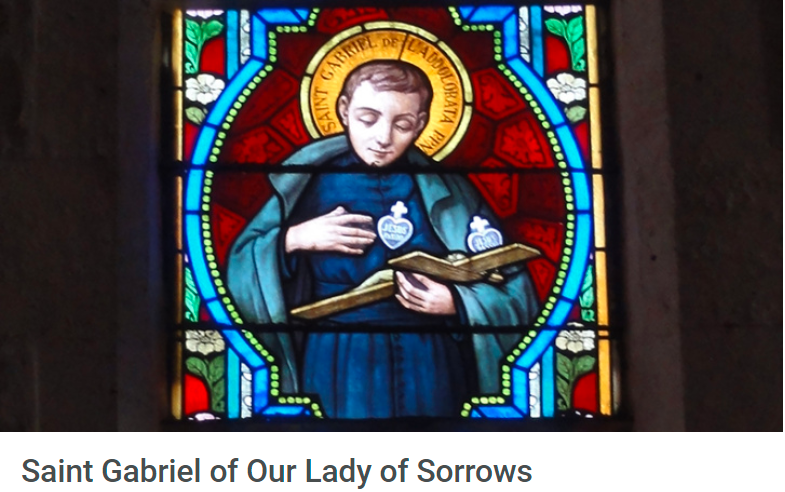
St. Gabriel Possenti (1838-1862), also known as St. Gabriel of Our Lady of Sorrows, was born in Italy into a large family and baptized Francis, Saint Gabriel lost his mother when he was only four years old. He was educated by the Jesuits and, having been cured twice of serious illnesses, came to believe that God was calling him to the religious life. Young Francis wished to join the Jesuits but was turned down, probably because of his age, not yet 17. Following the death of a sister to cholera, his resolve to enter religious life became even stronger and he was accepted by the Passionists. Upon entering the novitiate he was given the name Gabriel of Our Lady of Sorrows.
Ever popular and cheerful, Gabriel quickly was successful in his effort to be faithful in little things. His spirit of prayer, love for the poor, consideration of the feelings of others, exact observance of the Passionist Rule as well as his bodily penances—always subject to the will of his wise superiors— made a deep impression on everyone.
His superiors had great expectations of Gabriel as he prepared for the priesthood, but after only four years of religious life symptoms of tuberculosis appeared. Ever obedient, he patiently bore the painful effects of the disease and the restrictions it required, seeking no special notice. He died peacefully on February 27, 1862, at age 24, having been an example to both young and old.
Saint Gabriel of Our Lady of Sorrows was canonized in 1920.
Reflection
When we think of achieving great holiness by doing little things with love and grace, Therese of Lisieux comes first to mind. Like her, Gabriel died painfully from tuberculosis. Together they urge us to tend to the small details of daily life, to be considerate of others’ feelings every day. Our path to sanctity, like theirs, probably lies not in heroic doings but in performing small acts of kindness every day.
Saint Gabriel of Our Lady of Sorrows is the Patron Saint of: