Fr. Mike examines the relationship between the Church and non-Christian religions. He discusses that while there is some degree of goodness and truth in every religion, the fullness of truth exists in the Catholic Church. Fr. Mike concludes with a reflection on the statement from the early Church Fathers that “outside the Church there is no salvation.” Today’s readings are Catechism paragraphs 839-848.
Fr. Mike examines the relationship between the Church and non-Christian religions. He discusses that while there is some degree of goodness and truth in every religion, the fullness of truth exists in the Catholic Church. Fr. Mike concludes with a reflection on the statement from the early Church Fathers that “outside the Church there is no salvation.” Today’s readings are Catechism paragraphs 839-848.
God is truth, God is love, and God is being itself. Today’s Catechism readings begin to unpack the eternal nature of God and share with us God’s “innermost secret.” Fr. Mike teaches us that because God made us in his image and likeness, then we too are called to embody truth and love. Today’s readings are Catechism paragraphs 212-221.
1 Now it happened that on a Sabbath day He had gone to share a meal in the house of one of the leading Pharisees; and they watched Him closely. 7 He then told the guests a parable, because He had noticed how they picked the places of honour. He said this, 8 ‘When someone invites you to a wedding feast, do not take your seat in the place of honour. A more distinguished person than you may have been invited, 9 and the person who invited you both may come and say, “Give up your place to this man.” And then, to your embarrassment, you will have to go and take the lowest place. 10 No; when you are a guest, make your way to the lowest place and sit there, so that, you’re your host comes, he may say, “My friend, move up higher.” Then, everyone with you at the table will see you honoured. 11 For everyone who raises himself up will be humbled, and the one who humbles himself will be raised up.’ 12 Then He said to his host, ‘When you give a lunch or a dinner, do not invite your friends or your brothers or your relations or rich neighbours, in case they invite you back and so repay you. 13 No; when you have a party, invite the poor, the crippled, the lame, the blind; 14 then you will be blessed, for they have no means to repay you and so you will be repaid when the upright rise again.’
What is the most loving thing we can do for those we love and those we meet? To tell them the truth. And what is the truth? Okay, that was kind of a trick question. The truth is not an “it”. It’s a “Who.” Jesus said, “I am the way, the truth, and the life.” When we tell people the truth, we tell them about the Lord. The fullness of His message is found in the Catholic Church because the Catholic Church is our Lord as Paul discovered in the Book of Acts. We teach people the Faith. We show them His message which will sometimes infuriate them, but it will bring us peace, and that is exactly what our soul needs. The message to that person is one that will heal their soul and fulfill it. One day they will be united with Him in the Kingdom of Heaven if they have been faithful. So, how do we pass on His message? Saint Francis of Assisi said, “Preach the Gospel always, whether convenient or inconvenient, and if necessary, use words.” You may talk about our Good Lord, and you may have a fine religious education, but the best teaching is one of action out of love and forgiveness.
An odd thing happened a while ago, and one that I may have already told you about – I’m old and I repeat my stories – I’m near the end of my priesthood, and I don’t have many stories left to tell. Anyway, I was on duty at hospice, and we had a patient come in on a stretcher. The ambulance drivers came in and asked where we wanted him. All the nurses were busy, so I told the guys that we are going to put him in room 3. There were only two of them, and it takes three people to move a patient. One guy was at the head and shoulders, the other took the sheet, I took his legs, and 1-2-3 BOOM. Because I hadn’t been gloved and touched the man’s bare skin, I went over to the sink and washed my hands. One of the ambulance drivers came up to me and said, “thank you, Father.” And just by that…a small act of kindness. Done day in and day out, we are teaching about our Good Lord.
Do not be dissuaded by loud people, people who are drinking, people who walk away, people who text that our church is wrong and that the teachings of Christ are outdated. Why? Because the devil is always very loud, and everything he tells you is a lie. I know a priest at one of the hospitals in the VA system. He is the chief chaplain, so he has to go to all these meetings. I’d rather have a colonoscopy. There was this one meeting he had with the social worker. The social worker lectured this priest on the proper use of personal pronouns. The priest said, “We cannot as Catholics acknowledge that because it denies God’s creation and His creative Will.” Male and female is all there is. Christ said that marriage is between a male and female. We cannot undo God’s creative Will. It is obvious, and it would be denying our faith. If you deny an article of faith, you deny it all. So, this priest looked at the adjectives in which people are identified. To the social worker, He said, “May I ask you a question? Why don’t you call me by my own personal pronoun? By the way, it’s “Father.” And the social worker couldn’t answer him. That tells you it’s from satan.
Do not be discouraged by teaching the truth. Persevere. By doing so, the apostles said it will save your immortal souls. Do not cower to loud voices. Their voices are like little children whistling past the cemetery. I go into cemeteries at night…I don’t care. I know who I work for. Am I afraid? No, I’m not. Are you kidding me? Bring it! They are just like little children afraid of the dark. If you scream long enough and loud enough, you will believe all the evil propaganda the world has ever had.
So, do not be disheartened. Preach the truth. The truth is a Person and the fullness we have in the Catholic Church. I was reading the newspaper recently about the movie on the life of Saint Padre Pio. Know what happened to the actor who is portraying Saint Pio? Even though this actor had a colorful past, he became Catholic. What happened to the head of the Gestapo in Rome, Italy during WWII? A priest came to visit him, and he became Catholic. So do not be discouraged. Continue to proclaim the Gospel by words and actions. Proclaim your faith. That is the most loving thing to do.
How will you apply this message to your life? ____________________________________
You can read all of Father Fitzgibbons’ sermons by going to annunciationcatholicalbemarle.com and clicking on “Blog” then “Categories” then “Sermon Notes.” On a cell phone: click on “Blog” then “Menu” and then “Categories”
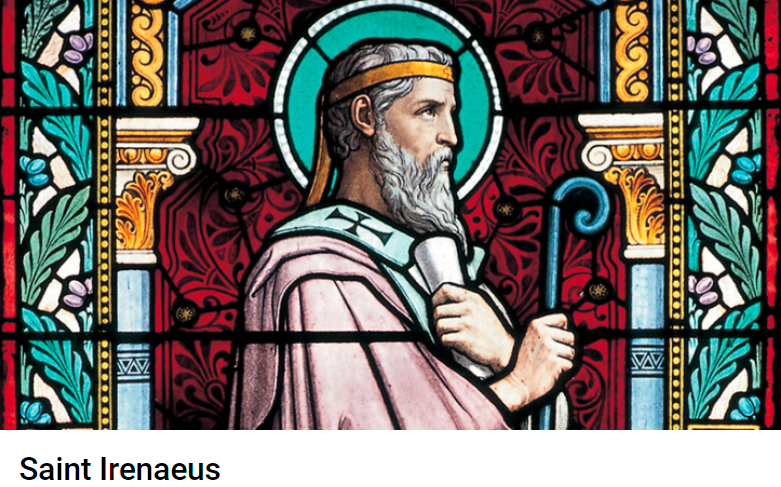
The Church is fortunate that Irenaeus was involved in many of its controversies in the second century. He was a student, well trained no doubt, with great patience in investigating, tremendously protective of apostolic teaching, but prompted more by a desire to win over his opponents than to prove them in error.
As bishop of Lyons he was especially concerned with the Gnostics, who took their name from the Greek word for “knowledge.” Claiming access to secret knowledge imparted by Jesus to only a few disciples, their teaching was attracting and confusing many Christians. After thoroughly investigating the various Gnostic sects and their “secret,” Irenaeus showed to what logical conclusions their tenets led. These he contrasted with the teaching of the apostles and the text of Holy Scripture, giving us, in five books, a system of theology of great importance to subsequent times. Moreover, his work, widely used and translated into Latin and Armenian, gradually ended the influence of the Gnostics.
The circumstances and details about his death, like those of his birth and early life in Asia Minor, are not at all clear.
Reflection
A deep and genuine concern for other people will remind us that the discovery of truth is not to be a victory for some and a defeat for others. Unless all can claim a share in that victory, truth itself will continue to be rejected by the losers, because it will be regarded as inseparable from the yoke of defeat. And so, confrontation, controversy and the like might yield to a genuine united search for God’s truth and how it can best be served.
On this channel, we speak a lot about the teachings of the Church and how our society longs for these truths. But have you ever stopped and asked yourself what truth really is? There can be a lot of long, philosophical, complicated answers to this question, but today we have a simple one: truth can simply be defined as “what is.” In other words, a statement is either true or false depending on how closely it describes reality, or what is. But if truth is centered around reality, are there different truths for different people?
Mari Pablo explains how we can find truth in a fallen world.
Unfortunately, lies are everywhere. But we as Christians don’t have to settle for this because we know that Jesus is THE truth. Because we live in a fallen world, however, this truth can be hard to find at times, especially in a society that praises social media and putting your “best self forward.” It’s up to us as sons and daughters of God to speak truth and stand up for what is good and beautiful, and to deny any lies the evil one wants us to believe.
The temptation of the devil is fear. Pontius Pilate was afraid. Really? A Roman governor with a Roman army that had no objections to killing people? That was their job. There were no cameras, no Miranda rights, and no defense attorneys. He could have swept everything up, and nobody would have said anything, anytime. He was afraid, although he didn’t realize why he was afraid. He asked our Lord, “What is truth?” while he was looking at truth in the face. The truth is a person – not an “it” but a “Who.” Remember Philosophy 101: there is only one truth – not your truth – but THE truth. Pilate said, “Ecce homo” – “Behold the man.” In contrast, what did John the Baptist say when he saw Christ? “Ecce Agnus Dei” – “Behold the lamb of God.” John was not afraid.
During His Passion, our Lord was scourged and was in absolute agony. The Romans were very good at their job. They had done this for centuries and knew how to prolong suffering. So, no one can hear, no one can look at the crucifix, and no one can read accounts about the Passion and still say, “My sin doesn’t affect anyone. It only hurts me. It’s a personal sin.” In one sense yes, but in another sense no. “It’s just a small sin. It’s just a white sin kinda like a white lie.” I studied theology, and I actually have the degree. The paperwork is somewhere. When you look at the crucifix, you see the effects of sin. But, you also see how much Christ loves us. This is the face of love. He suffered all of this just for you. Not “you” in the general sense, but “you” in the particular sense. “I suffered this just for you; that’s how much I love you. My act of love is always before the Father for you.” This act of love never ends. This act of love is perfect, but can be even more perfect if we respond to it. Follow Him and one day you will enjoy happiness in Heaven.
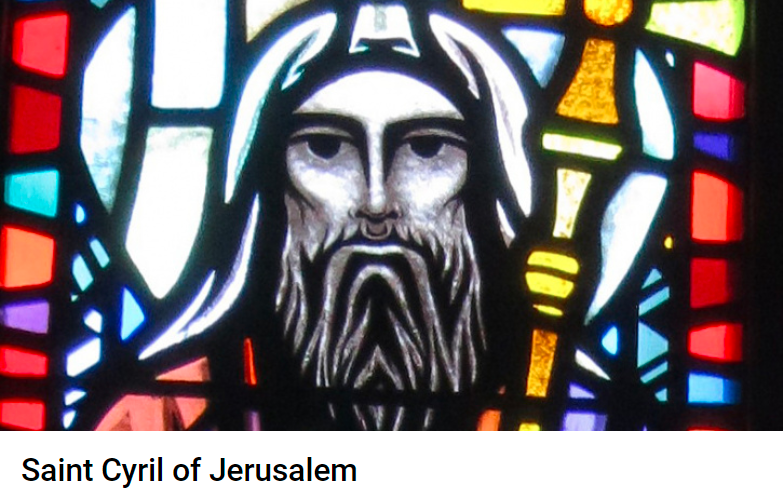
The crises that the Church faces today may seem minor when compared with the threat posed by the Arian heresy, which denied the divinity of Christ and almost overcame Christianity in the fourth century. Cyril was to be caught up in the controversy, accused of Arianism by Saint Jerome, and ultimately vindicated both by the men of his own time and by being declared a Doctor of the Church in 1822.
Raised in Jerusalem and well-educated, especially in the Scriptures, he was ordained a priest by the bishop of Jerusalem and given the task during Lent of catechizing those preparing for Baptism and catechizing the newly baptized during the Easter season. His Catecheses remain valuable as examples of the ritual and theology of the Church in the mid-fourth century.
There are conflicting reports about the circumstances of his becoming bishop of Jerusalem. It is certain that he was validly consecrated by bishops of the province. Since one of them was an Arian, Acacius, it may have been expected that his “cooperation” would follow. Conflict soon rose between Cyril and Acacius, bishop of the rival nearby see of Caesarea. Cyril was summoned to a council, accused of insubordination and of selling Church property to relieve the poor. Probably, however, a theological difference was also involved. He was condemned, driven from Jerusalem, and later vindicated, not without some association with and help from Semi-Arians. Half his episcopate was spent in exile; his first experience was repeated twice. He finally returned to find Jerusalem torn with heresy, schism and strife, and wracked with crime. Even Saint Gregory of Nyssa, who was sent to help, left in despair.
They both went to the Council of Constantinople, where the amended form of the Nicene Creed was promulgated in 381. Cyril accepted the word consubstantial—that is, Christ is of the same substance or nature as the Father. Some said it was an act of repentance, but the bishops of the Council praised him as a champion of orthodoxy against the Arians. Though not friendly with the greatest defender of orthodoxy against the Arians, Cyril may be counted among those whom Athanasius called “brothers, who mean what we mean, and differ only about the word consubstantial.”
Reflection
Those who imagine that the lives of saints are simple and placid, untouched by the vulgar breath of controversy, are rudely shocked by history. Yet, it should be no surprise that saints, indeed all Christians, will experience the same difficulties as their Master. The definition of truth is an endless, complex pursuit, and good men and women have suffered the pain of both controversy and error. Intellectual, emotional, and political roadblocks may slow up people like Cyril for a time. But their lives taken as a whole are monuments to honesty and courage.
33 So Pilate went back into the praetorium and summoned Jesus and said to him, “Are you the King of the Jews?”34 Jesus answered, “Do you say this on your own or have others told you about me?”35 Pilate answered, “I am not a Jew, am I? Your own nation and the chief priests handed you over to me. What have you done?”36 Jesus answered, “My kingdom does not belong to this world. If my kingdom did belong to this world, my attendants [would] be fighting to keep me from being handed over to the Jews. But as it is, my kingdom is not here.”37 So Pilate said to him, “Then you are a king?” Jesus answered, “You say I am a king. For this I was born and for this I came into the world, to testify to the truth. Everyone who belongs to the truth listens to my voice.”
I have been a priest for 35 years, and I’ve seen a lot. During that time, I have been forced to sit through lots of mandatory meetings……time I’ll never get back, but they have surely shortened my time in purgatory. Many of these meetings have been about creating new programs to bring converts to the Church.
I have a novel means of evangelizing….I tell people the whole truth. Christ said “I am the way and the truth and the life. No one comes to the Father except through me (John 14:6). Truth is a “Who” not a “what.” All truth is found in Jesus Christ. He is the truth that frees us from our slavery to sin. G. K. Chesterton was a convert to the Catholic faith. When asked why he converted, he said because Catholicism is true. He also said that he didn’t want his sins explained away….he wanted them forgiven.
There is nothing wrong with what we believe; the problems arise in how we live it. Catholicism is the beacon of truth. So, share the whole truth about our faith with others and, as St. Francis of Assisi said, use words if necessary. Just be prepared to hear lots of “yeah buts.”
It is important for priests to study philosophy before entering the seminary, because it helps them approach issues thoughtfully. In philosophy, truth is a central subject. Nobody can have their own truth. The truth is absolute and is true no matter which religion is practiced. We all worship the same God, so abortion is a mortal sin for everyone…not just Catholics. In John 8:31-32, Christ said “If you continue in my word you are truly my disciples; and you will know the truth, and the truth will make you free.” The whole truth sets us free…not versions of it. When you change the truth, you are trying to change Jesus Christ Himself.
Jesus taught the Apostles for two hours, and their hearts were aflame, because when they heard the truth, they recognized it. Pilot looked at truth in the face, and did not.
The Advent season begins on December 2nd. Advent is a time to prepare for the arrival of Christ at Christmas through the sacrament of reconciliation and acts of penance. I go to confession to confessors I’ve known for 40 years. I have my failings too, but I take up my crosses and follow Him. I hope you will too.
How will you apply this message to your life? Will you evangelize by sharing the whole truth about our faith with others? Will you prepare for Advent with acts of penance and reconciliation?