
contemplativemonk.substack.com
416 N 2nd St, Albemarle NC 28001 | (704) 982-2910
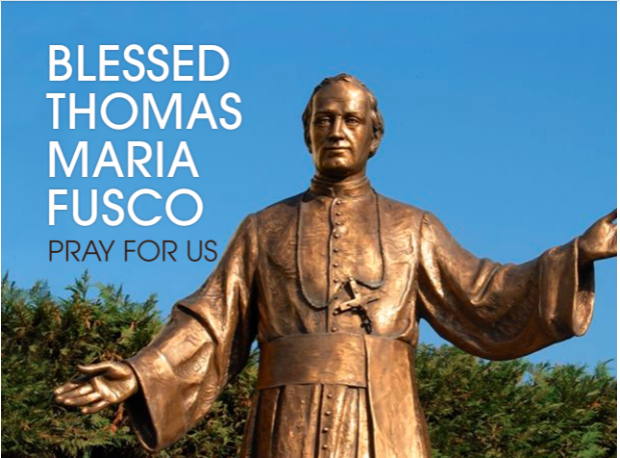
Blessed Thomas Maria Fusco, also known as Tommaso, (1831-1891) was born to a noble and pious family in Italy, the seventh of eight children. He was orphaned at an early age and raised by his uncle, a priest, who oversaw his education. He had a deep love for the faith, especially to the Passion of Christ and Our Lady of Sorrows. He became a priest at the age of 24 and opened a school in his own home. He later became an itinerant missionary throughout southern Italy. After traveling for a number of years he opened another school, this time to train priests on how to be good confessors. He also founded the Priestly Society of the Catholic Apostolate to support the missions, which gained papal approval. During his work with the poor he discerned a call to start a new religious order of sisters, the Daughters of Charity of the Most Precious Blood, to minister to orphaned children. In addition to all of this, Fusco was also a parish priest, a confessor to a group of cloistered nuns, and a spiritual father to a lay group at the nearby Shrine of Our Lady of Mount Carmel. He died of liver disease at the age of 59. He was beatified by Pope St. John Paul II in 2001. His feast day is February 24.
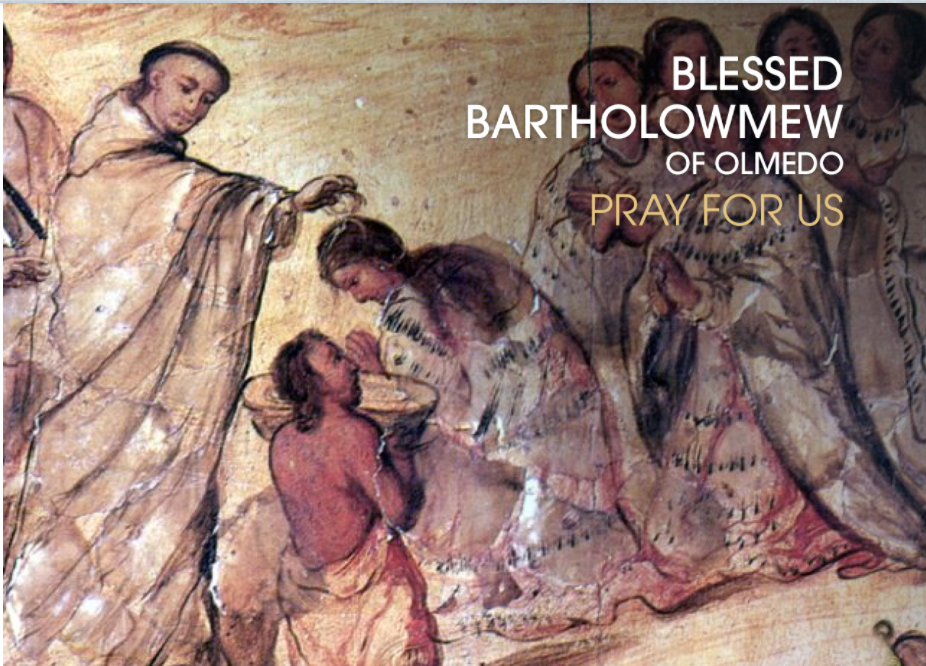
Blessed Bartholomew of Olmedo (1485-1524) was a Spanish Mercedarian priest, and the first priest to arrive on Mexican soil in 1516 at the age of 31. He was chaplain for the expedition of Spanish Conquistador Fernando Cortés, who began the Spanish colonization of the Americas and the downfall of the Aztec empire. Bartholomew was well-liked by the native people. He taught them the Christian faith and exhorted them to end their practice of human sacrifice. He also defended them against injustice and restrained Cortés from acting out in violence against them. Bartholomew taught the native Mexicans devotion to the Blessed Virgin Mary under the title of Our Lady of Mercy, which they embraced. Blessed Bartholomew of Olmedo baptized more than 2500 people before he died in Mexico in 1524 at the age of 39. He was buried in Santiago de Tlatelolco. His feast day is February 11.
//Catholic Company//
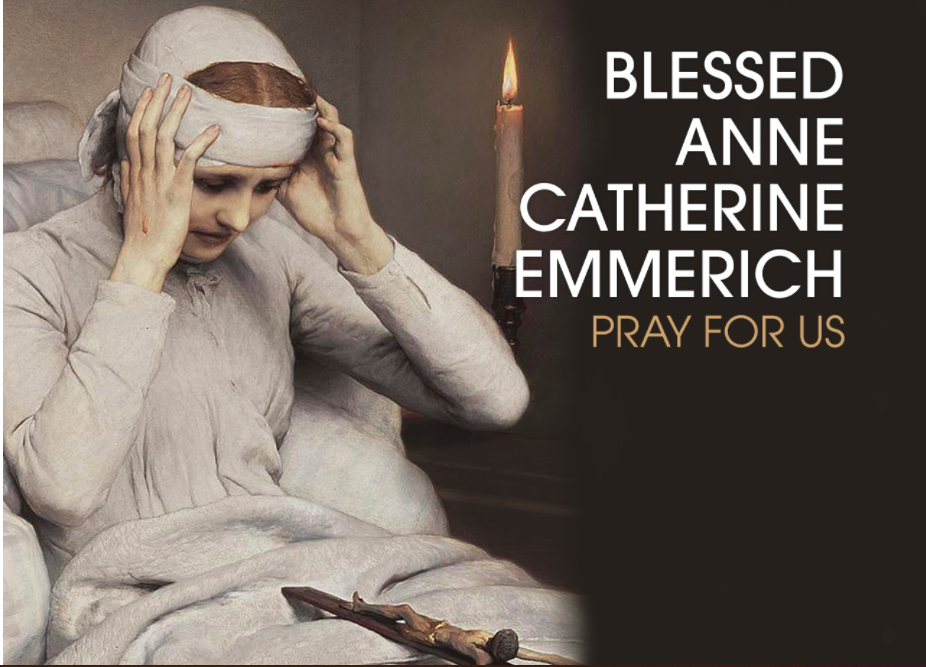
Blessed Anne Catherine Emmerich (1774-1824) was born in Germany to a devout peasant family. From a young age she received divine knowledge imparted to her through extremely detailed visions of the lives of Jesus, the Virgin Mary, and the saints. As a child her guardian angel often appeared to her, and Jesus himself visited her while she was tending sheep. The suffering souls in purgatory often called upon her assistance to offer prayers and penances on their behalf. At the age of 28, after many years of longing for the religious life, Anne Catherine entered the novitiate with the Augustinians. She devoted her life to waging a spiritual battle for suffering souls, and in her great charity she accepted extreme physical, yet supernatural, sufferings which ultimately left her bedridden. This strange phenomena of physical suffering for the spiritual condition of other souls was not always accepted by others, and she endured much ridicule due to the astonishing manner in which her experiences displayed themselves. Her daily visions gave her special insight into the spiritual realm which have been recorded into now-popular books, and were used to discover what is believed to be the house of Mary in Ephesus. Her feast day is February 9th.
//Catholic Company//
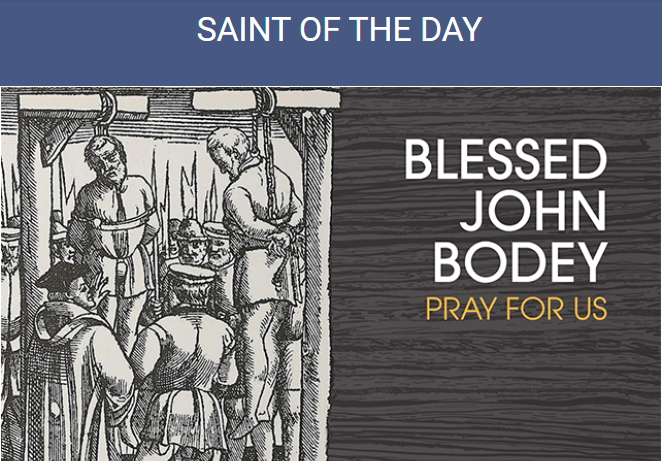
Blessed John Bodey (1549-1583) was born in Wells, England, the son of a wealthy merchant and former mayor. He studied at Oxford and became an Oxford Fellow in 1568 at the age of 19. Later he, along with seven others, was deprived of his fellowship for being a Roman Catholic by the Anglican Bishop of Winchester. Bodey, a married layman and schoolmaster, was arrested in 1580 for continuing to practice the Catholic religion and rejecting England’s newly-established heretical Church of England. He was kept in iron shackles for three years, which he called his “school of patience.” In 1583 he was tried for treason, both for being a faithful Roman Catholic and for repudiating King Henry VIII’s claim of supremacy of the Church in England over against the Holy Father. Bodey wrote that his iron chains were earning him glory in heaven, even kissing the chain halter around his neck. He was executed under Queen Elizabeth on November 2, 1583 by being hanged, drawn, and quartered at Andover. He died with the name of Jesus on his lips. His mother rejoiced that her son persevered to the end and won the crown of martyrdom; she gave a feast in honor of him being numbered among the saints in heaven. John Bodey was beatified in 1929 and is one of the 40 Martyrs of England and Wales. His feast day is November 2nd.
//Catholic Company//
“You Visit My Mother. . . I Remember Your Name”
Father Peter Fitzgibbons
August 14 – 15, 2021
Gospel: Luke 11:27-28
Where I’m from up north, I lived in a diverse community with very strong ethnic ties and associations. There was this gentleman who approached a priest and said, “Hey Father, you visit my mother – I remember your name.” Okay…I’d love to. What son, as hated as this gentleman allegedly was, doesn’t want to honor his mother. There’s no shame in honoring one’s mother. That’s true for us even with all our sins. What about our good Lord? He was the only child in history who actually created His mother. Throughout the centuries, for thousands of years, the Church has always called for devotion to the Blessed Mother – not for worship or adoration – that belongs only to God Himself – but for devotion. It’s not just a pious tradition for old women sitting in their living-rooms knitting, it’s for the whole Church. Over the past 50 years or so, Devotion to the Blessed Mother has really fallen to the wayside which is sad, because people really don’t know their faith or scripture. Non-Catholics say, “I study scripture and I pray scripturally.” Well, if you studied scripture and prayed scripturally, you would be Catholic. When you honor the Blessed Mother, you are praying scripturally.
You’ve heard the proclamation of the Holy Gospel of Saint Luke. Where did Luke get his gospel? He wasn’t one of the apostles. At the Annunciation, Mary was alone when the angel came to her. Luke wasn’t there. He wasn’t at Elizabeth’s house when Mary visited her. So, where did he get all of this information? Did Luke channel his inner Miss Cleo the psychic? The first part of the Gospel of Luke is known as the Gospel of Mary, because she told him everything that’s in it. So, Mary’s words are scriptural. All of those people who have gotten biblical, theological, or philosophy degrees and who are not Catholic, should sue their professors for theological and intellectual malpractice. You wasted your money. Because if you made it this far in the scriptures, then you must be Catholic, and you must honor the Blessed Mother.
What did Mary say further into the Magnificat? “All generations will call me blessed.” So, it’s a scriptural command to honor the mother of Jesus. It has been 70 years since the so-called Second Vatican Council and some decided that devotion to the Blessed Mother was not scriptural. Really? Devotion is decreasing and along with it purity and belief in the Real Presence. In order to understand Jesus, you have to understand Mary. In theological studies, Mariology (the study of Mary) is a subset of Christology (the study of Christ). It was from the Blessed Mother that He took His human nature. If you look throughout scripture, I’m not going to give you a whole class on Mariology today – it’s a semester-long study – but just look at the highlights. Protestants say they don’t have to rely on the saints. Really? Where is that in scripture? Who interceded for us before the first miracle recorded in scripture? The Blessed Mother at the wedding in Cana. During the Passion, our Lord looked at His mother and said, “Woman, behold your son.” He then looked at John and said, “Behold your mother.” Protestants also say, “In order to be saved, you must be washed in the blood.” Who was standing beneath the cross getting spattered with His blood? The Blessed Mother. The blood did not stop. . .the Romans were very good at what they did. When they took her Son down from the cross, He was placed in her lap. She was covered in His blood. Was she not bathed in the blood? Walk in the blood? After the Resurrection, Mary was in the Upper Room with the apostles when the Holy Spirit came. This was the second time that the Holy Spirit came to her. Remember the Annunciation? The angel said, “Hail full of grace.” Nobody else in scripture has been called that. The power of the Holy Spirit came and overshadowed her. “Oh, you have to be born again in the Holy Spirit.” Well, Mary did it twice.
This is why we have devotion to the Blessed Mother. Just like our own mothers who have died, and hopefully in Heaven, intercede for us to the Holy Father. How much more so can the mother of Christ intercede for us. The original woman, the old Eve, took us all out of paradise to the new Eve who leads us to paradise. Our Blessed Mother is the new Eve.
Not too long ago, I received a call to go visit woman who was in her last days. So, I went into the house and gave her the Last Rites. She said, “Father, I have a Rosary.” Oh, that’s great! It was beautiful set of beads. I said to her, “Hold them in your hands, and as often as you can say the Rosary so that when the time comes when you are to leave this world, our Blessed Mother will come take you by the hand and lead you to her Son.”
How will you apply this message to your life? Remain devoted to the Blessed Mother and ask for her intercession with her Son.
You can read all of Father Fitzgibbons’ sermons by going to https://annunciationcatholicalbemarle.com/ and clicking on “Blog” then “Categories” and then “Sermon Notes.” From a cell phone, click on “Blog” then “Menu” and then “Categories” (located at the end of page). There is also a search box if you are looking for a specific topic.
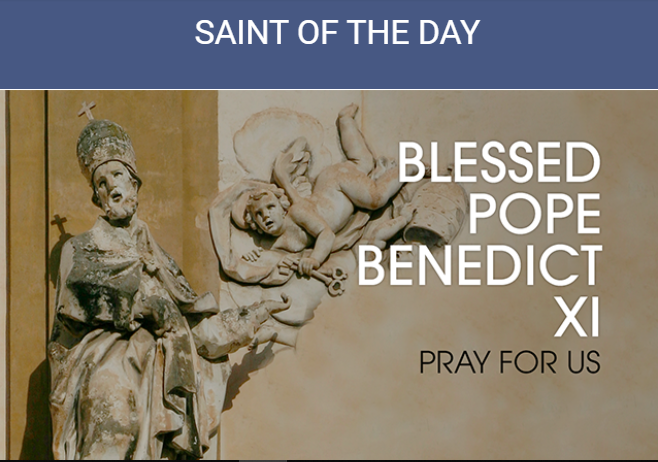
Bl. Pope Benedict XI (1240-1304) was born in Italy with the name Nicholas Boccasini. At the age of 14 he entered the Dominican Order, and went on to become a theology professor before being named Master General of the Order in 1296. As Master of the Dominicans, Boccasini defended Pope Boniface VIII when the hostility of secular rulers towards the Roman Pontiff grew, especially during the pope’s open conflict with the King of France. In reward for his loyalty, Boccasini was elevated to Cardinal and then Bishop of Ostia. When Hungary was torn with civil war, Boccasini was sent there by the Holy See to restore peace. When he returned to Rome, the Pope’s conflict with France reached its height; Boniface VIII was seized, beaten, and driven from the Sacred Palace by his enemies, while Boccasini was one of only two cardinals who defended the Holy Father to the end. After Boniface VIII died, Boccasini was elected in his place and took the name Pope Benedict XI. He excommunicated all those who had taken part in the seizure and abuse of his predecessor, while at the same time restoring peace with the French court. In this time of tumult he repaired the damage with leniency, yet without compromising the Holy See or the good memory of the previous pope. His reign was brief; he died suddenly of a suspected poisoning after only eight months in office. Bl. Pope Benedict XI was the author of a volume of sermons and commentaries on the Gospel of Matthew, Psalms, Job, and Revelation. His feast day is July 7th.
//Catholic Company//
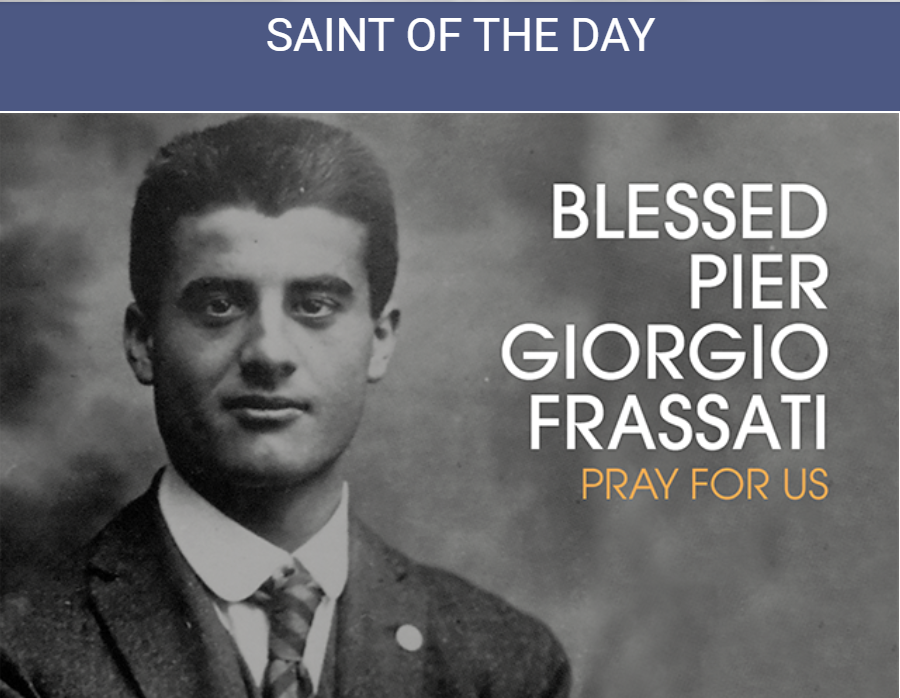
Blessed Pier Giorgio Frassati (1901-1925) was born in Turin, Italy, to a wealthy and prominent family. He was a vibrant, joyful, and athletic youth with an adventurous spirit and a strong zest for life. He loved mountain climbing, the theater, opera, and literature. He also had a deep spiritual life and a strong devotion to the Holy Eucharist and the Virgin Mary, even while his piety provoked criticism from his parents. He challenged his friends to a life of virtue, leading them in spiritual exercises such as daily Mass and the rosary. He joined the St. Vincent de Paul Society in 1918 and became a Lay Dominican in 1922. He was also politically active in resisting fascism and communism; he took part in public demonstrations and joined religious-political organizations such as the Catholic Students Federation and Catholic Action. He also spent much time caring for the sick and poor to a heroic degree, yet his parents punished him when they caught him giving away his money and possessions. While ministering to the sick he contracted polio and died just six days later at the age of 24. His family, thinking he suffered from a mild sickness, did not realize the seriousness of his condition until it was too late. At his funeral his parents were shocked to find thousands of the city’s poor, whom their son had helped in some way, arrive to pay their respects. Pope St. John Paul II called Pier Giorgio Frassati a “man of the beatitudes” at his beatification in 1990. His feast day is July 4th.
//Catholic Company//