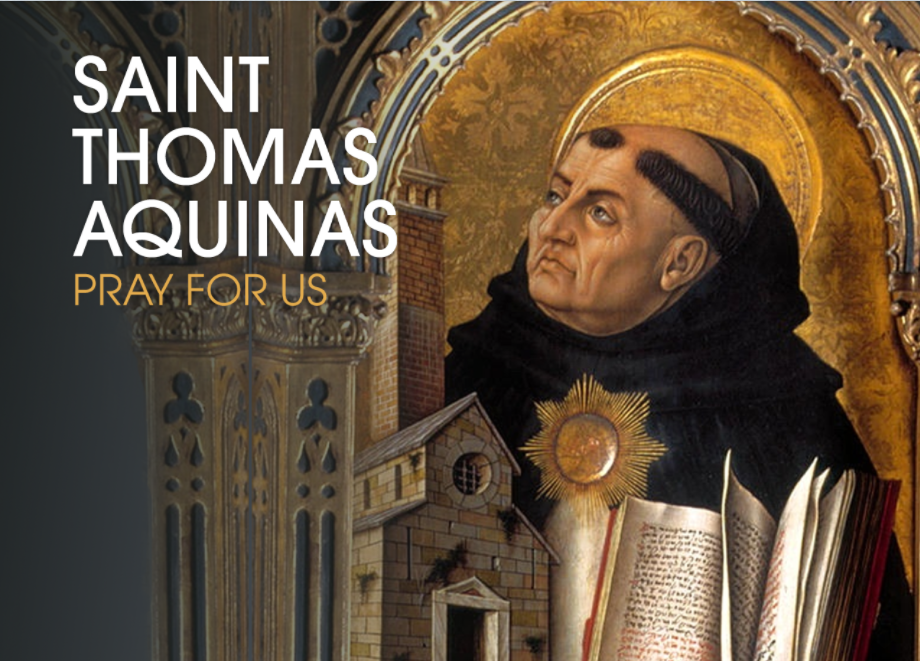
St. Thomas Aquinas (1225–1274) was born into a wealthy and noble family in Aquino, Italy. He was the pious and brilliant son of a count, and a lucrative future was planned for him. When Thomas set off to enter the newly founded Dominican order to be a poor mendicant friar, his mother held him prisoner in the family castle in order to dissuade him. His brothers tried to destroy his purity, and thus his vocation, by tempting him with a prostitute. However Thomas resisted and turned to God for help; as a result, angels were sent to guard and preserve his chastity. This long ordeal only strengthened his vocation, and eventually he escaped and joined the Dominicans. He was ordained to the priesthood and went on to become a famed professor and prolific writer. His works remain immensely influential in philosophy and theology, the most famous being his Summa Theologica, and multiple popes have upheld him as the model of a systematic Catholic education. St. Thomas Aquinas is the foremost Doctor of the Catholic Church, known as the “Angelic Doctor” for his purity of mind and body, and remarkable intelligence. St. Thomas Aquinas is the patron of schools and universities, students, philosophers, theologians, apologists, academics, and chastity. His feast day is January 28.
St. Aquilinus of Milan (d. 1015 A.D.), also known as St. Aquilinus of Cologne, was born to a noble family in Bavaria, Germany. He received his education in Cologne, Germany and was ordained to the priesthood. He was offered the bishopric of Cologne, but turned it down in order to be a missionary priest and itinerant preacher. He traveled through various European cities fighting against the dangerous and spreading heresies of the Cathars, Manichaeans, and Arians. He was also known to work miracles by healing people from disease, especially during a cholera epidemic. He eventually settled in Milan, Italy, and was so effective in his preaching against the Arian heretics that they stabbed him to death and threw his body in the city sewer. His body was recovered and buried in the Basilica of San Lorenzo, in a chapel which now bears his name. His feast day is January 29.
St. Martina of Rome (d. 228 A.D.) was born to a noble Roman family and orphaned at a young age. She was zealous in the practice of her faith, remained a virgin, and, in preparation for the Christian persecutions sweeping the city, gave much of her inheritance to the poor. She was martyred under Roman Emperor Alexander Severus. According to the accounts of her martyrdom, she was discovered praying in a church and was arrested by Roman soldiers. She was ordered to pay homage to the pagan gods, which she refused. She was then cruelly tortured over several days. She was raked with iron hooks and scourged, and when a bright light enveloped her, some of her torturers were converted to the Faith amid her fervent prayers. She was then taken to the temple of Diana to be forced to offer sacrifice, but at her presence the temple’s demon left with a scream. They next tried to throw her to a lion (it showed no interest in her) and to burn her alive, but she would not catch fire. Finally, she was beheaded. St. Martina’s feast day is January 30.
We know more about the devotion to Saint Blaise by Christians around the world than we know about the saint himself. His feast is observed as a holy day in some Eastern Churches. In 1222, the Council of Oxford prohibited servile labor in England on Blaise’s feast day. The Germans and Slavs hold him in special honor, and for decades many United States Catholics have sought the annual Saint Blaise blessing for their throats.
We know that Bishop Blaise was martyred in his episcopal city of Sebastea, Armenia, in 316. The legendary Acts of St. Blaise were written 400 years later. According to them Blaise was a good bishop, working hard to encourage the spiritual and physical health of his people. Although the Edict of Toleration (311), granting freedom of worship in the Roman Empire, was already five years old, persecution still raged in Armenia. Blaise was apparently forced to flee to the back country. There he lived as a hermit in solitude and prayer, but he made friends with the wild animals. One day a group of hunters seeking wild animals for the amphitheater stumbled upon Blaise’s cave. They were first surprised and then frightened. The bishop was kneeling in prayer surrounded by patiently waiting wolves, lions and bears.
The legend has it that as the hunters hauled Blaise off to prison, a mother came with her young son who had a fish bone lodged in his throat. At Blaise’s command the child was able to cough up the bone.
Agricolaus, governor of Cappadocia, tried to persuade Blaise to sacrifice to pagan idols. The first time Blaise refused, he was beaten. The next time he was suspended from a tree and his flesh torn with iron combs or rakes. Finally, he was beheaded.
Reflection
Four centuries give ample opportunity for fiction to creep in with fact. Who can be sure how accurate Blaise’s biographer was? But biographical details are not essential. Blaise is seen as one more example of the power those have who give themselves entirely to Jesus. As Jesus told his apostles at the Last Supper, “If you remain in me and my words remain in you, ask for whatever you want and it will be done for you” (John 15:7). With faith we can follow the lead of the Church in asking for Blaise’s protection.
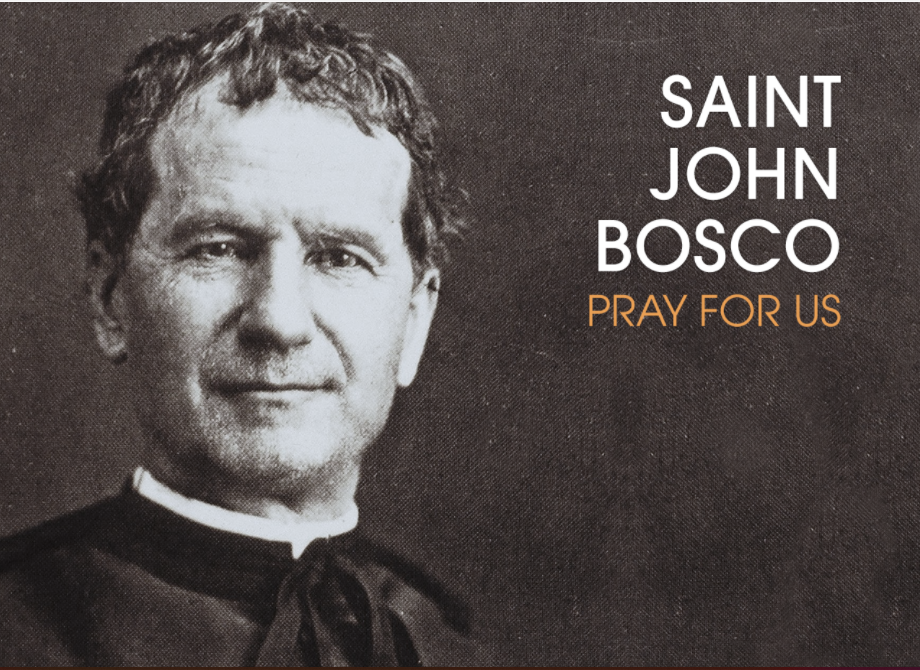
John Bosco’s theory of education could well be used in today’s schools. It was a preventive system, rejecting corporal punishment and placing students in surroundings removed from the likelihood of committing sin. He advocated frequent reception of the sacraments of Penance and Holy Communion. He combined catechetical training and fatherly guidance, seeking to unite the spiritual life with one’s work, study and play.
Encouraged during his youth in Turin to become a priest so he could work with young boys, John was ordained in 1841. His service to young people started when he met a poor orphan in Turin, and instructed him in preparation for receiving Holy Communion. He then gathered young apprentices and taught them catechism.
After serving as chaplain in a hospice for working girls, Don Bosco opened the Oratory of St. Francis de Sales for boys. Several wealthy and powerful patrons contributed money, enabling him to provide two workshops for the boys, shoemaking and tailoring.
By 1856, the institution had grown to 150 boys and had added a printing press for publication of religious and catechetical pamphlets. John’s interest in vocational education and publishing justify him as patron of young apprentices and Catholic publishers.
John’s preaching fame spread and by 1850 he had trained his own helpers because of difficulties in retaining young priests. In 1854, he and his followers informally banded together, inspired by Saint Francis de Sales.
With Pope Pius IX’s encouragement, John gathered 17 men and founded the Salesians in 1859. Their activity concentrated on education and mission work. Later, he organized a group of Salesian Sisters to assist girls.
Reflection
John Bosco educated the whole person—body and soul united. He believed that Christ’s love and our faith in that love should pervade everything we do—work, study, play. For John Bosco, being a Christian was a full-time effort, not a once-a-week, Mass-on-Sunday experience. It is searching and finding God and Jesus in everything we do, letting their love lead us. Yet, because John realized the importance of job-training and the self-worth and pride that come with talent and ability, he trained his students in the trade crafts, too.
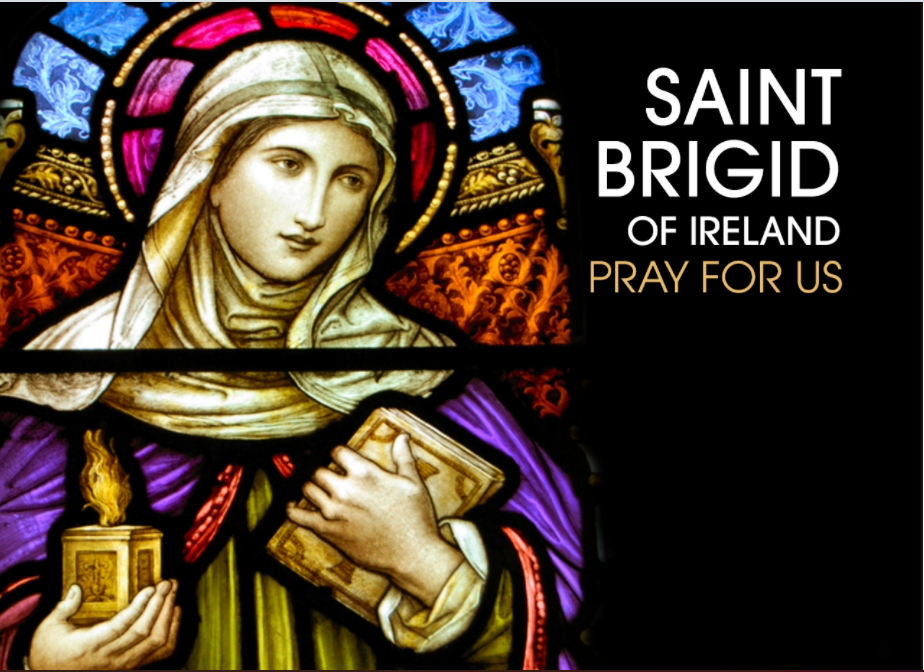
St. Brigid of Ireland (451–525 A.D.), also known as St. Brigit of Kildare, was born to a pagan Irish chieftain and a Christian slave mother. Being the daughter of a slave woman, she also was a slave, and worked as a dairy maid. She became known for her virtuous life and her charity to the poor. Recognizing her great piety and special graces, a Christian king convinced her father to grant Brigid her freedom. Once free to follow her own course in life, St. Brigid refused marriage, consecrated herself to Christ, and became Ireland’s first nun. She also formed Ireland’s first convent at Kildare and became its abbess. She went on to found many other religious communities, as well as a School of Art famous for its metal working and illuminated manuscripts. St. Brigid was known for her extraordinary spirituality, even converting her father to the faith after he witnessed her fashioning the sign of the cross from strands of rushes. She was also a contemporary and friend of St. Patrick. When she died, her sisters kept a fire burning in an enclosure at her Kildare convent. This fire burned for centuries, tended by the sisters and not burning out until the 13th century. It was later re-lit and burned for 400 more years until the Protestant revolt. St. Brigid is the patroness of Ireland and many other causes, most notably of dairy and milk maids, chicken farmers, travelers, and sailors. Her feast day is February 1st.
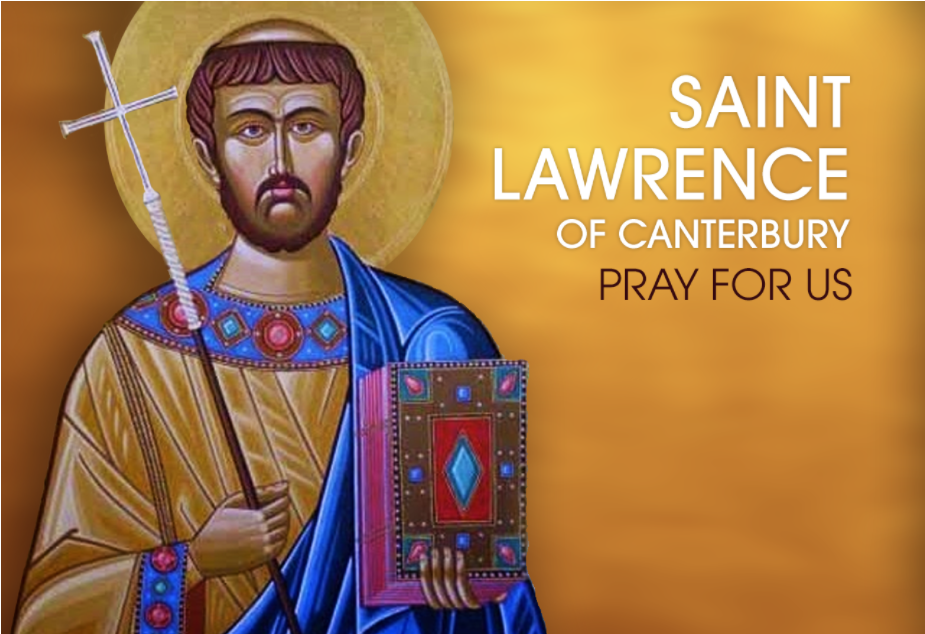
St. Lawrence of Canterbury (d. 619 A.D.) was among the original band of missionaries sent from Rome to evangelize England with St. Augustine, the first Archbishop of Canterbury. As a fruit of their labor the region’s most powerful ruler, the King of Kent, became a baptized Christian along with many of his countrymen. When Augustine died, Lawrence became Canterbury’s second Archbishop. He was a zealous leader and urged the Celtic bishops to keep peace and unity with Rome. When the King of Kent died, his pagan son caused great damage to the faith of the people and the mission work which had been done among them; because of this, some of the missionaries fled to Gaul. Lawrence was so upset by the abandonment of Christianity among his flock that he considered abandoning his bishopric as well. In response, St. Peter the Apostle appeared to him in a vision, rebuked him, and scourged him so badly that Lawrence had physical marks on his body from the encounter. St. Lawrence then relayed his vision to the king and showed him his wounds, causing the king to convert to the Christian faith as his father did. St. Lawrence’s feast day is February 2nd.
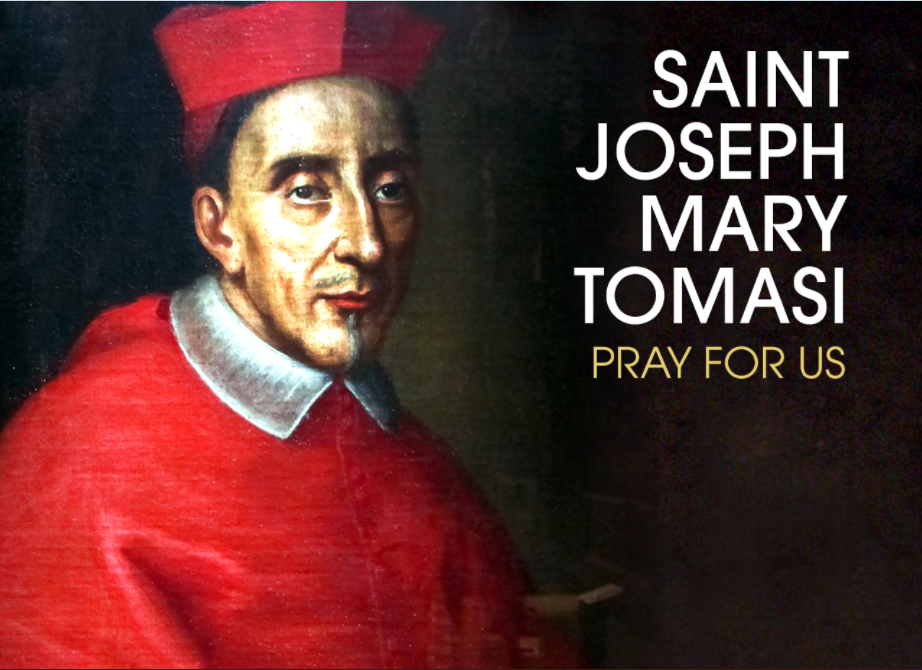
St. Joseph Mary Tomasi (1649-1713) was born in Sicily to noble and virtuous parents. He received a good Christian education and was drawn to the things of God from an early age. He renounced his inheritance and titles, transferring them to his brother, and entered religious life in the Order of the Clerics Regular Theatine founded by St. Cajetan. When their children were grown, his parents also entered religious life. St. Joseph Tomasi became so well known for his sanctity and learning that his advice and friendship was widely sought. He was a master of several languages, including Hebrew, and converted his teacher, a Jewish Rabbi, to Christianity. He is known for his writings on theology and love of the Roman liturgy, earning him the name “Liturgical Doctor.” Some of the liturgical reforms he sought were adopted in 20th century. He was famous for teaching catechism to the children of his titular church, and its congregants Gregorian chant. He was appointed a Cardinal, and not long after suffered from pneumonia and died. St. Joseph Mary Tomasi is the patron saint of liturgy. His feast day is January 1st.
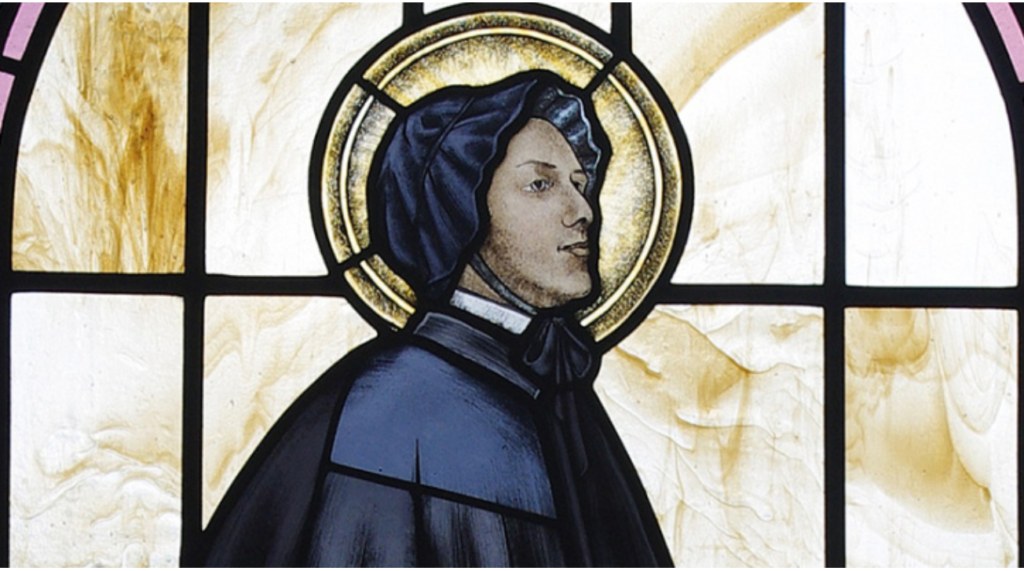
Image: Saint Elizabeth Ann Seton in St. Paul Catholic Church, Westerville, Ohio | photo by Nheyob
Saint Elizabeth Ann Seton’s Story (August 28, 1774 – January 4, 1821)
Mother Seton is one of the keystones of the American Catholic Church. She founded the first American religious community for women, the Sisters of Charity. She opened the first American parish school and established the first American Catholic orphanage. All this she did in the span of 46 years while raising her five children.
Elizabeth Ann Bayley Seton is a true daughter of the American Revolution, born August 28, 1774, just two years before the Declaration of Independence. By birth and marriage, she was linked to the first families of New York and enjoyed the fruits of high society. Reared a staunch Episcopalian, she learned the value of prayer, Scripture and a nightly examination of conscience. Her father, Dr. Richard Bayley, did not have much use for churches but was a great humanitarian, teaching his daughter to love and serve others.
The early deaths of her mother in 1777 and her baby sister in 1778 gave Elizabeth a feel for eternity and the temporariness of the pilgrim life on earth. Far from being brooding and sullen, she faced each new “holocaust,” as she put it, with hopeful cheerfulness.
At 19, Elizabeth was the belle of New York and married a handsome, wealthy businessman, William Magee Seton. They had five children before his business failed and he died of tuberculosis. At 30, Elizabeth was widowed and penniless, with five small children to support.
While in Italy with her dying husband, Elizabeth witnessed Catholicity in action through family friends. Three basic points led her to become a Catholic: belief in the Real Presence, devotion to the Blessed Mother and conviction that the Catholic Church led back to the apostles and to Christ. Many of her family and friends rejected her when she became a Catholic in March 1805.
To support her children, she opened a school in Baltimore. From the beginning, her group followed the lines of a religious community, which was officially founded in 1809.
The thousand or more letters of Mother Seton reveal the development of her spiritual life from ordinary goodness to heroic sanctity. She suffered great trials of sickness, misunderstanding, the death of loved ones (her husband and two young daughters) and the heartache of a wayward son. She died January 4, 1821, and became the first American-born citizen to be beatified (1963) and then canonized (1975). She is buried in Emmitsburg, Maryland.
Reflection
Elizabeth Ann Seton had no extraordinary gifts. She was not a mystic or stigmatic. She did not prophesy or speak in tongues. She had two great devotions: abandonment to the will of God and an ardent love for the Blessed Sacrament. She wrote to a friend, Julia Scott, that she would prefer to exchange the world for a “cave or a desert.” “But God has given me a great deal to do, and I have always and hope always to prefer his will to every wish of my own.” Her brand of sanctity is open to everyone if we love God and do his will.
Saint Elizabeth Ann Seton is a Patron Saint of:
Catholic Schools Educators/Teachers Loss of Parents Widows
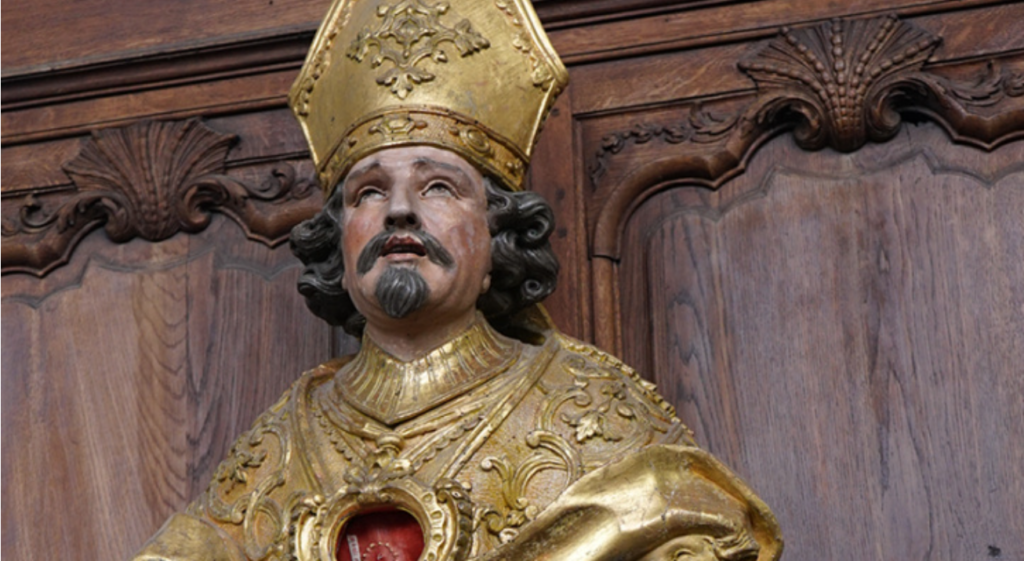
Image: Statue of Saint Hilary of Poitiers | en l’Église Saint-Hilaire de Givet | photo by G.Garitan
Saint Hilary of Poitiers’ Story (C. 315 – C. 368)
This staunch defender of the divinity of Christ was a gentle and courteous man, devoted to writing some of the greatest theology on the Trinity, and was like his Master in being labeled a “disturber of the peace.” In a very troubled period in the Church, his holiness was lived out in both scholarship and controversy. He was bishop of Poitiers in France.
Raised a pagan, he was converted to Christianity when he met his God of nature in the Scriptures. His wife was still living when he was chosen, against his will, to be the bishop of Poitiers in France. He was soon taken up with battling what became the scourge of the fourth century, Arianism, which denied the divinity of Christ.
The heresy spread rapidly. Saint Jerome said “The world groaned and marveled to find that it was Arian.” When Emperor Constantius ordered all the bishops of the West to sign a condemnation of Athanasius, the great defender of the faith in the East, Hilary refused and was banished from France to far off Phrygia. Eventually he was called the “Athanasius of the West.”
While writing in exile, he was invited by some semi-Arians (hoping for reconciliation) to a council the emperor called to counteract the Council of Nicea. But Hilary predictably defended the Church, and when he sought public debate with the heretical bishop who had exiled him, the Arians, dreading the meeting and its outcome, pleaded with the emperor to send this troublemaker back home. Hilary was welcomed by his people.
Reflection
Christ said his coming would bring not peace but a sword (see Matthew 10:34). The Gospels offer no support for us if we fantasize about a sunlit holiness that knows no problems. Christ did not escape at the last moment, though he did live happily ever after—after a life of controversy, problems, pain and frustration. Hilary, like all saints, simply had more of the same.


_-_stained_glass,_arcade,_Saint_Elizabeth_Ann_Seton.jpg)
