If you’re not feeling loved by someone you love, take courage in the story of Leah in Genesis.
Jacob, Leah’s husband, did not love her. In fact, what’s even worse, he loved her sister, Rachel, instead. Leah named her first three sons out of her hope and desire for her husband to love her, thinking if she bore him sons he would love him. She named her first “Reuben” which means, “Look, a son,” saying, “Now my husband will love me.” She named her second son “Simeon” which means “listening” because she felt the Lord heard her prayer for Jacob to love her. She named her third son “Levi” which means “joined together” because she believed this time her husband will finally be joined to her.
By the time she had her fourth son, she named him Judah, which means “may God be praised.” She finally stopped trying to make Jacob love her, and instead she let go and let God take over. It’s no coincidence that Jesus would be born from the line of Judah.
Some people love people the way they know how to love, and the beloved just doesn’t notice. A father may love her daughter through acts of service rather than words of affirmation or quality time.
Others may simply not love you, but that does not mean you’re unlovable.
You’re chosen by God for a reason only you can know. Do not wait for someone else to give you the love that God the Father has already given you.
Being alone isn’t supposed to be scary. In this video, Fr. Mike Schmitz shows us how solitude can be an invitation and doesn’t have to lead to loneliness. God himself has revealed to us how he is a relationship of love between Father, Son, and Holy Spirit. Made in his image, we are also made for relationship—with God and with one another. When we feel alone, it is because we were made to give ourselves to others as God gives himself to us.
The Wednesday of Holy Week is known to many as “Spy Wednesday”, but it’s also known as the “Day of Aloneness.” The backstory behind this moniker can have a profound impact on the way we live our lives.
There are two people in the Holy Week narrative that experience profound loneliness: Jesus and Judas. There’s an honorable form of aloneness that we feel when we’re doing something we ought to be doing (walking a road that no one else can), but there’s also a sadder form of loneliness that exists when we are doing something we shouldn’t be doing.
Today, Father Mike explains the difference between the aloneness Jesus felt during Holy Week, and what Judas felt.
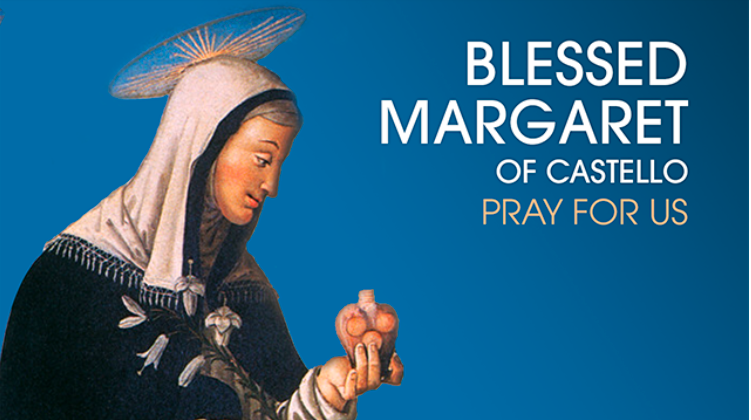
Bl. Margaret of Castello (1287–1320) was born to noble Italian parents who were awaiting the birth of the child of their dreams. Instead, they bore a daughter who was blind, dwarfed, lame, and hunchbacked. Margaret’s parents were horrified by the physical appearance of their newborn child, so they hid her and kept her existence secret. A servant had her baptized and named her Margaret, meaning, “Pearl.” When she was six years of age she was nearly discovered, so that her father confined her to a cell inside the wall of a church with her necessities given through a window. The parish priest took it upon himself to educate Margaret. She lived in this way until age sixteen, when her parents took her on pilgrimage to a shrine famous for miraculous healings. There they prayed earnestly for their daughter to be cured of her deformities, which they loathed. When no cure came, her parents abandoned her in the streets and returned home, never to see her again. Margaret begged for food and was helped by the town’s poor who took turns sheltering her in their homes. She became a Dominican Tertiary and took up the work of serving the sick, dying, and imprisoned. Margaret was known for her great joy, sanctity, and profound mystical experiences. She died at the age of 33, and hundreds of miracles were credited to her intercession both before and after her death. Her body is incorrupt. She is the patron against poverty, and of the disabled, handicapped, and unwanted. Her feast day is April 13th.
One needn’t live a long life to leave a deep imprint. Teresa of Los Andes is proof of that.
As a young girl growing up in the early 1900’s in Santiago, Chile, Juana Fernandez read an autobiography of a French-born saint—Thérèse, popularly known as the Little Flower. The experience deepened her desire to serve God and clarified the path she would follow. At age 19 Juana became a Carmelite nun, taking the name of Teresa.
The convent offered the simple lifestyle Teresa desired and the joy of living in a community of women completely devoted to God. She focused her days on prayer and sacrifice. “I am God’s,” she wrote in her diary. “He created me and is my beginning and my end.”
Toward the end of her short life, Teresa began an apostolate of letter-writing, sharing her thoughts on the spiritual life with many people. At age 20 she contracted typhus and quickly took her final vows. She died a short time later, during Holy Week.
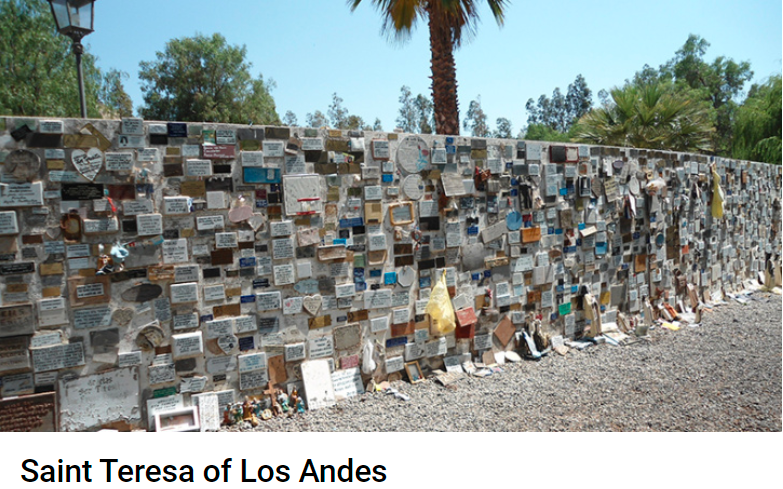
Known as the “Flower of the Andes,” Teresa remains popular with the estimated 100,000 pilgrims who visit her shrine in Los Andes each year. Canonized in 1993 by Pope John Paul II, she is Chile’s first saint.
Reflection
The special graces given Saint Teresa reflect the mysterious wisdom of God at work in individuals whether young or old. It appears God has his own logic when it comes to who gets what in the realm of grace. All we can say is; “Praised be the Lord.”
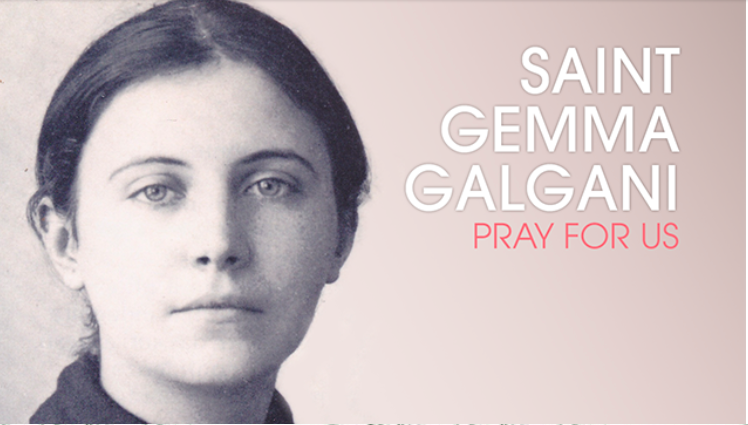
St. Gemma Galgani (1878-1903) was born in Italy, the fifth of eight children born to a prosperous pharmacist. When she was young, Gemma’s mother and three of her siblings died of tuberculous. When she was 18 her father died as well, leaving Gemma to help care for her younger siblings. She rejected two marriage proposals and became a housekeeper while trying to enter the religious life as a Passionist. She was rejected due to her poor heath, and later became a Tertiary member of the order. Gemma developed spinal meningitis but was miraculously healed, which she attributed to the Sacred Heart of Jesus through the intercession of St. Gabriel of Our Lady of Sorrows and St. Margaret Mary Alacoque. Throughout her life she united herself with the Passion of Christ and experienced great suffering as a result, but not without receiving many remarkable graces as well. She experienced many mystical visions and was often visited by her guardian angel, Jesus, and the Virgin Mary. For this she was known as a great mystic, and, according to her spiritual director, developed the stigmata at age 21. After a selfless life of love given to God for the conversion of sinners, she died on the Vigil of Easter at the age of 25. She is the patron saint of pharmacists, loss of parents, back illnesses, temptations, and those seeking purity of heart. Her feast day is April 11th.
How do you know someone is alive if you don’t see them? I’ve taken a clue from the sheriff detective…there is fresh evidence. For instance, you may not see a family member for a day, but you know they are alive, right? You see dirty plates right where they left them. You see your husband’s dirty socks right where he left them. I guess he figured the Molly Maid Service would come by and pick them up. You may not see the person, but you see fresh evidence that they’ve been there and that they are alive. They may have left a note for you. They may have cooked dinner for you. You know they are alive even though you may not have touched them or laid eyes on them. Likewise, we have not touched the resurrected Christ, but we know that He is alive. We see the evidence.
From the very beginning, the Chief Priests bribed Roman soldiers to lie and say that disciples stole the body of Christ. That must have been one big bribe. The Romans knew quite well what betrayal meant. It meant instant death. The Romans did not refer anyone to defense counsel. If you failed in doing your duty, you were duly executed in a very brutal way. The Roman army did not play. No bail. No defense attorney. You were executed. So, it had to be a pretty big bribe. Even back then, there was fake news. “Christ wasn’t resurrected.” “His body was stolen.” You don’t steal a body after a couple days in Palestine. Trust me on this one. Ask any police officer or nurse. Nobody steals a body after that length of time. That’s fake news. Sound familiar? As scripture says, there’s nothing new under the sun. All through the centuries, people have claimed that Christ is dead or He was just a nice guy or He was the same as Muhammad and Buddha. None of them claimed that He was God. They try to relegate religion to just old wives tales. But, as much as they tried, the Chief Priests couldn’t keep a lid on the news of Christ’s resurrection even with the use of armies and the threat of persecution. That’s because it’s true. If it wasn’t, why would they spend all the time, money, and energy to say it’s not?
Why do people complain about the Catholic Church and its teachings? It’s the message of Christ. If it’s not true, why do they bother? If it’s not true, why do they care? They can go live their lives and do other stuff. They complain, because they know it is true. Our Lord proved Himself to all those detractors. They are gone, but we are still here. We have evidence through the centuries that Christ is still alive. Look at what our Catholic Church has done. We have built universities and hospitals. These are the things we do best. What was the cause of all those centuries of good works? It was the love of Christ in us. The living love of Christ is still evident today. You know it’s true, because you are here today. You have faith in the resurrection, and you have faith in Jesus Christ. You are here to be touched by the love of God and to draw closer to Him. Is there some fear in all of us? Of course there is, just as there was for the women at the tomb. But, you overcome your fear through your faith. That’s why you are here today. By your presence, you proclaim the resurrection of Christ, and that He is not dead. He’s not a footnote in history. He wasn’t just some really nice guy. By your faithful attendance at Mass and participation in the Sacraments, you are making your profession and belief in the resurrection and that Christ lives. One day you will share His life. Most of us won’t be around for the end of the world; as far as I know.. I haven’t gotten any phone calls. On that day, we too will go to the tomb just like Mary Magdalene and the women did on Good Friday morning.
As you look through the history of the Church, God has never been unfaithful to His followers. Never…not once. In seminary I learned a lot of stuff, well they think I did, but I was supposed to learn a lot of stuff. We studied Thomas Aquinas and the five proofs of God. I will prove to you that God exists and also how faithful He is. I guarantee that if you pray for this it will happen on your way home. Guaranteed. Pray for patience. “Lord, I want to grow in patience, I want to be meek, humble, and understanding,” Pray that prayer, and I guarantee that you will find five nitwits who will irritate the living heck out of you and try your patience on the way home. Patience is an acquired virtue that you get by practice. Ask for patience, and our good Lord will say, “Great! You got it.” He will send all those nitwits to help you grow in that virtue. That’s the quickest way to prove that God exists. The quickest proof that God listens to your prayers and answers them. God is alive and active. We have 2,000 years of proof. We see His results. Do we see them as often as we’d like? No. He hides in our human nature.
We believe in the resurrection of Christ. If it wasn’t true, why have so many people for over 2,000 years kept saying it’s not true? You can see that God is alive. We do not see Him directly, but He is alive. He is working in us. He is working through you. He took the humanity that He received from the Blessed Mother to His sacred Passion and resurrection and then to Heaven. He uses His humanity to make His love present and known to the world. He does that for us. Each of us, in our own vocation, are to prove to the world that God’s love is alive. The grave could not hold Him. God promised that we will imitate His resurrection. So, for those who follow Him, the grave will not hold us. We will be like Him. We will suffer probably, in one way or another, and we will rest in our graves until the day of our own resurrection. That is not defeat…that is victory.
How will you apply this message to your life? Will you help prove to the world that God’s love is alive?
Father’s Afterthoughts…
Now part of my Irish cultural heritage is the belief that leprechauns are real. I think it’s because we drank a wee bit too much ale. You never hear anyone complain about leprechauns. But, they don’t exist. If you see any, I can get you some help. I know people. You will feel much better.
You can read all of Father Fitzgibbons’ sermons by going to https://annunciationcatholicalbemarle.com/ and clicking on “Blog” then “Categories” and then “Sermon Notes. From a cell phone, click on “Blog” then “Menu” and then “Categories” (located at the end of page). There is also a search box if looking for a specific topic.
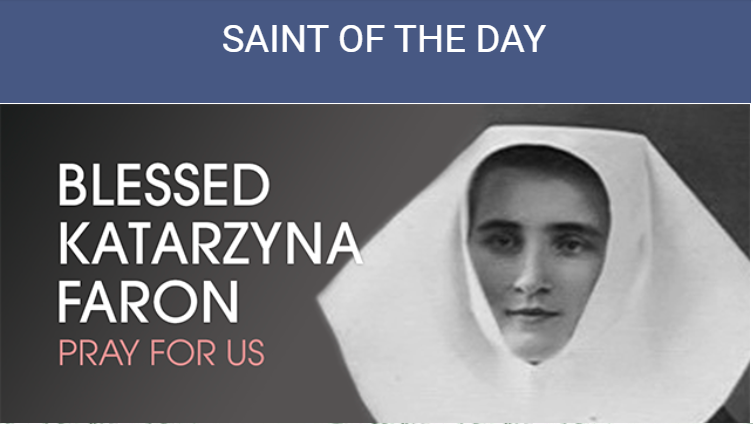
Bl. Katarzyna Celestyna (Catherine Celestine) Faron (1913-1944) was born in Zabrzez, Poland. At the age of five she was orphaned and raised by pious, childless relatives. Desiring the religious life, she entered the Congregation of the Sisters Servants of Mary Immaculate in 1930. She served in the community as a kindergarten teacher and catechist. After the breakout of World War II she became the leader of her religious house, ran an orphanage, and helped the poor. She was eventually arrested by the Gestapo, charged with conspiracy against the Nazis, and sent to the Auschwitz concentration camp on the feast of Epiphany in 1943, where she was assigned to manual labor digging ditches. She praised God in all her suffering and resigned herself to following his will. Due to the poor conditions she developed typhoid fever and tuberculosis. Because she completed the nine First Fridays devotion to the Sacred Heart of Jesus, she trusted that she wouldn’t die without Holy Communion, as Our Lord promised. On December 8, 1943, the feast of the Immaculate Conception, she received Holy Communion as viaticum which was secretly brought to the camp by a prisoner priest.
While on her deathbed Catherine prayed intensely for various intentions on a rosary made of bread. According to witnesses she offered her sufferings for the conversion of a priest who had fallen away from the Church, who later did return to the true Faith. Bl. Katarzyn finally died from her illness on Easter morning. She is one of the 108 beatified Polish Catholic Martyrs killed during World War II by Nazi Germany. Her feast day is April 9th.
Saint Julie Billiart (July 12, 1751 – April 8, 1816)
Born in Cuvilly, France, into a family of well-to-do farmers, young Marie Rose Julie Billiart showed an early interest in religion and in helping the sick and poor. Though the first years of her life were relatively peaceful and uncomplicated, Julie had to take up manual work as a young teen when her family lost its money. However, she spent her spare time teaching catechism to young people and to the farm laborers.
A mysterious illness overtook her when she was about 30. Witnessing an attempt to wound or even kill her father, Julie was paralyzed and became a complete invalid. For the next two decades, she continued to teach catechism lessons from her bed, offered spiritual advice, and attracted visitors who had heard of her holiness.
When the French Revolution broke out in 1789, revolutionary forces became aware of her allegiance to fugitive priests. With the help of friends, she was smuggled out of Cuvilly in a haycart. She then spent several years hiding in Compiegne, being moved from house to house despite her growing physical pain. She even lost the power of speech for a time.
But this period also proved to be a fruitful spiritual time for Julie. It was at this time she had a vision in which she saw Calvary surrounded by women in religious habits and heard a voice saying, “Behold these spiritual daughters whom I give you in an institute marked by the cross.”
As time passed and Julie continued her mobile life, she made the acquaintance of an aristocratic woman, Françoise Blin de Bourdon, who shared Julie’s interest in teaching the faith. In 1803, the two women began the Institute of Notre Dame, which was dedicated to the education of the poor, young Christian girls, and the training of catechists. The following year, the first Sisters of Notre Dame made their vows. That was the same year that Julie recovered from the illness: She was able to walk for the first time in 22 years.
Though Julie had always been attentive to the special needs of the poor and that always remained her priority, she also became aware that other classes in society needed Christian instruction. From the founding of the Sisters of Notre Dame until her death, Julie was on the road, opening a variety of schools in France and Belgium that served the poor and the wealthy, vocational groups, teachers. Ultimately, Julie and Françoise moved the motherhouse to Namur, Belgium.
Julie died there in 1816. She was canonized in 1969.
Reflection
Julie’s immobility in no way impeded her activities. In spite of her suffering, she managed to co-found a teaching order that tended to the needs of both the poor and the well-to-do. Each of us has limitations, but the worst malady any of us can suffer is the spiritual paralysis that keeps us from doing God’s work on earth.
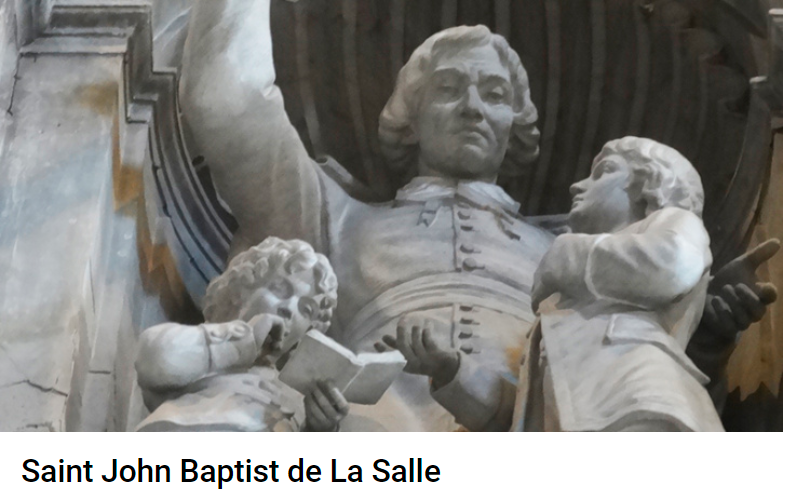
Saint John Baptist de La Salle (April 30, 1651 – April 7, 1719)
Complete dedication to what he saw as God’s will for him dominated the life of John Baptist de La Salle. In 1950, Pope Pius XII named him patron of schoolteachers for his efforts in upgrading school instruction. As a young 17th-century Frenchman, John had everything going for him: scholarly bent, good looks, noble family background, money, refined upbringing. At the early age of 11, he received the tonsure and started preparation for the priesthood, to which he was ordained at 27. He seemed assured then of a life of dignified ease and a high position in the Church.
But God had other plans for John, which were gradually revealed to him in the next several years. During a chance meeting with Monsieur Adrien Nyel, he became interested in the creation of schools for poor boys in Rheims, where he was stationed. Though the work was extremely distasteful to him at first, he became more involved in working with the deprived youths.
Once convinced that this was his divinely appointed mission, John threw himself wholeheartedly into the work, left home and family, abandoned his position as canon at Rheims, gave away his fortune, and reduced himself to the level of the poor to whom he devoted his entire life.
The remainder of his life was closely entwined with the community of religious men he founded, the Brothers of the Christian School (also called Christian Brothers or De La Salle Brothers). This community grew rapidly and was successful in educating boys of poor families, using methods designed by John. It prepared teachers in the first training college for teachers and also set up homes and schools for young delinquents of wealthy families. The motivating element in all these endeavors was the desire to become a good Christian.
Yet even in his success, John did not escape experiencing many trials: heart-rending disappointment and defections among his disciples, bitter opposition from the secular schoolmasters who resented his new and fruitful methods, and persistent opposition from the Jansenists of his time, whose moral rigidity and pessimism about the human condition John resisted vehemently all his life.
Afflicted with asthma and rheumatism in his last years, he died at age 68 on Good Friday, and was canonized in 1900.
Reflection
Complete dedication to one’s calling by God, whatever it may be, is a rare quality. Jesus asks us to “love the Lord your God with all your heart, with all your soul, with all your mind, and with all your strength” (Mark 12:30b, emphasis added). Paul gives similar advice: “Whatever you do, do from the heart…” (Colossians 3:23).
Saint John Baptist de La Salle is the Patron Saint of: