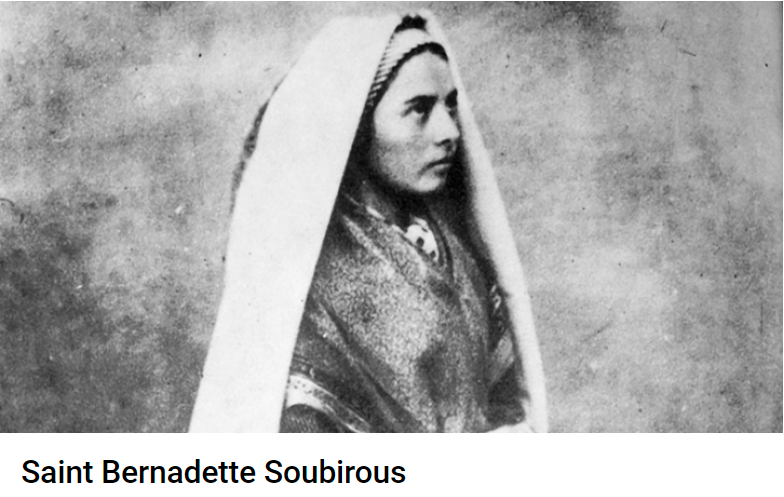
Saint of the Day – April 16 – Saint Bernadette Soubirous

(JANUARY 7, 1844 – APRIL 16, 1879)

Saint Bernadette Soubirous’ Story

Bernadette Soubirous was born in 1844, the first child of an extremely poor miller in the town of Lourdes in southern France. The family was living in the basement of a dilapidated building when on February 11, 1858, the Blessed Virgin Mary appeared to Bernadette in a cave above the banks of the Gave River near Lourdes. Bernadette, 14 years old, was known as a virtuous girl though a dull student who had not even made her first Holy Communion. In poor health, she had suffered from asthma from an early age.

There were 18 appearances in all, the final one occurring on the feast of Our Lady of Mt. Carmel, July 16. Although Bernadette’s initial reports provoked skepticism, her daily visions of “the Lady” brought great crowds of the curious. The Lady, Bernadette explained, had instructed her to have a chapel built on the spot of the visions. There, the people were to come to wash in and drink of the water of the spring that had welled up from the very spot where Bernadette had been instructed to dig.

According to Bernadette, the Lady of her visions was a girl of 16 or 17 who wore a white robe with a blue sash. Yellow roses covered her feet, a large rosary was on her right arm. In the vision on March 25 she told Bernadette, “I am the Immaculate Conception.” It was only when the words were explained to her that Bernadette came to realize who the Lady was.

Few visions have ever undergone the scrutiny that these appearances of the Immaculate Virgin were subject to. Lourdes became one of the most popular Marian shrines in the world, attracting millions of visitors. Miracles were reported at the shrine and in the waters of the spring. After thorough investigation, Church authorities confirmed the authenticity of the apparitions in 1862.

During her life, Bernadette suffered much. She was hounded by the public as well as by civic officials until at last she was protected in a convent of nuns. Five years later, she petitioned to enter the Sisters of Notre Dame of Nevers. After a period of illness she was able to make the journey from Lourdes and enter the novitiate. But within four months of her arrival she was given the last rites of the Church and allowed to profess her vows. She recovered enough to become infirmarian and then sacristan, but chronic health problems persisted. She died on April 16, 1879, at the age of 35.

Bernadette Soubirous was canonized in 1933.

Reflection

Millions of people have come to the spring Bernadette uncovered for healing of body and spirit, but she found no relief from ill health there. Bernadette moved through life, guided only by blind faith in things she did not understand—as we all must do from time to time.

//Franciscan Media//

The Power of Words to Tell Lies or Speak Truth

Mari Pablo explains how we can find truth in a fallen world.

Unfortunately, lies are everywhere. But we as Christians don’t have to settle for this because we know that Jesus is THE truth. Because we live in a fallen world, however, this truth can be hard to find at times, especially in a society that praises social media and putting your “best self forward.” It’s up to us as sons and daughters of God to speak truth and stand up for what is good and beautiful, and to deny any lies the evil one wants us to believe.


Turn Your “No, But” into a “Yes, And”

When was the last time you said “yes” to God?

In improv, there’s a practice where participants are encouraged to never respond with “no, but” and to instead offer a “yes, and…” This allows for not only growth in the scene but in the actors as well. Similarly, God is always offering us different “scenes” to get us to sainthood. How are we responding? Turning our “no, but” into a “yes, and” opens our life to Christ’s will, and is the quickest path to sanctification.

Today, Fr. Mike explains how we can practice a better relationship with God by just saying “yes, and…”


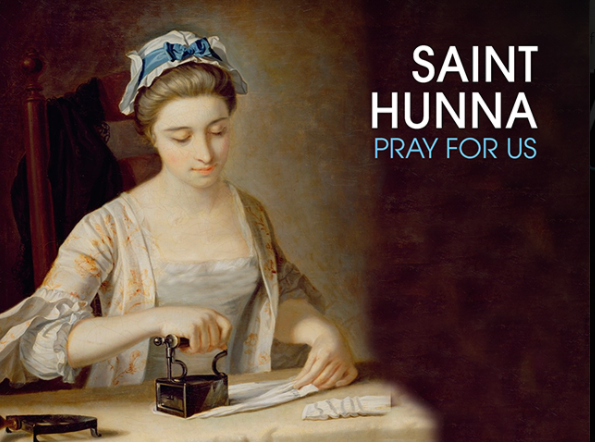
Saint of the Day – April 15 – Saint Hunna

St. Hunna (d. 679 A.D.) was born in Alsace, France. She was the virtuous daughter of a duke, and she married a similarly virtuous nobleman. Hunna and her husband did not indulge in unnecessary luxuries according to their high state in life, and instead detached themselves from their riches by opening their home to the poor and assisting them in their need. St. Deodatus, a bishop who resigned from his See, came to live with the holy couple for a time. St. Hunna and her husband greatly profited from his religious instruction and grew in sanctity as a result. When Hunna bore a son, she named him after St. Deodatus. This child, raised by such holy parents, later joined a monastery and also became a saint. After her husband’s death Hunna continued to spend her life serving the poor, especially women. No task was too menial for her. She tended to the poor and the sick and regularly, including their laundry and mending, even to the point of exhaustion. For this she was nicknamed the “Holy Washerwoman.” She also gave away her wealth and property to build churches and monasteries. So many miracles were attributed to her that Pope Leo X canonized her in 1520. St. Hunna is the patron saint of laundresses and her feast day is April 15.

//The Catholic Company//


The Key to a Happy Death

The key to a happy death is not a long and fulfilled life—it’s a life of gratitude for the time given.

If these videos have been a blessing to you, please consider helping us offset the costs of production and keep our free Catholic media flowin’ (https://tinyurl.com/ygl8ajld​). Thank you!

We often forget that this life isn’t owed to us. Every breath we take is a gift from God, who is holding us in existence at this very moment. Once we start to think that this life is owed to us, that in some way we deserve it, we will become ungrateful for the time that is given, even if we’ve lived a long and happy life.

Today, Father Mike explains how to fill your life with gratitude, and how that will prepare you for a happy death.


What Cancer Taught Me About Life

Mari Pablo shares the lessons she learned from cancer.

Want more Mari? She’s featured in Ascension’s upcoming program Connected: Catholic Social Teaching for This Generation. Sign up for updates here: https://tinyurl.com/yf59qsdc​

Almost all of us have shared some kind of experience with the devastating effects of cancer. Either we’ve known someone diagnosed with it, lost someone to it, or have had it ourselves. Regardless of how cancer has made its way into your life though, it’s impacted each of us in a specific way.

Today, Mari shares 4 personal stories about people in her life who’ve fought cancer, and what she learned from each one.


Is It Ever Okay to Give Up?

When is it okay for us to give up? Is it ever okay?

You may have seen the movie Rudy. Its eponymous protagonist is a not-so-athletic college football player who spent years taking hits and practicing with his team, only to see a few moments on the field. Those short moments, however, left him with a tremendous feeling of accomplishment and pride, knowing that he committed to something and saw it through, even when it seemed hopeless.

The question: is that always the right approach? Maybe if Rudy had dedicated that time to learning something he was naturally better at, he could have become an expert in his field. The choice Rudy made was made out of passion: he loved the game to the point of dedicating his college career to it, and not caring if the outcome wasn’t what he had expected.

But what about bigger dreams? The dream of getting married, having kids, getting into a certain religious order, entering into a certain profession? Is there ever a point where you just have to give it up?

There are a few things it’s never okay to give up. It’s never okay to give up hope itself. Hope is trust in the Lord extended into the future, knowing that he will always be with you in whatever circumstances you find yourself in. It’s also never okay to give up faith, God’s promises, or life itself.

However, it is okay—and sometimes wise—to reevaluate certain outcomes, and realize that maybe it’s time to adjust your expectations. How do you know when to do that? When reality makes it obvious.

For Rudy, that might have meant recognizing that he wasn’t going to be a starter on his football team. It’s still okay for him to want to be a part of the team in some way, and maybe get playing time one day, but reality must be acknowledged and accepted in these situations, or else we risk chasing empty expectations.

This doesn’t mean you have to give up on your dreams, or that you can’t do anything: it just means you can’t do everything. Maybe your dream is to have a family, but you and your spouse can’t get pregnant. You might not be able to conceive, but you can still adopt, or be a foster parent. Accepting the reality of your current situation means having a dream, realizing it’s place in your life, and then asking, “Okay God, now what do you want me to do?”

The outcome may not be what you had expected or planned, but if it’s with the Lord, it will still be good. And once we accept this reality, we will start to see that the real work is being done in our character, and that’s the power of trying. It may not make you the kind of person you had planned to be, but it will make you the kind of person that God wants you to be.


Just Surrender to Jesus! But How???

Mari Pablo uncovers what surrendering to God really looks like. Anytime we face trials, temptations, or hard times, we hear the common adages telling us to “offer it up” or “give it to God.” But what does that actually look like? Where do we begin that process? Maybe there is no concrete “how-to guide”, but we can start by doing two simple things:

1) Stop Fighting.

2) Surrender.


Loving Mean People

We can expect people to be mean sometimes—especially on social media. But what we don’t always expect is for people who claim to be Christians to be those mean people. It’s always difficult for us to react in a charitable way when people are rude or mean to us, but what we must remember is that—as Christians—we are examples of Christ by bearing the name of his people. Today, Jackie gives some advice on dealing with mean people.


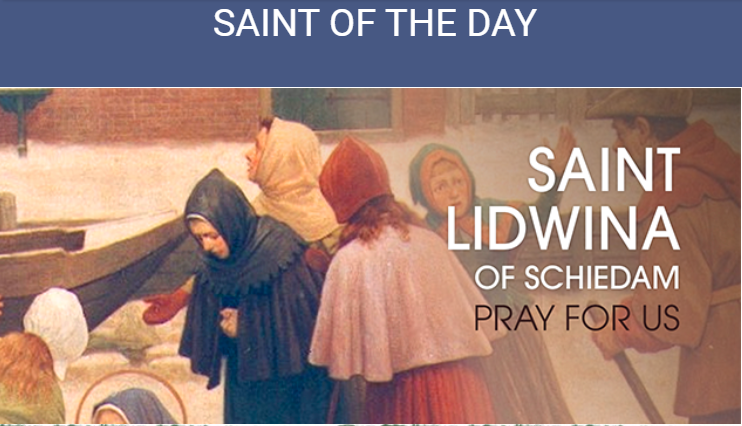
Saint of the Day – April 14 – Saint Lidwina of Schiedam

St. Lidwina of Schiedam (1380-1433) was born to a poor family in Holland. She had a devotion to the Blessed Mother and would often pray before the miraculous image of Our Lady of Schiedam. One winter, when she was 15 years old, she fell while ice skating and broke a rib, which she never recovered from. Gangrene spread throughout her body, which became as one big sore, and she was bed-ridden for the rest of her life. No medicine was able to help her. Her gradual physical deterioration was so grotesque that many suspected her of being possessed by the devil. However, when a priest brought her an unconsecrated Host, she was able to discern that it was not the Body and Blood of Christ. She experienced great suffering in this way until she was 53, but God rewarded her with the gift of heightened prayer, mystical visions, and spiritual consolations. Although she was not cured, many miraculous healings were attributed to her intercession. She fasted continuously, eventually surviving on only the Eucharist, and after her death on Easter Sunday the sweet odor of sanctity filled her room. Her grave became a pilgrimage site over which a chapel was erected. St. Lidwina of Schiedam is the patron of the chronically ill and ice skaters. Her feast day is April 14th.

//The Catholic Company//