
Sermon Notes – The Face of Love

Good Friday – April 2, 2021

Father Peter Fitzgibbons

“The Face of Love“

Gospel:  John 18: 1-19:42

The temptation of the devil is fear.  Pontius Pilate was afraid. Really?  A Roman governor with a Roman army that had no objections to killing people? That was their job.  There were no cameras, no Miranda rights, and no defense attorneys.  He could have swept everything up, and nobody would have said anything, anytime.  He was afraid, although he didn’t realize why he was afraid.  He asked our Lord, “What is truth?” while he was looking at truth in the face.  The truth is a person – not an “it” but a “Who.”  Remember Philosophy 101: there is only one truth – not your truth – but THE truth.  Pilate said, “Ecce homo” – “Behold the man.”  In contrast, what did John the Baptist say when he saw Christ?  “Ecce Agnus Dei” – “Behold the lamb of God.”  John was not afraid. 

During His Passion, our Lord was scourged and was in absolute agony.  The Romans were very good at their job.  They had done this for centuries and knew how to prolong suffering.  So, no one can hear, no one can look at the crucifix, and no one can read accounts about the Passion and still say, “My sin doesn’t affect anyone. It only hurts me. It’s a personal sin.”  In one sense yes, but in another sense no.  “It’s just a small sin. It’s just a white sin kinda like a white lie.”  I studied theology, and I actually have the degree. The paperwork is somewhere.  When you look at the crucifix, you see the effects of sin.  But, you also see how much Christ loves us.  This is the face of love.  He suffered all of this just for you.  Not “you” in the general sense, but “you” in the particular sense.  “I suffered this just for you; that’s how much I love you.  My act of love is always before the Father for you.” This act of love never ends. This act of love is perfect, but can be even more perfect if we respond to it.  Follow Him and one day you will enjoy happiness in Heaven.


Sermon Notes – “When a One Man Band Gets Hit in the Butt by a Beer Truck, the Music Stops“

“When a One Man Band Gets Hit in the Butt by a Beer Truck, the Music Stops“

Father Peter Fitzgibbons

Holy Thursday – April 1, 2021

Gospel:  John 13:1-15

Without the institution of the priesthood, the gift our Lord gave the apostles would have ended when He took the human nature He received from the Blessed Mother to Heaven on Pentecost.  When a one man band gets hit in the butt by a beer truck, the music stops.  He took the human nature of the apostles and made them into Christs.  This was part of their ordination at the Last Supper….to continue the gifts of His love and the fruits of His sacrifice and to feed His people with His most Precious Body and Blood as they were fed.  The hands that fed the apostles of Christ so too are the hands that feed you when the priest gives you Holy Communion.  The priest acts in persona Christi, in the person of Christ, to feed you the exact same body and the exact same blood.  Outward appearances vary, but it is the same Christ who feeds you.  It is the same Christ who enters your soul through participation in the Sacraments.  It was so great an honor for the apostles, that He reminded them when He washed their feet. Washing feet was a dirty, disgusting job that was left to slaves to do.  But, Jesus showed them His humility and told them that they must do the same.  “You have been given a great gift.  I have chosen you; you have not chosen Me. I have chosen you for the possibility of cooperating with the grace of great teachers, healers, and evangelists of the world.  But, to do so, you must be like Me who humbled Himself by taking the form of a slave.  You, too, must be willing to do the work of a slave.”

This gift I have been given as a priest, which has been passed on from generation to generation, is not for me.  It’s not a reward for my parents for raising a nice little boy.  It’s not a reward for me for passing all my courses in seminary.  I really did.  My degree was not honorary, contrary to popular belief.  I really earned it.  This gift is not a reward because I could pass tests.  It was given for you so that you may have Christ in you and the fruits of His death given to you.  It was given so that you could receive the fruits of the Mass by being fed His body and blood.  It was given so that your souls could be washed in His blood in the Sacrament of Penance.  It was given so that you could be united in the Sacrament of Marriage, strengthened in Confirmation, and healed on the way to salvation by receiving Last Rights.  In the past week, I have administered five.  It’s been an interesting week.  But, this gift is for you.  The gift of priests is a gift to the Church.  To bring salvation and the gift of the Real Presence of our Lord, body, blood, soul, and divinity in the Most Blessed Sacrament. This is our faith.  I am vowed as a priest to protect it with my very life.  Priests never talk about that vow.  They talk about the promises they made, but they never talk about their vow to protect the Most Blessed Sacrament. 

God loves you so much and wants to be with you to help you bear the crosses of this life so that you may have eternal life.  That’s His great love.  That’s why He gave these gifts to the Church.  That’s why He instituted the priesthood – not for me so that I could have a fancy title before my name, but to administer His Sacraments, to teach, sanctify and lead people to Him.  These gifts were given for you so that you may have life and have it to the fullest.  And, one day after courageously bearing your crosses, and not only courageously bearing them, but getting back up after you’ve fallen, you will enjoy the fullness of His love.  Pray for that last Sacrament to be given. 

As Saint Simeon said, “Now let Your servant go in peace; Your word has been fulfilled.”


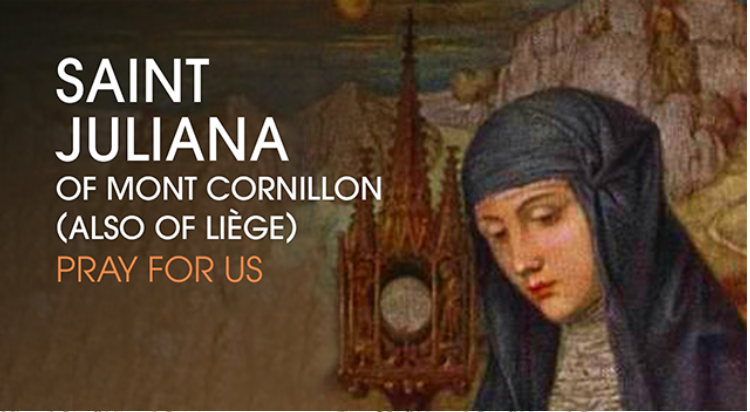
Saint of the Day – April 6th – Saint Juliana of Mont Cornillon

Blessed Juliana of Mont Cornillon, also known as Juliana of Liege (1193-1258) was born near Liege, Belgium. She was orphaned at the age of five and placed in the convent of Mt. Cornillon near Liege. She made rapid progress in virtue and grew in love for the Passion of Christ, the Blessed Virgin Mary, and the Blessed Sacrament. At the age of thirteen she became a nun and devoted herself to caring for the sick in the convent hospital. She eventually became the superioress of her community.

Taught in repeated visions that Our Lord wanted a liturgical feast in honor of the Holy Eucharist to be established, Juliana worked diligently to have the feast of Corpus Christi instituted for the Universal Church, a task for which she endured much opposition. She was forced to flee her convent after its general superior excited the populace against her and her visions. She was later vindicated by the bishop and returned to her rightful place, only to be forced to flee a final time, ending her life in seclusion.

The feast of Corpus Christi was finally instituted six years after her death by Pope Urban IV, who also commissioned Saint Thomas Aquinas to prepare the magnificent texts for the feast’s Office and Mass. Her feast day is April 6.


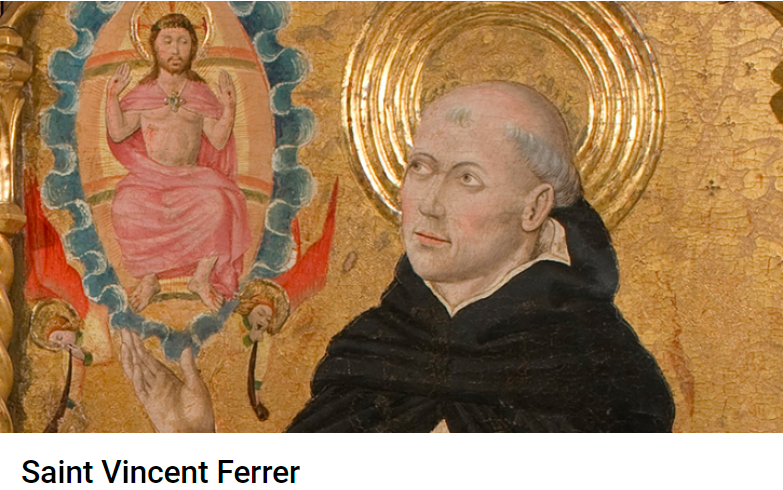
Saint of the Day – April 5th – Saint Vincent Ferrer

Saint Vincent (January 23, 1350 – April 5, 1419)

The polarization in the Church today is a mild breeze compared with the tornado that ripped the Church apart during the lifetime of this saint. If any saint is a patron of reconciliation, Vincent Ferrer is.

Despite parental opposition, he entered the Dominican Order in his native Spain at 19. After brilliant studies, he was ordained a priest by Cardinal Peter de Luna—who would figure tragically in his life.

Of a very ardent nature, Vincent practiced the austerities of his Order with great energy. He was chosen prior of the Dominican house in Valencia shortly after his ordination.

The Western schism divided Christianity first between two, then three, popes. Clement VII lived at Avignon in France, Urban VI in Rome. Vincent was convinced the election of Urban was invalid, though Catherine of Siena was just as devoted a supporter of the Roman pope. In the service of Cardinal de Luna, Vincent worked to persuade Spaniards to follow Clement. When Clement died, Cardinal de Luna was elected at Avignon and became Benedict XIII.

Vincent worked for him as apostolic penitentiary and Master of the Sacred Palace. But the new pope did not resign as all candidates in the conclave had sworn to do. He remained stubborn, despite being deserted by the French king and nearly all of the cardinals.

Vincent became disillusioned and very ill, but finally took up the work of simply “going through the world preaching Christ,” though he felt that any renewal in the Church depended on healing the schism. An eloquent and fiery preacher, he spent the last 20 years of his life spreading the Good News in Spain, France, Switzerland, the Low Countries and Lombardy, stressing the need of repentance and the fear of coming judgment. He became known as the “Angel of the Judgment.”

Vincent tried unsuccessfully, in 1408 and 1415, to persuade his former friend to resign. He finally concluded that Benedict was not the true pope. Though very ill, he mounted the pulpit before an assembly over which Benedict himself was presiding, and thundered his denunciation of the man who had ordained him a priest. Benedict fled for his life, abandoned by those who had formerly supported him. Strangely, Vincent had no part in the Council of Constance, which ended the schism.

Reflection

The split in the Church at the time of Vincent Ferrer should have been fatal—36 long years of having two “heads.” We cannot imagine what condition the Church today would be in if, for that length of time, half the world had followed a succession of popes in Rome, and half an equally “official” number of popes in say, Rio de Janeiro. It is an ongoing miracle that the Church has not long since been shipwrecked on the rocks of pride and ignorance, greed and ambition. Contrary to Lowell’s words, “Truth forever on the scaffold, wrong forever on the throne,” we believe that “truth is mighty, and it shall prevail”—but it sometimes takes a long time.


Saint Vincent Ferrer is the Patron Saint of:

Builders
Businessmen
Reconciliation

//Franciscan Media//


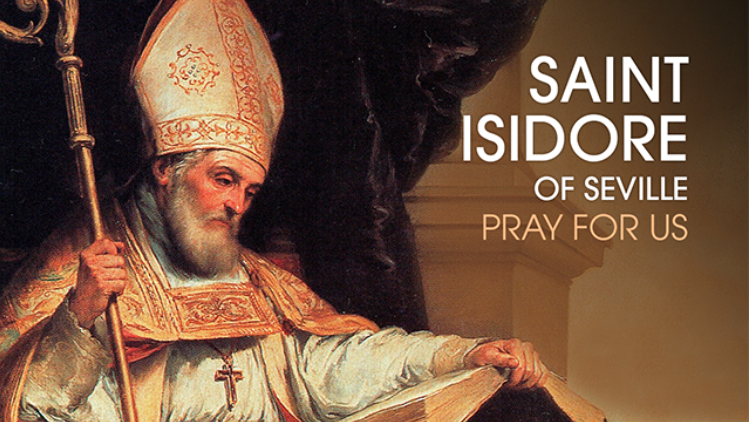
Saint of the Day – April 4th – Saint Isidore of Seville

Saint Isidore (C. 560 – APRIL 4, 636)

The 76 years of Isidore’s life were a time of conflict and growth for the Church in Spain. The Visigoths had invaded the land a century and a half earlier, and shortly before Isidore’s birth they set up their own capital. They were Arians—Christians who said Christ was not God. Thus, Spain was split in two: One people (Catholic Romans) struggled with another (Arian Goths).

Isidore reunited Spain, making it a center of culture and learning. The country served as a teacher and guide for other European countries whose culture was also threatened by barbarian invaders.

Born in Cartagena of a family that included three other sibling saints—Leander, Fulgentius and Florentina—he was educated by his elder brother, whom he succeeded as bishop of Seville.

An amazingly learned man, he was sometimes called “The Schoolmaster of the Middle Ages” because the encyclopedia he wrote was used as a textbook for nine centuries. He required seminaries to be built in every diocese, wrote a Rule for religious orders, and founded schools that taught every branch of learning. Isidore wrote numerous books, including a dictionary, an encyclopedia, a history of Goths, and a history of the world—beginning with creation! He completed the Mozarabic liturgy, which is still in use in Toledo, Spain. For all these reasons, Isidore has been suggested as patron of the Internet. Several others—including Anthony of Padua—also have been suggested.

He continued his austerities even as he approached age 80. During the last six months of his life, he increased his charities so much that his house was crowded from morning till night with the poor of the countryside.

Reflection

Our society can well use Isidore’s spirit of combining learning and holiness. Loving, understanding and knowledge can heal and bring a broken people back together. We are not barbarians like the invaders of Isidore’s Spain. But people who are swamped by riches and overwhelmed by scientific and technological advances can lose much of their understanding love for one another.

Saint Isidore of Seville is the Patron Saint of:

Internet
Computers

//Franciscan Media//


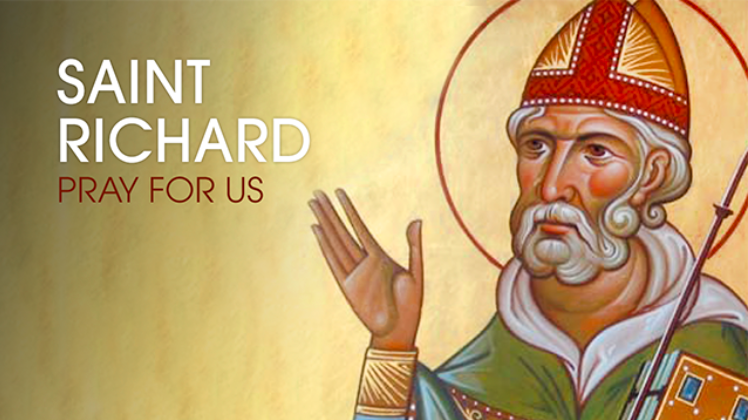
Saint of the Day – April 3rd – Saint Richard of Chichester

St. Richard of Chichester (1197-1253), also known as St. Richard de Wyche, was born in Worcestershire, England to a land-owning squire. His father died when he was young, causing the family to suffer hardship for many years. The situation became dire enough for Richard to suspend his studies to take over the family estates and make them profitable again. He went on to Oxford to study for the priesthood, and was so poor that he and two companions shared a set of clothes which they took turns wearing to class. He obtained degrees at the universities in Paris and Bologna before being appointed as the Chancellor of Oxford University.

Richard became well-known for his learning and sanctity. As a result he next became Chancellor for the Archbishop of Canterbury, St. Edmund Rich, to whom he was a faithful companion and advisor. Years later St. Richard was ordained the Bishop of Chichester. In this position he entered into power struggles with King Henry III, who withheld his diocesan revenues and blocked his access to the cathedral. St. Richard had many accomplishments as bishop, including establishing greater order and reverence to the liturgy, vigorously defending the rights of the Church, assisting the poor and the oppressed, and preaching a crusade against the Saracens at the request of the Pope.

Richard died of fever surrounded by his closest friends at about 56 years of age. He was buried in the Chichester Cathedral and his shrine became a popular place of pilgrimage before being destroyed by King Henry VIII. St. Richard’s feast day is April 3rd.

//The Catholic Company//


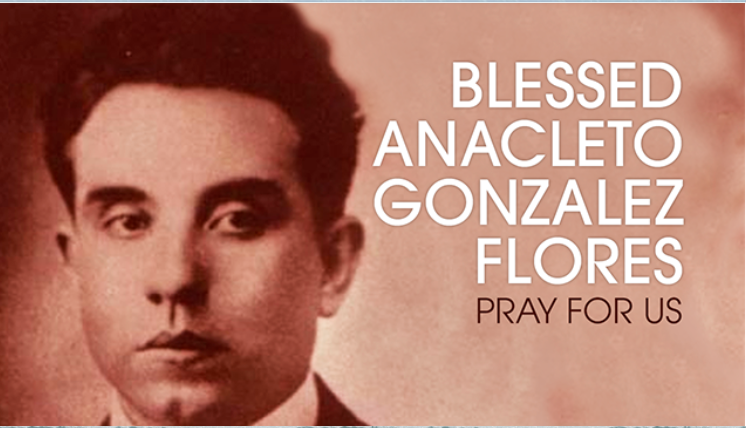
Saint of the Day – April 1 – Blessed Anacleto Gonzalez Flores

Bl. Anacleto Gonzalez Flores (1888–1927) was the second of twelve children born to a poor family in Jalisco, Mexico. He was baptized the day after his birth. As he grew, a priest recognized his intelligence and recommended that he enter the seminary. Anacleto studied there for a time before discerning that he was not called to the priesthood. Instead he became an attorney, husband, and father, as well as an activist for his Catholic faith. He was a prolific writer and dedicated catechism teacher, and attended daily Mass. He joined the Catholic Association of Young Mexicans (ACJM) in addition to starting another Catholic lay organization committed to resisting the fierce persecution of the Catholic Church under the infamous Mexican dictator, Calles. Initially he participated only in the non-violent resistance against Calles, until four members of the ACJM were murdered in 1926. Their deaths spurred Anacleto to lend support to the armed resistance movement. Anacleto did not take up arms but instead gave speeches to encourage Catholics to support the Cristeros, the Catholic army fighting against Calles.

Anacleto was captured during the Cristero War on April 1, 1927, and was brutally tortured before being martyred by firing squad. His feast day is April 1st.

//The Catholic Company//


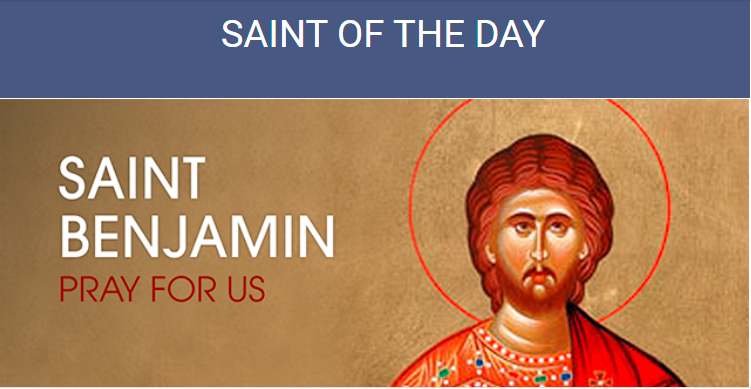
Saint of the Day – March 31 – Saint Benjamin

St. Benjamin (d. 424 A.D.) was a deacon martyred in Persia during a forty-year-long Christian persecution under two tyrannical Persian kings. He was imprisoned for a year due to his Christian faith and then released with the help of the Eastern Roman Emperor Theodosius II. As a condition of his release he was ordered to no longer publicly proclaim his faith. Benjamin declared that it was his duty to preach the Gospel of Jesus Christ and he refused to be silenced. He continued preaching Christ crucified, and, when word reached the king, he was arrested again. In response, Benjamin asked the king what opinion he would have of any of his subjects if they were to renounce their allegiance to the king and join in war against him; in the same way Benjamin could not renounce his allegiance to Christ. This comment enraged the king, and he ordered Benjamin to endure cruel tortures. Sharpened reeds were repeatedly jammed underneath his fingernails, toenails, and other tender parts of the body. He died when a knotted stake was jammed into his bowels. St. Benjamin’s feast day is celebrated on March 31st.

//The Catholic Company//


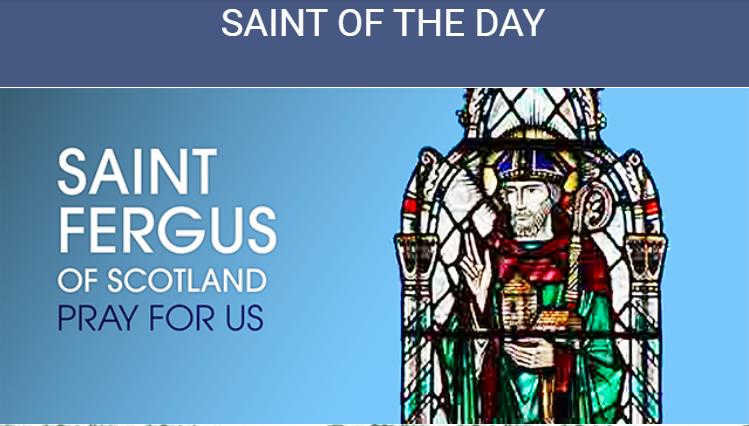
Saint of the Day – March 30 – Saint Fergus of Scotland

St. Fergus of Scotland (d. 730 A.D.), also known as St. Fergustian or Fergus the Pict, Bishop of the Gaels, was a bishop serving in the north of Scotland. Little is known of his life. He is believed to have been trained as a bishop in Ireland, ministering there for many years before traveling as a missionary to Scotland. He went throughout the Scottish countryside preaching the Gospel, setting up churches dedicated to St. Patrick of Ireland, and working to convert the pagan people to Christianity. He also traveled to St. Peter’s Basilica to participate in the Council of Rome in 721 A.D. He died around the year 730 A.D. and is buried in Glamis, Angus, in Scotland. Nearby is St. Fergus’ Well. The site is believed to be where St. Fergus presided over religious services before the first church of Glamis was built. His feast day is March 30th.

//The Catholic Company//


Saint of the Day – March 29 – Saint Berthold

St. Berthold of Mt. Carmel (d. 1195), also known as Bartoldus of Calabria, was born in France, the son of a Count. He excelled at his studies and was ordained a priest. Berthold’s brother, Aymeric, became the Latin patriarch of Antioch. The two joined together to participate in a Crusade to the Holy Land.

While in the Holy Land, Berthold traveled to Mount Carmel and built a monastery and church dedicated to the Prophet Elijah. He gathered together a number of hermits scattered throughout Palestine to live together in imitation of the life of the great prophet as recorded in the Old Testament. Berthold became the group’s superior and stayed with the community at Mount Carmel for 45 years until his death in 1195.

It was the life and work of St. Berthold that laid the foundation for the Carmelite Order, whose rule was approved by Pope Honorius III in 1226. St. Berthold’s feast day is March 29.

//The Catholic Company//