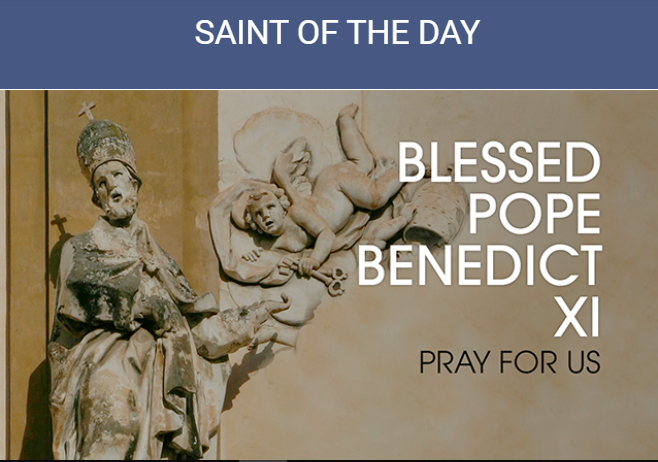
Bl. Pope Benedict XI (1240-1304) was born in Italy with the name Nicholas Boccasini. At the age of 14 he entered the Dominican Order, and went on to become a theology professor before being named Master General of the Order in 1296. As Master of the Dominicans, Boccasini defended Pope Boniface VIII when the hostility of secular rulers towards the Roman Pontiff grew, especially during the pope’s open conflict with the King of France. In reward for his loyalty, Boccasini was elevated to Cardinal and then Bishop of Ostia. When Hungary was torn with civil war, Boccasini was sent there by the Holy See to restore peace. When he returned to Rome, the Pope’s conflict with France reached its height; Boniface VIII was seized, beaten, and driven from the Sacred Palace by his enemies, while Boccasini was one of only two cardinals who defended the Holy Father to the end. After Boniface VIII died, Boccasini was elected in his place and took the name Pope Benedict XI. He excommunicated all those who had taken part in the seizure and abuse of his predecessor, while at the same time restoring peace with the French court. In this time of tumult he repaired the damage with leniency, yet without compromising the Holy See or the good memory of the previous pope. His reign was brief; he died suddenly of a suspected poisoning after only eight months in office. Bl. Pope Benedict XI was the author of a volume of sermons and commentaries on the Gospel of Matthew, Psalms, Job, and Revelation. His feast day is July 7th.
What is the greatest gift our Lord has given us? The gift of Himself. He offers us the perfect gift of love. Why? Because He loves us and wants to draw us closer to Him. He really wants to give us that gift, sometimes more than we really want it. But, since you are all here, I imagine you all want His gift. Unfortunately, we have people in our lives who don’t seem to want it. They go off the reservation. They turn their backs on everything their parents did for them and sacrificed for them. It breaks your heart. But, you pray and sacrifice for them anyway, don’t you?
We are supposed to pray constantly. Saint Peter said that the devil is always prowling about seeking the ruin of souls. What do we pray for? A lot of times when we pray, we pray too small. We pray for those who do not like us. We do not pray that they will have a heart attack or suffer any other kind of injury. Instead, you pray that their souls may be converted or that you may have the strength to not choke the living you-know-what out of them when they are around. We pray for a lot of good things. The ultimate good thing is eternal salvation. This is the eternal good we should pray for…both for ourselves and others.
What’s the definition of insanity? Doing the same things over and over and expecting different results. We are human and not angels, so it is frustrating when we don’t see the results of our prayers right away. We like things immediately. Even the coffee maker isn’t fast enough for us. Remember the televisions that we had to wait on to warm up? Can you imagine that now? When we do not see the results of our prayers right away, we think they are not working. We give God a hard time, because we want what we pray for today. However, God’s ways are not our ways. He tells us to never be discouraged by prayer. Maybe God said “No.” If so, it is probably good that He did, because instead of giving us what we ask for, He gives us a greater good.
Always say a prayer for yourself and your own salvation and another prayer for the salvation of others, especially your family. It may take years and years to see any results from your prayers, and you may get more grey hair and worry lines. You may get fed up and write them off, and that may be necessary if they have other problems. But still pray for their salvation. God never gives up. You never know what He has in store, so do not get discouraged when praying for family and friends. One of the side effects of prayer is that it changes us. We develop a deeper trust and resignation to the will of God. In today’s Gospel, people said “the child is dead” so do not bother. They gave up. But, Jesus said, “If I gave you these small things which are not the best, why would I not give you the big things if you ask for it?”
You never know what God will do, and I’ll give you several examples. One is Saint Monica and her son, Saint Augustine. Saint Monica never gave up on Saint Augustine, and he did a lot of crazy things. He couldn’t write about it very well, and his confessions were boring as heck. He’d put you right to sleep. Still, he did a lot. Then, you have my own family. My oldest brother and evil twin brother moved away from the faith, but they both received last rites and entrance into Heaven. Who knew? Through prayer…my mother’s prayers, my father’s prayers, and my prayers, I was able to do their funeral Mass. Another example is one that I remember quite clearly. I was at Presbyterian Hospital in the Oncology Unit, and I had three patients on my list to see…two on the left and one on the right. I thought, I’ll go see the patient on the right first. So, I went into the room and introduced myself as the Catholic chaplain for the hospital. The patient’s husband said, “Father, my wife is dying. Will you give her the Last Rites?” So, I gave her the Last Rites. I anointed her and right where the ritual states “at or near the moment of death,” the woman took her last breath and died. I looked at the nurse who shrugged her shoulders. So, I said, “Go forth, Christian soul, from this world in the name of God, the almighty Father, who created you.” When I came out of the elevator that day, something had told me to take a right turn instead of a left. I had not seen these people before that day or after. Another time when I was at Atrium, I was walking up the stairs, more steps for my heart, and a nurse asked me if I was a priest. I said “Yeah.” Go figure, huh? Actually, I’m the pastor at a Baptist church, and I’m just trying to confuse everybody. Anyway, the nurse said she was going to call me about a patient in ICU who was dying of cancer. I never saw the patient before and I never saw her after. Saint John Vianney, the Cure of Ars, had the gift of reading souls. One day while he was taking a walk, he saw a woman who approached him. She said, “Curate, you have the gift of seeing souls.” Sometimes. “Remember my husband? He is dead.” Saint John said, ”Yes. I’ll offer him a prayer.” The woman said, “He fell off a bridge and drowned. He was an evil man. He’s in hell isn’t he?” Saint John said, “I don’t know.” The woman was irate and said, “You don’t know? What do you mean you don’t know! He hit me, he spent money, and he drank!” Finally, after she had finished unloading all her vile on him, Saint John said, “There was a lot of time from when he left the bridge and until he hit the water.”
Imperfect contrition is the fear of God’s punishment and is sufficient to get you into purgatory and eventually into Heaven. Even saying “I’m sorry” is enough. So, we do not know what will happen. We will find that out only if we get to heaven. Remember, we have control over that. Everyone in hell is a self-made man or woman. I’m not sexist. So, keep up your prayers for all of those who need His love. That’s the way to love.
Now, I am not much. I’m not that bright, but I can read a calendar, so I know my sell-by date is rapidly approaching. I pray for a happy death and that God will allow me in heaven with all my sins and faults. I pray that I will see the rest of my family. So, never, ever, ever stop praying. We never know how it will end. Remember, God wants your family, friends, and enemies in Heaven more than even you do.
How will you apply this message to your life? No matter what, keep praying for yourself and your salvation and the salvation of your family, friends, and enemies.
You can read all of Father Fitzgibbons’ sermons by going to https://annunciationcatholicalbemarle.com/ and clicking on “Blog” then “Categories” and then “Sermon Notes.” From a cell phone, click on “Blog” then “Menu” and then “Categories” (located at the end of page). There is also a search box if you are looking for a specific topic.
One of the largest crowds ever assembled for a canonization—250,000—symbolized the reaction of millions touched by the simple story of Maria Goretti. She was the daughter of a poor Italian tenant farmer, had no chance to go to school, never learned to read or write. When Maria made her First Communion not long before her death, she was one of the larger and somewhat backward members of the class.
On a hot afternoon in July, Maria was sitting at the top of the stairs of her house, mending a shirt. She was not quite 12 years old, but physically mature. A cart stopped outside, and a neighbor, 18-year-old Alessandro, ran up the stairs. He seized her and pulled her into a bedroom. She struggled and tried to call for help. “No, God does not wish it,” she cried out. “It is a sin. You would go to hell for it.” Alessandro began striking at her blindly with a long dagger.
Maria was taken to a hospital. Her last hours were marked by the usual simple compassion of the good—concern about where her mother would sleep, forgiveness of her murderer (she had been in fear of him, but did not say anything lest she cause trouble to his family), and her devout welcoming of Viaticum, her last Holy Communion. She died about 24 hours after the attack.
Alessandro was sentenced to 30 years in prison. For a long time he was unrepentant and surly. One night he had a dream or vision of Maria gathering flowers and offering them to him. His life changed. When he was released after 27 years, his first act was to beg the forgiveness of Maria’s mother.
Devotion to the young martyr grew, miracles were worked, and in less than half a century she was canonized. At her beatification in 1947, her 82-year-old mother, two sisters, and her brother appeared with Pope Pius XII on the balcony of St. Peter’s. Three years later, at Maria’s canonization, a 66-year-old Alessandro Serenelli knelt among the quarter-million people and cried tears of joy.
Reflection
Maria may have had trouble with catechism, but she had no trouble with faith. God’s will was holiness, decency, respect for one’s body, absolute obedience, total trust. In a complex world, her faith was simple: It is a privilege to be loved by God, and to love him—at any cost.
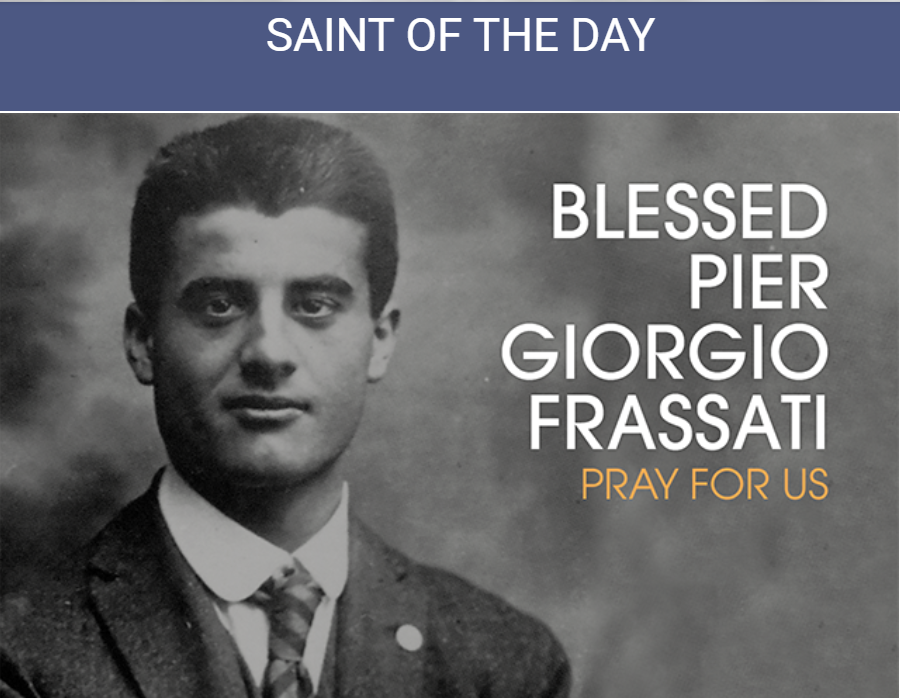
Blessed Pier Giorgio Frassati (1901-1925) was born in Turin, Italy, to a wealthy and prominent family. He was a vibrant, joyful, and athletic youth with an adventurous spirit and a strong zest for life. He loved mountain climbing, the theater, opera, and literature. He also had a deep spiritual life and a strong devotion to the Holy Eucharist and the Virgin Mary, even while his piety provoked criticism from his parents. He challenged his friends to a life of virtue, leading them in spiritual exercises such as daily Mass and the rosary. He joined the St. Vincent de Paul Society in 1918 and became a Lay Dominican in 1922. He was also politically active in resisting fascism and communism; he took part in public demonstrations and joined religious-political organizations such as the Catholic Students Federation and Catholic Action. He also spent much time caring for the sick and poor to a heroic degree, yet his parents punished him when they caught him giving away his money and possessions. While ministering to the sick he contracted polio and died just six days later at the age of 24. His family, thinking he suffered from a mild sickness, did not realize the seriousness of his condition until it was too late. At his funeral his parents were shocked to find thousands of the city’s poor, whom their son had helped in some way, arrive to pay their respects. Pope St. John Paul II called Pier Giorgio Frassati a “man of the beatitudes” at his beatification in 1990. His feast day is July 4th.
St. Paul tells us, “Do everything without grumbling,” but even the best-intentioned Christians can fall into a toxic habit of constant complaining. It’s true that sometimes, sharing a complaint can help rectify an unjust situation or call attention to something that needs to change. But when you start fixating on the negative things around you and voicing your critiques or grievances about everything in your life, you imprison yourself in your own personal hell.
Today, Fr. Mike encourages us to ask for God’s grace to break free from the habit of complaining.
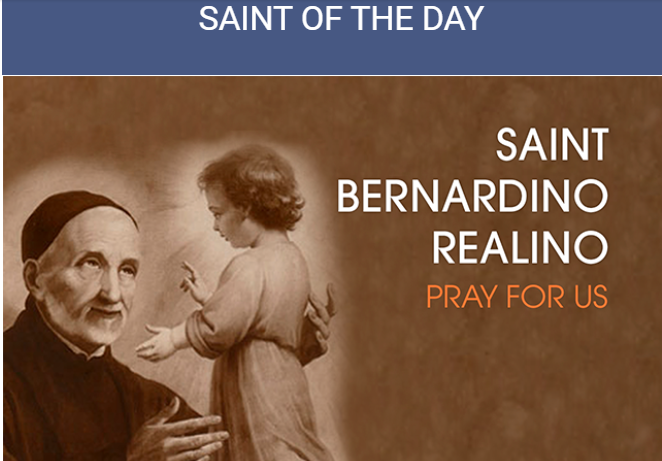
St. Bernardino Realino (1530–1616) was born in Italy to a noble family. He grew into an accomplished “Renaissance Man” of his day; he studied law and medicine, had a successful career as an attorney and judge, and served as the mayor of three cities. At the age of 34 he completed an eight-day retreat with Jesuit priests, and during this time he discerned a call to the religious life. He entered the Jesuit order and was ordained a priest in 1567. As a priest he preached, taught, and visited the sick and poor in the areas of Naples and Lecce. He was much loved and venerated by the people he ministered to, especially because of the miracles he performed. It was commonly believed among the people that he was a living saint. Even public scandal and civil strife were calmed due to his holy influence. While he was on his death bed, the city leaders of Lecce came to request of him that he become the official patron saint of their city once he entered heaven. After St. Bernardino’s death, vials of his blood were kept for veneration, which were observed to liquefy and exhibit unusual phenomena for more than a century. St. Bernardino Realino’s feast day is July 2nd.
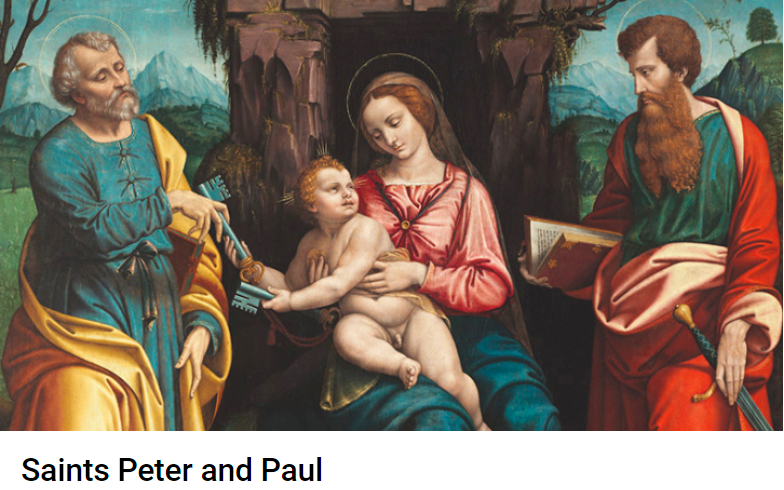
Image:The Virgin and Child with Saints Peter and Paul | Girolamo Figino
Saints Peter and Paul’s Story
Peter (d. 64?) Saint Mark ends the first half of his Gospel with a triumphant climax. He has recorded doubt, misunderstanding, and the opposition of many to Jesus. Now Peter makes his great confession of faith: “You are the Messiah” (Mark 8:29b). It was one of the many glorious moments in Peter’s life, beginning with the day he was called from his nets along the Sea of Galilee to become a fisher of men for Jesus.
The New Testament clearly shows Peter as the leader of the apostles, chosen by Jesus to have a special relationship with him. With James and John he was privileged to witness the Transfiguration, the raising of a dead child to life, and the agony in Gethsemane. His mother-in-law was cured by Jesus. He was sent with John to prepare for the last Passover before Jesus’ death. His name is first on every list of apostles.
And to Peter only did Jesus say, “Blessed are you, Simon son of Jonah. For flesh and blood has not revealed this to you, but my heavenly Father. And so I say to you, you are Peter, and upon this rock I will build my church, and the gates of the netherworld shall not prevail against it. I will give you the keys to the kingdom of heaven. Whatever you bind on earth shall be bound in heaven; and whatever you loose on earth shall be loosed in heaven” (Matthew 16:17b-19).
But the Gospels prove their own trustworthiness by the unflattering details they include about Peter. He clearly had no public relations person. It is a great comfort for ordinary mortals to know that Peter also has his human weakness, even in the presence of Jesus.
He generously gave up all things, yet he can ask in childish self-regard, “What are we going to get for all this?” (see Matthew 19:27). He receives the full force of Christ’s anger when he objects to the idea of a suffering Messiah: “Get behind me, Satan! You are an obstacle to me. You are thinking not as God does, but as human beings do” (Matthew 16:23b).
Peter is willing to accept Jesus’ doctrine of forgiveness, but suggests a limit of seven times. He walks on the water in faith, but sinks in doubt. He refuses to let Jesus wash his feet, then wants his whole body cleansed. He swears at the Last Supper that he will never deny Jesus, and then swears to a servant maid that he has never known the man. He loyally resists the first attempt to arrest Jesus by cutting off Malchus’ ear, but in the end he runs away with the others. In the depth of his sorrow, Jesus looks on him and forgives him, and he goes out and sheds bitter tears. The Risen Jesus told Peter to feed his lambs and his sheep (John 21:15-17).
Paul (d. 64?) If the most well-known preacher today suddenly began preaching that the United States should adopt Marxism and not rely on the Constitution, the angry reaction would help us understand Paul’s life when he started preaching that Christ alone can save us. He had been the most pharisaic of Pharisees, the most legalistic of Mosaic lawyers. Now he suddenly appears to other Jews as a heretical welcomer of Gentiles, a traitor and apostate.
Paul’s central conviction was simple and absolute: Only God can save humanity. No human effort—even the most scrupulous observance of law—can create a human good which we can bring to God as reparation for sin and payment for grace. To be saved from itself, from sin, from the devil, and from death, humanity must open itself completely to the saving power of Jesus.
Paul never lost his love for his Jewish family, though he carried on a lifelong debate with them about the uselessness of the Law without Christ. He reminded the Gentiles that they were grafted on the parent stock of the Jews, who were still God’s chosen people, the children of the promise.
Reflection
We would probably go to confession to Peter sooner than to any of the other apostles. He is perhaps a more striking example of the simple fact of holiness. Jesus says to us as he said, in effect, to Peter: “It is not you who have chosen me, but I who have chosen you. Peter, it is not human wisdom that makes it possible for you to believe, but my Father’s revelation. I, not you, build my Church.” Paul’s experience of the risen Jesus on the road to Damascus was the driving force that made him one of the most zealous, dynamic, and courageous ambassadors of Christ the Church has ever had. But persecution, humiliation, and weakness became his day-by-day carrying of the cross, material for further transformation. The dying Christ was in him; the living Christ was his life.
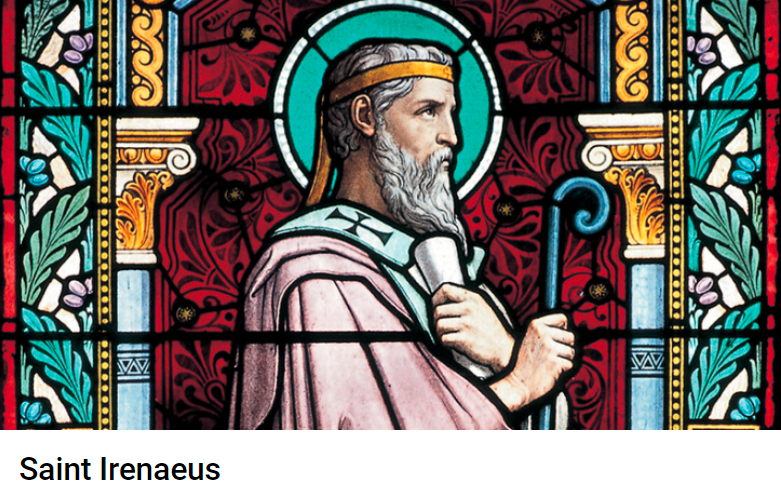
The Church is fortunate that Irenaeus was involved in many of its controversies in the second century. He was a student, well trained no doubt, with great patience in investigating, tremendously protective of apostolic teaching, but prompted more by a desire to win over his opponents than to prove them in error.
As bishop of Lyons he was especially concerned with the Gnostics, who took their name from the Greek word for “knowledge.” Claiming access to secret knowledge imparted by Jesus to only a few disciples, their teaching was attracting and confusing many Christians. After thoroughly investigating the various Gnostic sects and their “secret,” Irenaeus showed to what logical conclusions their tenets led. These he contrasted with the teaching of the apostles and the text of Holy Scripture, giving us, in five books, a system of theology of great importance to subsequent times. Moreover, his work, widely used and translated into Latin and Armenian, gradually ended the influence of the Gnostics.
The circumstances and details about his death, like those of his birth and early life in Asia Minor, are not at all clear.
Reflection
A deep and genuine concern for other people will remind us that the discovery of truth is not to be a victory for some and a defeat for others. Unless all can claim a share in that victory, truth itself will continue to be rejected by the losers, because it will be regarded as inseparable from the yoke of defeat. And so, confrontation, controversy and the like might yield to a genuine united search for God’s truth and how it can best be served.
On this channel, we speak a lot about the teachings of the Church and how our society longs for these truths. But have you ever stopped and asked yourself what truth really is? There can be a lot of long, philosophical, complicated answers to this question, but today we have a simple one: truth can simply be defined as “what is.” In other words, a statement is either true or false depending on how closely it describes reality, or what is. But if truth is centered around reality, are there different truths for different people?