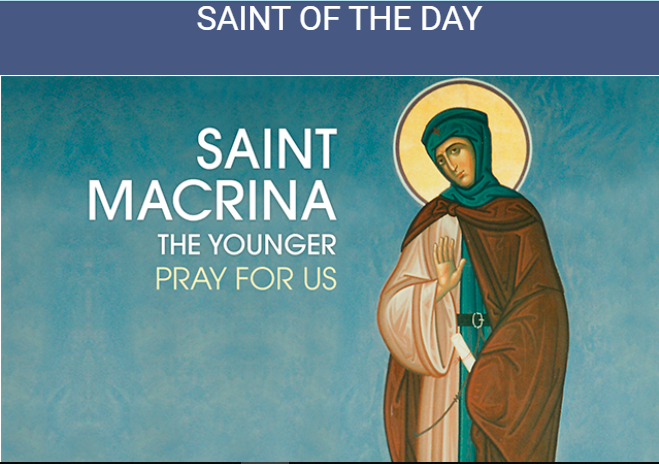
St. Macrina the Younger (d. 380 A.D.) was born in Cappadocia to a family of saints. Her mother was St. Emelia, and her father was St. Basil the Elder. Her grandmother was St. Macrina the Elder, after whom she was named. Her holy parents had ten children. Macrina was one of the oldest, and received an excellent religious education from her holy mother. Her parents betrothed her to a pious youth, but he died before the marriage took place. Macrina then consecrated her virginity to God and lived a life of great asceticism. She remained living with her parents, helping to raise her younger siblings, directing the household servants, and supporting the family with her domestic skills. Among her siblings were St. Basil the Great and St. Gregory of Nyssa (who both became Cappadocian Fathers and Doctors of the Church) St. Peter of Sebaste, and St. Theosevia. When their father died, Macrina became the main support for the family. It was Macrina who profoundly influenced the spiritual discipline of her younger brothers. When all her siblings were grown, Macrina convinced her mother to give up their family belongings, set their servants free, and convert their home into a monastery. Many of their servants joined them in this spiritual pursuit; they all lived together as a family, sharing all things in common. When her mother died, Macrina led the religious community. The biography of St. Macrina’s life was written by her brother, St. Gregory. Her feast day is July 19th.
St. Alexius (d. 417 A.D.) was a native of Rome, the son of a distinguished Roman senator. His parents arranged a marriage for him, but he had a divine calling to a higher vocation. On the night of his wedding, with permission from his fiance, he secretly fled to Edessa in Syria to live in poverty and obscurity as a holy ascetic. He disguised himself as a beggar, unrecognized by all, even accepting alms from his own servants who were sent to look for him. St. Alexius lived in this way for seventeen years. A vision of the Blessed Virgin Mary in the church near his dwelling identified him as a “Man of God.” When the fame of his sanctity spread in Edessa, he moved back to Rome so that he could continue his hidden life. He lived as a beggar under the very stairs of his father’s palace, his true identity completely unknown to anyone. He lived in this way for another seventeen years. He was befriended by other Christians, shared his alms with the poor, and taught catechism to children. It was only after his death that his identity was revealed through a document that he secretly carried on his person. He was then venerated as a saint, and his father’s palace was converted into a church in his honor. St. Alexius’ feast day is July 17.
I came here 18 years ago. God bless you for doing that penance on Earth. You are gaining in purgatory here on Earth. I remember an article in the local paper about a gentleman from Misenheimer. Unfortunately, he received a cancer diagnosis. This was in the paper, so it’s public knowledge. This man decided not to go with conventional treatment, but with alternative medicine like living in a yurt in Misenheimer. And, as they say in medicine, he did not have an optimal outcome and died shortly thereafter. I don’t know what he was clinging to, but he had some hope and the knowledge that he wouldn’t have to go through the rigors of chemo, radiation, and surgery. If the diagnosis was dire, maybe this was one thing that unconventional medicine could do for him. At one time, shark cartilage was all the rage for people with cancer. It didn’t help the patient or the shark one bit. But, it gave cancer patients a glimmer of hope…there was something there, and they grasped at it. When we are afraid and hurt so much, we want something to heal us.
There is so much evil, anger, and strife in the world. We blame our co-dependent behavior on mental illness. But, we don’t have to be like that. None of us have to be like we were. . .wicked. A lot of Protestant sects are dying out. They try to make each other more relevant by legitimizing mental illness which is a diagnosis for gender dysphoria. They are co-signing these behaviors. Our good Lord told us that “I am the way, the truth, and the life.” Follow Him, and you will find peace in your soul. Our Lord offers hope. This hope is not theoretical or intuitive, but a certainty. The hope He offers us is a promise. We have a program that our Lord has given us, and we know exactly what we must do. If we do what He asks us to do, these things will happen.
God’s promise has been demonstrated over history. For example, if you take your medicine, you will see positive results. If I take a tiny, little pill in the morning, my blood pressure is fine all day. This is a demonstrable result. If I don’t take that pill for a long time, bad things will happen to me. Our Lord gives us hope to enable us to carry our crosses day-by-day. Some crosses are predominate and have always been with us, while others change over time with old age and infirmities. Whatever crosses we bear, whether it is gender dysphoria or addiction, the good Lord gives us the grace to triumph over them. This is not a wish, and it’s not a hope as the world sees hope. It is a certainty that if you do what Christ says, you will get what He promises.
Your crosses are many, and I know they are heavy. Our faith gives us not only a hope, but a way of making that hope a reality, bringing peace to our soul, making sense of the sufferings we endure, and giving us the strength to bear whatever cross our good Lord has asked us to bear for love of Him, for our salvation, and the salvation of others. This is the faith. This is the Church and the deposit of faith that gives us hope. There is no other way. If you look at history, everyone who has tried something different has failed. In the words of G.K. Chesterton, “It’s not that Christianity has been tried and found wanting, but that it has been found difficult and left untried.”
You have hope, and you are demonstrating that hope by your presence here today. You come for God’s grace through the Most Holy Sacrifice of the Mass so that you can carry your daily crosses and be good followers of Christ. When you demonstrate your hope, you are teaching others, because they see it in you. It’s a day-to-day thing. Give that hope to someone else.
As a young man, I read the biographies of the saints and how their lives were transformed. I don’t read fiction. . .I’m a little old for fairytales. I like to read about what people did so that I can learn from them. Saint Ignatius of Loyola, founded the Jesuit Order. Now, I was trained by the Dominicans, so this is a stretch for me to say this. What did he do? Saint Ignatius was a professional soldier…a hit man. He was a hired gun. Give him a lot of money and, although he wasn’t Italian, he would put the whack on people especially because of their religion. And, look at what happened to him. He had a great conversion. The head of the gestapo in Rome, Italy, was Herbert Kappler. He put the whack on people. . . a lot. After the war, a priest visited him, and he became Catholic. Dr. Bernard Nathanson performed over 10,000 abortions. He also converted to Catholicism after a priest visited him.
My correspondence is different from most. I received a letter in the mail the other day from the local, state-run, residential community known as the Albemarle Correction Facility, a medium security prison that I visit. This one man, who didn’t know me, reached out to me. The envelope was addressed to “Priest Peter Fitzgibbons.” Close enough…at least he’s getting there. He told me that he had grown up Catholic, but had fallen off the wagon a bit. . .or a lot. He’s a “state employee” now and eats state-issued fish. Ugh! If you’re out in the parking lot when they are cooking fish, and the wind is just right, you know it. I’m a hospital chaplain, so smells don’t usually bother me, but that one does. Anyhow, this inmate wants to come back to the Church. He’s had enough. There are a couple of other inmates that I’ve brought in to the Faith. They also were at a point where they’d had enough and reached out to me in hope. You know who touched them in prison? It wasn’t me…I’m only there once a month. Other inmates who’d had enough and came back to Jesus. They saw hope realized in other people.
Our testimony to the world is the faith that we have been given, the faith that we have been called to hand down, and the faith that we teach by example. We are living testimonies of the power of Christ by carrying our cross every day. We may fall down, but we have the strength to get back up and carry on. This is the hope and reality we can pass on by our actions. It is how we teach and how we give hope to others. We can give other people hope with their struggles just as you found hope with the crosses you carry. But, we can’t if we are angry and bitter. What’s wrong with you? Jesus was a man of peace. Our good Lord loves them and wants to transform them. You are not your sins. You are not your crosses. You are children of God. God has given us the truth, the means, and the infallible teaching of how to achieve the daily transformation we need in order to get to heaven. Sometimes, these transformations are amazingly quick, and at other times they are sustaining. “Well, Father you have been a priest for a long time.” Yes. “I see you haven’t changed much.” But, can you imagine what I’d be like without my prayers every day, my confessions, and daily Mass? Can you imagine what I’d be like? I’d rather not…You cannot unsee some things. Our transformation is always happening in us and won’t be complete until we die.
How will you apply this message to your life? Renew your hope in Him so that you can teach others by your example.
You can read all of Father Fitzgibbons’ sermons by going to https://annunciationcatholicalbemarle.com/ and clicking on “Blog” then “Categories” and then “Sermon Notes.” From a cell phone, click on “Blog” then “Menu” and then “Categories” (located at the end of page). There is also a search box if you are looking for a specific topic.
St. Marie Magdalen Postel (1756–1846) was born in a fishing village in Normandy, one of seven children of a middle class family. As a child she became famous for her generosity; she would often give her food and belongings to the needy, acts for which she was often rebuked. She was educated by Benedictine nuns and decided to devote her life to the service of God. She took a private vow of chastity, and at the age of 18 opened her own school for girls. This began her life mission dedicated to the education of children. The school ran for five years until the French Revolution shut it down. During that time of great turmoil she used the school to house fugitive priests. She also encouraged the faithful amidst the terrible persecution, and was granted special permission to keep in her possession the Blessed Sacrament to give to those who were in immediate danger of death. She continued her work in education after the unrest subsided, founding a religious community called ‘The Poor Daughters of Mercy’ living under the rule of the Third Order of St. Francis. The community was later renamed ‘Sisters of the Christian Schools of Mercy’ taking the rule of St. John Baptist de la Salle, founder of the Christian Brothers, a religious order dedicated to the education of children. St. Marie Magdalen’s school for girls was so effective that it was declared the best-run organization of its kind. St. Marie Magdalen Postel died at the age of 90 after seeing her community grow and spread. Her feast day is July 16th.
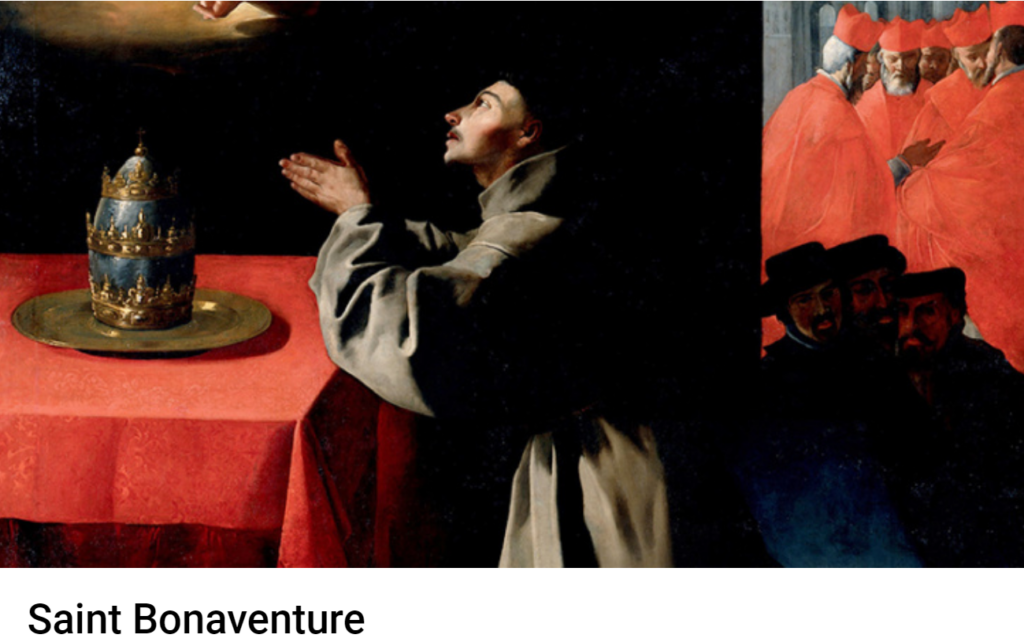
Perhaps not a household name for most people, Saint Bonaventure, nevertheless, played an important role in both the medieval Church and the history of the Franciscan Order. A senior faculty member at the University of Paris, Saint Bonaventure certainly captured the hearts of his students through his academic skills and insights. But more importantly, he captured their hearts through his Franciscan love for Jesus and the Church. Like his model, Saint Francis, Jesus was the center of everything—his teaching, his administration, his writing, and his life. So much so, that he was given the title “Seraphic Doctor.”
Born in Bagnorea in 1221, Saint Bonaventure was baptized John, but received the name Bonaventure when he became a Franciscan at the age of 22. Little is known about his childhood, but we do know that his parents were Giovanni di Fidanza and Maria Ritell. It seems that his father was a physician and a man of means. While Saint Francis died about five years after the saint’s birth, he is credited with healing Bonaventure as a boy of a serious illness.
Saint Bonaventure’s teaching career came to a halt when the Friars elected him to serve as their General Minister. His 17 years of service were not easy as the Order was embroiled in conflicts over the interpretation of poverty. Some friars even ended up in heresy saying that Saint Francis and his community were inaugurating the era of the Holy Spirit which was to replace Jesus, the Church, and Scripture. But because he was a man of prayer and a good administrator, Saint Bonaventure managed to structure the Order through effective legislation. But more importantly, he offered the Friars an organized spirituality based on the vision and insights of Saint Francis. Always a Franciscan at heart and a mystical writer, Bonaventure managed to unite the pastoral, practical aspects of life with the doctrines of the Church. Thus, there is a noticeable warmth to his teachings and writings that make him very appealing.
Shortly before he ended his service as General Minister, Pope Gregory X created him a Cardinal and appointed him bishop of Albano. But a little over a year later, while participating in the Second Council of Lyon, Saint Bonaventure suddenly died on July 15, 1274. There is a theory that he was poisoned.
Saint Bonaventure left behind a structured and renewed Franciscan Order and a body of work all of which glorifies his major love—Jesus.
Reflection
Bonaventure so united holiness and theological knowledge that he rose to the heights of mysticism while remaining a very active preacher and teacher, one beloved by all who met him. To know him was to love him; to read him is still for us today to meet a true Franciscan and a gentleman.
The blood of martyrs is the seed of saints. Nine years after the Jesuits Isaac Jogues and Jean de Lelande were tomahawked by Iroquois warriors, a baby girl was born near the place of their martyrdom, Auriesville, New York.
Her mother was a Christian Algonquin, taken captive by the Iroquois and given as wife to the chief of the Mohawk clan, the boldest and fiercest of the Five Nations. When she was four, Tekakwitha lost her parents and little brother in a smallpox epidemic that left her disfigured and half blind. She was adopted by an uncle, who succeeded her father as chief. He hated the coming of the Blackrobes—Jesuit missionaries—but could do nothing to them because a peace treaty with the French required their presence in villages with Christian captives. She was moved by the words of three Blackrobes who lodged with her uncle, but fear of him kept her from seeking instruction. Tekakwitha refused to marry a Mohawk brave, and at 19 finally got the courage to take the step of converting. She was baptized with the name Kateri–Catherine–on Easter Sunday.
Now she would be treated as a slave. Because she would not work on Sunday, Kateri received no food that day. Her life in grace grew rapidly. She told a missionary that she often meditated on the great dignity of being baptized. She was powerfully moved by God’s love for human beings and saw the dignity of each of her people.
She was always in danger, for her conversion and holy life created great opposition. On the advice of a priest, Kateri stole away one night and began a 200-mile walking journey to a Christian Indian village at Sault St. Louis, near Montreal.
For three years she grew in holiness under the direction of a priest and an older Iroquois woman, giving herself totally to God in long hours of prayer, in charity, and in strenuous penance. At 23, Kateri took a vow of virginity, an unprecedented act for an Indian woman whose future depended on being married. She found a place in the woods where she could pray an hour a day—and was accused of meeting a man there!
Her dedication to virginity was instinctive: Kateri did not know about religious life for women until she visited Montreal. Inspired by this, she and two friends wanted to start a community, but the local priest dissuaded her. She humbly accepted an “ordinary” life. She practiced extremely severe fasting as penance for the conversion of her nation. Kateri Tekakwitha died the afternoon before Holy Thursday. Witnesses said that her emaciated face changed color and became like that of a healthy child. The lines of suffering, even the pockmarks, disappeared and the touch of a smile came upon her lips. She was beatified in 1980 and canonized in 2012.
Reflection
We like to think that our proposed holiness is thwarted by our situation. If only we could have more solitude, less opposition, better health. Kateri Tekakwitha repeats the example of the saints: Holiness thrives on the cross, anywhere. Yet she did have what Christians—all people—need: the support of a community. She had a good mother, helpful priests, Christian friends. These were present in what we call primitive conditions, and blossomed in the age-old Christian triad of prayer, fasting and almsgiving: union with God in Jesus and the Spirit, self-discipline and often suffering, and charity for her brothers and sisters.
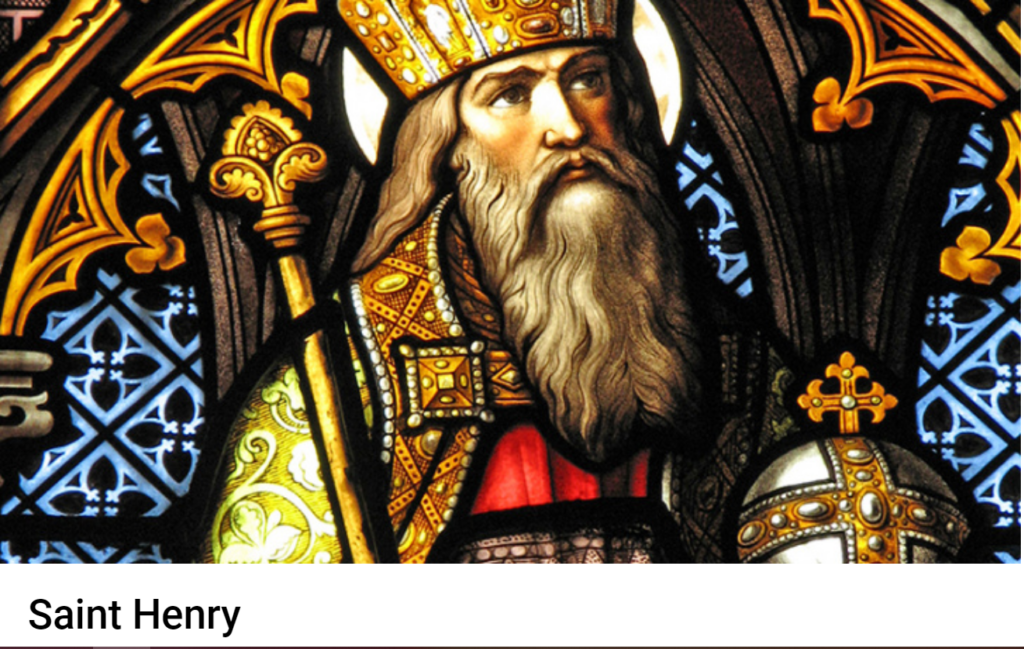
As German king and Holy Roman Emperor, Henry was a practical man of affairs. He was energetic in consolidating his rule. He crushed rebellions and feuds. On all sides he had to deal with drawn-out disputes so as to protect his frontiers. This involved him in a number of battles, especially in the south in Italy; he also helped Pope Benedict VIII quell disturbances in Rome. Always his ultimate purpose was to establish a stable peace in Europe.
According to eleventh-century custom, Henry took advantage of his position and appointed as bishops men loyal to him. In his case, however, he avoided the pitfalls of this practice and actually fostered the reform of ecclesiastical and monastic life. He was canonized in 1146.
Reflection
All in all, this saint was a man of his times. From our standpoint, he may have been too quick to do battle and too ready to use power to accomplish reforms. But granted such limitations, he shows that holiness is possible in a busy secular life. It is in doing our job that we become saints.
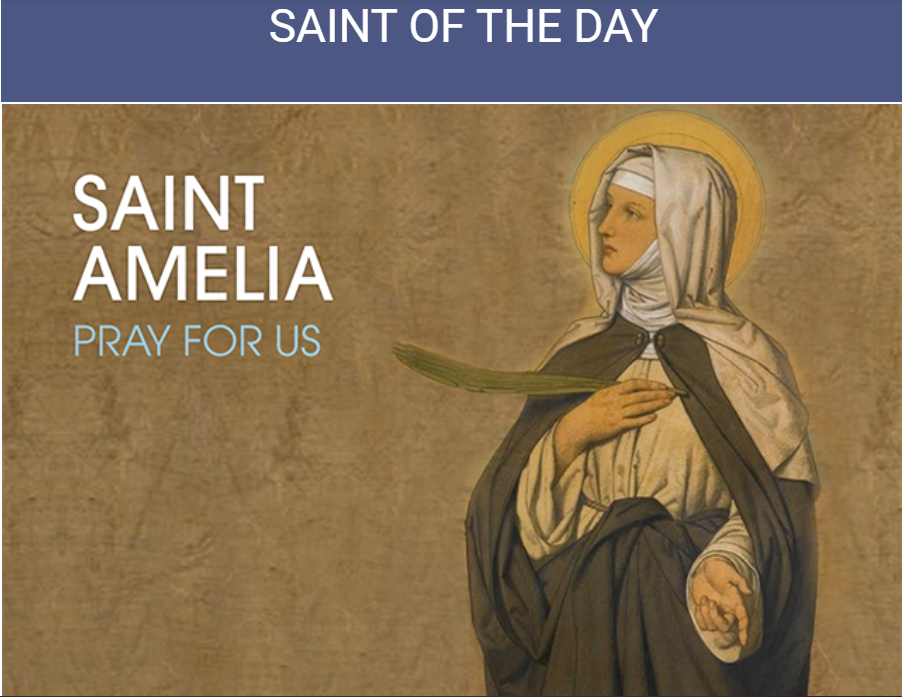
St. Amelia (741-772 A.D.) was born into a noble and pious Christian family in the land of the Ardennes, bordering what is today Belgium and Luxembourg. She was a devout child of strong character who committed her virginity to Christ from a young age. However, because she was such a beautiful and virtuous woman, she was pursued for several years by the young Charlemagne. In one account, Charlemagne broke her arm in a physical struggle to hold her hand, and afterwards her arm was miraculously healed. His romantic interest was rebuffed, and Amelia was eventually able to realize her desire to enter the convent. She spent the rest of her life in the Benedictine abbey of Münster-Bilzen in Belgium, and helped to build a church dedicated to the Virgin Mary in the Belgian town of Temsche. St. Amelia is said to have performed many miracles, the most famous being the one in which she crossed the Schelde River miraculously while standing on the back of a giant sturgeon fish. St. Amelia is the patroness of farmers, fishermen, and those suffering from arm and shoulder pain. Her feast day is celebrated on July 10th.
Saint Augustine Zhao Rong’s and Companions’ Stories
Christianity arrived in China by way of Syria in the 600s. Depending on China’s relations with the outside world, Christianity over the centuries was free to grow or was forced to operate secretly.
The 120 martyrs in this group died between 1648 and 1930. Eighty-seven of them were born in China, and were children, parents, catechists, or laborers, ranging in age from nine years to 72. This group includes four Chinese diocesan priests. The 33 foreign-born martyrs were mostly priests or women religious, especially from the Order of Preachers, the Paris Foreign Mission Society, the Friars Minor, Society of Jesus, Society of St. Francis de Sales (Salesians), and Franciscan Missionaries of Mary.
Augustine Zhao Rong was a Chinese soldier who accompanied Bishop John Gabriel Taurin Dufresse of the Paris Foreign Mission Society to his martyrdom in Beijing. Not long after his baptism, Augustine was ordained as a diocesan priest. He was martyred in 1815.
Beatified in groups at various times, these 120 martyrs were canonized together in Rome on October 1, 2000.
Reflection
The People’s Republic of China and the Roman Catholic Church each have well over a billion members, but there are only about 12 million Catholics in China. The reasons for that are better explained by historical conflicts than by a wholesale rejection of the Good News of Jesus Christ. The Chinese-born martyrs honored by today’s feast were regarded by their persecutors as dangerous because they were considered allies of enemy, Catholic countries. The martyrs born outside China often tried to distance themselves from European political struggles relating to China, but their persecutors saw them as Westerners and therefore, by definition, anti-Chinese.
The Good News of Jesus Christ is intended to benefit all peoples; today’s martyrs knew that. May 21st-century Christians live in such a way that Chinese women and men will be attracted to hear that Good News and embrace it.
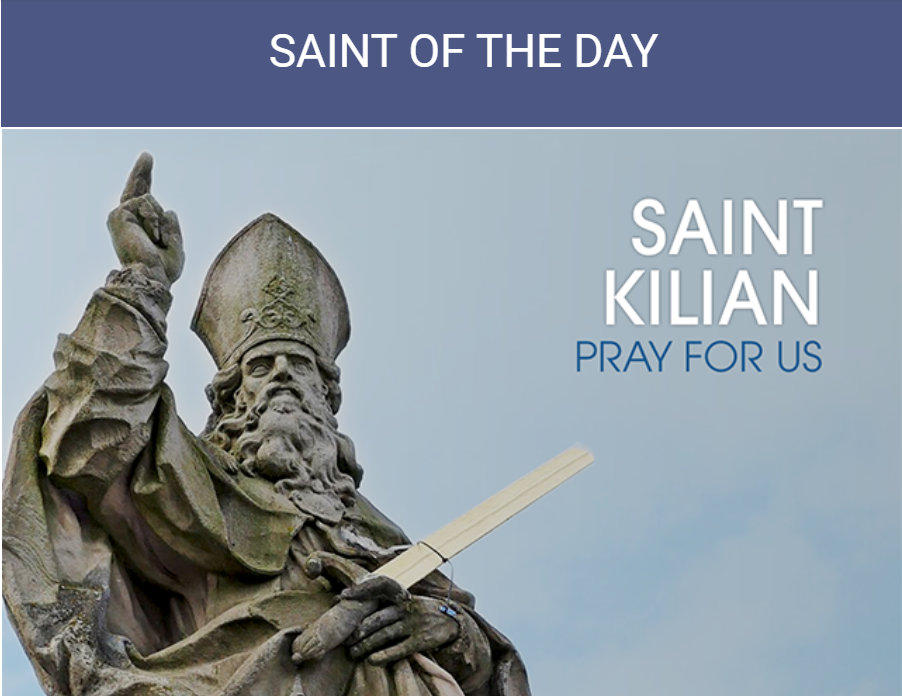
St. Kilian (c. 640-689 A.D.), also known as St. Cillian, was born to a noble family in Ireland. As a child he was known for his piety and love of study, which led him to the priesthood. He became a traveling bishop on the island, and in 686 A.D. left Ireland with eleven companions to travel throughout Gaul (present day France and parts of Germany) to preach the Gospel. From there he traveled to Rome to get official sanction from the Pope to become a missionary. Once obtained, St. Kilian returned north and settled in Würzburg as his base of activity along with two of his original companions. He began his work evangelizing the pagans in large parts of Franconia and Thuringia (north and central Germany), earning the name ‘Apostle of Franconia.’ Saint Kilian converted the Duke of Würzburg and convinced him to end his unlawful marriage. This greatly angered the Duke’s wife, who resisted St. Kilian’s attempts to convert her. While her husband was away, she had St. Kilian and his two missionary companions beheaded as they were preaching. A cathedral was built on the spot of their martyrdom by the first bishop of Würzburg. On St. Kilian’s feast his relics, along with those of his two companions, are paraded through the streets and put on display in the Würzburg Cathedral, which is dedicated to him. St. Kilian’s feast day is July 8th.