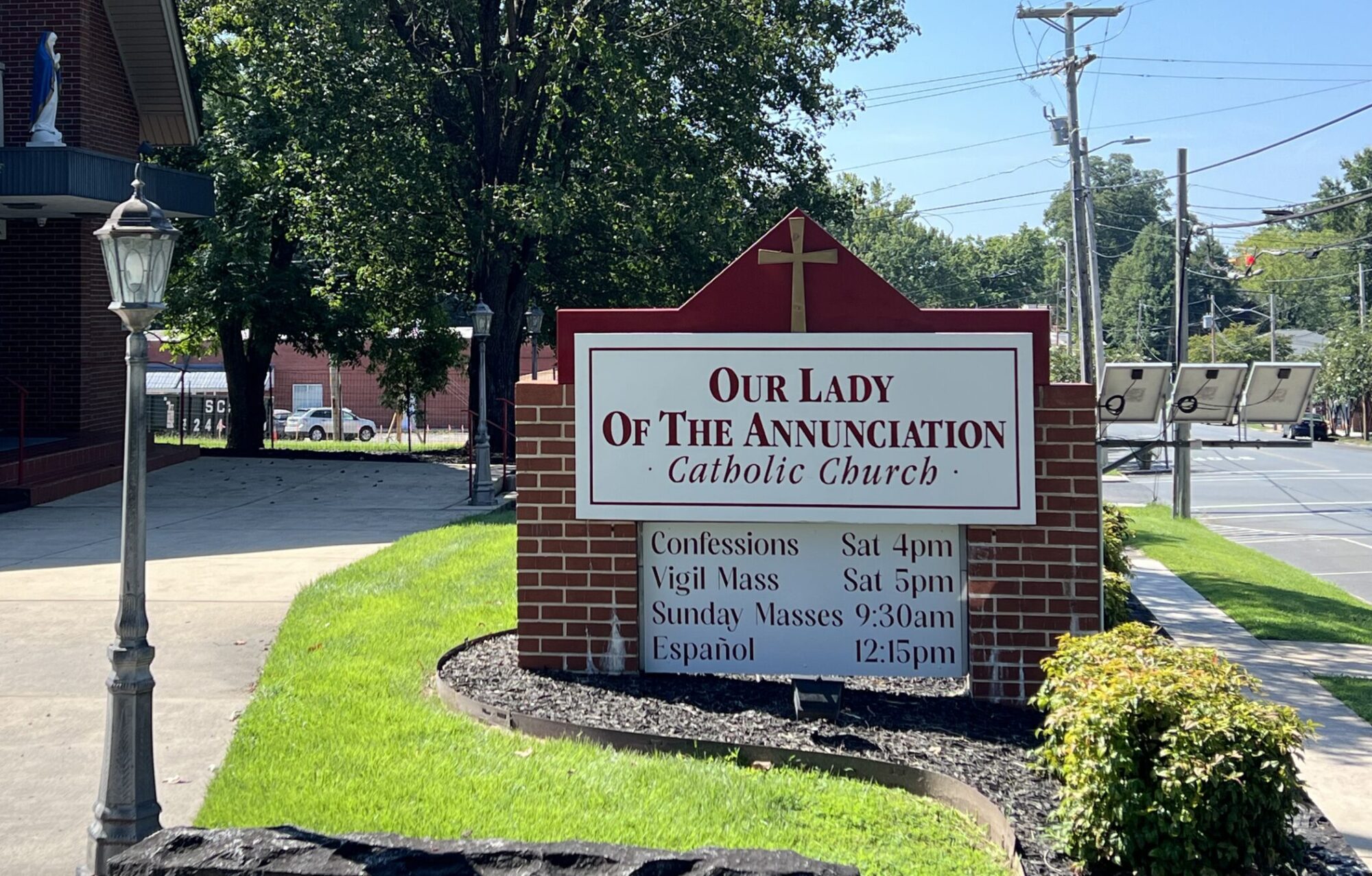
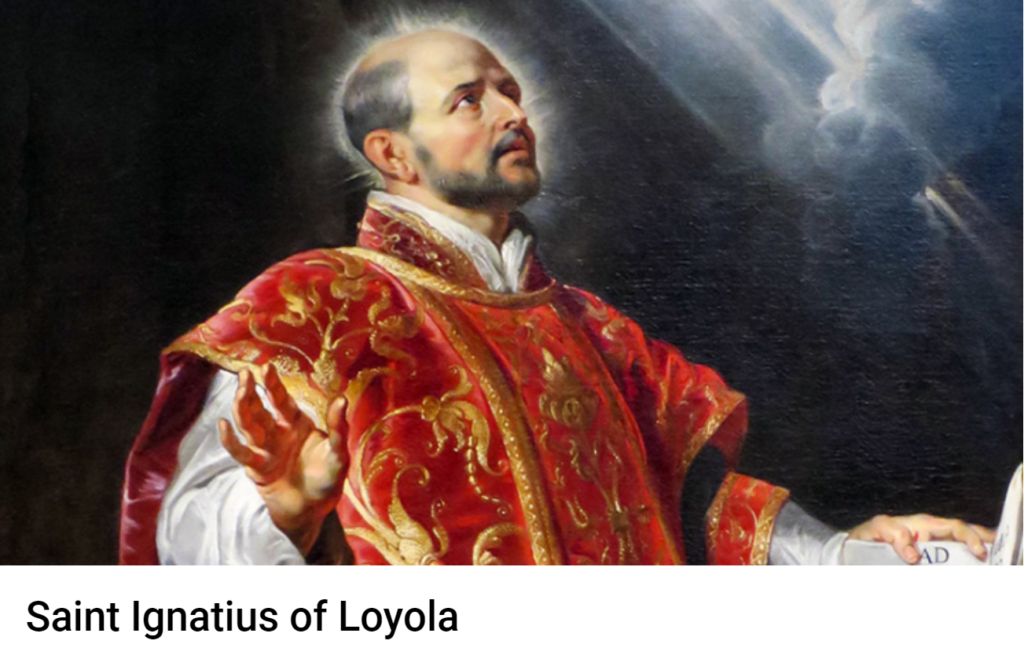
Saint of the Day – July 31 – Saint Ignatius of Loyola

(OCTOBER 23, 1491 – JULY 31, 1556)
Saint Ignatius of Loyola’s Story

The founder of the Jesuits was on his way to military fame and fortune when a cannon ball shattered his leg. Because there were no books of romance on hand during his convalescence, Ignatius whiled away the time reading a life of Christ and lives of the saints. His conscience was deeply touched, and a long, painful turning to Christ began. Having seen the Mother of God in a vision, he made a pilgrimage to her shrine at Montserrat near Barcelona. He remained for almost a year at nearby Manresa, sometimes with the Dominicans, sometimes in a pauper’s hospice, often in a cave in the hills praying. After a period of great peace of mind, he went through a harrowing trial of scruples. There was no comfort in anything—prayer, fasting, sacraments, penance. At length, his peace of mind returned.

It was during this year of conversion that Ignatius began to write down material that later became his greatest work, the Spiritual Exercises.

He finally achieved his purpose of going to the Holy Land, but could not remain, as he planned, because of the hostility of the Turks. Ignatius spent the next 11 years in various European universities, studying with great difficulty, beginning almost as a child. Like many others, his orthodoxy was questioned; Ignatius was twice jailed for brief periods.

In 1534, at the age of 43, he and six others—one of whom was Saint Francis Xavier—vowed to live in poverty and chastity and to go to the Holy Land. If this became impossible, they vowed to offer themselves to the apostolic service of the pope. The latter became the only choice. Four years later Ignatius made the association permanent. The new Society of Jesus was approved by Pope Paul III, and Ignatius was elected to serve as the first general.

When companions were sent on various missions by the pope, Ignatius remained in Rome, consolidating the new venture, but still finding time to found homes for orphans, catechumens, and penitents. He founded the Roman College, intended to be the model of all other colleges of the Society.

Ignatius was a true mystic. He centered his spiritual life on the essential foundations of Christianity—the Trinity, Christ, the Eucharist. His spirituality is expressed in the Jesuit motto, Ad majorem Dei gloriam—“for the greater glory of God.” In his concept, obedience was to be the prominent virtue, to assure the effectiveness and mobility of his men. All activity was to be guided by a true love of the Church and unconditional obedience to the Holy Father, for which reason all professed members took a fourth vow to go wherever the pope should send them for the salvation of souls.

Reflection

Luther nailed his theses to the church door at Wittenberg in 1517. Seventeen years later, Ignatius of Loyola founded the Society that was to play so prominent a part in the Catholic Reformation. He was an implacable foe of Protestantism. Yet the seeds of ecumenism may be found in his words: “Great care must be taken to show forth orthodox truth in such a way that if any heretics happen to be present they may have an example of charity and Christian moderation. No hard words should be used nor any sort of contempt for their errors be shown.” One of the greatest ecumenists was the 20th-century German Jesuit, Cardinal Augustin Bea.

Saint Ignatius of Loyola is the Patron Saint of:

Retreats

//Franciscan Media//
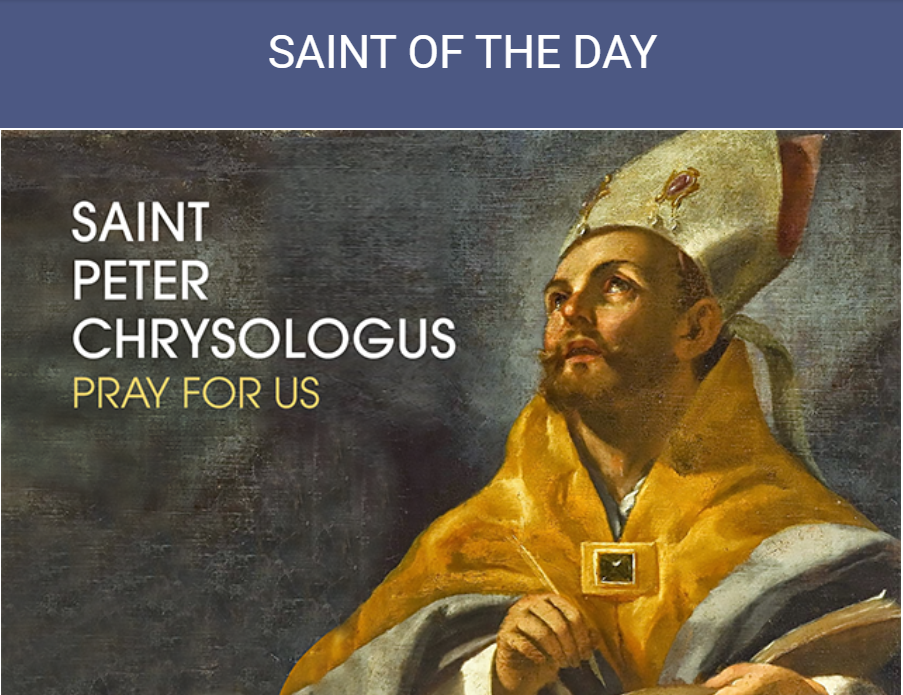

Saint of the Day – July 30 – Saint Peter Chrysologus

St. Peter Chrysologus (406-450 A.D.) was born in Imola, Italy. He was an adult convert to Christianity and studied under his bishop, Cornelius, who ordained him a deacon. In his day the city of Ravenna was the center of the Roman Empire, making the Archbishop of Ravenna an important position in the Church. When the Archbishop of Ravenna died, a new archbishop was elected by the clergy and the people of Ravenna. Bishop Cornelius of Imola went to Rome with his deacon, St. Peter Chyrsologus, to have the Ravenna appointment confirmed by Pope Sixtus III. When the pope saw St. Peter, he appointed him the new Archbishop of Ravenna instead. St. Peter was an effective shepherd who stamped out paganism, heresy, and ecclesiastical abuses from his diocese, earning the high regard of Emperor Valentinan III who resided in Ravenna. He also organized services to help the poor of the city. St. Peter was renowed for his profound and eloquent sermons, and his skill with taking complex theological truths and putting them in plain language, earning him the name ‘Chrysologus’ meaning ‘the man of golden speech’ or ‘golden word’ as well as the ‘Doctor of Homilies.’ In 1729, Pope Benedict XIII declared him a Doctor of the Church. His feast day is July 30.

//Catholic Company//


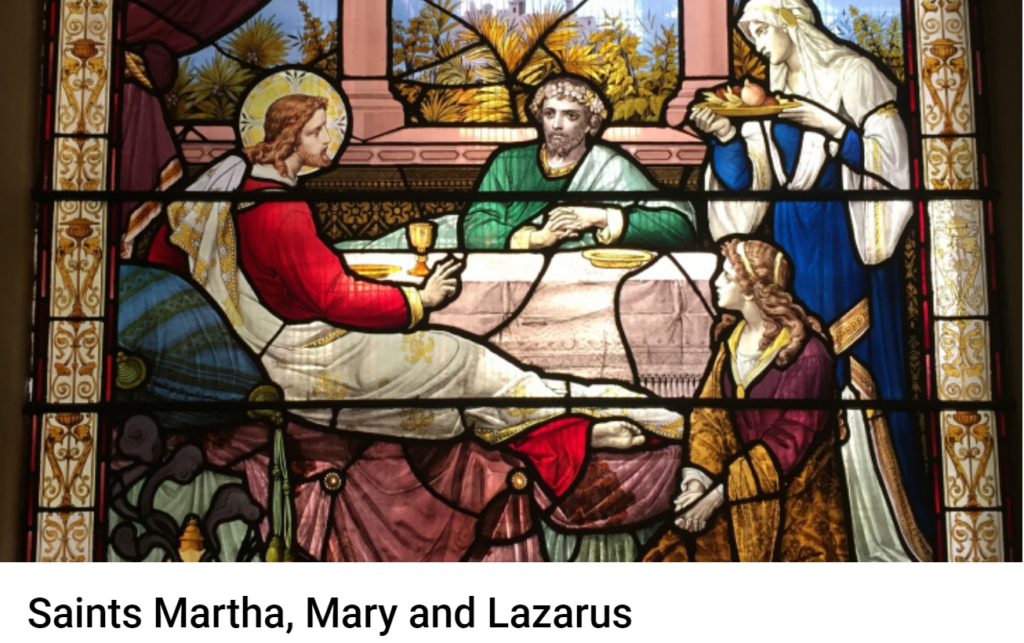
Saint of the Day – July 29 – Saints Martha, Mary, & Lazarus

Saints Martha, Mary and Lazarus’ story (1st Century)

Martha, Mary, and their brother Lazarus were evidently close friends of Jesus. He came to their home simply as a welcomed guest, rather than as one celebrating the conversion of a sinner like Zacchaeus or one unceremoniously received by a suspicious Pharisee. The sisters felt free to call on Jesus at their brother’s death, even though a return to Judea at that time seemed to spell almost certain death.

Martha’s great glory is her simple and strong statement of faith in Jesus after her brother’s death. “Jesus told her, ‘I am the resurrection and the life; whoever believes in me, even if he dies, will live, and everyone who lives and believes in me will never die. Do you believe this?’ She said to him, ‘Yes, Lord. I have come to believe that you are the Messiah, the Son of God, the one who is coming into the world’” (John 11:25-27).

No doubt Martha was an active sort of person. On one occasion, she prepares the meal for Jesus and possibly his fellow guests and forthrightly states the obvious: All hands should pitch in to help with the dinner. The Lord recognizes that Martha is “worried about many things,” also noting that Mary, who has spent the preparation time at Jesus’ feet listening to his words “has chosen the better part.” John 12:1-8 describes Mary’s anointing of Jesus’ feet at Bethany, an act which he praised highly.

Immediately after we are told that the chief priests plotted to kill Lazarus “because many of the Jews were turning away and believing in Jesus because of him.” Lazarus was the one of whom the Jews said, “See how much he loved him.” In their sight Jesus raised his friend Lazarus from the dead.

Legends abound about the life of Lazarus after the death and resurrection of Jesus. He is supposed to have left a written account of what he saw in the next world before he was called back to life. Some say he followed Peter into Syria. Another story is that despite being put into a leaking boat by the Jews at Jaffa, he, his sisters, and others landed safely in Cyprus. There he died peacefully after serving as bishop for 30 years.

It is certain there was early devotion to the saint. Around the year 390, the pilgrim lady Etheria talks of the procession that took place on the Saturday before Palm Sunday at the tomb where Lazarus had been raised from the dead. In the West, Passion Sunday was called Dominica de Lazaro, and Augustine tells us that in Africa the Gospel of the raising of Lazarus was read at the office of Palm Sunday.

Reflection

In its 2021 decree on combining veneration of Mary and Lazarus with Martha, the Congregation for Divine Worship and the Sacraments said, “In the household of Bethany, the Lord Jesus experienced the family spirit and friendship of Martha, Mary and Lazarus, and for this reason the Gospel of John states that he loved them. Martha generously offered him hospitality, Mary listened attentively to his words and Lazarus promptly emerged from the tomb at the command of the one who humiliated death.”

Saint Martha is a Patron Saint of:

Cooks
Homemakers
Restaurant servers

Saints Martha, Mary, and Lazarus are Patron Saints of:

Siblings

//Franciscan Media//


Sermon Notes – July 25 – We Repeat What We Do Not Repair

 “We Repeat What We Do Not Repair”

Father Peter Fitzgibbons

 July 24 – 25, 2021

Gospel:  John 6:1-15

It is said that lessons must be repeated until they are learned which means, for most of us, lessons need to be constantly repeated.  Sometimes, you think you’ve learned a lesson, but you learned it incorrectly.  Other times, we see things and know right away this means this and that means that.  We’ve taken something away from the lesson that wasn’t really there. Oops!  We need to be better students and learners.  Do you know which virtue “learning” is connected to?  Justice.  I remember one man, a seminarian and now a priest, who asked me for advice.  I told him to always take his books into the chapel before the Blessed Sacrament.  If you are going to read about the Man, then be with the Man.  Good idea…I have a few now and again. 

In the story about God’s miracle involving the loaves and fishes, 5,000 men were there who could not find places to sit…that’s a lot of men.  There were no women and children there…apparently, they had not been vaccinated.  Now, this scripture was written in Hebrew, so 5,000 was a number beyond all counting… an infinite number.  Philip told our Lord that “Two hundred days’ wages worth of food would not be enough for each of them to have a little bit.”  So, was Philip like Stuart Varney, a market watcher?  Did he watch the market and know the cost of food?  No, Philip was using a hyperbole…a number beyond comprehension.  After everyone had eaten, the apostles collected 12 baskets of leftover food.  The number 12 is another mystical number in Hebrew representing the 12 nations of Israel.  So, it was a huge number beyond counting, demonstrating the power of Christ and what He can do.  And, what did they learn from the miracle?  They learned the wrong thing.  They thought He was the “bread king.”  “Hey, He fed us, so He’s going to give us stuff we didn’t have to work for. Cool!  We will make Him king, and we’ll get all the stuff we want.”  This was another temptation of Christ.  Remember, the first temptation?  After spending 40 days of fasting in the desert, Satan said to Him, “If You are the Son of God, tell these stones to become bread.”   After seeing the miracle with the loaves and fishes, did people want holiness and their souls filled?  No, they wanted their stomachs filled. They wanted stuff.  The temptation of Christ was to give people stuff even though He came for the salvation of souls.  First things first.

People come every day and want stuff from the church.  Their stories are really fun, but it’s not what we can give.  In Acts, Peter said, “Silver and gold I have none; but what I have, I give you.  Pick up your mat and walk.”   At first, even the apostles didn’t get the lesson.  He came down to redeem you.  That was the lesson to take away.  After all the miracles our good Lord did, how many were there with Him at the end?  They did not learn the lesson until they were enlightened by grace.  They had the knowledge, because they had heard Him.  They weren’t idiots, but they didn’t know what the knowledge meant.  This is when we have to go to prayer to listen and to be enlightened.  You may have the knowledge, but that doesn’t guarantee you know what it means. 

I was reading an article this morning about the old Latin Mass.  “People did not participate in the Latin Mass.”  Or, in the order of the Mass we do now, “People must participate.  They have to run up and down the aisle.  We have to do a better job.”  I say, at best, that is blasphemy and at worst, it’s sacrilegious, because you know nothing about the Mass.  If you took a picture at Calvary, how many people were running around?  Do you think the Blessed Mother was crucifying Jesus?  No.  They stood there and shared in His suffering.  They became part of His suffering through love.  Whose human nature suffered on the cross? The Blessed Mother’s.  Whose human nature suffered along with Him?  That of Saint John the Apostle, Mary the wife of Clopas, and Mary Magdalene.   This is what the faithful do, because in the Holy Sacrifice of the Mass, you give your human nature to me, as the priest functioning in the person of Christ, and you are just like Saint John, Mary, and Mary at the cross suffering with Christ.  You cannot get more participation than that.  The people who say these things never offered Mass, and they probably aren’t priests.  If they are, they are stupid ones.  When I offer Mass in nursing homes, I don’t get much singing and all that.  Sometimes, the mentally challenged residents will yell out during Mass, “Father, I have an idea!”  We’ll talk about it after Mass.  Do they participate?  Yes, as much as they can. 

People have heard the lesson and they have the knowledge, but they have no idea what it means.  In order to have knowledge, we have to be humble, and we have to become small.  As Saint Therese of Lisieux said, “When I am small, I am safe.”  We must surrender to judgement.  Sometimes, we tell God, “I cannot do this…I don’t understand.”  Well, I don’t understand a lot of things.  Each day I’m mystified by something, and that’s okay.  I don’t have to understand everything.  I know a lot of bright people I can call up or text, not while I’m driving, and probably get some guidance.  Why does God allow this?  Why did God allow this to happen?  It’s always good to ask, not for understanding, but for the strength to bear what we cannot endure.  Sometimes, our lives and our crosses seem too much to bear.  To learn the proper lessons our Lord is teaching us today is a precursor to the Eucharist.  Lord, speak for your servant is listening.

How will you apply this message to your life? You may have the knowledge, but do you know what it means?   Go to prayer to listen and to be enlightened. 

You can read all of Father Fitzgibbons’ sermons by going to https://annunciationcatholicalbemarle.com/ and clicking on “Blog” then “Categories” and then “Sermon Notes.”  From a cell phone, click on “Blog” then “Menu” and then “Categories” (located at the end of page).  There is also a search box if you are looking for a specific topic.


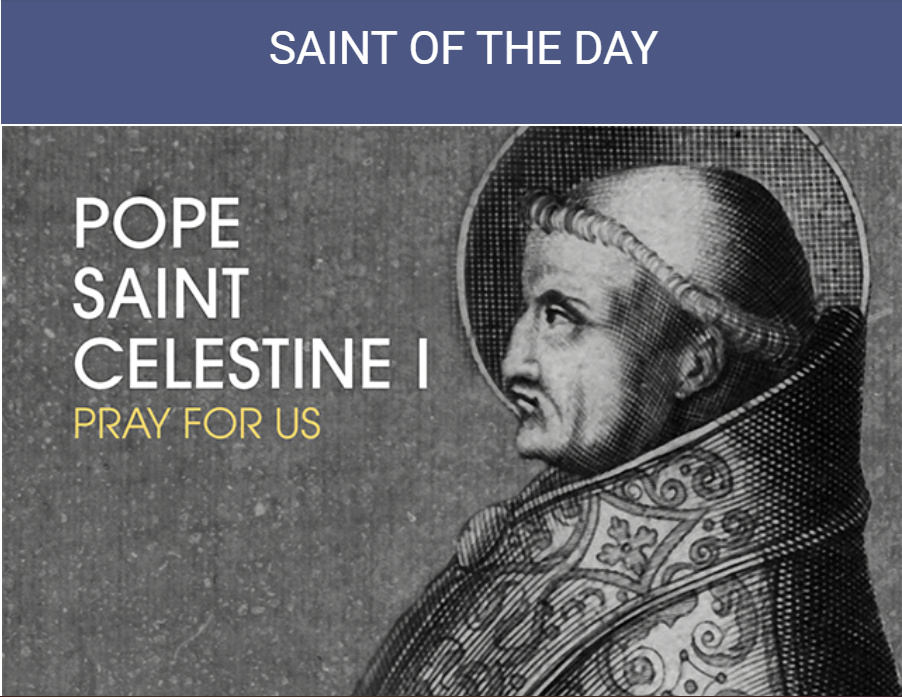
Saint of the Day – July 27 – Pope Saint Celestine I

Pope St. Celestine I (d. 432 A.D.) was a Roman deacon who was elected Supreme Pontiff in 422 A.D. He was a contemporary of St. Augustine, and it is said that the two were good friends. He also lived with St. Ambrose in Milan prior to serving in Rome. Pope St. Celestine lead the Church for nine years during a troubled time of social upheaval. Within the Church there were multiple dangerous heresies spreading and corrupting the faith of the people, especially Nestorianism and Pelagianism, which he staunchly fought against, and for this he is known as a defender of orthodox doctrine. Outside the Church, barbarian hordes were invading the West, leading to the collapse of the Roman Empire. Pope St. Celestine I worked to restore the churches that were attacked when Alaric the Goth sacked Rome. He also established the papal diplomatic service to send ambassadors, known as nuncios, from the Vatican to other governments around the world. He is also the Holy Father who sent St. Patrick to evangelize Ireland, and who introduced the responsorial psalm into the papal Mass at Rome. His feast day is July 27th.

//Catholic Company//


Saint of the Day – July 25 – Saint Christopher

St. Christopher (3rd c.) is a highly popular saint, though little is known about him with certainty. According to one account, a pagan queen prayed to the Blessed Virgin Mary for a child, whom she named Offerus and dedicated to the pagan gods. The child grew into a man of exceptional size and strength, and he endeavored to serve only the strongest and most courageous of masters. First he served a heathen king, but soon realized that the king feared the Devil. He then served the Devil, until he saw that the Devil feared the Sign of the Cross. He then decided to serve Christ, reasoning that Christ must be the strongest master of all. Offerus found a Christian hermit who instructed him in the faith, baptized him, and gave him a new name, Christopher, or “Christ-bearer.” From then on Christopher determined to serve Christ by using his great physical strength to assist travelers crossing a treacherous river. One day he helped a small child across the river; as Christopher carried the child he felt his burden becoming strangely heavy, as if the weight of the whole world was upon his shoulders. When he spoke of this, the child replied that Christopher carried not only the whole world, but also Him who made it. The child then revealed himself as Jesus Christ and announced that Christopher’s humble service was pleasing to Him, and worked a miracle by turning Christopher’s staff into a tree. Due to this miracle many converted to Christianity, which caused Christopher to be imprisoned, tortured, and beheaded for refusing to worship the pagan gods. St. Christopher is the patron saint of travelers. His feast day is July 25th.

//Catholic Company//


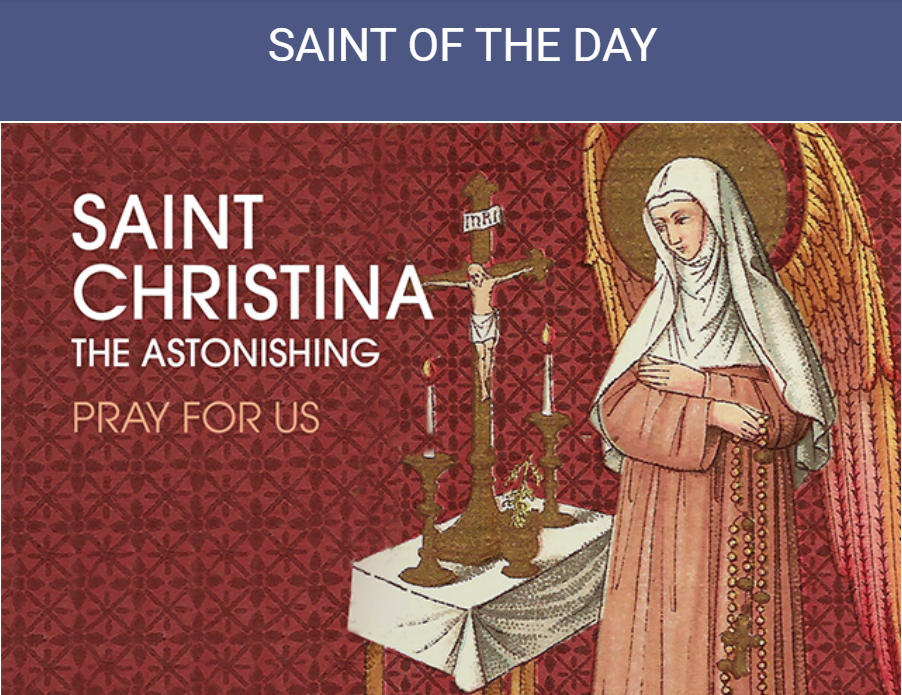
Saint of the Day – Saint Christina the Astonishing

St. Christina (1150-1224) was born to a peasant family in Belgium. She was orphaned as a child and raised by her two older sisters. When she was 21 she had what was believed to be a severe seizure, and was pronounced dead. At her funeral she suddenly revived and levitated before the bewildered congregation. She said that during her coma she had been to heaven, hell, and purgatory and had been given the option to either die and enter heaven, or return to earth to suffer and pray for the holy souls in purgatory. Christina chose the greater act of charity. From then on she lived in extreme poverty: wearing rags, sleeping on rocks, and begging for her food. She is called “Astonishing” because she did the most bizarre things and suffered the pains of inhuman feats without being physically harmed by them. She would roll in fire and hide in hot ovens; she would stand in freezing water for hours in the dead of winter; she allowed herself to be dragged under water by a mill wheel; she spent much time in graveyards. She would also climb trees to escape the strong odor of sin in those she met. Many thought her to be possessed by demons or insane, but many devout people recognized and vouched for her sincerity, obedience, and sanctity. They believed that she was a living witness to the pains that souls experience in purgatory, willingly suffering with them and for them. Christina the Astonishing is the patron of those with mental illness and disorders, mental health workers, psychiatrists, and therapists. Her feast day is July 24th.

//Catholic Company//


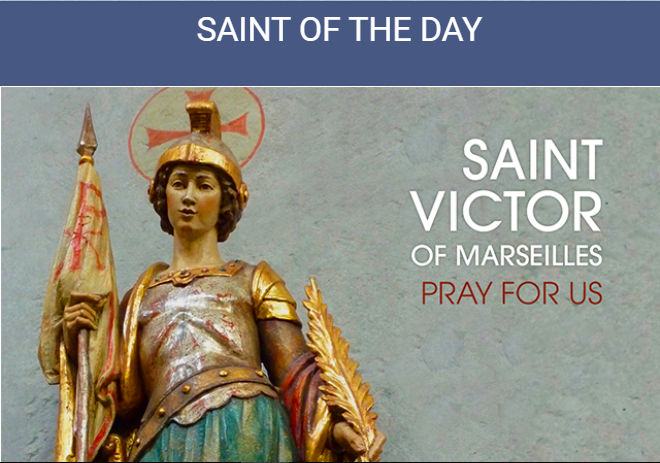
Saint of the Day – July 21 – Saint Victor of Marseilles

St. Victor of Marseilles (d. 290 A.D.) was a Christian soldier serving in the Roman imperial army in Marseilles, France. Christianity was thriving there, until Emperor Maximian arrived with the intention of putting the Christians to death. This caused the Christians to fear, and St. Victor would go from house to house under the cover of night to admonish them to stand strong in their faith. This behavior drew attention, and during one of his nightly rounds he was arrested. The Roman prefects tried to dissuade him from following a “dead man” (Jesus), but St. Victor testified boldly for the truth of the Christian faith. Enraged, the prefects had him bound and dragged through the streets. Victor was undeterred and continued to denounce the Roman gods. His tortures were renewed until his torturers grew tired, after which he was thrown into a dungeon. That night he was visited by angels, and his three guards were converted and baptized that same night. The next morning the Emperor had the guards beheaded, while St. Victor was kept alive for fresh torments. After three days of abuse, the Emperor commanded Victor to burn incense to the gods. Instead, St. Victor walked up to the altar and kicked it over with his foot. In retaliation, his foot was cut off. Seeing that his efforts to cause Victor to apostatize were useless, the Emperor finally had him crushed to death on a grindstone. His body was thrown into the sea before being recovered and buried by Christians. His tomb became a place where many miracles occurred. St. Victor of Marseilles’ feast day is July 21st.

//Catholic Company//


What to Do When You Get Interrupted

An interruption is anything that takes our attention away from our primary task. We may think our days are filled with interruptions: people cutting us off in traffic, a slow internet connection, etc. But in order to truly be interrupted, we have to have a primary task. We live in a world that is constantly trying to distract us, so much so that if we really start to think about what our primary task for today is, we may not be able to come up with one. What if we lived every day with the primary task of strengthening our relationship with Christ, and hedging our way towards eternity in Heaven? Today, Fr. Mike explains the purpose interruptions have in our lives, and how they can even guide us back to our primary task of reaching Heaven.