Looking to dive deeper into The Rosary? We all know The Rosary is an important part of our Catholic faith, and you may have even started praying it consistently, but do you know why you’re praying it? It’s not uncommon that we’re taught how to do things and not why to do things, and if we don’t understand the meaning and purpose behind our prayer, it won’t transform our hearts in the ways the Lord wants. Today, Fr. Mark-Mary shares some tips on how we can pray The Rosary habitually and intentionally.
How to Participate More Fully in Holy Mass
Last week, Fr. Mark-Mary invited us to not just show up for Mass, but actually pray the Mass—participate in the Mass. But… what does that actually look like? Today, Fr. Mark-Mary gives us 5 concrete ways to enter more fully into the celebration of Holy Mass.
Don’t Just Go to Mass . . . Pray the Mass!
For practicing Catholics who attend Mass every Sunday, it can be easy to get caught up in the routine instead of consciously entering into the sacrament. When this happens, although we remain physically present, we start to become emotionally distant from what’s actually taking place on the altar, while missing some of the main aspects of our faith. Today, Fr. Mark-Mary shares some ways we can dive deeper into the Mass through prayer. You can read the institution narratives that Fr. Mark-Mary mentions in the following passages: Matthew 26:20-29 Mark 14:17-25 Luke 22:14-20 1 Corinthians 11:23-25
Saint of the Day – August 8 – Saint Dominic
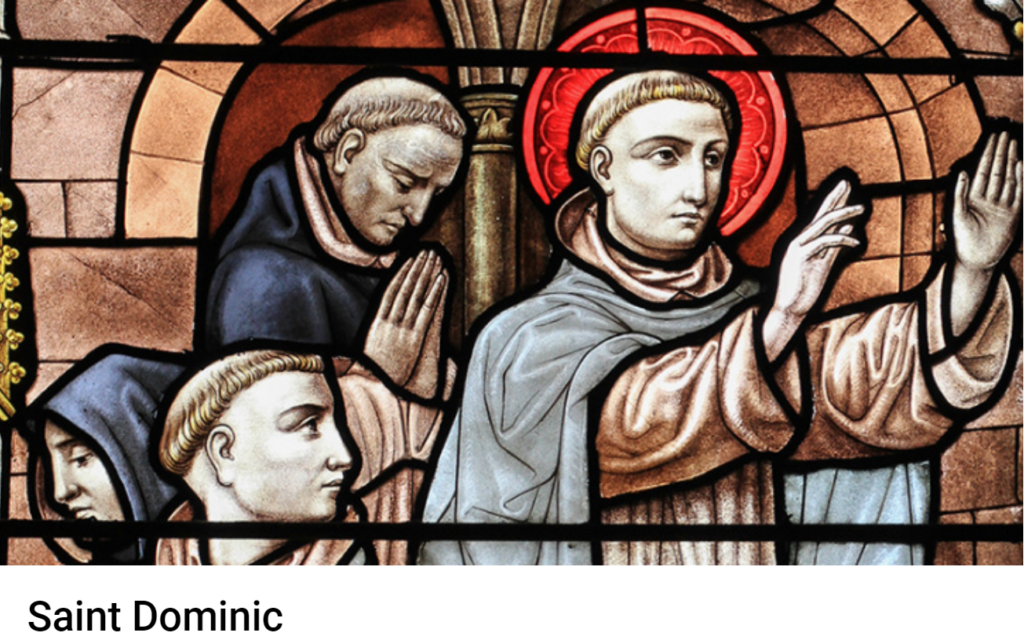
Saint Dominic’s Story
If he hadn’t taken a trip with his bishop, Dominic would probably have remained within the structure of contemplative life; after the trip, he spent the rest of his life being a contemplative in active apostolic work.
Born in old Castile, Spain, Dominic was trained for the priesthood by a priest-uncle, studied the arts and theology, and became a canon of the cathedral at Osma, where there was an attempt to revive the apostolic common life described in Acts of the Apostles.
On a journey through France with his bishop, Dominic came face to face with the then virulent Albigensian heresy at Languedoc. The Albigensians–or Cathari, “the pure ones”–held to two principles—one good, one evil—in the world. All matter is evil—hence they denied the Incarnation and the sacraments. On the same principle, they abstained from procreation and took a minimum of food and drink. The inner circle led what some people regarded as a heroic life of purity and asceticism not shared by ordinary followers.
Dominic sensed the need for the Church to combat this heresy, and was commissioned to be part of the preaching crusade against it. He saw immediately why the preaching crusade was not succeeding: the ordinary people admired and followed the ascetical heroes of the Albigenses. Understandably, they were not impressed by the Catholic preachers who traveled with horse and retinues, stayed at the best inns and had servants. Dominic therefore, with three Cistercians, began itinerant preaching according to the gospel ideal. He continued this work for 10 years, being successful with the ordinary people but not with the leaders.
His fellow preachers gradually became a community, and in 1215 Dominic founded a religious house at Toulouse, the beginning of the Order of Preachers or Dominicans.
Dominic’s ideal, and that of his Order, was to organically link a life with God, study, and prayer in all forms, with a ministry of salvation to people by the word of God. His ideal: contemplata tradere: “to pass on the fruits of contemplation” or “to speak only of God or with God.”
Reflection
The Dominican ideal, like that of all religious communities, is for the imitation, not merely the admiration, of the rest of the Church. The effective combining of contemplation and activity is the vocation of truck driver Smith as well as theologian Aquinas. Acquired contemplation is the tranquil abiding in the presence of God, and is an integral part of any full human life. It must be the wellspring of all Christian activity.
Saint Dominic is the Patron Saint of:
Astronomers
Dominican Republic
//Franciscan Media//
Saint of the Day – August 7 – Pope Saint Sixtus II
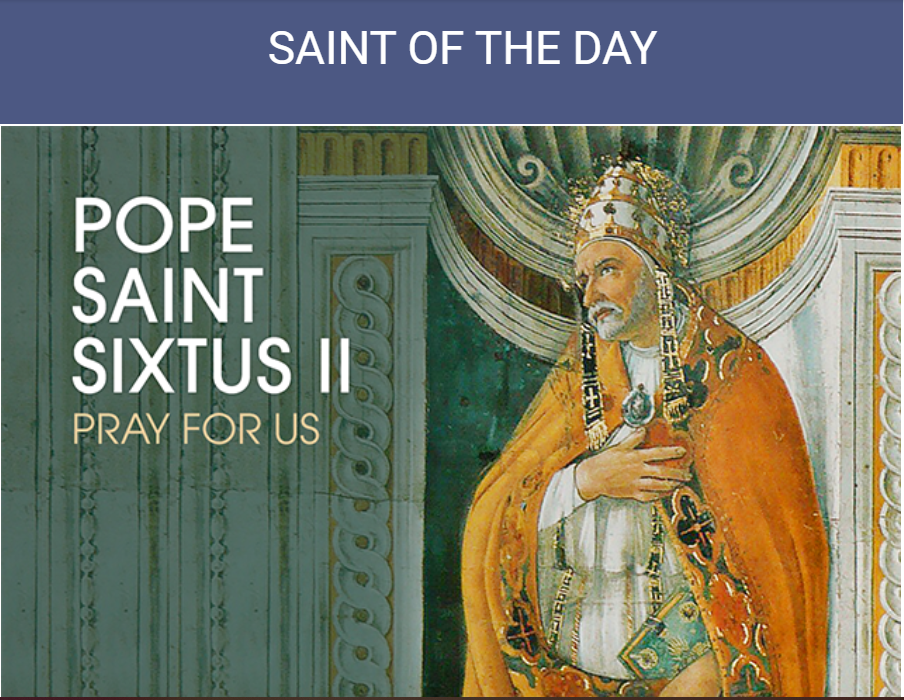
Pope St. Sixtus II (d. 258 A.D.) became the Roman Pontiff in the year 257 A.D. His early life is uncertain, and he is mentioned by name in the Roman Canon of the Mass. He helped mend the relationship between Rome and the Eastern and African churches over the problem of the rebaptism of converted heretics, a controversy which threatened schism. St. Sixtus II, a peaceful man, restored friendly relations and maintained unity. However, he served as Holy Father for only one year due to the persecution of Christians by Roman Emperor Valerian. As a result, Pope St. Sixtus II was suppressed and forbidden to celebrate the Holy Sacrifice of the Mass. He continued to worship in secret in defiance to the unjust law, and while offering Mass in a cemetery chapel he was ambushed and beheaded by Roman soldiers. His feast day is August 7th.
//Catholic Company//
Saint of the Day – August 6 – Blessed Maria Francesca Rubatto

Bl. Maria Francesca of Jesus Rubatto (1844– 1904) was one of eight children from an Italian family. Her father died when she was four. In her teenage years she received an offer of marriage, which she declined as she had taken a vow of virginity from an early age. When she was nineteen, after the death of her mother, Maria moved to Turin and befriended a noblewoman who gave her assistance. Maria taught catechism to the woman’s children, in addition to the other children in the city. She also had a habit of visiting the sick and poor. One day a construction worker had an accident while building a convent, and Maria, who was walking nearby, helped him and gave him money so that he could recover from his injury. The sisters of the convent took notice of Maria for this act of charity and desired that she join their community. Maria accepted their invitation and was later appointed superior of this new community of Capuchin Franciscan sisters. She had a desire to serve in the overseas missions, and in 1892 left Italy and crossed the Atlantic Ocean to South America. She made this journey seven times in her work of founding Catholic missions in Uruguay and Argentina. Her feast day is August 6th.
//Catholic Company//
Saint of the Day – August 5 – Saint Oswald of Northumbria

St. Oswald (605-642 A.D.) was the second of seven sons born to the pagan king of Northumbria in northern England. After his father was killed in battle, the kingdom was split. His uncle claimed the throne, while Oswald fled with his mother and brothers to Scotland for safety. There his family was converted to Christianity by the renowned monks of Iona. Oswald was educated by the holy monks and grew into a brave and pious warrior. After the death of his uncle and elder brother, Oswald moved to reclaim his father’s throne and liberate it from enemy rule. On the eve of a decisive battle, he received a vision of St. Columba who promised him success. Before battle, Oswald erected a cross and knelt before it in prayer, along with his army. Following his victory, St. Oswald reunited Northumbria and was made king. His influence as a monarch was so great that he was considered the Emperor of almost all of Britain, uniting the the Britons, Picts, Scots, and the English. He requested a bishop to be sent to his kingdom to aid in the conversion of his people to Christianity; he also invited St. Aidan and a group of Irish monks from Iona to found a monastery for the kingdom at Lindisfarne. This ushered in Northumbria’s “golden age” as the most important centre of learning and arts in the British Isles. Oswald ruled as a saintly and powerful Christian king, in justice, humility, and generosity to the poor and strangers, as noted by the prestigious historian, the Venerable Bede. St. Oswald was killed in battle, and afterwards the place of his death was noted for many miracles. His feast day is August 5th.
//Catholic Company//
Saint of the Day – August 4 – Saint John Vianney

Saint John Vianney’s Story
A man with vision overcomes obstacles and performs deeds that seem impossible. John Vianney was a man with vision: He wanted to become a priest. But he had to overcome his meager formal schooling, which inadequately prepared him for seminary studies.
His failure to comprehend Latin lectures forced him to discontinue. But his vision of being a priest urged him to seek private tutoring. After a lengthy battle with the books, John was ordained.
Situations calling for “impossible” deeds followed him everywhere. As pastor of the parish at Ars, John encountered people who were indifferent and quite comfortable with their style of living. His vision led him through severe fasts and short nights of sleep.
With Catherine Lassagne and Benedicta Lardet, he established La Providence, a home for girls. Only a man of vision could have such trust that God would provide for the spiritual and material needs of all those who came to make La Providence their home.
His work as a confessor is John Vianney’s most remarkable accomplishment. In the winter months he was to spend 11 to 12 hours daily reconciling people with God. In the summer months this time was increased to 16 hours. Unless a man was dedicated to his vision of a priestly vocation, he could not have endured this giving of self day after day.
Many people look forward to retirement and taking it easy, doing the things they always wanted to do but never had the time. But John Vianney had no thoughts of retirement. As his fame spread, more hours were consumed in serving God’s people. Even the few hours he would allow himself for sleep were disturbed frequently by the devil.
Who, but a man with vision, could keep going with ever-increasing strength? In 1929, Pope Pius XI named him the patron of parish priests worldwide.
Reflection
Indifference toward religion, coupled with a love for material comfort, seem to be common signs of our times. A person from another planet observing us would not likely judge us to be pilgrim people, on our way to somewhere else. John Vianney on the other hand, was a man on a journey, with his goal before him at all times.
Saint John Vianney is the Patron Saint of:
Diocesan Priests
Parish Priests
//Franciscan Media//
Saint of the Day – August 3 – Saint Lydia Purpuraria
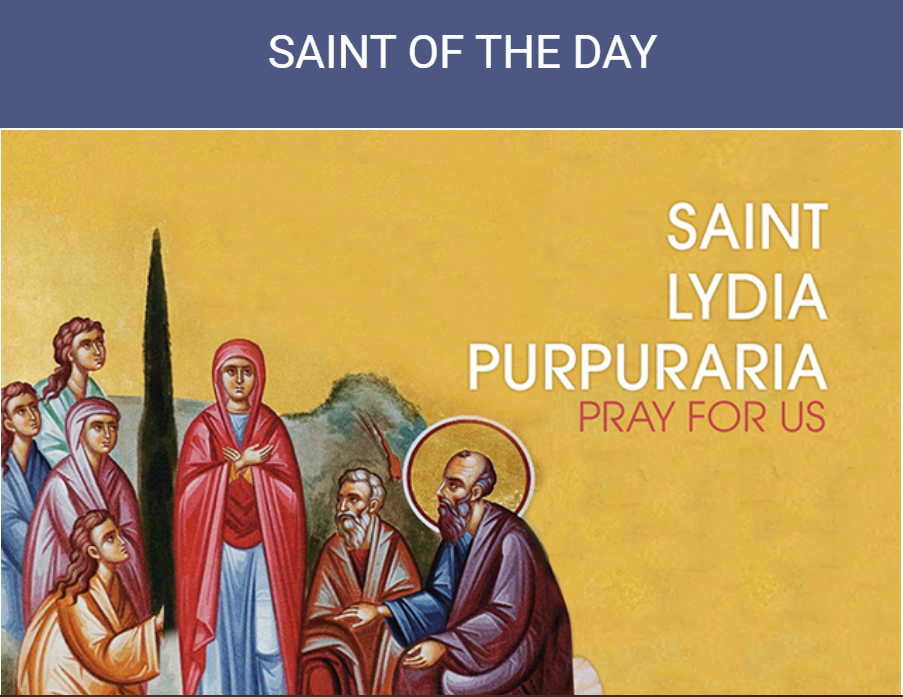
St. Lydia Purpuraria, also called Lydia of Thyatira (1st. c), was a pious and wealthy woman involved in the textile trade in Philippi, Macedonia. She and her husband manufactured and traded in the lucrative business of purple dyes and fabrics, a luxury for the elite. Lydia was a worshiper of the true God, and when St. Paul’s missionary journeys brought him to Philippi in about 50 A.D., God opened Lydia’s heart to accept the Gospel of Jesus Christ. Lydia and her family became St. Paul’s very first converts to Christianity, as mentioned in the Acts of the Apostles. After her family was baptized, Lydia invited Paul and his companion, St. Timothy, to stay in her home. Lydia served the Lord through her gift of hospitality, and her home became a meeting place for the early Christians. After Paul and Silas were released from prison, it was to Lydia’s home that they first went to meet and encourage the believers gathered there. St. Lydia’s feast day is August 3.
//Catholic Company//
Saint of the Day – August 1 – Saint Alphonsus Liguori
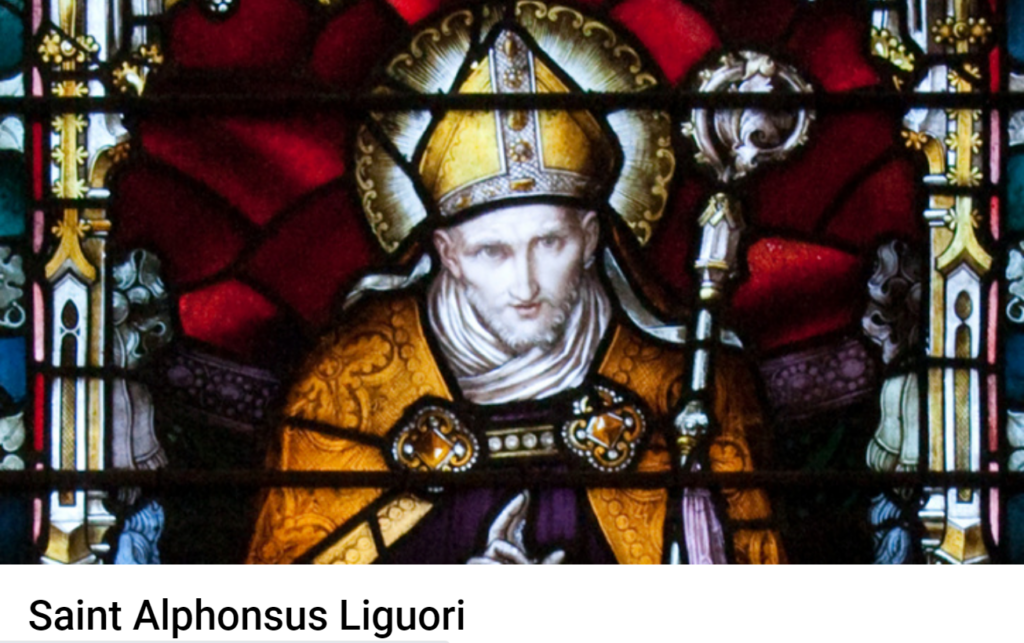

Saint Alphonsus Liguori (September 27, 1696 – August 1, 1787)
Moral theology, Vatican II said, should be more thoroughly nourished by Scripture, and show the nobility of the Christian vocation of the faithful and their obligation to bring forth fruit in charity for the life of the world. Alphonsus, declared patron of moral theologians by Pius XII in 1950, would rejoice in that statement.
In his day, Alphonsus fought for the liberation of moral theology from the rigidity of Jansenism. His moral theology, which went through 60 editions in the century following him, concentrated on the practical and concrete problems of pastors and confessors. If a certain legalism and minimalism crept into moral theology, it should not be attributed to this model of moderation and gentleness.
At the University of Naples, Alphonsus received a doctorate in both canon and civil law by acclamation, at the age of 16, but he soon gave up the practice of law for apostolic activity. He was ordained a priest, and concentrated his pastoral efforts on popular parish missions, hearing confessions, and forming Christian groups.
He founded the Redemptorist congregation in 1732. It was an association of priests and brothers living a common life, dedicated to the imitation of Christ, and working mainly in popular missions for peasants in rural areas. Almost as an omen of what was to come later, he found himself deserted after a while by all his original companions except one lay brother. But the congregation managed to survive and was formally approved 17 years later, though its troubles were not over.
Alphonsus’ great pastoral reforms were in the pulpit and confessional—replacing the pompous oratory of the time with simplicity, and the rigorism of Jansenism with kindness. His great fame as a writer has somewhat eclipsed the fact that for 26 years he traveled up and down the Kingdom of Naples preaching popular missions.
He was made bishop at age 66 after trying to reject the honor, and at once instituted a thorough reform of his diocese.
His greatest sorrow came toward the end of his life. The Redemptorists, precariously continuing after the suppression of the Jesuits in 1773, had difficulty in getting their Rule approved by the Kingdom of Naples. Alphonsus acceded to the condition that they possess no property in common, but with the connivance of a high Redemptorist official, a royal official changed the Rule substantially. Alphonsus, old, crippled and with very bad sight, signed the document, unaware that he had been betrayed. The Redemptorists in the Papal States then put themselves under the pope, who withdrew those in Naples from the jurisdiction of Alphonsus. It was only after his death that the branches were united.
At 71, Alphonsus was afflicted with rheumatic pains which left incurable bending of his neck. Until it was straightened a little, the pressure of his chin caused a raw wound on his chest. He suffered a final 18 months of “dark night” scruples, fears, temptations against every article of faith and every virtue, interspersed with intervals of light and relief, when ecstasies were frequent.
Alphonsus is best known for his moral theology, but he also wrote well in the field of spiritual and dogmatic theology. His Glories of Mary is one of the great works on that subject, and his book Visits to the Blessed Sacrament went through 40 editions in his lifetime, greatly influencing the practice of this devotion in the Church.
Reflection
Saint Alphonsus was known above all as a practical man who dealt in the concrete rather than the abstract. His life is indeed a practical model for the everyday Christian who has difficulty recognizing the dignity of Christian life amid the swirl of problems, pain, misunderstanding and failure. Alphonsus suffered all these things. He is a saint because he was able to maintain an intimate sense of the presence of the suffering Christ through it all.
Saint Alphonsus Liguori is the Patron Saint of:
Theologians
Vocations
//Franciscan Media//