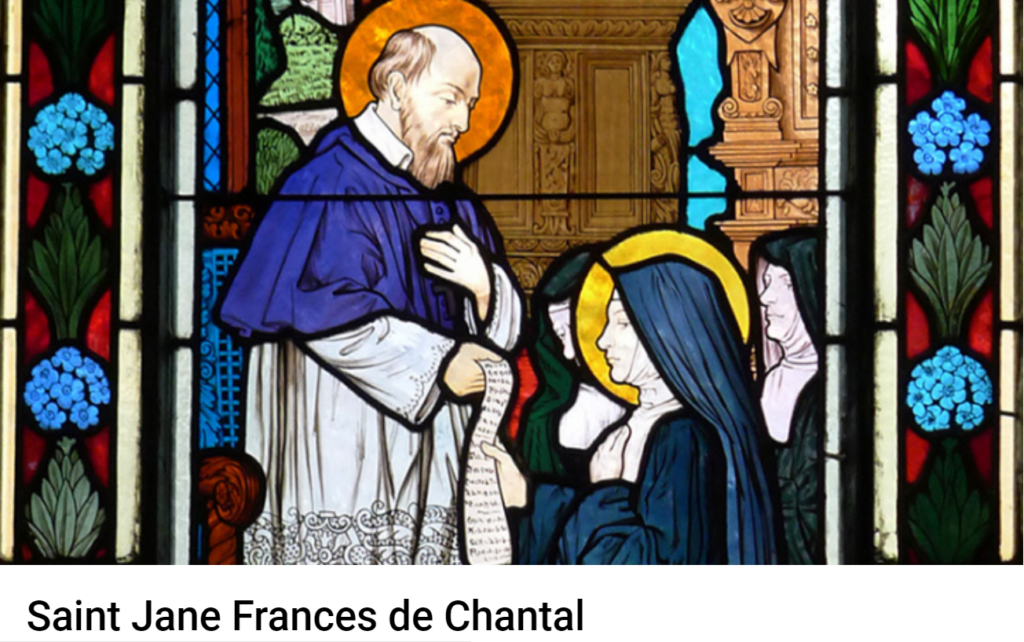
Saint of the Day – August 12 – Saint Jane Frances de Chantal

(JANUARY 28, 1572 – DECEMBER 13, 1641)
Saint Jane Frances de Chantal’s Story

Jane Frances was wife, mother, nun, and founder of a religious community. Her mother died when she was 18 months old, and her father, head of parliament at Dijon, France, became the main influence on her education. Jane developed into a woman of beauty and refinement, lively and cheerful in temperament. At 21, she married Baron de Chantal, by whom she had six children, three of whom died in infancy. At her castle, she restored the custom of daily Mass, and was seriously engaged in various charitable works.

Jane’s husband was killed after seven years of marriage, and she sank into deep dejection for four months at her family home. Her father-in-law threatened to disinherit her children if she did not return to his home. He was then 75, vain, fierce, and extravagant. Jane Frances managed to remain cheerful in spite of him and his insolent housekeeper.

When she was 32, Jane met Saint Francis de Sales who became her spiritual director, softening some of the severities imposed by her former director. She wanted to become a nun but he persuaded her to defer this decision. She took a vow to remain unmarried and to obey her director.

After three years, Francis told Jane of his plan to found an institute of women that would be a haven for those whose health, age, or other considerations barred them from entering the already established communities. There would be no cloister, and they would be free to undertake spiritual and corporal works of mercy. They were primarily intended to exemplify the virtues of Mary at the Visitation—hence their name the Visitation nuns—humility and meekness.

The usual opposition to women in active ministry arose and Francis de Sales was obliged to make it a cloistered community following the Rule of Saint Augustine. Francis wrote his famous Treatise on the Love of God for them. The congregation consisting of three women began when Jane Frances was 45. She underwent great sufferings: Francis de Sales died; her son was killed; a plague ravaged France; her daughter-in-law and son-in-law died. She encouraged the local authorities to make great efforts for the victims of the plague, and she put all her convent’s resources at the disposal of the sick.

During a part of her religious life, Jane Frances had to undergo great trials of the spirit—interior anguish, darkness, and spiritual dryness. She died while on a visitation of convents of the community.

Reflection

It may strike some as unusual that a saint should be subject to spiritual dryness, darkness, interior anguish. We tend to think that such things are the usual condition of “ordinary” sinful people. Some of our lack of spiritual liveliness may indeed be our fault. But the life of faith is still one that is lived in trust, and sometimes the darkness is so great that trust is pressed to its limit.

Saint Jane Frances de Chantal is a Patron Saint of:

Mothers
Widows
Wives

//Franciscan Media//


Saint of the Day – August 11 – Saint Clare of Assisi

(JULY 16, 1194 – AUGUST 11, 1253)
Saint Clare of Assisi’s Story

One of the more sugary movies made about Francis of Assisi pictures Clare as a golden-haired beauty floating through sun-drenched fields, a sort of one-woman counterpart to the new Franciscan Order.

The beginning of her religious life was indeed movie material. Having refused to marry at 15, Clare was moved by the dynamic preaching of Francis. He became her lifelong friend and spiritual guide.

At 18, Clare escaped from her father’s home one night, was met on the road by friars carrying torches, and in the poor little chapel called the Portiuncula received a rough woolen habit, exchanged her jeweled belt for a common rope with knots in it, and sacrificed her long tresses to Francis’ scissors. He placed her in a Benedictine convent, which her father and uncles immediately stormed in rage. Clare clung to the altar of the church, threw aside her veil to show her cropped hair, and remained adamant.


The Poor Ladies went barefoot, slept on the ground, ate no meat, and observed almost complete silence. Later Clare, like Francis, persuaded her sisters to moderate this rigor: “Our bodies are not made of brass.” The greatest emphasis, of course, was on gospel poverty. They possessed no property, even in common, subsisting on daily contributions. When even the pope tried to persuade Clare to mitigate this practice, she showed her characteristic firmness: “I need to be absolved from my sins, but I do not wish to be absolved from the obligation of following Jesus Christ.”

Contemporary accounts glow with admiration of Clare’s life in the convent of San Damiano in Assisi. She served the sick and washed the feet of the begging nuns. She came from prayer, it was said, with her face so shining it dazzled those about her. She suffered serious illness for the last 27 years of her life. Her influence was such that popes, cardinals, and bishops often came to consult her—Clare herself never left the walls of San Damiano.

Francis always remained her great friend and inspiration. Clare was always obedient to his will and to the great ideal of gospel life which he was making real.

A well-known story concerns her prayer and trust. Clare had the Blessed Sacrament placed on the walls of the convent when it faced attack by invading Saracens. “Does it please you, O God, to deliver into the hands of these beasts the defenseless children I have nourished with your love? I beseech you, dear Lord, protect these whom I am now unable to protect.” To her sisters she said, “Don’t be afraid. Trust in Jesus.” The Saracens fled.

Reflection

The 41 years of Clare’s religious life are scenarios of sanctity: an indomitable resolve to lead the simple, literal gospel life as Francis taught her; courageous resistance to the ever-present pressure to dilute the ideal; a passion for poverty and humility; an ardent life of prayer; and a generous concern for her sisters.

Saint Clare is the Patron Saint of:

Protection from eye disorders
Television


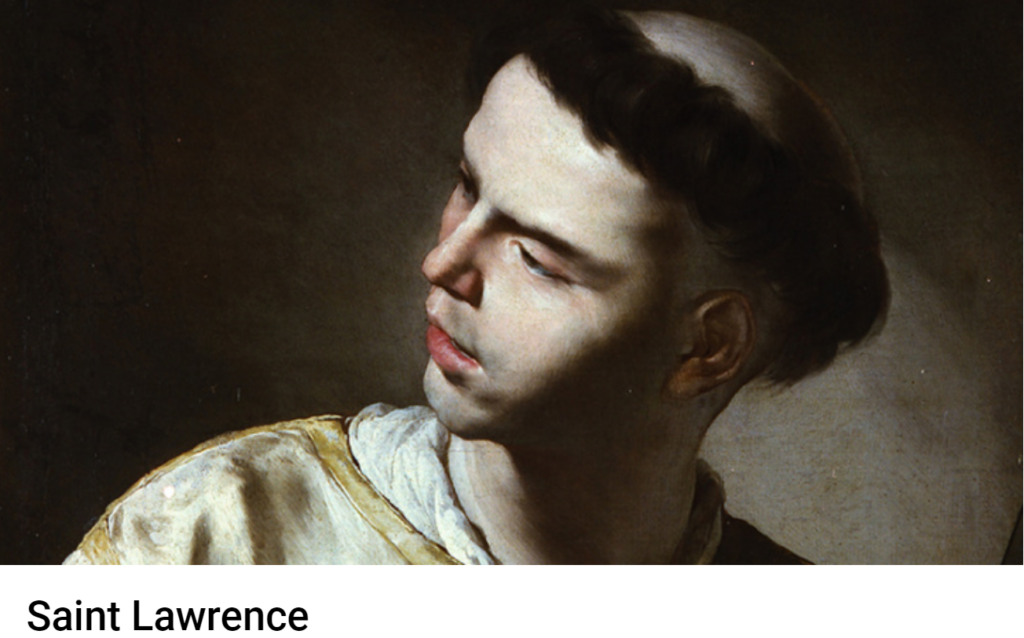
Saint of the Day – August 10 – Saint Lawrence

(C. 225 – AUGUST 10, 258)

Saint Lawrence’s Story

The esteem in which the Church holds Lawrence is seen in the fact that today’s celebration ranks as a feast. We know very little about his life. He is one of those whose martyrdom made a deep and lasting impression on the early Church. Celebration of his feast day spread rapidly.

He was a Roman deacon under Pope Saint Sixtus II. Four days after this pope was put to death, Lawrence and four clerics suffered martyrdom, probably during the persecution of the Emperor Valerian.

Legendary details of Lawrence’s death were known to Damasus, Prudentius, Ambrose, and Augustine. The church built over his tomb became one of the seven principal churches in Rome and a favorite place for Roman pilgrimages.

A well-known legend has persisted from earliest times. As deacon in Rome, Lawrence was charged with the responsibility for the material goods of the Church, and the distribution of alms to the poor. When Lawrence knew he would be arrested like the pope, he sought out the poor, widows, and orphans of Rome and gave them all the money he had on hand, selling even the sacred vessels of the altar to increase the sum. When the prefect of Rome heard of this, he imagined that the Christians must have considerable treasure. He sent for Lawrence and said, “You Christians say we are cruel to you, but that is not what I have in mind. I am told that your priests offer in gold, that the sacred blood is received in silver cups, that you have golden candlesticks at your evening services. Now, your doctrine says you must render to Caesar what is his. Bring these treasures—the emperor needs them to maintain his forces. God does not cause money to be counted: He brought none of it into the world with him—only words. Give me the money, therefore, and be rich in words.”

Lawrence replied that the Church was indeed rich. “I will show you a valuable part. But give me time to set everything in order and make an inventory.” After three days he gathered a great number of blind, lame, maimed, leprous, orphaned, and widowed persons and put them in rows. When the prefect arrived, Lawrence simply said, “These are the treasure of the Church.”

The prefect was so angry he told Lawrence that he would indeed have his wish to die—but it would be by inches. He had a great gridiron prepared with coals beneath it, and had Lawrence’s body placed on it. After the martyr had suffered the pain for a long time, the legend concludes, he made his famous cheerful remark, “It is well done. Turn me over!”

Reflection

Once again we have a saint about whom almost nothing is known, yet one who has received extraordinary honor in the Church since the fourth century. Almost nothing—yet the greatest fact of his life is certain: He died for Christ. We who are hungry for details about the lives of the saints are again reminded that their holiness was after all, a total response to Christ, expressed perfectly by a death like this.

Saint Lawrence is a Patron Saint of:

Cooks
Deacons
Poor

//Franciscan Media//


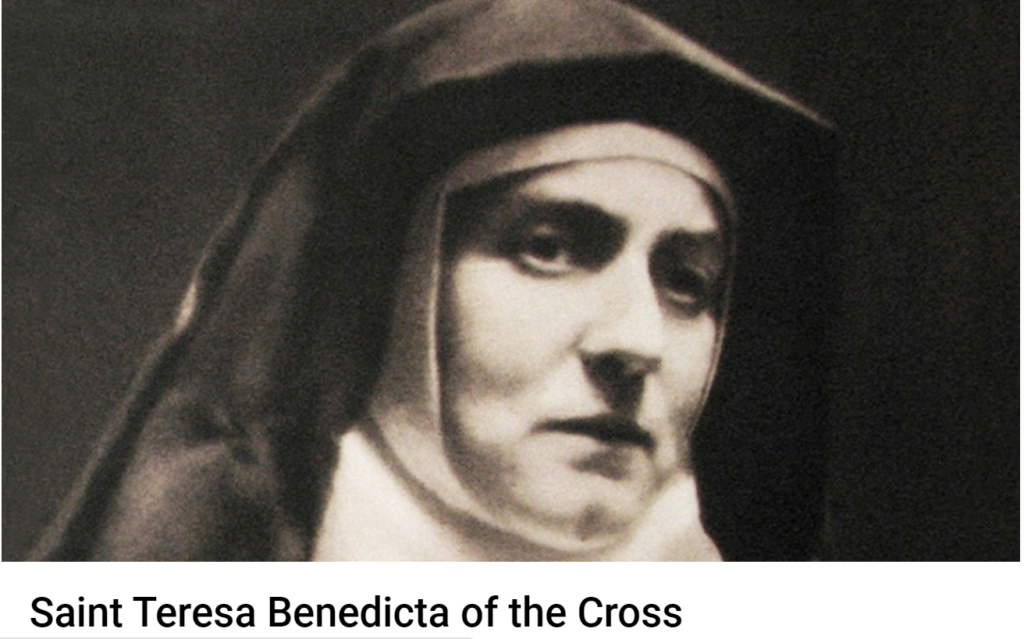
Saint of the Day – August 9 – Saint Teresa Benedicta of the Cross

(October 12, 1891 – August 9, 1942)
Saint Teresa Benedicta of the Cross’ Story

A brilliant philosopher who stopped believing in God when she was 14, Edith Stein was so captivated by reading the autobiography of Teresa of Avila that she began a spiritual journey that led to her baptism in 1922. Twelve years later she imitated Saint Teresa by becoming a Carmelite, taking the name Teresa Benedicta of the Cross.

Born into a prominent Jewish family in Breslau, Germany—now Wroclaw, Poland—Edith abandoned Judaism in her teens. As a student at the University of Göttingen, she became fascinated by phenomenology–an approach to philosophy. Excelling as a protégé of Edmund Husserl, one of the leading phenomenologists, Edith earned a doctorate in philosophy in 1916. She continued as a university teacher until 1922, when she moved to a Dominican school in Speyer; her appointment as lecturer at the Educational Institute of Munich ended under pressure from the Nazis.

After living for four years in the Cologne Carmel, Sister Teresa Benedicta moved to the Carmelite monastery in Echt, Netherlands, in 1938. The Nazis occupied that country in 1940. In retaliation for being denounced by the Dutch bishops, the Nazis arrested all Dutch Jews who had become Christians. Teresa Benedicta and her sister Rosa, also a Catholic, died in a gas chamber in Auschwitz on August 9, 1942.

Pope John Paul II beatified Teresa Benedicta of the Cross in 1987 and canonized her 12 years later.

Reflection

The writings of Edith Stein fill 17 volumes, many of which have been translated into English. A woman of integrity, she followed the truth wherever it led her. After becoming a Catholic, Edith continued to honor her mother’s Jewish faith. Sister Josephine Koeppel, O.C.D., translator of several of Edith’s books, sums up this saint with the phrase, “Learn to live at God’s hands.”

Saint Teresa Benedicta of the Cross is a Patron Saint of:

Converts to Christianity
Europe

//Franciscan Media//


5 Keys to Discern Anything

How to discern God’s will is one of Fr. Mark-Mary’s favorite topics. He has some principles he uses to guide his discernment. He narrows these principles down to four: needs, responsibilities, desires, and capacities. Needs: We need to be intimate with God’s word. He has already given us his word, but often we haven’t read it before discerning. Have a regular relationship with the Word of God. The primary place we should look to learn his will is in Scripture. Responsibilities: School, your career, or your living situation are examples of responsibilities that you should consider when figuring out God’s will for you. God probably isn’t calling you to travel the world as a missionary if you’re the father of five kids under seven. If you’re a student who needs to study, God probably is not calling you to go on a service trip with friends. Desires: Even though they shouldn’t determine everything, your desires do matter. If a desire doesn’t go against the other principles, then do it. Capacities: If you want to do service and grow in your relationship with God, understand your limitations. If you’re honest about your capacities, God will understand. Maybe you just don’t have the capacity to make that extra commitment. Whether or not you can do something is important, and if you can’t that’s nothing to be ashamed of. God is probably calling you to something else. If you push yourself too much you may end up hurting yourself and others. Lastly, we can all do a better job serving the needs of the poor. When discerning, do not forget what you can do for them. Remember, we are pilgrims. Little by little, we’re going to make it.


Do You Really Trust God?

The question “Do you really trust God?” was right in Father Mark-Mary’s face when a full-grown rhinoceros was running toward him in South Africa. The rangers with him and his group on that walking safari told the group to stop, but then the rhino charged at them. Its big ugly horn came closer and closer, but then the rangers did the most unexpected thing. They ran at the beast, screaming as loud as they could. Then the rhinoceros ran off. The lie that we can’t trust God is like that rhinoceros. Father Mark-Mary challenges us to run straight toward that lie, remembering these words from Christ: “And every one who has left houses or brothers or sisters or father or mother or children or lands, for my name’s sake, will receive a hundredfold, and inherit eternal life” (Matthew 19:29)


Struggling to Hear God?

If you’re struggling to hear God’s voice, take heart in Fr. Mark-Mary’s words of hope here. Complementing the advice given by Jackie and Bobby Angel in their new book, Fr. Mark-Mary encourages you to trust in God’s guidance. He recounts the time when he was working as a missionary in Honduras providing for the poorest families there. The decisions he had to make to ensure the most needy families received food from his mission weighed on him tremendously. Only by praying, deciding, and trusting in God’s providence was he able to proceed and provide the help the families needed. Especially in discerning his vocation as a Franciscan Friar of the Renewal, Fr. Mark-Mary put God’s will before all else. It seems to have paid off quite well, and that’s why he wants to embolden you to do the same.


Unsure About What to Do?

Mother Clare and Fr. Mark-Mary discuss how to live with uncertainty. Being uncertain about something isn’t entirely problematic, because uncertainty requires that we trust something or someone. Often we put that trust in empirical research, the scientific method, tried and true procedures, and so on. How often do we put our trust in God when we are uncertain about something, though. Sometimes trusting God requires letting go of our trust in ourselves. When Peter was invited by Jesus to walk onto the water, Peter had to let go of his understanding of reality. His uncertainty got the best of him after just a few steps, but perhaps there is a lesson in that as well. We often want God to give us the grace and certainty needed for several steps ahead, but he only gives us certainty in our next step so we have to trust each step we take. God gives you sufficient grace for today, not tomorrow, next week or fifty years from now.


An Essential Part of Christian Life

No time to pray? Then pray more. There’s a reason it’s an essential part of Christian life. That’s Father Mark-Mary’s advice, and he’s in good company, in fact he’s in saintly company. He recounts a story when Fr. Benedict Groeschel told St. Mother Teresa that he didn’t have time for a daily holy hour, and Mother Teresa told him then he should make two holy hours a day. She understood that prayer isn’t just a nice thing, prayer is a necessary thing. This advice points to the reality that if we have a busy day, we need to pray more—not less. We want to build great things for the Lord, but they must be built on a solid foundation of prayer and communication with God. In their daily journey to become more holy, this lesson has become vital to Father Mark-Mary and the Franciscan Friars of the Renewal.


How to REALLY Pray the Rosary

Fr. Mark-Mary discusses how to really pray the Rosary and go deeper than the external mechanics. Primarily it’s about relationship and not simply recitation. Fr. Mark-Mary explains three aspects of the Rosary on which we can contemplate: The person of Jesus Christ The words of the prayers, which are Scriptural The Mysteries, which cover the whole life of Jesus. There is so much to be found in this beautiful prayer, but its beauty can easily be overlooked. As Pope St. Paul VI said: “Without contemplation the Rosary is just a body without a soul.” It does no good to pray the Rosary while your mind and heart are somewhere different. If you’re new to praying the Rosary or have struggled to pray it, maybe just read one of the mysteries in Scripture and pray three Hail Marys. Fall in love with the Rosary little by little if that’s what it takes.