There are a lot of different kinds of prayers (liturgical, litanies, the rosary, the chaplet of divine mercy, etc.), but today Father hones in on mental prayer. Mental prayer—including lectio divina and Ignatian prayer—is about having a conversation with God and inviting him into your mind and your heart. But our minds are messy places, and our hearts are wounded. Should we really be talking to God about all of our thoughts, longings, and desires?
You probably have someone in your life that seems to be on the hunt for anything they can criticize. It might not be a friend, a coworker, or a family member. It might just be yourself.
Today, Fr. Mike explains how to turn your inner critic into your inner coach.
Learn more about Fr. Mike Schmitz and Fr. Josh Johnson’s Pocket Guide to the Sacrament of Reconciliation: https://tinyurl.com/yhwfakge
Confession is a place of never ending mercy and forgiveness, and is one of the most beautiful parts of our Catholic faith. But for many, it can also be a very daunting experience, especially if it’s been a long time since your last confession. Whether it’s the first time you’ve gone in a year, or it’s the first time you’ve gone in your life, God is ready and willing to forgive your sins. All we have to do is let him into our hearts.
Today, Fr. Mike explains how to approach going to confession for the first time in a long time.
Is it just us, or does the world seem a bit divided right now?
Human beings were not only created with a unique purpose, but also created to live in community. However, there are two things that can disrupt this call: division and distraction. Why these two? Well, distractions are things that take us away from a given task or goal, taking us away from living with a purpose. Likewise, division takes away from living in community with those around us.
The twentieth century brought with it innumerable inventions of distraction: things like television, radio, computers, etc. All of these products are great innovations that have moved us forward in our abilities to create community and showcase our unique strengths, but they’ve also put distraction at our fingertips.
It’s not just technology that has caused distractions either. We can become distracted by virtually anything: chores, work, leisurely activities. But when we’re distracted, we’re held back from the task at hand, and the ongoing task for all of us is to live in community, and live with purpose.
What does that mean for something like politics? Well, if you’re American, you basically have two political responsibilities as an American citizen: educate yourself well on the politics in your country, and vote whenever elections come around. Anything other than those two tasks are distractions from the purpose of politics.
When it comes to division, our country has definitely had its fair share. So how do we fight against this division that seems to be splitting our country? Through conversation and through kindness. We’re called to be united in community with those around us, so much so that Jesus refers to them as our brothers and sisters. Division won’t be conquered easily, but if we’re willing to converse, listen, and treat each other with kindness, we can get a couple strides closer to the community God desires for us.
If the media has you confused about what should be informing your vote, inform your conscience with over 2,000 years of Church teaching. Read Clear Conscience: A Catholic Guide to Voting (http://tinyurl.com/y3ejf2xj) and get ready to vote!
Chances are that if you’ve been on social media or listened to the news in the past year, you’ve heard of “cancel culture.” Cancel culture is that practice of boycotting a person or group of people because of controversial actions or opinions. While it might have a fancy new name, this is nothing new to history. Every time period has had some individuals or practices that society deems as controversial or questionable. But are we supposed to practice this kind of behavior as Christians?
Today, Fr. Mike talks about cancel culture, and how we as Christians are called to respond to it.
“It is good to guard the secret of a king, but gloriously to reveal the works of God, and with fitting honor to acknowledge him.” – Tobit 12:7
How often do you acknowledge the works of God? How often do you recognize what he’s doing in your life? In this passage from Tobit, the Archangel Raphael is encouraging us to pay attention to the works of God—not only in our lives, but in the lives of those around us. He is constantly present, even in our most mundane tasks. But how often do we notice his works, note his presence and goodness, and declare it to the world?
Today, Fr. Mike encourages us to acknowledge the presence of God in our lives through 3 steps: noticing, noting, and declaring.
This is just an introduction to discovering God in your everyday life. To go deeper, check out Danielle Bean’s new book, Whisper: Finding God in the Everyday.
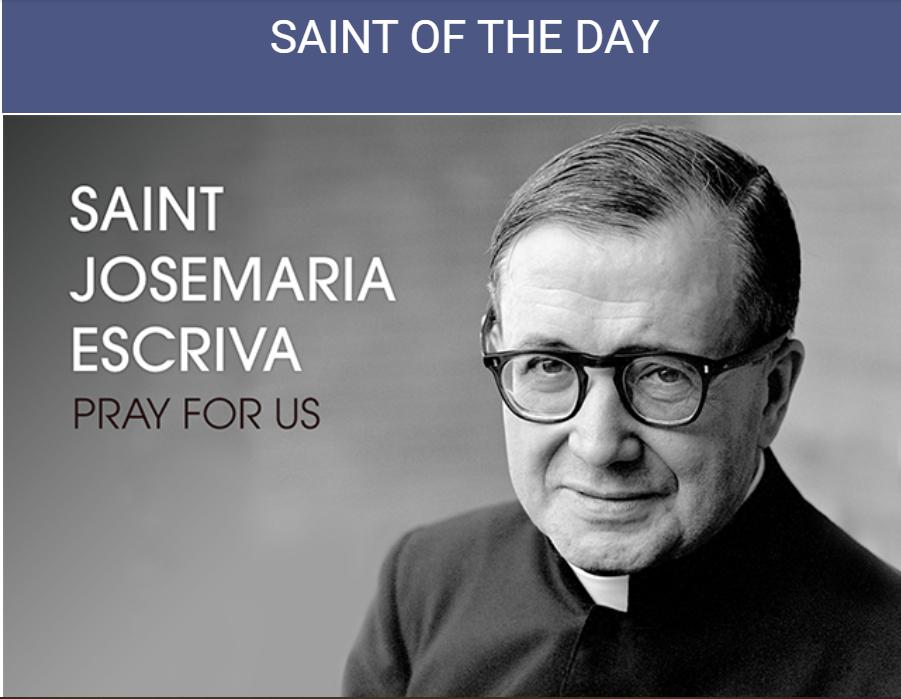
St. Josemaria Escriva (1902-1975) was born in Spain, one of six children of a devout Catholic family. Growing up, he observed his parents faithfully endure painful family trials (the death of three of their young children and devastating financial setbacks) and this had a profound effect on his own faith. As a teenager he discovered his vocation to the priesthood when he saw the path of footprints in the snow left by a barefoot Carmelite friar. He then experienced a radical conversion: he gave up his intended career as an architect and entered the seminary. He spent most of his life studying and teaching in universities, earning a doctorate in civil law and theology. Saint Josemaria Escriva’s lasting impact lies in the foundation of Opus Dei (“The Work of God”), an organization of laity and priests dedicated to the universal call of holiness and the belief that ordinary, daily life is an authentic path to sanctity. Today Opus Dei has over 80,000 members worldwide. His famous written work is The Way, a collection of spiritual and pastoral reflections on the gospels and their application to everyday life. On June 26, 1975, after glancing at an image of Our Lady of Guadalupe in his office in Rome, St. Josemaría died suddenly of cardiac arrest. He was canonized by Pope St. John Paul II. His feast day is June 26th.
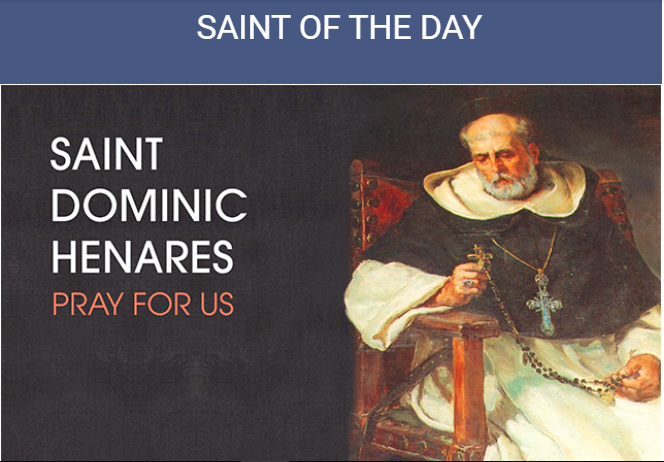
St. Dominic Henares (1764-1838) was born to a poor family in Spain. He joined the Dominican Order and was ordained a priest in 1790. Ten years later he was sent as a missionary to the Far East. He went from Mexico to the Philippines, and finally to North Vietnam. He became Bishop of Phunhay, Vietnam, in 1803. In 1831 the Vietnamese emperor officially prohibited Catholicism and severely persecuted the Church. Whole villages were sent into exile; priests were arrested and subjected to the most terrible tortures before they were killed. Those who helped capture them were richly rewarded. Bishop Henares was arrested and beheaded in Nam Dinh on June 25, 1838; the soldiers and villagers who participated in his arrest received generous compensation. St. Dominic Henares is one of an estimated 130,000 to 300,000 Catholics martyred for the faith in Vietnam between the 15th and 20th centuries. They were canonized together by Pope St. John Paul II in 1988. St. Dominic Henares’ feast day is June 25, and the collective memorial for 117 of the Vietnamese Martyrs is November 24.
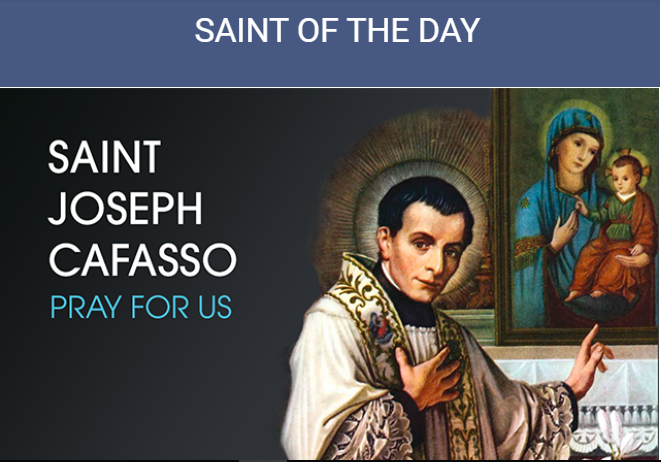
St. Joseph Cafasso (1811–1860) was born in Castelnuovo d’Asti, Italy, to a peasant family. He was born with a physical deformity of the spine, which caused him to grow into a stunted and crippled man. Discerning a call to Holy Orders, he entered the seminary in Turin where he later met another famous saint—John Bosco. Joseph taught John Bosco and encouraged him in his mission to minister to the town’s impoverished street youth. Joseph was an excellent professor of moral theology, as well as a famed preacher and confessor. He performed his duties so well that he became known as the “Priest’s Priest.” He spent entire days preaching in prisons, offering comfort to the prisoners, hearing their confessions, and even advocating to improve the poor conditions of the prison. For this work he also earned the name, “Priest of the Gallows.” St. Joseph Cafasso is the patron saint of prisoners, prisons, and prison chaplains. His feast day is June 23rd.
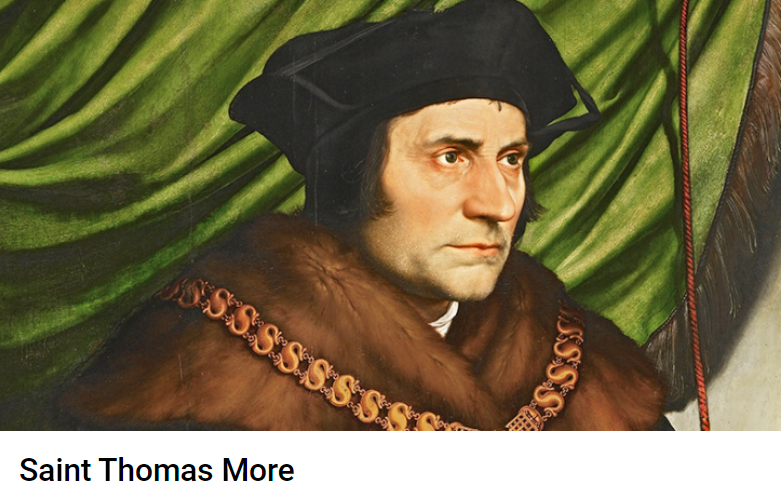
His belief that no lay ruler has jurisdiction over the Church of Christ cost Thomas More his life.
Beheaded on Tower Hill, London, on July 6, 1535, More steadfastly refused to approve King Henry VIII’s divorce and remarriage and establishment of the Church of England.
Described as “a man for all seasons,” More was a literary scholar, eminent lawyer, gentleman, father of four children, and chancellor of England. An intensely spiritual man, he would not support the king’s divorce from Catherine of Aragon in order to marry Anne Boleyn. Nor would he acknowledge Henry as supreme head of the Church in England, breaking with Rome, and denying the pope as head.
More was committed to the Tower of London to await trial for treason: not swearing to the Act of Succession and the Oath of Supremacy. Upon conviction, More declared he had all the councils of Christendom and not just the council of one realm to support him in the decision of his conscience.
Reflection
Four hundred years later in 1935, Thomas More was canonized a saint of God. Few saints are more relevant to our time. In the year 2000, in fact, Pope John Paul II named him patron of political leaders. The supreme diplomat and counselor, he did not compromise his own moral values in order to please the king, knowing that true allegiance to authority is not blind acceptance of everything that authority wants. King Henry himself realized this and tried desperately to win his chancellor to his side because he knew More was a man whose approval counted, a man whose personal integrity no one questioned. But when Thomas More resigned as chancellor, unable to approve the two matters that meant most to Henry, the king had to get rid of him.
Saint Thomas More is the Patron Saint of:
Attorneys Civil Servants Court Clerks Lawyers Politicians Public Servants