Saint of the Day – February 25th

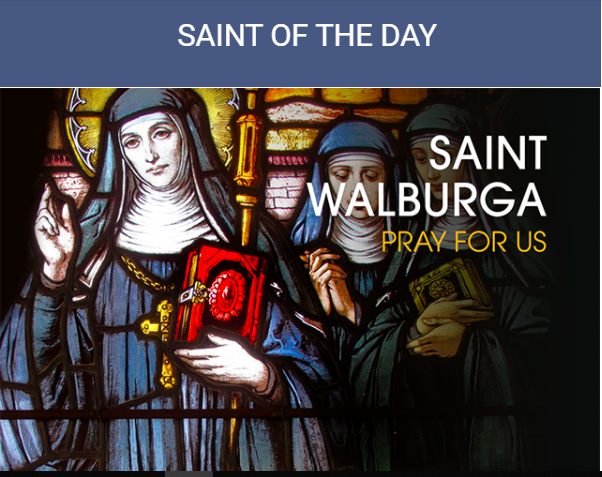
St. Walburga (710-777 A.D.) was born near Devonshire, England, the daughter of St. Richard the Pilgrim (a Saxon king) and the sister of Sts. Willibald and Winebald. When she was eleven her father and brothers went on pilgrimage to the Holy Land, while her father placed her in a convent famous for its holiness. She was well educated according to her rank, became a nun, and lived there for twenty-six years. Her uncle, St. Boniface, then brought her to what is now Germany to help him evangelize that country and establish the Church there. In this missionary activity she joined her brothers who were also laboring for the faith in that country, one as an abbot, the other as a bishop.

Because of Walburga’s education, she was able to document the travels of her brother in the Holy Land, and for this work she became the first female author of England and Germany. She was known as a miracle worker and healer both in her life and after her death.

St. Walburga’s relics have the miraculous property of exuding oil to which many cures have been ascribed through the centuries. St. Walburga is the patron saint of sailors, mariners, and farmers, and against hydrophobia, famine, coughs, rabies, plague, and storms. St. Walburga’s feast day is February 25th.
Saint of the Day – February 24th

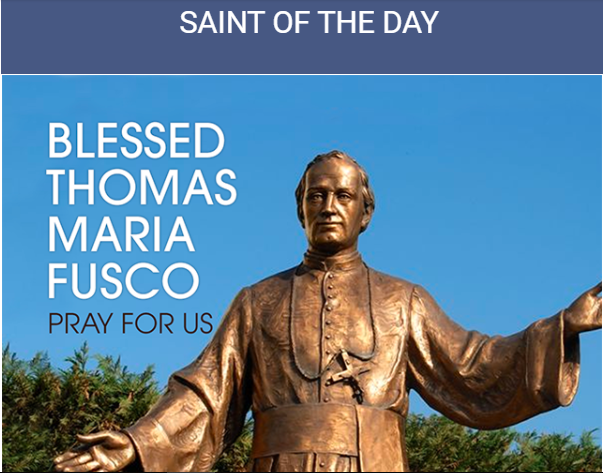
Bl. Thomas Maria Fusco (1831-1891) was born to a noble and pious family in Italy, the seventh of eight children. He was orphaned at an early age and raised by his uncle, a priest, who oversaw his education. He had a deep love for the faith, especially to the Passion of Christ and Our Lady of Sorrows. He became a priest at the age of 24 and opened a school in his own home. He later became an itinerant missionary throughout southern Italy. After traveling for a number of years he opened another school, this time to train priests on how to be good confessors. He also founded the Priestly Society of the Catholic Apostolate to support the missions, which gained papal approval. During his work with the poor he discerned a call to start a new religious order of sisters, the Daughters of Charity of the Most Precious Blood, to minister to orphaned children. In addition to all of this, Fusco was also a parish priest, a confessor to a group of cloistered nuns, and a spiritual father to a lay group at the nearby Shrine of Our Lady of Mount Carmel. He died of liver disease at the age of 59. He was beatified by Pope St. John Paul II in 2001. His feast day is February 24.


Saint of the Day – February 18th

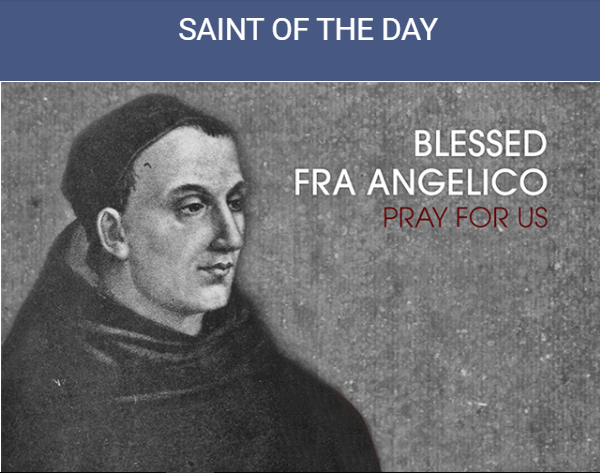
Bl. Fra Angelico (1387-1455) was born Guido di Pietro in Tuscany, Italy. Little is known of his early life, but he became a famous early Italian Renaissance master painter. Fra Angelico would pray earnestly before he painted, being convinced that in order to paint Christ perfectly, one must also be Christlike. His paintings then became tools for contemplating the theological mysteries hidden in the biblical events he depicted. He joined the Dominican Order in 1407 and was given the name Brother John, often called “Angelic Brother John”, or Fra Angelico (Angelic Friar) because of his holiness. He lived and worked in several friaries until moving to the Friary of San Marco in Florence. While in Florence he was surrounded by an artistic community, and, due to his great talent, gained the patronage of the famous Medici family.  In 1445 he was summoned to Rome to work on St. Peter’s Basilica in various chapels. From 1449 until shortly before his death, Fra Angelico was also prior of the convent in Fiesole. He passed away while working again in Rome and is buried in the Dominican church of Santa Maria Sopra Minerva. Fra Angelico was beatified by Pope St. John Paul II and is the patron saint of Catholic artists. His feast day is February 18.

//The Catholic Company//


Saint of the Day – February 15th

(FEBRUARY 2, 1641 – FEBRUARY 15, 1682)
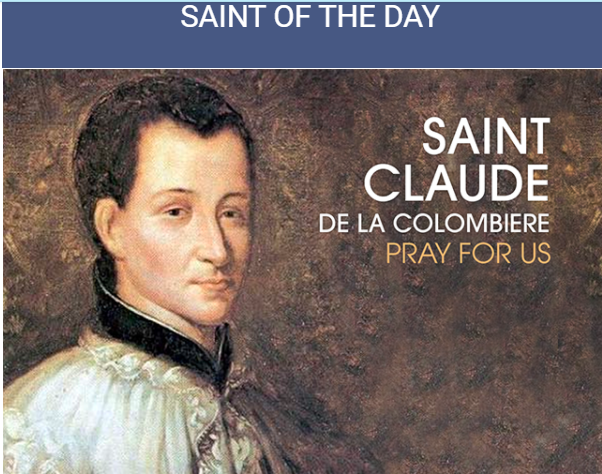
Saint Claude de la Colombière’s Story

This is a special day for the Jesuits, who claim today’s saint as one of their own. It’s also a special day for people who have a special devotion to the Sacred Heart of Jesus—a devotion Claude de la Colombière promoted, along with his friend and spiritual companion, Saint Margaret Mary Alacoque. The emphasis on God’s love for all was an antidote to the rigorous moralism of the Jansenists, who were popular at the time.

Claude showed remarkable preaching skills long before his ordination in 1675. Two months later, he was made superior of a small Jesuit residence in Burgundy. It was there he first encountered Margaret Mary Alacoque. For many years after he served as her confessor.

He was next sent to England to serve as confessor to the Duchess of York. He preached by both words and by the example of his holy life, converting a number of Protestants. Tensions arose against Catholics and Claude, rumored to be part of a plot against the king, was imprisoned. He was ultimately banished, but by then his health had been ruined.

He died in 1682. Pope John Paul II canonized Claude de la Colombière in 1992.

Reflection

As a fellow Jesuit and as a promoter of the devotion to the Sacred Heart of Jesus, Saint Claude must be very special to Pope Francis who has so beautifully emphasized the mercy of Jesus. The emphasis on God’s love and mercy are characteristic of both men.


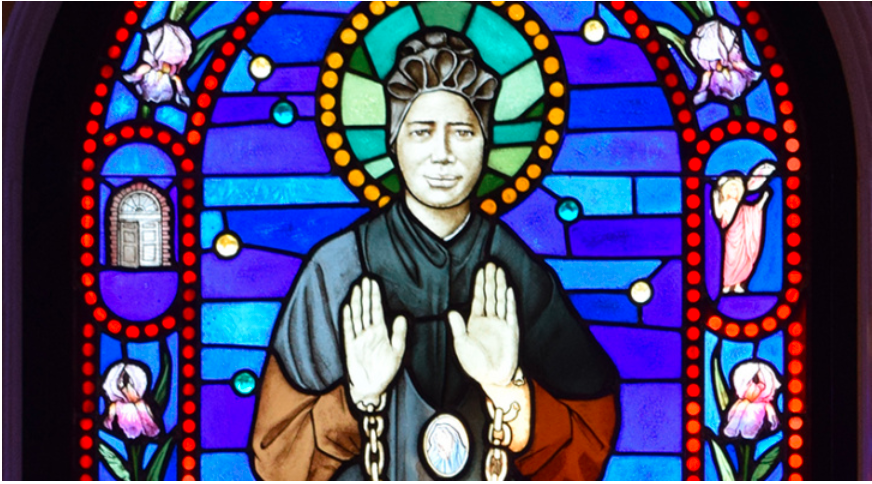
Saint of the Day – February 8th – Saint Josephine Bakhita

Image: Stained Glass of St. Josephine Bakhita, Saint John Paul II Chapel, Mundelein | photo by Fr. Gaurav Shroff | flickr

Saint Josephine Bakhita’s Story

For many years, Josephine Bakhita (c. 1869 – February 8, 1947) was a slave but her spirit was always free and eventually that spirit prevailed.

Born in Olgossa in the Darfur region of southern Sudan, Josephine was kidnapped at the age of 7, sold into slavery and given the name Bakhita, which means fortunate. She was resold several times, finally in 1883 to Callisto Legnani, Italian consul in Khartoum, Sudan.

Two years later, he took Josephine to Italy and gave her to his friend Augusto Michieli. Bakhita became babysitter to Mimmina Michieli, whom she accompanied to Venice’s Institute of the Catechumens, run by the Canossian Sisters. While Mimmina was being instructed, Josephine felt drawn to the Catholic Church. She was baptized and confirmed in 1890, taking the name Josephine.

When the Michielis returned from Africa and wanted to take Mimmina and Josephine back with them, the future saint refused to go. During the ensuing court case, the Canossian Sisters and the patriarch of Venice intervened on Josephine’s behalf. The judge concluded that since slavery was illegal in Italy, she had actually been free since 1885.

Josephine entered the Institute of St. Magdalene of Canossa in 1893 and made her profession three years later. In 1902, she was transferred to the city of Schio (northeast of Verona), where she assisted her religious community through cooking, sewing, embroidery, and welcoming visitors at the door. She soon became well loved by the children attending the sisters’ school and the local citizens. She once said, “Be good, love the Lord, pray for those who do not know Him. What a great grace it is to know God!”

The first steps toward her beatification began in 1959. She was beatified in 1992 and canonized eight years later.

Reflection

Josephine’s body was mutilated by those who enslaved her, but they could not touch her spirit. Her Baptism set her on an eventual path toward asserting her civic freedom and then service to God’s people as a Canossian Sister.

She who worked under many “masters” was finally happy to address God as “master” and carry out everything that she believed to be God’s will for her.


Saint of the Day – February 7th

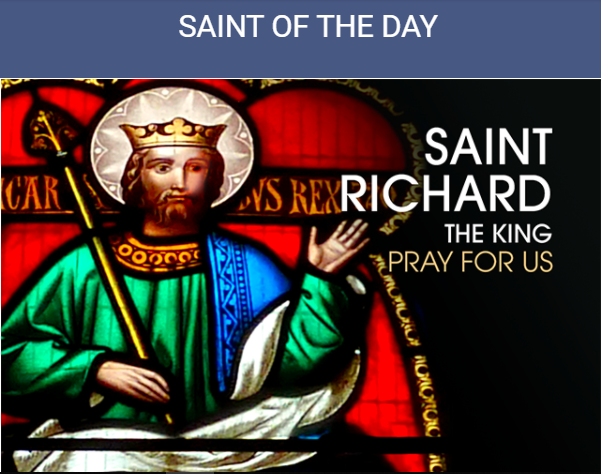
St. Richard the King (c. 720 A.D.), also known as Richard the Pilgrim, was a Saxon king born in Wessex, England, who was related by blood to the royal house of Kent. His brother-in-law was St. Boniface, and three of his children are numbered among the saints: St. Willibald, St. Winnebald, and St. Walburga.

When Willibald was gravely ill as a child, Richard’s prayers for his son are said to have saved his life. He wrapped his child in a blanket and took him to the foot of a large crucifix erected near their village, and the child recovered. When Willibald was grown, he convinced his father and brother to accompany him on a missionary pilgrimage to Rome and the Holy Land. St. Richard agreed, renounced his royal estate, and embarked on the journey with his two sons, while his daughter entered a convent. In Italy he became sick and died, and was buried in Tuscany at the Church of San Frediano. Numerous miracles are reported to have occurred at his tomb. Some of his relics were transported to Eichstatt, Germany, where his son Winnebald would become Bishop. His feast day is celebrated on February 7th.


Saint of the Day – February 6th

D. 1597

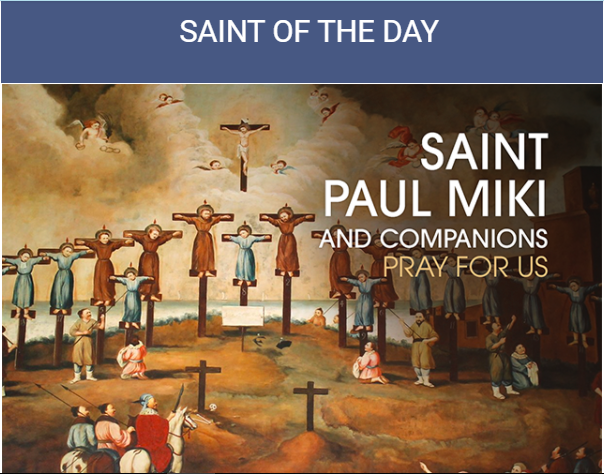
Saint Paul Miki and Companions’ Story

Nagasaki, Japan, is familiar to Americans as the city on which the second atomic bomb was dropped, immediately killing over 37,000 people. Three and a half centuries before, 26 martyrs of Japan were crucified on a hill, now known as the Holy Mountain, overlooking Nagasaki. Among them were priests, brothers, and laymen, Franciscans, Jesuits, and members of the Secular Franciscan Order; there were catechists, doctors, simple artisans, and servants, old men and innocent children—all united in a common faith and love for Jesus and his Church.

Brother Paul Miki, a Jesuit and a native of Japan, has become the best known among the martyrs of Japan. While hanging upon a cross, Paul Miki preached to the people gathered for the execution: “The sentence of judgment says these men came to Japan from the Philippines, but I did not come from any other country. I am a true Japanese. The only reason for my being killed is that I have taught the doctrine of Christ. I certainly did teach the doctrine of Christ. I thank God it is for this reason I die. I believe that I am telling only the truth before I die. I know you believe me and I want to say to you all once again: Ask Christ to help you to become happy. I obey Christ. After Christ’s example I forgive my persecutors. I do not hate them. I ask God to have pity on all, and I hope my blood will fall on my fellow men as a fruitful rain.”

When missionaries returned to Japan in the 1860s, at first they found no trace of Christianity. But after establishing themselves they found that thousands of Christians lived around Nagasaki and that they had secretly preserved the faith. Beatified in 1627, the martyrs of Japan were finally canonized in 1862.

Reflection

Today, a new era has come for the Church in Japan. Although the number of Catholics is not large, the Church is respected and has total religious freedom. The spread of Christianity in the Far East is slow and difficult. Faith such as that of the 26 martyrs is needed today as much as in 1597.


Saint of the Day – February 5th

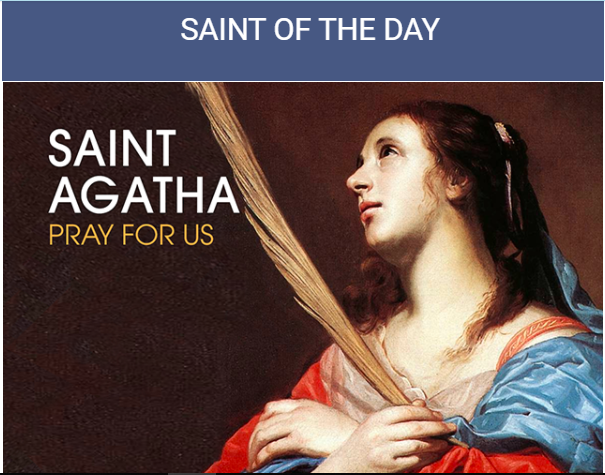
Saint Agatha’s Story

As in the case of Agnes (C. 230 – 251), another virgin-martyr of the early Church, almost nothing is historically certain about this saint except that she was martyred in Sicily during the persecution of Emperor Decius in 251.

Legend has it that Agatha, like Agnes, was arrested as a Christian, tortured, and sent to a house of prostitution to be mistreated. She was preserved from being violated, and was later put to death.

She is claimed as the patroness of both Palermo and Catania. The year after her death, the stilling of an eruption of Mt. Etna was attributed to her intercession. As a result, apparently, people continued to ask her prayers for protection against fire.

Reflection

The scientific modern mind winces at the thought of a volcano’s might being contained by God because of the prayers of a Sicilian girl. Still less welcome, probably, is the notion of that saint being the patroness of such varied professions as those of foundry workers, nurses, miners and Alpine guides. Yet, in our historical precision, have we lost an essential human quality of wonder and poetry, and even our belief that we come to God by helping each other, both in action and prayer?

Saint Agatha is the Patron Saint of:

Diseases of the Breast
Nurses


Saint of the Day – February 4th

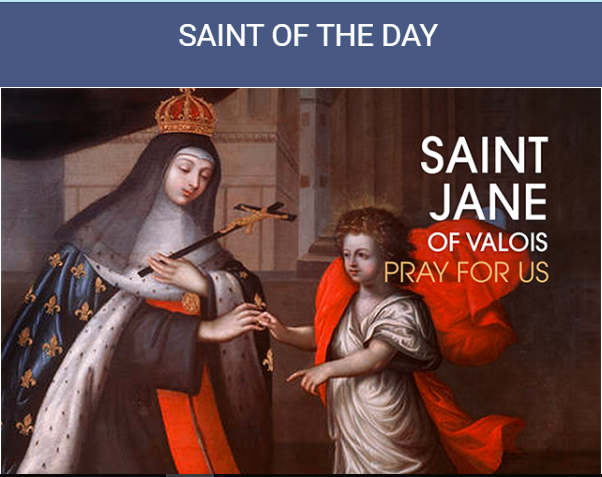
St. Jane of Valois (1464-1505) was born to French King Louis XI and Charlotte of Savoy. Much of her life was marked by neglect and emotional abuse. Her father resented her because she was a sickly and deformed female child. He sent her away to a remote country home where she was carelessly raised before being married off at the age of nine to her cousin, the Duke of Orléans. Her husband likewise despised and publicly humiliated her, and their marriage was never consummated.

Jane had a devotion to the Blessed Virgin Mary from a young age, especially in the mystery of the Incarnation. One day Our Lady appeared to Jane and told her that in the future she would found a religious community. Through her veneration of the Blessed Mother, Jane found the strength to be a loyal and devoted wife during her painful twenty-two year marriage. When her husband became king, he had their marriage annulled. This left Jane free to found the Order of the Annunciation dedicated to imitating Mary’s virtues, as Our Lady foretold. She also gave her Order the duty of constant prayer for the souls of her father and husband who both mistreated her.

St. Jane of Valois’ feast day is February 4th.


Saint of the Day – February 3, 2021

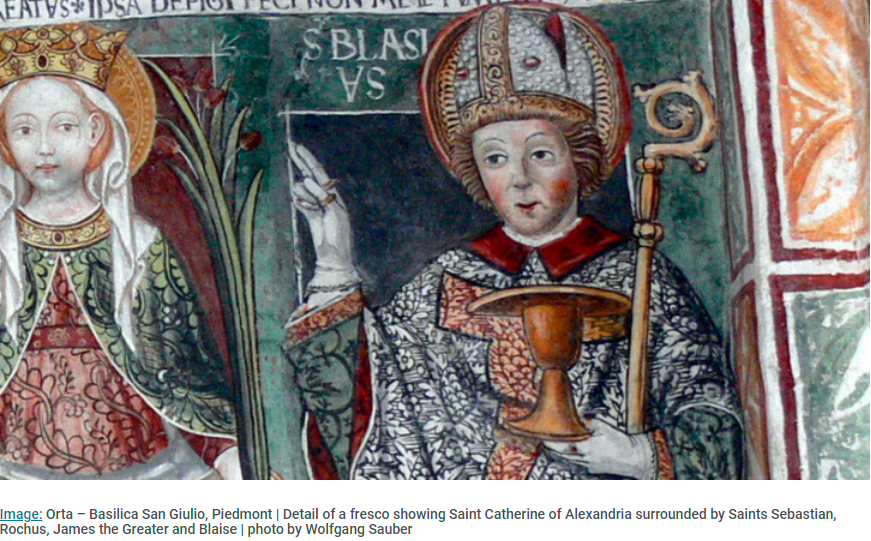
Saint Blaise (d. 316 A.D.)

Saint Blaise’s Story

We know more about the devotion to Saint Blaise by Christians around the world than we know about the saint himself. His feast is observed as a holy day in some Eastern Churches. In 1222, the Council of Oxford prohibited servile labor in England on Blaise’s feast day. The Germans and Slavs hold him in special honor, and for decades many United States Catholics have sought the annual Saint Blaise blessing for their throats.

We know that Bishop Blaise was martyred in his episcopal city of Sebastea, Armenia, in 316. The legendary Acts of St. Blaise were written 400 years later. According to them Blaise was a good bishop, working hard to encourage the spiritual and physical health of his people. Although the Edict of Toleration (311), granting freedom of worship in the Roman Empire, was already five years old, persecution still raged in Armenia. Blaise was apparently forced to flee to the back country. There he lived as a hermit in solitude and prayer, but he made friends with the wild animals. One day a group of hunters seeking wild animals for the amphitheater stumbled upon Blaise’s cave. They were first surprised and then frightened. The bishop was kneeling in prayer surrounded by patiently waiting wolves, lions and bears.

The legend has it that as the hunters hauled Blaise off to prison, a mother came with her young son who had a fish bone lodged in his throat. At Blaise’s command the child was able to cough up the bone.

Agricolaus, governor of Cappadocia, tried to persuade Blaise to sacrifice to pagan idols. The first time Blaise refused, he was beaten. The next time he was suspended from a tree and his flesh torn with iron combs or rakes. Finally, he was beheaded.

Reflection

Four centuries give ample opportunity for fiction to creep in with fact. Who can be sure how accurate Blaise’s biographer was? But biographical details are not essential. Blaise is seen as one more example of the power those have who give themselves entirely to Jesus. As Jesus told his apostles at the Last Supper, “If you remain in me and my words remain in you, ask for whatever you want and it will be done for you” (John 15:7). With faith we can follow the lead of the Church in asking for Blaise’s protection.

Saint Blaise is the Patron Saint of:

Throat Ailments
English Wool Combers