Saint of the Day – March 9th


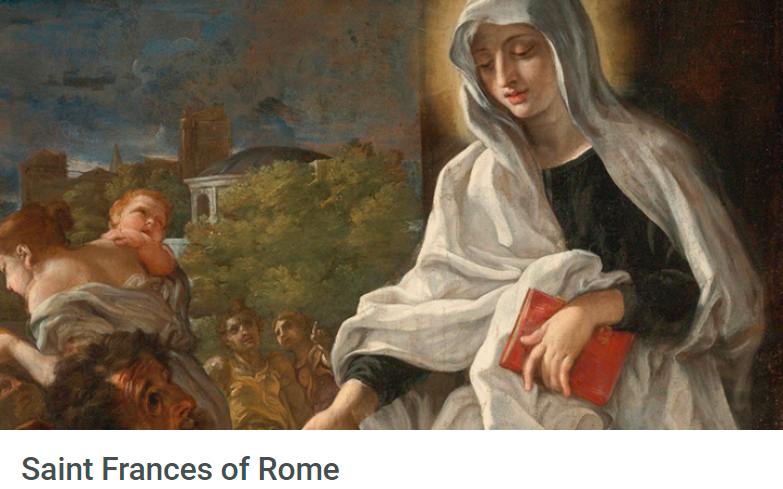
Saint Frances of Rome (1384 – March 9, 1440

Frances’ life combines aspects of secular and religious life. A devoted and loving wife, she longed for a lifestyle of prayer and service, so she organized a group of women to minister to the needs of Rome’s poor.

Born of wealthy parents, Frances found herself attracted to the religious life during her youth. But her parents objected and a young nobleman was selected to be her husband.

As she became acquainted with her new relatives, Frances soon discovered that the wife of her husband’s brother also wished to live a life of service and prayer. So the two, Frances and Vannozza, set out together—with their husbands’ blessings—to help the poor.

Frances fell ill for a time, but this apparently only deepened her commitment to the suffering people she met. The years passed, and Frances gave birth to two sons and a daughter. With the new responsibilities of family life, the young mother turned her attention more to the needs of her own household.

The family flourished under Frances’ care, but within a few years a great plague began to sweep across Italy. It struck Rome with devastating cruelty and left Frances’ second son dead. In an effort to help alleviate some of the suffering, Frances used all her money and sold her possessions to buy whatever the sick might possibly need. When all the resources had been exhausted, Frances and Vannozza went door to door begging. Later, Frances’ daughter died, and the saint opened a section of her house as a hospital.

Reflection

Looking at the exemplary life of fidelity to God and devotion to her fellow human beings which Frances of Rome was blessed to lead, one cannot help but be reminded of Saint Teresa of Calcutta, who loved Jesus Christ in prayer and also in the poor. The life of Frances of Rome calls each of us not only to look deeply for God in prayer, but also to carry our devotion to Jesus living in the suffering of our world. Frances shows us that this life need not be restricted to those bound by vows.

Saint Frances of Rome is the Patron Saint of:

Motorists
Widows

Saint of the Day – March 8th

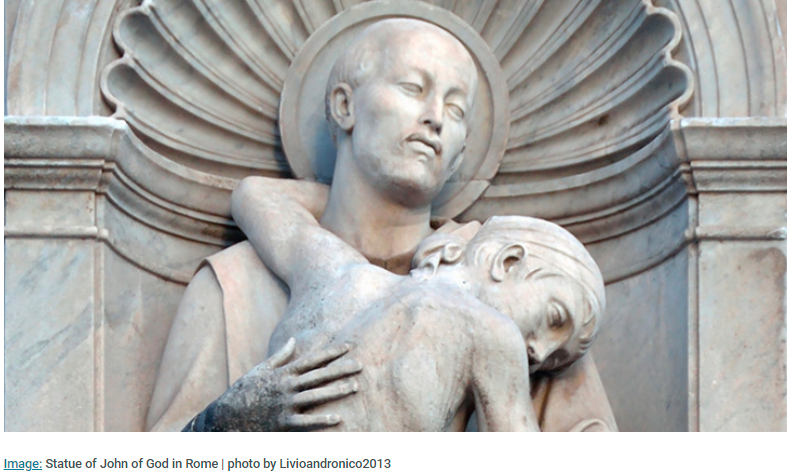
Saint John of God (March 8, 1495 – March 8, 1550)

Having given up active Christian belief while a soldier, John was 40 before the depth of his sinfulness began to dawn on him. He decided to give the rest of his life to God’s service, and headed at once for Africa where he hoped to free captive Christians and, possibly, be martyred.

He was soon advised that his desire for martyrdom was not spiritually well based, and returned to Spain and the relatively prosaic activity of a religious goods store. Yet he was still not settled. Moved initially by a sermon of Saint John of Avila, he one day engaged in a public beating of himself, begging mercy and wildly repenting for his past life.

Committed to a mental hospital for these actions, John was visited by Saint John, who advised him to be more actively involved in tending to the needs of others rather than in enduring personal hardships. John gained peace of heart, and shortly after left the hospital to begin work among the poor.

He established a house where he wisely tended to the needs of the sick poor, at first doing his own begging. But, excited by the saint’s great work and inspired by his devotion, many people began to back him up with money and provisions. Among them were the archbishop and marquis of Tarifa.

Behind John’s outward acts of total concern and love for Christ’s sick poor was a deep interior prayer life which was reflected in his spirit of humility. These qualities attracted helpers who, 20 years after John’s death, formed the Brothers Hospitallers, now a worldwide religious order.

John became ill after 10 years of service, but tried to disguise his ill health. He began to put the hospital’s administrative work into order and appointed a leader for his helpers. He died under the care of a spiritual friend and admirer, Lady Ana Ossorio.


Reflection

The utter humility of John of God, which led to a totally selfless dedication to others, is most impressive. Here is a man who realized his nothingness in the face of God. The Lord blessed him with the gifts of prudence, patience, courage, enthusiasm, and the ability to influence and inspire others. He saw that in his early life he had turned away from the Lord, and, moved to receive his mercy, John began his new commitment to love others in openness to God’s love.

Saint John of God is the Patron Saint of:

Booksellers
Firefighters
Heart Patients
Hospitals
Nurses
Printers
Sick


Saint of the Day – March 7th

(d. 203)

Audio file


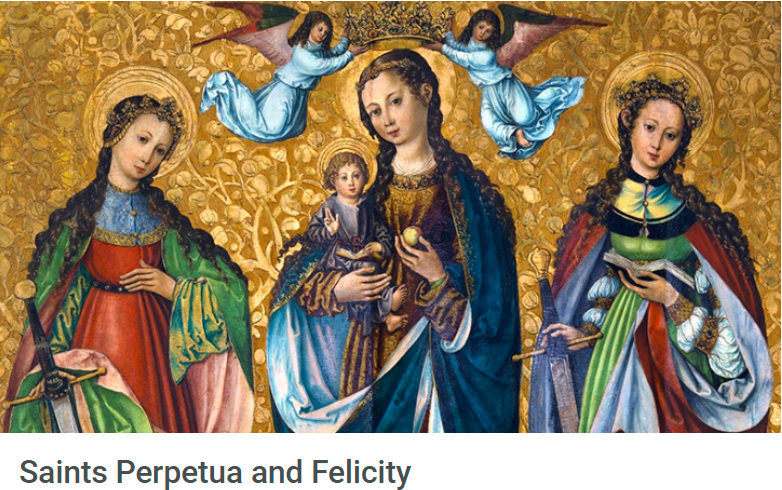
Saints Perpetua and Felicity’s Story

“When my father in his affection for me was trying to turn me from my purpose by arguments and thus weaken my faith, I said to him, ‘Do you see this vessel—waterpot or whatever it may be? Can it be called by any other name than what it is?’ ‘No,’ he replied. ‘So also I cannot call myself by any other name than what I am—a Christian.’”

So writes Perpetua: young, beautiful, well-educated, a noblewoman of Carthage in North Africa, mother of an infant son and chronicler of the persecution of the Christians by Emperor Septimius Severus.

Perpetua’s mother was a Christian and her father a pagan. He continually pleaded with her to deny her faith. She refused and was imprisoned at 22.

In her diary, Perpetua describes her period of captivity: “What a day of horror! Terrible heat, owing to the crowds! Rough treatment by the soldiers! To crown all, I was tormented with anxiety for my baby…. Such anxieties I suffered for many days, but I obtained leave for my baby to remain in the prison with me, and being relieved of my trouble and anxiety for him, I at once recovered my health, and my prison became a palace to me and I would rather have been there than anywhere else.”

Despite threats of persecution and death, Perpetua, Felicity–a slavewoman and expectant mother–and three companions, Revocatus, Secundulus and Saturninus, refused to renounce their Christian faith. For their unwillingness, all were sent to the public games in the amphitheater. There Perpetua and Felicity were beheaded, and the others killed by beasts.

Felicity gave birth to a girl a few days before the games commenced.

Perpetua’s record of her trial and imprisonment ends the day before the games. “Of what was done in the games themselves, let him write who will.” The diary was finished by an eyewitness.


Reflection

Persecution for religious beliefs is not confined to Christians in ancient times. Consider Anne Frank, the Jewish girl who with her family, was forced into hiding and later died in Bergen-Belsen, one of Hitler’s death camps during World War II. Anne, like Perpetua and Felicity, endured hardship and suffering and finally death because she committed herself to God. In her diary, Anne writes, “It’s twice as hard for us young ones to hold our ground, and maintain our opinions, in a time when all ideals are being shattered and destroyed, when people are showing their worst side, and do not know whether to believe in truth and right and God.”


Saint Felicity is the Patron Saint of:

Widows
Mothers of Deceased Sons


Saint of the Day – March 5th

( AUGUST 15, 1654 – MARCH 5, 1734)’

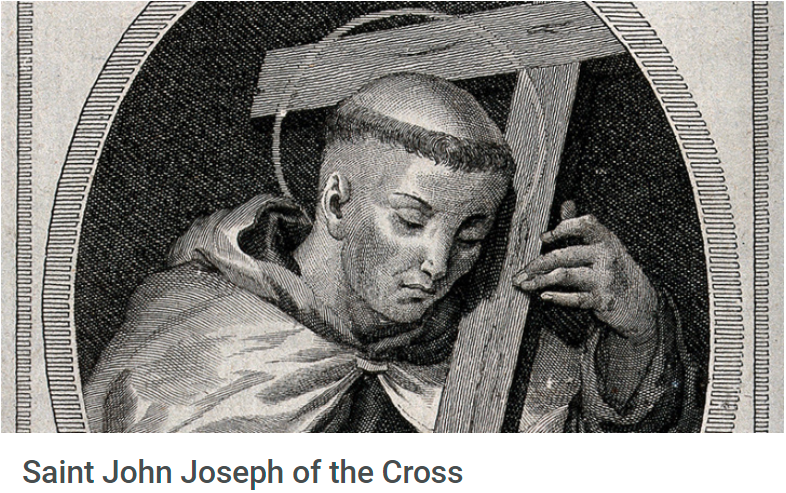
Saint John Joseph of the Cross Story

Self-denial is never an end in itself but is only a help toward greater charity—as the life of Saint John Joseph shows.

John Joseph was very ascetic even as a young man. At 16, he joined the Franciscans in Naples; he was the first Italian to follow the reform movement of Saint Peter Alcantara. John Joseph’s reputation for holiness prompted his superiors to put him in charge of establishing a new friary even before he was ordained.

Obedience moved John Joseph to accept appointments as novice master, guardian and, finally, provincial. His years of mortification enabled him to offer these services to the friars with great charity. As guardian he was not above working in the kitchen or carrying the wood and water needed by the friars.

When his term as provincial expired, John Joseph dedicated himself to hearing confessions and practicing mortification, two concerns contrary to the spirit of the dawning Age of Enlightenment. John Joseph of the Cross was canonized in 1839.

Reflection

John Joseph’s mortification allowed him to be the kind of forgiving superior intended by Saint Francis. Self-denial should lead us to charity—not to bitterness; it should help us clarify our priorities and make us more loving. John Joseph is living proof of Chesterton’s observation: “It is always easy to let the age have its head; the difficult thing is to keep one’s own” (G. K. Chesterton, Orthodoxy, page 101).

//Franciscan Media//


Saint of the Day – March 4th

Saint Casimir (1458 – 1483)

Casimir, born of kings and in line to be a king himself, was filled with exceptional values and learning by a great teacher, John Dlugosz. Even his critics could not say that his conscientious objection indicated softness. As a teenager, Casimir lived a highly disciplined, even severe life, sleeping on the ground, spending a great part of the night in prayer and dedicating himself to lifelong celibacy.

When nobles in Hungary became dissatisfied with their king, they prevailed upon Casimir’s father, the king of Poland, to send his son to take over the country. Casimir obeyed his father, as many young men over the centuries have obeyed their governments. The army he was supposed to lead was clearly outnumbered by the “enemy”; some of his troops were deserting because they were not paid. At the advice of his officers, Casimir decided to return home.

His father was irked at the failure of his plans, and confined his 15-year-old son for three months. The lad made up his mind never again to become involved in the wars of his day, and no amount of persuasion could change his mind. He returned to prayer and study, maintaining his decision to remain celibate even under pressure to marry the emperor’s daughter.

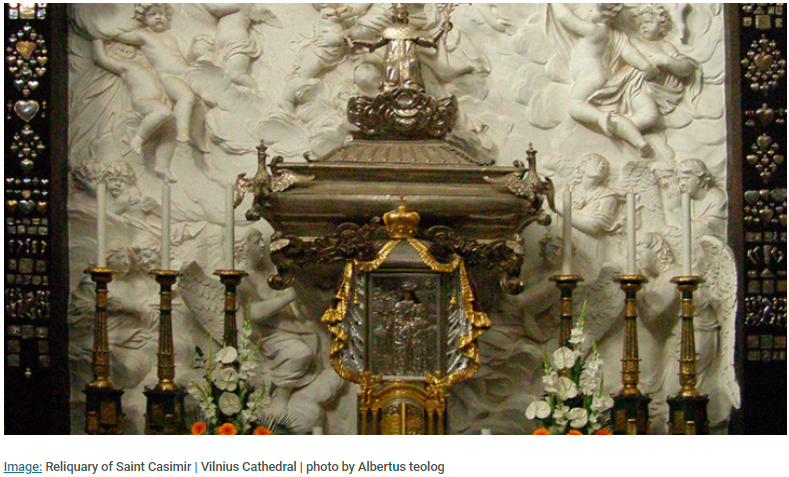
He reigned briefly as king of Poland during his father’s absence. He died of lung trouble at 25 while visiting Lithuania, of which he was also Grand Duke. He was buried in Vilnius, Lithuania.


Reflection

For many years, Poland and Lithuania faded into the gray prison on the other side of the Iron Curtain. Despite repression, the Poles and Lithuanians remained firm in the faith which has become synonymous with their name. Their youthful patron reminds us: Peace is not won by war; sometimes a comfortable peace is not even won by virtue, but Christ’s peace can penetrate every government repression of religion.

Saint Casimir is the Patron Saint of:

Lithuania
Poland
Russia


Saint of the Day – March 2nd

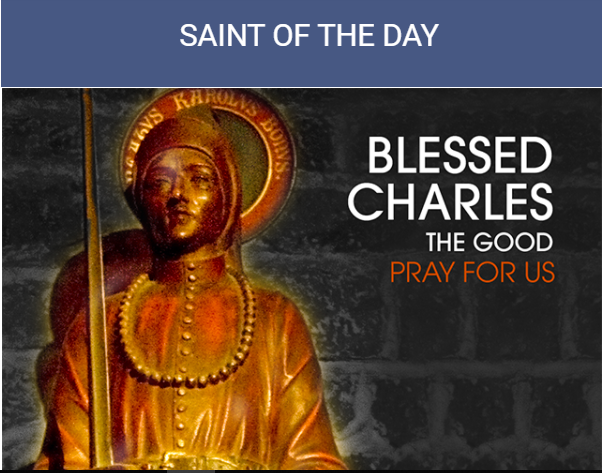
Blessed Charles the Good (1083–1127), also known as Charles I and the Count of Flanders, was born in Denmark, the only son of King Canute IV (St. Canute) and Adela of Flanders. He was five years old when his father was assassinated in the Odense Cathedral, after which he and his mother fled for their lives to Flanders. He grew up in the royal court in that country and accompanied his maternal grandfather, a Count, on a crusade to the Holy Land.

After his grandfather’s death, Blessed Charles became an advisor to the next Count, his uncle; after his uncle’s death, Charles became Count. He was highly regarded by the people for his holiness and virtue. He was outspoken against the common practice of hoarding grain and selling it at inflated prices, and opposed the prominent Erembald family who gained their financial prosperity through this unjust practice.

On March 2, 1127, while Charles was in church praying, he was slain by soldiers loyal to the Erembald family, in the same manner his father was killed. His death sparked a public outcry and uprising against the Erembald family, while Charles was immediately looked upon as a martyr and saint. His feast day is March 2nd.


Saint of the Day – March 1st

(D. MARCH 1, 589)

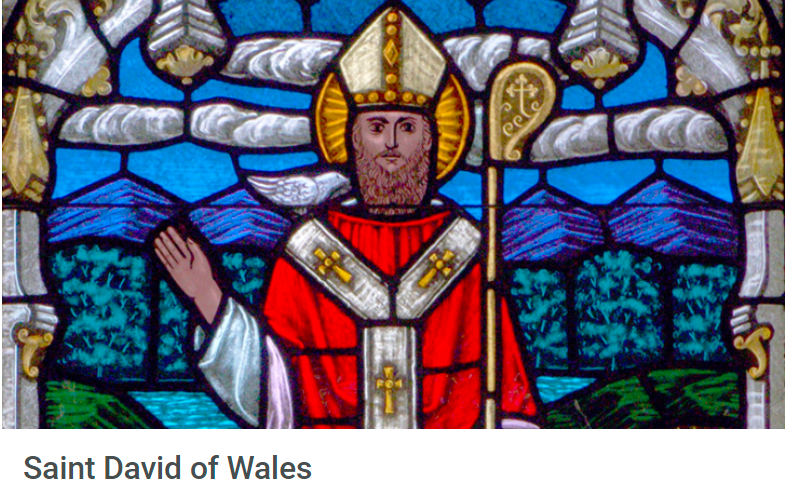
Saint David of Wales’ Story

David (D. March 1, 589) is the patron saint of Wales and perhaps the most famous of British saints. Ironically, we have little reliable information about him.

It is known that he became a priest, engaged in missionary work, and founded many monasteries, including his principal abbey in southwestern Wales. Many stories and legends sprang up about David and his Welsh monks. Their austerity was extreme. They worked in silence without the help of animals to till the soil. Their food was limited to bread, vegetables and water.

In about the year 550, David attended a synod where his eloquence impressed his fellow monks to such a degree that he was elected primate of the region. The episcopal see was moved to Mynyw, where he had his monastery, now called St. David’s. He ruled his diocese until he had reached a very old age. His last words to his monks and subjects were: “Be joyful, brothers and sisters. Keep your faith, and do the little things that you have seen and heard with me.”

Saint David is pictured standing on a mound with a dove on his shoulder. The legend is that once while he was preaching a dove descended to his shoulder and the earth rose to lift him high above the people so that he could be heard. Over 50 churches in South Wales were dedicated to him in pre-Reformation days.

Reflection

Were we restricted to hard manual labor and a diet of bread, vegetables and water, most of us would find little reason to rejoice. Yet joy is what David urged on his brothers as he lay dying. Perhaps he could say that to them—and to us—because he lived in and nurtured a constant awareness of God’s nearness. For, as someone once said, “Joy is the infallible sign of God’s presence.” May his intercession bless us with the same awareness!

Saint David of Wales is the Patron Saint of:

Wales

//Franciscan Media//


Saint of the Day – February 28th

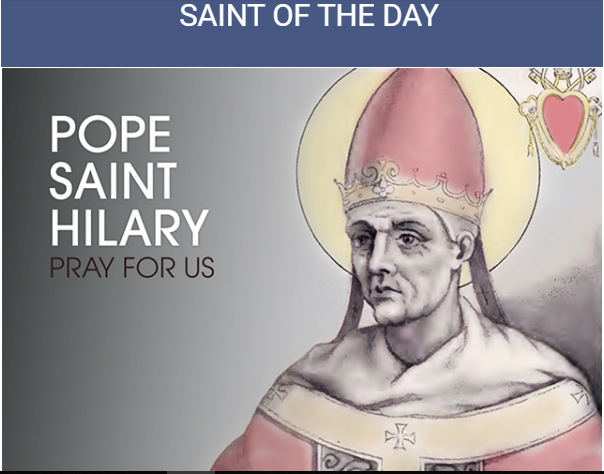
Pope Saint Hilary (5th c.) was Bishop of Rome from 461 to 468. Not much is known of his early life other than that he was from Sardinia. He rose to prominence in the Church when he became archdeacon under Pope St. Leo the Great, working closely with him as a trusted aid. St. Leo sent Hilary as one of the papal legates to the Council of Ephesus in 449. There St. Hilary fought bravely against the monophysite heresy, for which his life was threatened. He was forced into hiding and fled back to Rome for safety. He was so highly esteemed that after Pope Leo’s death he was elected to the papacy. As pope, St. Hilary fought for the rights of the papacy in spiritual matters against the Roman Emperor, and increased organization and discipline between the bishops and the Holy See. He also did much work in building, remodeling, and decorating Roman churches and other public places. Pope St. Hilary’s feast day is February 28.


Saint of the Day – February 27th

(MARCH 1, 1838 – FEBRUARY 27, 1862)

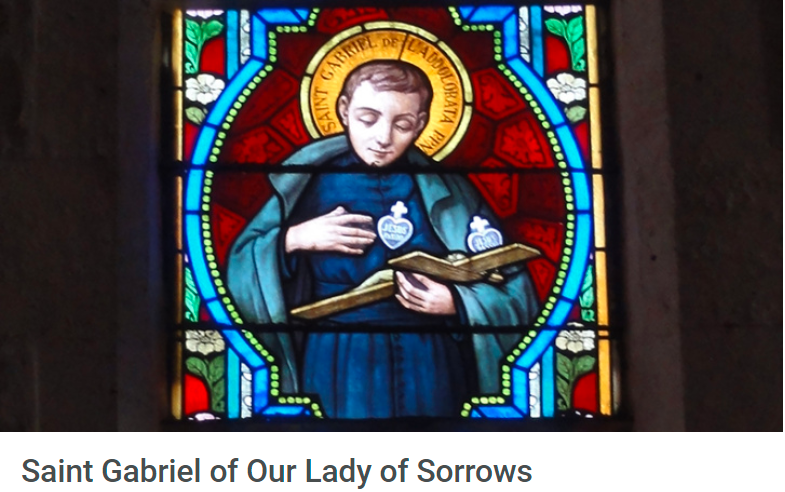
Saint Gabriel of Our Lady of Sorrows’ Story

St. Gabriel Possenti (1838-1862), also known as St. Gabriel of Our Lady of Sorrows, was born in Italy into a large family and baptized Francis, Saint Gabriel lost his mother when he was only four years old. He was educated by the Jesuits and, having been cured twice of serious illnesses, came to believe that God was calling him to the religious life. Young Francis wished to join the Jesuits but was turned down, probably because of his age, not yet 17. Following the death of a sister to cholera, his resolve to enter religious life became even stronger and he was accepted by the Passionists. Upon entering the novitiate he was given the name Gabriel of Our Lady of Sorrows.

Ever popular and cheerful, Gabriel quickly was successful in his effort to be faithful in little things. His spirit of prayer, love for the poor, consideration of the feelings of others, exact observance of the Passionist Rule as well as his bodily penances—always subject to the will of his wise superiors— made a deep impression on everyone.

His superiors had great expectations of Gabriel as he prepared for the priesthood, but after only four years of religious life symptoms of tuberculosis appeared. Ever obedient, he patiently bore the painful effects of the disease and the restrictions it required, seeking no special notice. He died peacefully on February 27, 1862, at age 24, having been an example to both young and old.

Saint Gabriel of Our Lady of Sorrows was canonized in 1920.

Reflection

When we think of achieving great holiness by doing little things with love and grace, Therese of Lisieux comes first to mind. Like her, Gabriel died painfully from tuberculosis. Together they urge us to tend to the small details of daily life, to be considerate of others’ feelings every day. Our path to sanctity, like theirs, probably lies not in heroic doings but in performing small acts of kindness every day.

Saint Gabriel of Our Lady of Sorrows is the Patron Saint of:

Clergy
Students
Young People

//Franciscan Media//


Saint of the Day – February 26th

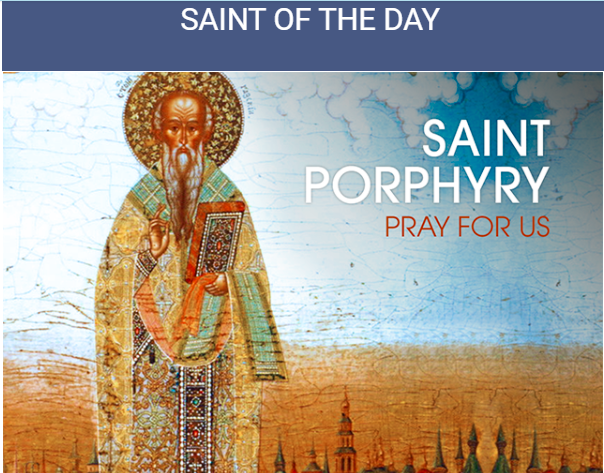
St. Porphyry (Porphyrius) of Gaza (c. 347-420 A.D.) was born in Thessalonica in present-day Greece. Although a wealthy man, at the age of 25 he went to live in Egypt as a desert hermit. He later moved to Palestine near the Jordan River, then to Jerusalem itself. He did great penances and would often visit the holy places where Jesus lived and walked, despite his poor health. He then renounced all material goods and his inheritance and became a priest in Jerusalem at the age of 40. The relics of the True Cross in Jerusalem were entrusted to his care. Despite his protests he was ordained Bishop of Gaza, a pagan stronghold with an insignificant Christian community. Gaza’s pagans were hostile, and St. Porphyry appealed to the emperor for protection and for the destruction of pagan temples, which he obtained. St. Porphyry built a Christian church on the site of the most important pagan temple dedicated to the chief god, so that he could say Mass in the place where the devil was previously most honored. St. Porphyry labored for his flock and won many converts through his miracles, though pagan opposition continued throughout his life. He was successful in spreading the Christian faith across his diocese. His feast day is February 26.

//The Catholic Company//