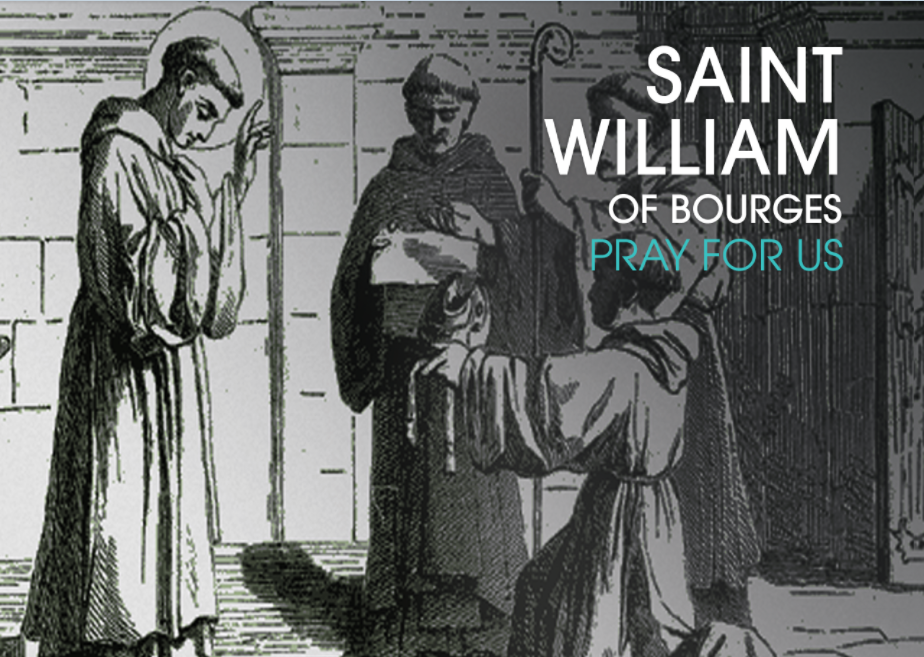
St. William of Bourges (1155–1209), also known as St. William the Confessor, was born to a noble family in France. He was educated under his uncle who was an archdeacon, and from a young age turned away from the world and gave himself over to religion and learning. He became a priest and later entered religious life in a Cistercian monastery, an order famous for strict discipline. St. William was known to be a cheerful man and a hard worker, and pure of heart. He was chosen to be Archbishop of Bourges in the year 1200, much to his dismay. He left the solitude of the monastery out of obedience and entered into the public life of a bishop, throwing himself wholeheartedly into serving both the spiritual and physical needs of the poor. As bishop he continued his great austerities. He had a great devotion to the Blessed Sacrament and would spend much time in prayer at the foot of the altar. He was known for performing miracles both during his life and after his death. He died kneeling at prayer, and by request was buried wearing his hair shirt and lying in ashes. His feast day is January 10.
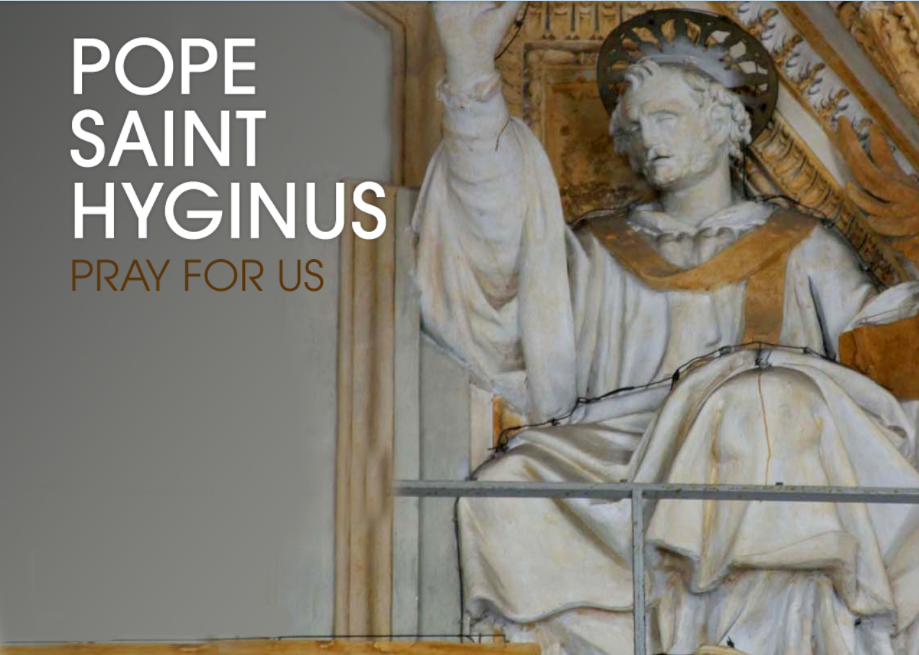
Pope St. Hyginus (d. 142 A.D.) was born in Athens, Greece, and became the ninth successor to the Chair of St. Peter. He reigned as pope for four years from about 138-142 A.D. Many of the details of his life have not been preserved, although various actions are credited to him: defending the Catholic faith against the Gnostic heresy which spread in Rome; beginning the practice of including godparents at infant baptisms to help the newborn child receive a Christian upbringing; and decreeing that all churches must be consecrated. Pope St. Hyginus is buried near the tomb of St. Peter on Vatican Hill. It is uncertain whether he became a martyr under the persecutions of Roman Emperor Marcus Aurelius. His feast day is January 11.
St. Marguerite Bourgeoys (1620-1700) was born in France to a large middle-class Christian family. After having a deep religious experience at the age of 20, Marguerite dedicated her life to God through the Virgin Mary. She then joined an aposolate which served God by educating underprivileged children. When she was 32 the governor of Fort Ville-Marie (now Montreal, Canada), visited Marguerite’s town and invited her to be a missionary in the New World as a lay teacher, instructing the children of the colonists and the Native Americans. Marguerite agreed and made the long ocean journey. Realizing the importance of the family in establishing New France, Marguerite mentored young ladies and prepared them for marriage and family life as pioneer women. She signed as a witness on the marriage certificates of many early settlers. As a result of these activities she was affectionately called the “Mother of the Colony.” She also worked to build the first church and the first school. She also founded the Congregation of Notre Dame of Montreal, which is an active religious order to this day. For her great apostolic and missionary activity she is considered the co-foundress of Montreal. She is also the first woman saint of the Catholic Church in Canada. Her feast day is January 12.
St. Felix of Nola (d. 250 A.D.) was born in Italy near Naples, the son of a Syrian soldier. After his father’s death, Felix gave his goods to the poor and entered the priesthood. He was ordained by his bishop, St. Maximus of Nola, and served as his assistant. When persecution against Christians increased under Roman Emperor Decius, St. Maximus hid in the desert while St. Felix was captured, tortured, and thrown into prison. While in prison an angel appeared to Felix and freed him from his chains, bidding him to go to the aid of his bishop, St. Maximus, who was at the point of starving to death. After assisting the bishop, Felix fled from his captors by hiding in a hole. Miraculously, a spider quickly spun a web over the hole and prevented St. Felix from being caught by his pursuers. Felix continued hiding in a dry well for six months until the persecution abated. Afterwards he declined an offer to become the bishop of Nola following the death of St. Maximus. Felix’s property was confiscated in the persecutions, so he lived his remaining years farming a few acres of rented land for his own sustenance as well as alms for the poor. His feast day is January 14.
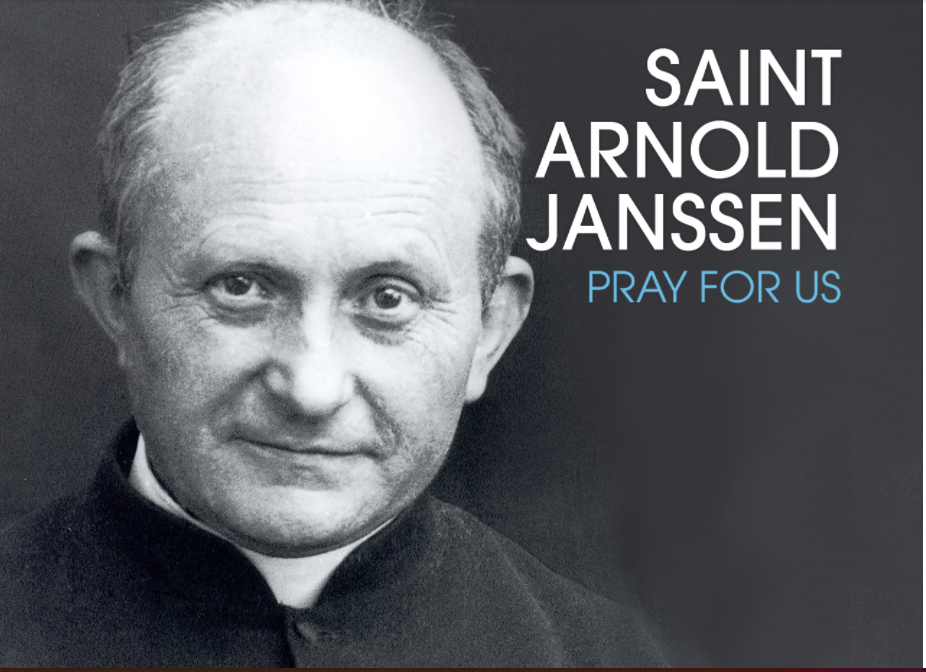
St. Arnold Janssen (1837–1909) was born in Germany to a large Catholic family. He was a man of simple faith who studied theology, entered the priesthood, and served as a school teacher. He had a profound devotion to the Sacred Heart of Jesus, which awakened in him an increasing desire for missionary work. This led him to found The Little Messenger of the Sacred Heart, a monthly magazine sharing news of the Church’s missionary activities and encouraging German Catholics to do more to help the missions. This was during a time of anti-Catholic persecution in Germany, and many priests were expelled from the country. Arnold suggested that these expelled priests serve in the missions, and for this purpose he founded the Society of the Divine Word, known as the Divine Word Missionaries, a religious congregation of missionary priests and lay brothers. He also founded two Orders of religious sisters associated with this missionary activity. Today more than 6,000 Divine Word Missionaries are active in 63 countries. St. Arnold was canonized in 2003 by Pope St. John Paul II. His feast day is celebrated on January 15.
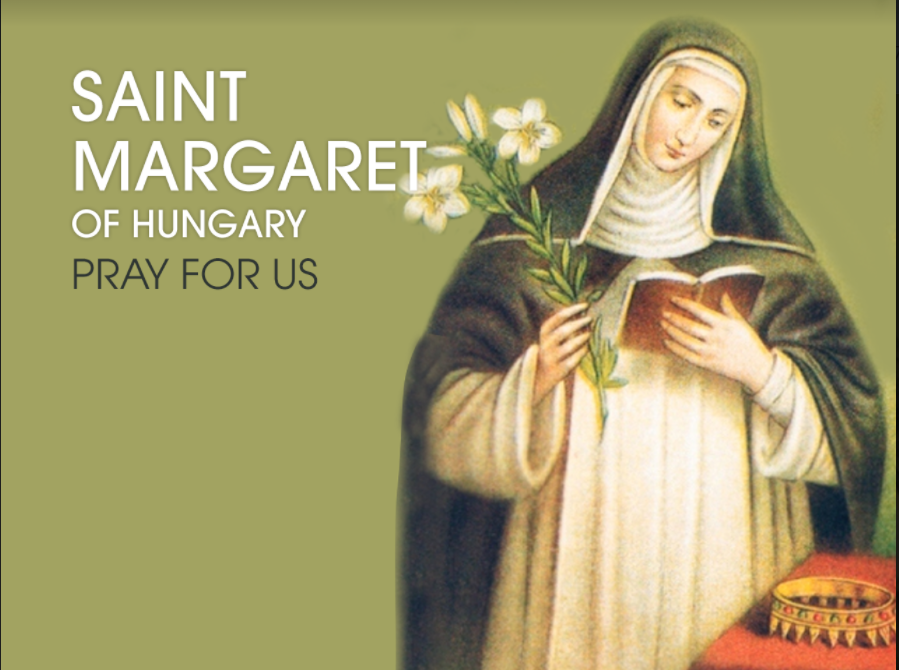
St. Margaret of Hungary (1242–1271) was the daughter of King Bela IV of Hungary, and niece of the famed St. Elizabeth of Hungary. Her royal parents made a vow to God that if Hungary was saved from the Mongol invasion they would dedicate Margaret to religion. God heard their prayer and the country was saved. The king and queen then entrusted four-year-old Margaret to be raised and educated in a Dominican convent. At the age of ten Margaret was transferred to the Convent of the Blessed Virgin founded by her parents, built on an island her parents named after her. Margaret spent the rest of her life there, dedicating herself to prayer and severe penances. She opposed her father’s attempts to arrange her political marriage with the King of Bohemia, even though her suitor obtained a dispensation from the pope to release her from her religious vows so that she could enter into matrimony. Margaret made her solemn vows as a Dominican nun at the age of eighteen. Although a beautiful princess, she took the most menial tasks in the convent and dedicated her life to serving the poor and sick. She was considered a saint during her life and after her death. Many miracles, especially the curing of illnesses, were attributed to her intercession. She died at the age of 28. Her feast day is January 18.
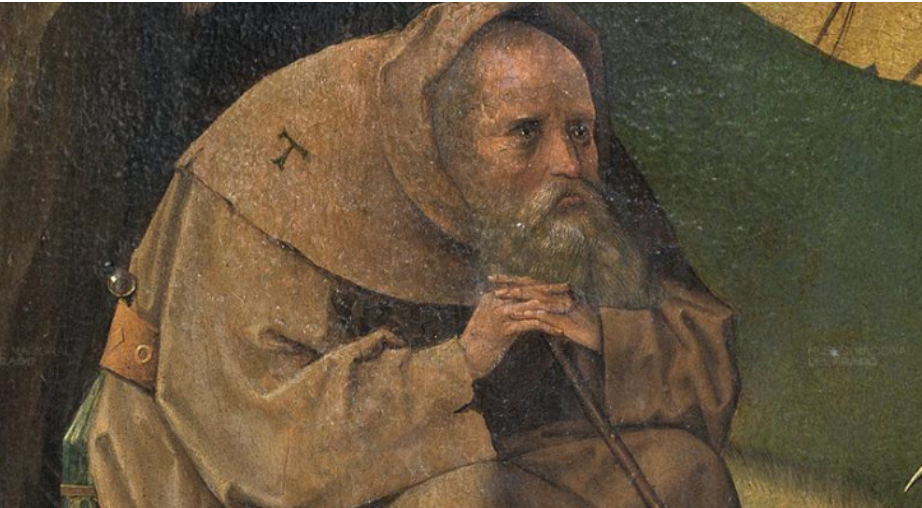
The life of Anthony will remind many people of Saint Francis of Assisi. At 20, Anthony was so moved by the Gospel message, “Go, sell what you have, and give to [the] poor” (Mark 10:21b), that he actually did just that with his large inheritance. He is different from Francis in that most of Anthony’s life was spent in solitude. He saw the world completely covered with snares, and gave the Church and the world the witness of solitary asceticism, great personal mortification and prayer. But no saint is antisocial, and Anthony drew many people to himself for spiritual healing and guidance.
At 54, he responded to many requests and founded a sort of monastery of scattered cells. Again, like Francis, he had great fear of “stately buildings and well-laden tables.”
At 60, he hoped to be a martyr in the renewed Roman persecution of 311, fearlessly exposing himself to danger while giving moral and material support to those in prison. At 88, he was fighting the Arian heresy, that massive trauma from which it took the Church centuries to recover. “The mule kicking over the altar” denied the divinity of Christ.
Anthony is associated in art with a T-shaped cross, a pig and a book. The pig and the cross are symbols of his valiant warfare with the devil—the cross his constant means of power over evil spirits, the pig a symbol of the devil himself. The book recalls his preference for “the book of nature” over the printed word. Anthony died in solitude at age 105.
Reflection
In an age that smiles at the notion of devils and angels, a person known for having power over evil spirits must at least make us pause. And in a day when people speak of life as a “rat race,” one who devotes a whole life to solitude and prayer points to an essential of the Christian life in all ages. Anthony’s hermit life reminds us of the absoluteness of our break with sin and the totality of our commitment to Christ. Even in God’s good world, there is another world whose false values constantly tempt us.
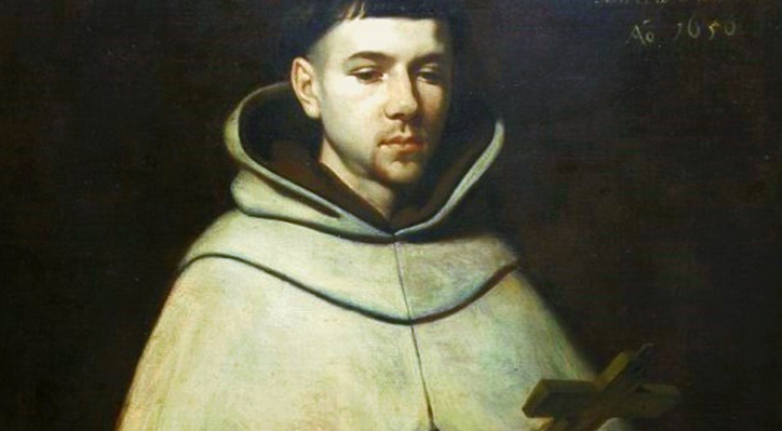
Saint John of the Cross’ Story (June 24, 1542 – December 14, 1591)
John is a saint because his life was a heroic effort to live up to his name: “of the Cross.” The folly of the cross came to full realization in time. “Whoever wishes to come after me must deny himself, take up his cross, and follow me” (Mark 8:34b) is the story of John’s life. The Paschal Mystery—through death to life—strongly marks John as reformer, mystic-poet, and theologian-priest.
Ordained a Carmelite priest in 1567 at age 25, John met Teresa of Avila and like her, vowed himself to the primitive Rule of the Carmelites. As partner with Teresa and in his own right, John engaged in the work of reform, and came to experience the price of reform: increasing opposition, misunderstanding, persecution, imprisonment. He came to know the cross acutely—to experience the dying of Jesus—as he sat month after month in his dark, damp, narrow cell with only his God.
Yet, the paradox! In this dying of imprisonment John came to life, uttering poetry. In the darkness of the dungeon, John’s spirit came into the Light. There are many mystics, many poets; John is unique as mystic-poet, expressing in his prison-cross the ecstasy of mystical union with God in the Spiritual Canticle.
But as agony leads to ecstasy, so John had his Ascent to Mt. Carmel, as he named it in his prose masterpiece. As man-Christian-Carmelite, he experienced in himself this purifying ascent; as spiritual director, he sensed it in others; as psychologist-theologian, he described and analyzed it in his prose writings. His prose works are outstanding in underscoring the cost of discipleship, the path of union with God: rigorous discipline, abandonment, purification. Uniquely and strongly John underlines the gospel paradox: The cross leads to resurrection, agony to ecstasy, darkness to light, abandonment to possession, denial to self to union with God. If you want to save your life, you must lose it. John is truly “of the Cross.” He died at 49—a life short, but full.
Reflection
In his life and writings, John of the Cross has a crucial word for us today. We tend to be rich, soft, comfortable. We shrink even from words like self-denial, mortification, purification, asceticism, discipline. We run from the cross. John’s message—like the gospel—is loud and clear: Don’t—if you really want to live!
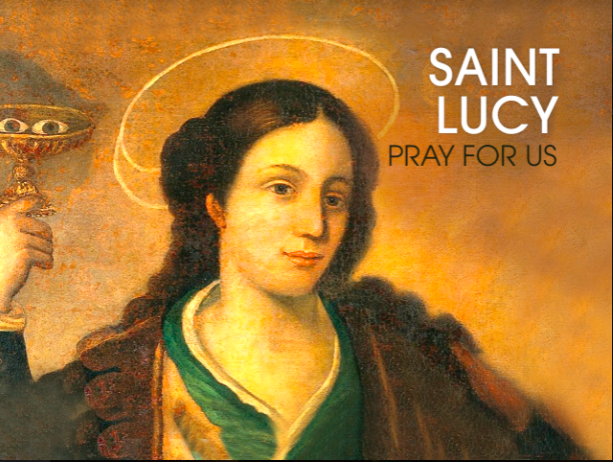
Every little girl named Lucy must bite her tongue in disappointment when she first tries to find out what there is to know about her patron saint. The older books will have a lengthy paragraph detailing a small number of traditions. Newer books will have a lengthy paragraph showing that there is little basis in history for these traditions. The single fact survives that a disappointed suitor accused Lucy of being a Christian, and she was executed in Syracuse, Sicily, in the year 304. But it is also true that her name is mentioned in the First Eucharistic Prayer, geographical places are named after her, a popular song has her name as its title, and down through the centuries many thousands of little girls have been proud of the name Lucy.
One can easily imagine what a young Christian woman had to contend with in pagan Sicily in the year 300. If you have trouble imagining, just glance at today’s pleasure-at-all-costs world and the barriers it presents against leading a good Christian life.
Her friends must have wondered aloud about this hero of Lucy’s, an obscure itinerant preacher in a far-off captive nation that had been destroyed more than 200 years before. Once a carpenter, he had been crucified by the Romans after his own people turned him over to their authority. Lucy believed with her whole soul that this man had risen from the dead. Heaven had put a stamp on all he said and did. To give witness to her faith she had made a vow of virginity.
What a hubbub this caused among her pagan friends! The kindlier ones just thought her a little strange. To be pure before marriage was an ancient Roman ideal, rarely found, but not to be condemned. To exclude marriage altogether, however, was too much. She must have something sinister to hide, the tongues wagged.
Lucy knew of the heroism of earlier virgin martyrs. She remained faithful to their example and to the example of the carpenter, whom she knew to be the Son of God. She is the patroness of eyesight.
Reflection
If you are a little girl named Lucy, you need not bite your tongue in disappointment. Your patron is a genuine authentic heroine, first class, an abiding inspiration for you and for all Christians. The moral courage of the young Sicilian martyr shines forth as a guiding light, just as bright for today’s youth as it was in A.D. 304.
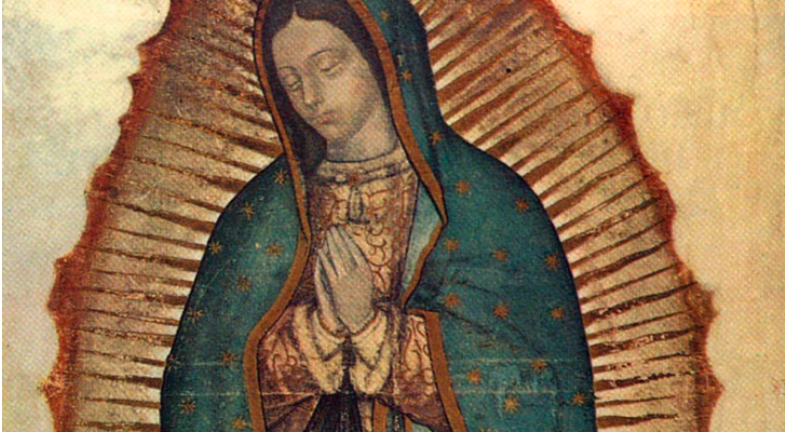
The feast in honor of Our Lady of Guadalupe goes back to the 16th century. Chronicles of that period tell us the story.
A poor Indian named Cuauhtlatohuac was baptized and given the name Juan Diego. He was a 57-year-old widower, and lived in a small village near Mexico City. On Saturday morning December 9, 1531, he was on his way to a nearby barrio to attend Mass in honor of Our Lady.
Juan was walking by a hill called Tepeyac when he heard beautiful music like the warbling of birds. A radiant cloud appeared, and within it stood an Indian maiden dressed like an Aztec princess. The lady spoke to him in his own language and sent him to the bishop of Mexico, a Franciscan named Juan de Zumarraga. The bishop was to build a chapel in the place where the lady appeared.
Eventually the bishop told Juan to have the lady give him a sign. About this same time Juan’s uncle became seriously ill. This led poor Juan to try to avoid the lady. Nevertheless the lady found Juan, assured him that his uncle would recover, and provided roses for Juan to carry to the bishop in his cape or tilma.
On December 12, when Juan Diego opened his tilma in the bishop’s presence, the roses fell to the ground, and the bishop sank to his knees. On the tilma where the roses had been appeared an image of Mary exactly as she had appeared at the hill of Tepeyac.
Reflection
Mary’s appearance to Juan Diego as one of his people is a powerful reminder that Mary—and the God who sent her—accept all peoples. In the context of the sometimes rude and cruel treatment of the Indians by the Spaniards, the apparition was a rebuke to the Spaniards and an event of vast significance for the indigenous population. While a number of them had converted before this incident, they now came in droves. According to a contemporary chronicler, nine million Indians became Catholic in a very short time. In these days when we hear so much about God’s preferential option for the poor, Our Lady of Guadalupe cries out to us that God’s love for and identification with the poor is an age-old truth that stems from the Gospel itself.