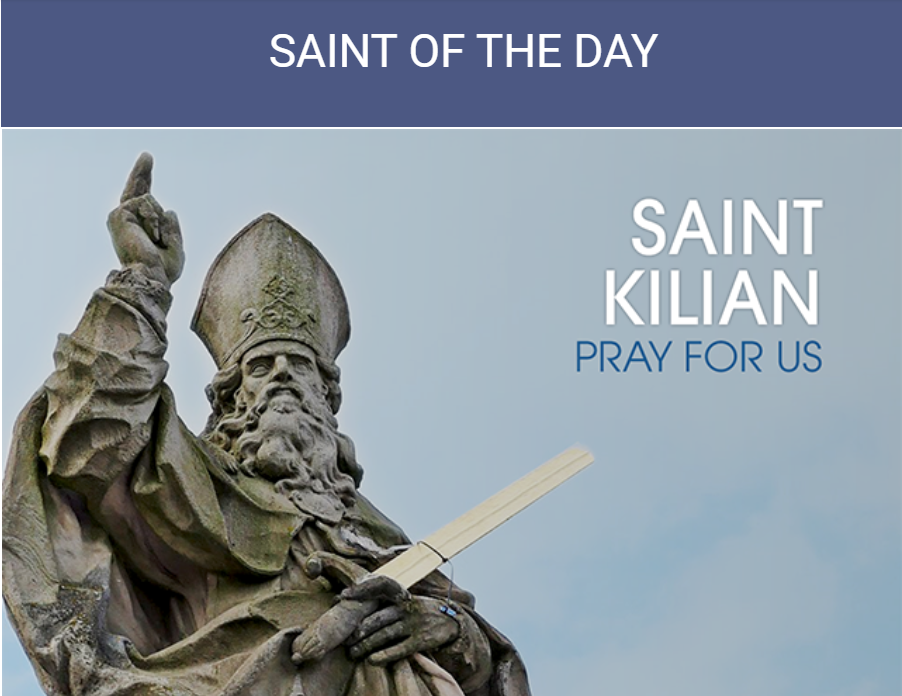
St. Kilian (c. 640-689 A.D.), also known as St. Cillian, was born to a noble family in Ireland. As a child he was known for his piety and love of study, which led him to the priesthood. He became a traveling bishop on the island, and in 686 A.D. left Ireland with eleven companions to travel throughout Gaul (present day France and parts of Germany) to preach the Gospel. From there he traveled to Rome to get official sanction from the Pope to become a missionary. Once obtained, St. Kilian returned north and settled in Würzburg as his base of activity along with two of his original companions. He began his work evangelizing the pagans in large parts of Franconia and Thuringia (north and central Germany), earning the name ‘Apostle of Franconia.’ Saint Kilian converted the Duke of Würzburg and convinced him to end his unlawful marriage. This greatly angered the Duke’s wife, who resisted St. Kilian’s attempts to convert her. While her husband was away, she had St. Kilian and his two missionary companions beheaded as they were preaching. A cathedral was built on the spot of their martyrdom by the first bishop of Würzburg. On St. Kilian’s feast his relics, along with those of his two companions, are paraded through the streets and put on display in the Würzburg Cathedral, which is dedicated to him. St. Kilian’s feast day is July 8th.
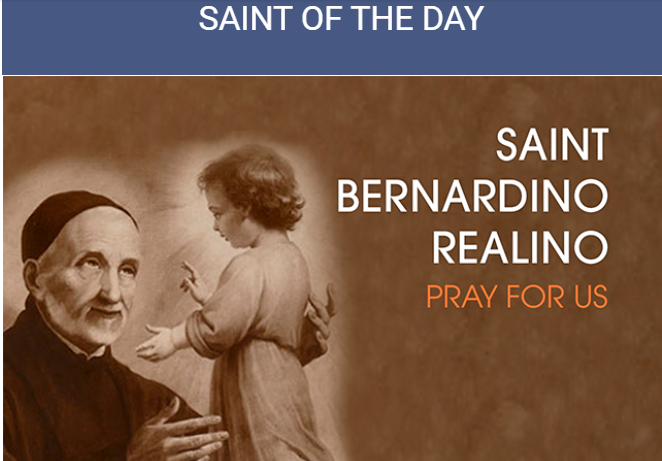
St. Bernardino Realino (1530–1616) was born in Italy to a noble family. He grew into an accomplished “Renaissance Man” of his day; he studied law and medicine, had a successful career as an attorney and judge, and served as the mayor of three cities. At the age of 34 he completed an eight-day retreat with Jesuit priests, and during this time he discerned a call to the religious life. He entered the Jesuit order and was ordained a priest in 1567. As a priest he preached, taught, and visited the sick and poor in the areas of Naples and Lecce. He was much loved and venerated by the people he ministered to, especially because of the miracles he performed. It was commonly believed among the people that he was a living saint. Even public scandal and civil strife were calmed due to his holy influence. While he was on his death bed, the city leaders of Lecce came to request of him that he become the official patron saint of their city once he entered heaven. After St. Bernardino’s death, vials of his blood were kept for veneration, which were observed to liquefy and exhibit unusual phenomena for more than a century. St. Bernardino Realino’s feast day is July 2nd.
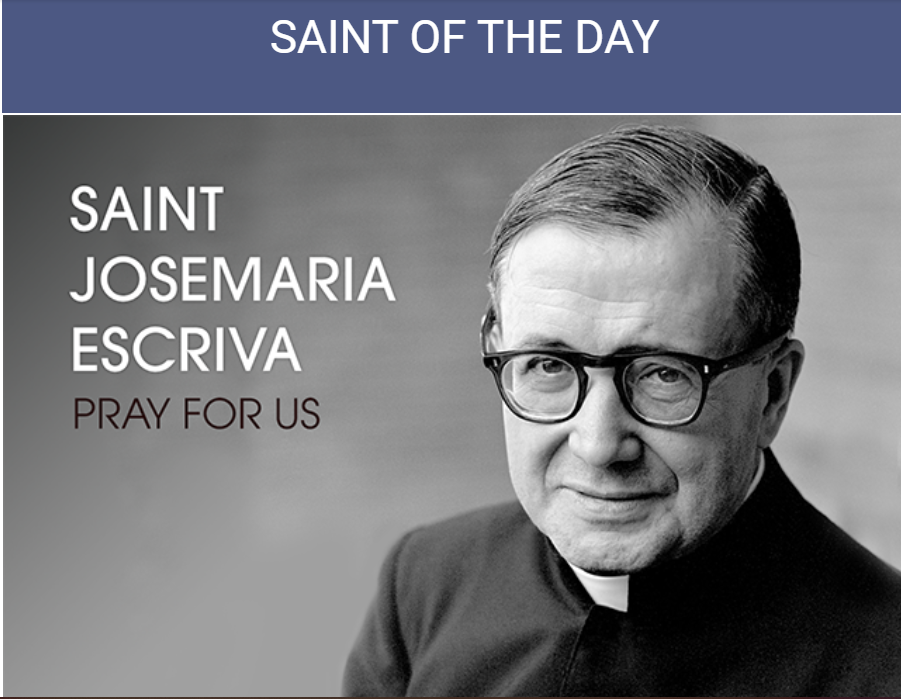
St. Josemaria Escriva (1902-1975) was born in Spain, one of six children of a devout Catholic family. Growing up, he observed his parents faithfully endure painful family trials (the death of three of their young children and devastating financial setbacks) and this had a profound effect on his own faith. As a teenager he discovered his vocation to the priesthood when he saw the path of footprints in the snow left by a barefoot Carmelite friar. He then experienced a radical conversion: he gave up his intended career as an architect and entered the seminary. He spent most of his life studying and teaching in universities, earning a doctorate in civil law and theology. Saint Josemaria Escriva’s lasting impact lies in the foundation of Opus Dei (“The Work of God”), an organization of laity and priests dedicated to the universal call of holiness and the belief that ordinary, daily life is an authentic path to sanctity. Today Opus Dei has over 80,000 members worldwide. His famous written work is The Way, a collection of spiritual and pastoral reflections on the gospels and their application to everyday life. On June 26, 1975, after glancing at an image of Our Lady of Guadalupe in his office in Rome, St. Josemaría died suddenly of cardiac arrest. He was canonized by Pope St. John Paul II. His feast day is June 26th.
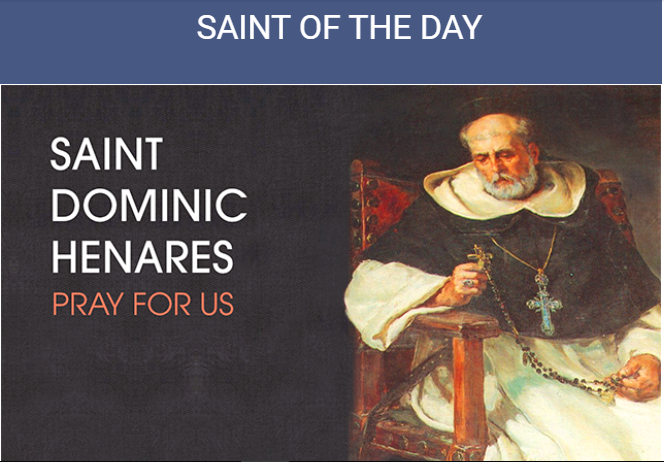
St. Dominic Henares (1764-1838) was born to a poor family in Spain. He joined the Dominican Order and was ordained a priest in 1790. Ten years later he was sent as a missionary to the Far East. He went from Mexico to the Philippines, and finally to North Vietnam. He became Bishop of Phunhay, Vietnam, in 1803. In 1831 the Vietnamese emperor officially prohibited Catholicism and severely persecuted the Church. Whole villages were sent into exile; priests were arrested and subjected to the most terrible tortures before they were killed. Those who helped capture them were richly rewarded. Bishop Henares was arrested and beheaded in Nam Dinh on June 25, 1838; the soldiers and villagers who participated in his arrest received generous compensation. St. Dominic Henares is one of an estimated 130,000 to 300,000 Catholics martyred for the faith in Vietnam between the 15th and 20th centuries. They were canonized together by Pope St. John Paul II in 1988. St. Dominic Henares’ feast day is June 25, and the collective memorial for 117 of the Vietnamese Martyrs is November 24.
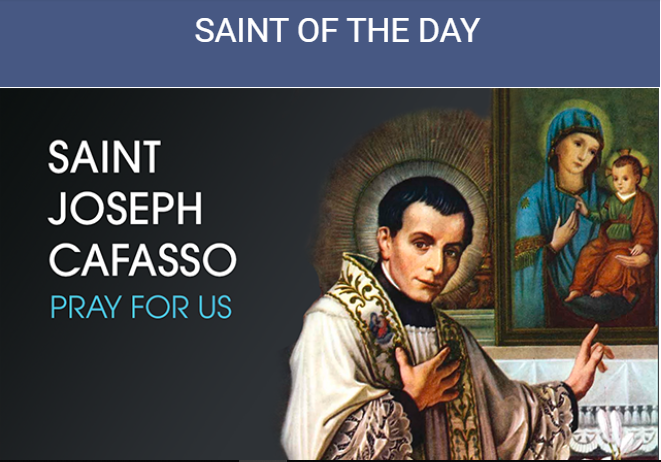
St. Joseph Cafasso (1811–1860) was born in Castelnuovo d’Asti, Italy, to a peasant family. He was born with a physical deformity of the spine, which caused him to grow into a stunted and crippled man. Discerning a call to Holy Orders, he entered the seminary in Turin where he later met another famous saint—John Bosco. Joseph taught John Bosco and encouraged him in his mission to minister to the town’s impoverished street youth. Joseph was an excellent professor of moral theology, as well as a famed preacher and confessor. He performed his duties so well that he became known as the “Priest’s Priest.” He spent entire days preaching in prisons, offering comfort to the prisoners, hearing their confessions, and even advocating to improve the poor conditions of the prison. For this work he also earned the name, “Priest of the Gallows.” St. Joseph Cafasso is the patron saint of prisoners, prisons, and prison chaplains. His feast day is June 23rd.
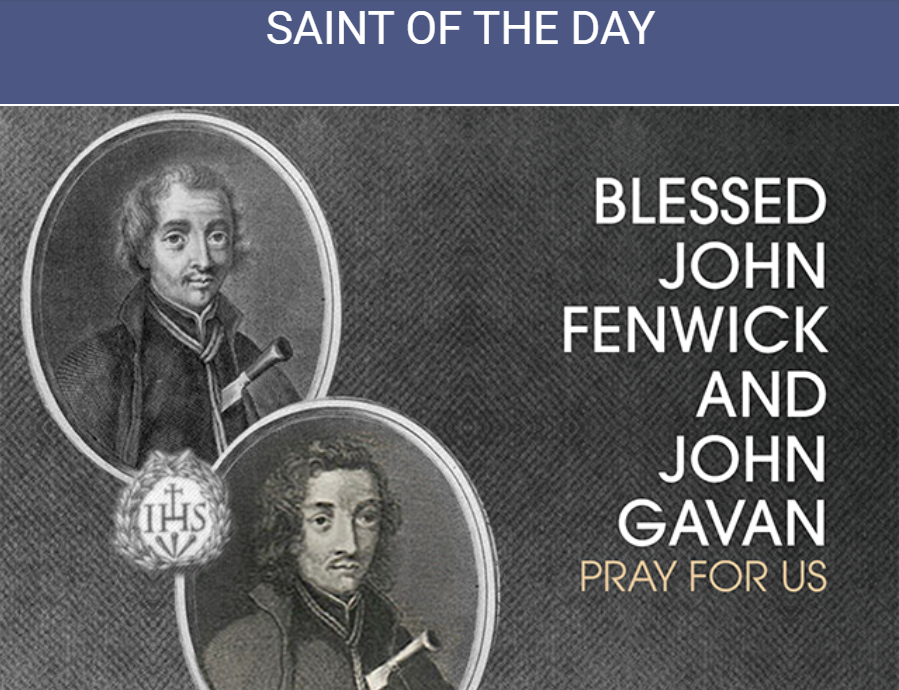
Bl. John Fenwick and Bl. John Gavan (d. 1679) were Englishmen and Jesuit priests who were martyred for their faith in England during the monarchy’s persecution of the Catholic Church. John Fenwick’s Protestant parents disowned him when he became a Catholic. The two priests, along with three other Jesuits, were falsely accused of involvement in the “Popish Plot,” a fabricated conspiracy that mounted to anti-Catholic hysteria in England over the course of three years. The men were charged with complicity to assassinate King Charles II and condemned on the charges of High Treason and subversion of the nation’s Protestant religion. During their trial, John Gavan acted as the principal spokesman for the group; one historian called him one of the ablest priests of his generation. Both priests were condemned to be hung, drawn, and quartered. It is said that the King, knowing they were innocent yet unwilling to grant them pardon, permitted them to be hanged only. After giving a rousing speech declaring their innocence, Bl. John Fenwick and Bl. John Gavan were martyred together on June 20th, 1679. They share a feast day on June 20th.
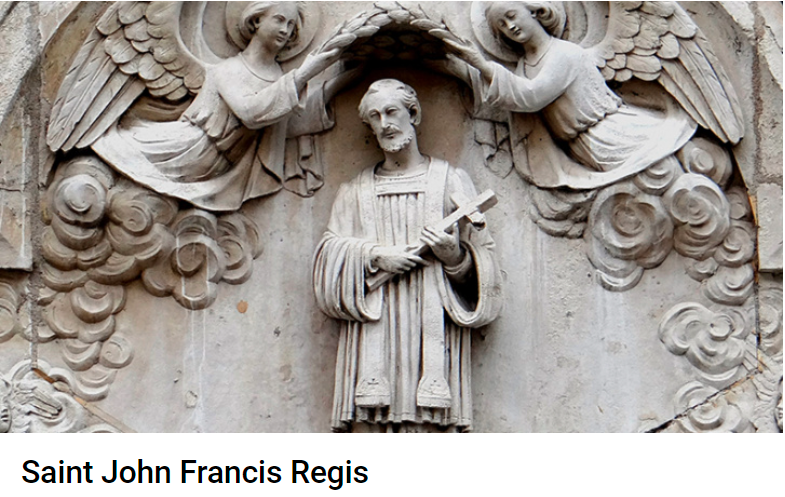
Born into a family of some wealth, John Francis was so impressed by his Jesuit educators that he himself wished to enter the Society of Jesus. He did so at age 18. Despite his rigorous academic schedule, he spent many hours in chapel, often to the dismay of fellow seminarians who were concerned about his health. Following his ordination to the priesthood, John Francis undertook missionary work in various French towns. While the formal sermons of the day tended toward the poetic, his discourses were plain. But they revealed the fervor within him and attracted people of all classes. Father Regis especially made himself available to the poor. Many mornings were spent in the confessional or at the altar celebrating Mass; afternoons were reserved for visits to prisons and hospitals.
The bishop of Viviers, observing the success of Father Regis in communicating with people, sought to draw on his many gifts, especially needed during the prolonged civil and religious strife then rampant throughout France. With many prelates absent and priests negligent, the people had been deprived of the sacraments for 20 years or more. Various forms of Protestantism were thriving in some cases while a general indifference toward religion was evident in other instances. For three years, Father Regis traveled throughout the diocese, conducting missions in advance of a visit by the bishop. He succeeded in converting many people and in bringing many others back to religious observances.
Though Father Regis longed to work as a missionary among the Native Americans in Canada, he was to live out his days working for the Lord in the wildest and most desolate part of his native France. There he encountered rigorous winters, snowdrifts and other deprivations. Meanwhile he continued preaching missions and earned a reputation as a saint. Upon entering the town of Saint-Andé, one man came upon a large crowd in front of a church and was told that people were waiting for “the saint” who was coming to preach a mission.
The last four years of his life were spent preaching and organizing social services, especially for prisoners, the sick and the poor. In the autumn of 1640, Father Regis sensed that his days were coming to a conclusion. He settled some of his affairs and prepared for the end by continuing to do what he did so well: speaking to the people about the God who loved them. On December 31, he spent most of the day with his eyes on the crucifix. That evening, he died. His final words were: “Into thy hands I commend my spirit.”
John Francis Regis was canonized in 1737.
Reflection
John longed to travel to the New World and become a missionary to the Native Americans, but he was called instead to work among his own compatriots. Unlike many famous preachers, he isn’t remembered for golden-tongued oratory. What people who listened to him heard was his own fervent faith, and it had a powerful effect on them. We can recall homilists who impressed us for the same reason. More importantly for us, we can also remember ordinary people, neighbors and friends, whose faith and goodness touched us and brought us to deeper faith. That is the calling most of us must follow.
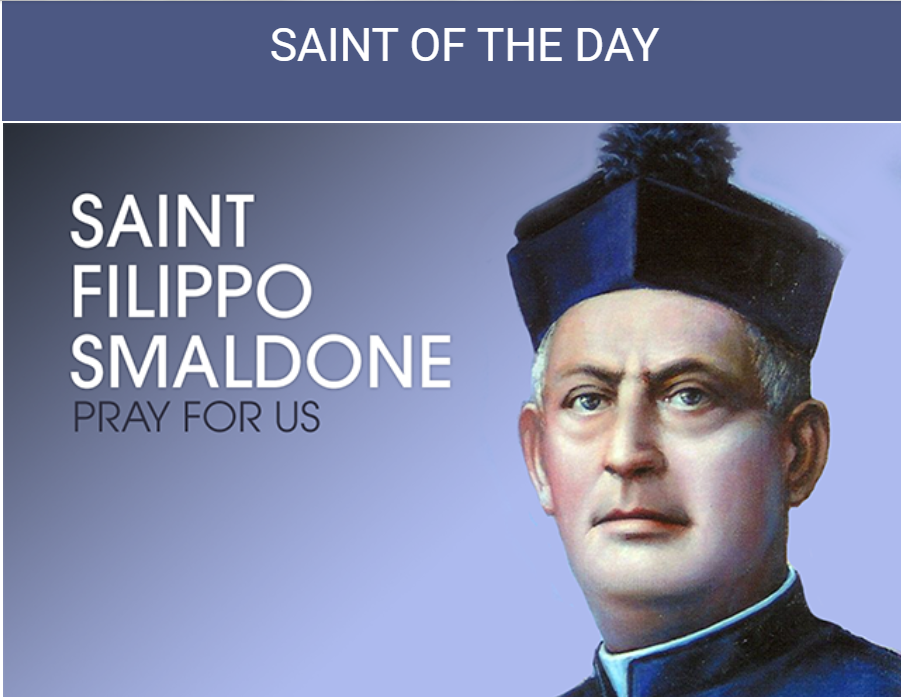
St. Filippo Smaldone (1848–1923) was born in Naples, Italy, during a time of upheaval and unrest both in Italy and in the Church. He decided to become a priest, and while in seminary he took on a personal apostolate of assisting the deaf and mute community in Naples. He dedicated so much time to this work that he barely passed his exams. After his ordination he continued to assist the marginalized of his community, especially the sick. When the plague hit his city he contracted it, however, he was healed after praying to Our Lady of Pompeii, to whom he had a special devotion. He continued his pioneer work in the education of the deaf and mute, though he became discouraged at the difficulty of the task and considered going into the foreign missions instead. Dissuaded from the abandonment of his work by his confessor, St. Filippo committed his life’s mission to the needs of the deaf and mute, training a group of nuns in the work which grew into a new religious foundation. He later expanded his work to include children that were blind, orphaned, and abandoned. His feast day is June 4th.
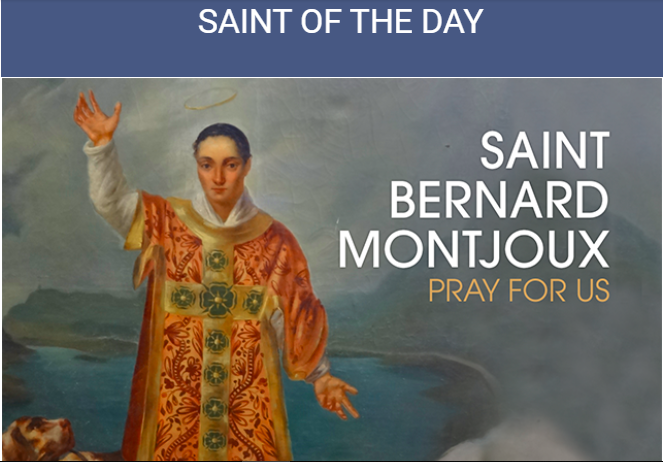
St. Bernard of Montjoux (c. 923–1008 A.D.), also known as St. Bernard of Menthon, was born to a wealthy and noble family in the Kingdom of Arles (present day France and Switzerland). As an adult he refused an honorable marriage and determined instead to give his life in service to the Church. He became a priest in northern Italy and spent more than four decades doing missionary work in the Alps. He built schools and churches, and is especially known for aiding travelers. The area where he ministered had an ancient, snowy, and dangerous pass winding through the mountains along which pilgrims traveled to and from Rome. To serve the pilgrims St. Bernard built a hospice at the highest point of the pass, 8,000 feet above sea level. Later he founded another hospice along another smaller pass.
St. Bernard obtained papal approval for communities of priests to serve in the hospices, which have generously aided travelers for more than a millennium. The priests and their well-trained dogs (the St. Bernard breed named for the saint) would seek and rescue lost pilgrims. St. Bernard was declared the patron saint of skiers and mountain climbers by Pope Pius XI in 1923. His feast day is celebrated on May 28th.
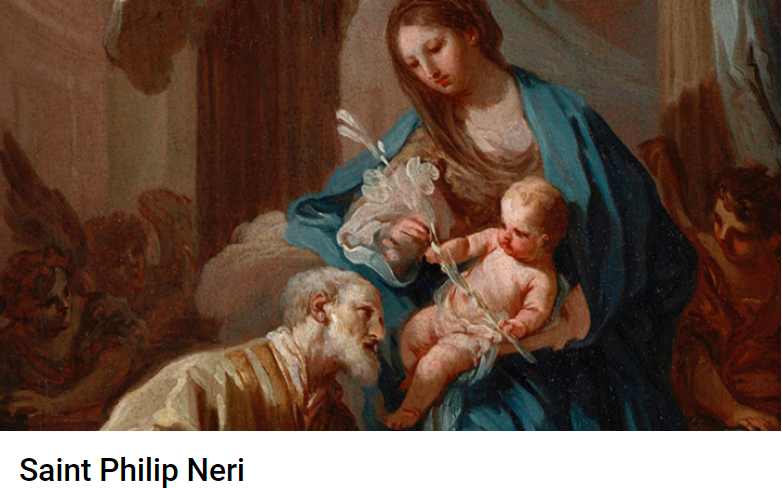
Philip Neri was a sign of contradiction, combining popularity with piety against the background of a corrupt Rome and a disinterested clergy: the whole post-Renaissance malaise.
At an early age, Philip abandoned the chance to become a businessman, moved to Rome from Florence, and devoted his life and individuality to God. After three years of philosophy and theology studies, he gave up any thought of ordination. The next 13 years were spent in a vocation unusual at the time—that of a layperson actively engaged in prayer and the apostolate.
As the Council of Trent (1545-63) was reforming the Church on a doctrinal level, Philip’s appealing personality was winning him friends from all levels of society, from beggars to cardinals. He rapidly gathered around himself a group of laypersons won over by his audacious spirituality. Initially, they met as an informal prayer and discussion group, and also served poor people in Rome.
At the urging of his confessor, Philip was ordained a priest and soon became an outstanding confessor himself, gifted with the knack of piercing the pretenses and illusions of others, though always in a charitable manner and often with a joke. He arranged talks, discussions, and prayers for his penitents in a room above the church. He sometimes led “excursions” to other churches, often with music and a picnic on the way.
Some of Philip’s followers became priests and lived together in community. This was the beginning of the Oratory, the religious institute he founded. A feature of their life was a daily afternoon service of four informal talks, with vernacular hymns and prayers. Giovanni Palestrina was one of Philip’s followers, and composed music for the services. The Oratory was finally approved after suffering through a period of accusations of being an assembly of heretics, where laypersons preached and sang vernacular hymns!
Philip’s advice was sought by many of the prominent figures of his day. He is one of the influential figures of the Counter-Reformation, mainly for converting to personal holiness many of the influential people within the Church itself. His characteristic virtues were humility and gaiety.
After spending a day hearing confessions and receiving visitors, Philip Neri suffered a hemorrhage and died on the feast of Corpus Christi in 1595. He was beatified in 1615 and canonized in 1622. Three centuries later, Cardinal John Henry Newman founded the first English-speaking house of the Oratory in London.
Reflection
Many people wrongly feel that such an attractive and jocular personality as Philip’s cannot be combined with an intense spirituality. Philip’s life melts our rigid, narrow views of piety. His approach to sanctity was truly catholic, all-embracing, and accompanied by a good laugh. Philip always wanted his followers to become not less but more human through their striving for holiness.