Saint of the Day – March 16th

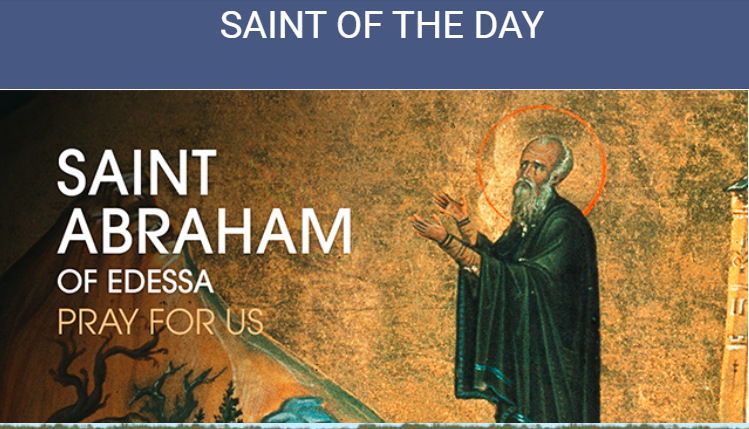
St. Abraham of Edessa (300-360 A.D.), also known as Abraham of Kidunaia, was a rich nobleman from Mesopotamia. He married according to his parents’ wishes, despite his desire to give himself totally to God. After the wedding ceremony he fled to a cave and hid himself, leaving only a small window to receive food. He lived there as a hermit, and after the death of his parents gave his inheritance to the poor.

The Bishop of Edessa ordained him as a priest and sent him to lead a notoriously sinful city. There Abraham was beaten and maligned for three years until his prayers prevailed and every citizen came to him for baptism. He then returned to his hermitage and lived there the rest of his life.

After his brother’s death his young niece was left to his care. He set her up to live as a religious in a cell next to his, which she did for twenty years until she succumbed to the seduction of a rogue hermit. She was so ashamed of her sin that she despaired of God’s mercy and became a prostitute. St. Abraham prayed for his niece earnestly for two years; then, discovering her location, left his cell and came to her disguised as a suitor. When they were alone he revealed his identity to her, and, pleading with her throughout the night, prevailed upon her to return with him to her life of prayer and penance. She came back to her cell, which Abraham relocated directly behind his own for her protection, and became St. Mary of Edessa. St. Abraham’s feast day is March 16th.

//The Catholic Company//
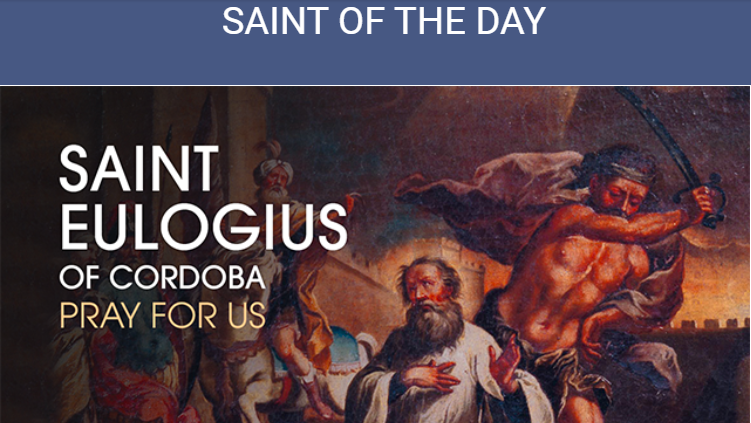

Saint of the Day – March 11th

St. Eulogius of Cordoba (9th c.) was a priest from a prominent Christian family in Cordoba (Cordova), Spain. He was well-educated, humble, gentle, friendly, and a gifted leader with the charism of encouragement, especially towards Christians facing martyrdom. In his time Cordoba was the capital of the Muslim conquerors of Catholic Spain.

The Muslim leaders allowed Christians to live in relative peace until a persecution arose when some of the Muslim population began converting to Christianity. They imprisoned the clergy, including Eulogius. While in prison Eulogius read the Bible to his companions and exhorted them to faithfulness in the face of martyrdom. He also wrote to two other young female converts who were facing threats, instructing them that no matter how terribly they were physically abused, it could not harm their souls, and that they must fight for their faith till death and leave God to defend his Church.

St. Eulogius was released and later jailed again for hiding a young female convert who fled from her family in fear of her life. St. Eulogius’ judge offered him escape if he would weaken the practice of his religion, but instead he preached the Gospel to the presiding court. He was immediately beheaded. St. Eulogius’ feast day is March 11th.


Saint of the Day – February 26th

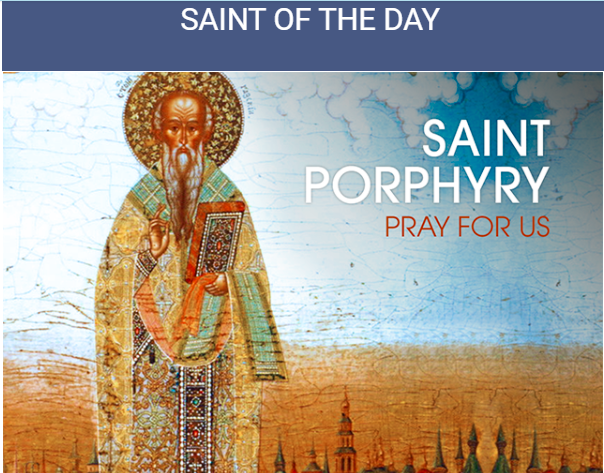
St. Porphyry (Porphyrius) of Gaza (c. 347-420 A.D.) was born in Thessalonica in present-day Greece. Although a wealthy man, at the age of 25 he went to live in Egypt as a desert hermit. He later moved to Palestine near the Jordan River, then to Jerusalem itself. He did great penances and would often visit the holy places where Jesus lived and walked, despite his poor health. He then renounced all material goods and his inheritance and became a priest in Jerusalem at the age of 40. The relics of the True Cross in Jerusalem were entrusted to his care. Despite his protests he was ordained Bishop of Gaza, a pagan stronghold with an insignificant Christian community. Gaza’s pagans were hostile, and St. Porphyry appealed to the emperor for protection and for the destruction of pagan temples, which he obtained. St. Porphyry built a Christian church on the site of the most important pagan temple dedicated to the chief god, so that he could say Mass in the place where the devil was previously most honored. St. Porphyry labored for his flock and won many converts through his miracles, though pagan opposition continued throughout his life. He was successful in spreading the Christian faith across his diocese. His feast day is February 26.

//The Catholic Company//


Saint of the Day – February 24th

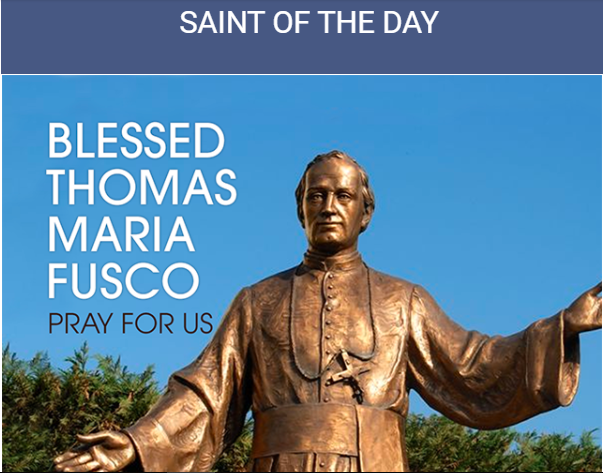
Bl. Thomas Maria Fusco (1831-1891) was born to a noble and pious family in Italy, the seventh of eight children. He was orphaned at an early age and raised by his uncle, a priest, who oversaw his education. He had a deep love for the faith, especially to the Passion of Christ and Our Lady of Sorrows. He became a priest at the age of 24 and opened a school in his own home. He later became an itinerant missionary throughout southern Italy. After traveling for a number of years he opened another school, this time to train priests on how to be good confessors. He also founded the Priestly Society of the Catholic Apostolate to support the missions, which gained papal approval. During his work with the poor he discerned a call to start a new religious order of sisters, the Daughters of Charity of the Most Precious Blood, to minister to orphaned children. In addition to all of this, Fusco was also a parish priest, a confessor to a group of cloistered nuns, and a spiritual father to a lay group at the nearby Shrine of Our Lady of Mount Carmel. He died of liver disease at the age of 59. He was beatified by Pope St. John Paul II in 2001. His feast day is February 24.