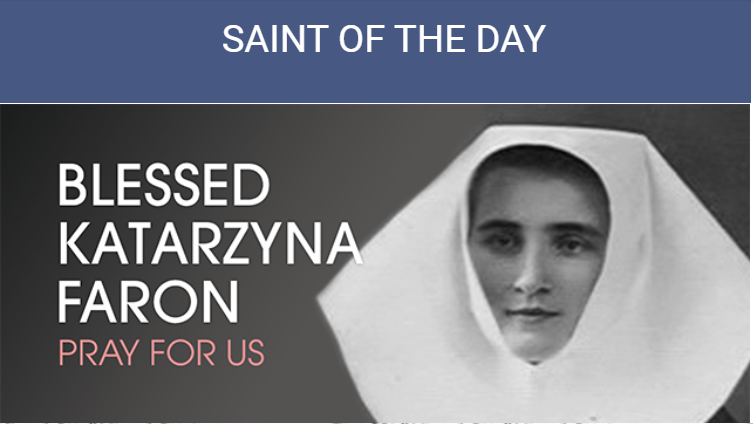
Saint of the Day – April 9th – Blessed Katarzyna Faron

Bl. Katarzyna Celestyna (Catherine Celestine) Faron (1913-1944) was born in Zabrzez, Poland. At the age of five she was orphaned and raised by pious, childless relatives. Desiring the religious life, she entered the Congregation of the Sisters Servants of Mary Immaculate in 1930. She served in the community as a kindergarten teacher and catechist. After the breakout of World War II she became the leader of her religious house, ran an orphanage, and helped the poor. She was eventually arrested by the Gestapo, charged with conspiracy against the Nazis, and sent to the Auschwitz concentration camp on the feast of Epiphany in 1943, where she was assigned to manual labor digging ditches. She praised God in all her suffering and resigned herself to following his will. Due to the poor conditions she developed typhoid fever and tuberculosis. Because she completed the nine First Fridays devotion to the Sacred Heart of Jesus, she trusted that she wouldn’t die without Holy Communion, as Our Lord promised. On December 8, 1943, the feast of the Immaculate Conception, she received Holy Communion as viaticum which was secretly brought to the camp by a prisoner priest.

While on her deathbed Catherine prayed intensely for various intentions on a rosary made of bread. According to witnesses she offered her sufferings for the conversion of a priest who had fallen away from the Church, who later did return to the true Faith. Bl. Katarzyn finally died from her illness on Easter morning. She is one of the 108 beatified Polish Catholic Martyrs killed during World War II by Nazi Germany. Her feast day is April 9th.

//The Catholic Company//


Saint of the Day – April 8 – Saint Julie Billiart

Saint Julie Billiart (July 12, 1751 – April 8, 1816)

Born in Cuvilly, France, into a family of well-to-do farmers, young Marie Rose Julie Billiart showed an early interest in religion and in helping the sick and poor. Though the first years of her life were relatively peaceful and uncomplicated, Julie had to take up manual work as a young teen when her family lost its money. However, she spent her spare time teaching catechism to young people and to the farm laborers.

A mysterious illness overtook her when she was about 30. Witnessing an attempt to wound or even kill her father, Julie was paralyzed and became a complete invalid. For the next two decades, she continued to teach catechism lessons from her bed, offered spiritual advice, and attracted visitors who had heard of her holiness.

When the French Revolution broke out in 1789, revolutionary forces became aware of her allegiance to fugitive priests. With the help of friends, she was smuggled out of Cuvilly in a haycart. She then spent several years hiding in Compiegne, being moved from house to house despite her growing physical pain. She even lost the power of speech for a time.

But this period also proved to be a fruitful spiritual time for Julie. It was at this time she had a vision in which she saw Calvary surrounded by women in religious habits and heard a voice saying, “Behold these spiritual daughters whom I give you in an institute marked by the cross.”

As time passed and Julie continued her mobile life, she made the acquaintance of an aristocratic woman, Françoise Blin de Bourdon, who shared Julie’s interest in teaching the faith. In 1803, the two women began the Institute of Notre Dame, which was dedicated to the education of the poor, young Christian girls, and the training of catechists. The following year, the first Sisters of Notre Dame made their vows. That was the same year that Julie recovered from the illness: She was able to walk for the first time in 22 years.

Though Julie had always been attentive to the special needs of the poor and that always remained her priority, she also became aware that other classes in society needed Christian instruction. From the founding of the Sisters of Notre Dame until her death, Julie was on the road, opening a variety of schools in France and Belgium that served the poor and the wealthy, vocational groups, teachers. Ultimately, Julie and Françoise moved the motherhouse to Namur, Belgium.

Julie died there in 1816. She was canonized in 1969.

Reflection

Julie’s immobility in no way impeded her activities. In spite of her suffering, she managed to co-found a teaching order that tended to the needs of both the poor and the well-to-do. Each of us has limitations, but the worst malady any of us can suffer is the spiritual paralysis that keeps us from doing God’s work on earth.

//Franciscan Media//


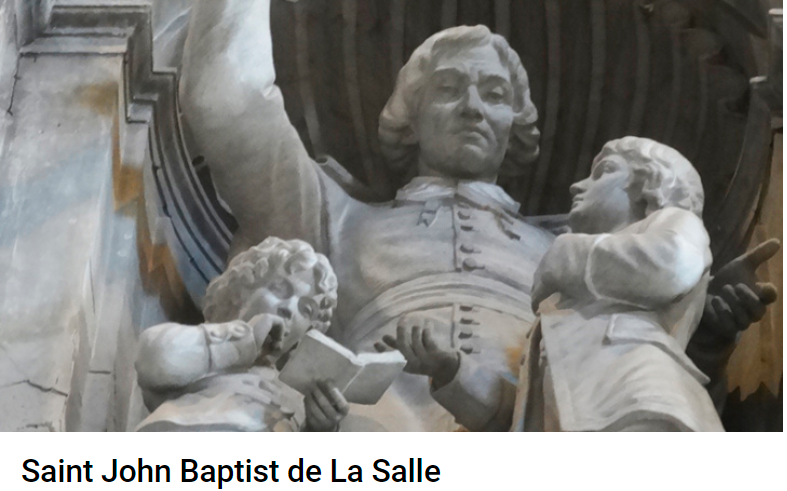
Saint of the Day – April 7 – Saint John Baptist de La Salle

Saint John Baptist de La Salle (April 30, 1651 – April 7, 1719)

Complete dedication to what he saw as God’s will for him dominated the life of John Baptist de La Salle. In 1950, Pope Pius XII named him patron of schoolteachers for his efforts in upgrading school instruction. As a young 17th-century Frenchman, John had everything going for him: scholarly bent, good looks, noble family background, money, refined upbringing. At the early age of 11, he received the tonsure and started preparation for the priesthood, to which he was ordained at 27. He seemed assured then of a life of dignified ease and a high position in the Church.

But God had other plans for John, which were gradually revealed to him in the next several years. During a chance meeting with Monsieur Adrien Nyel, he became interested in the creation of schools for poor boys in Rheims, where he was stationed. Though the work was extremely distasteful to him at first, he became more involved in working with the deprived youths.

Once convinced that this was his divinely appointed mission, John threw himself wholeheartedly into the work, left home and family, abandoned his position as canon at Rheims, gave away his fortune, and reduced himself to the level of the poor to whom he devoted his entire life.

The remainder of his life was closely entwined with the community of religious men he founded, the Brothers of the Christian School (also called Christian Brothers or De La Salle Brothers). This community grew rapidly and was successful in educating boys of poor families, using methods designed by John. It prepared teachers in the first training college for teachers and also set up homes and schools for young delinquents of wealthy families. The motivating element in all these endeavors was the desire to become a good Christian.

Yet even in his success, John did not escape experiencing many trials: heart-rending disappointment and defections among his disciples, bitter opposition from the secular schoolmasters who resented his new and fruitful methods, and persistent opposition from the Jansenists of his time, whose moral rigidity and pessimism about the human condition John resisted vehemently all his life.

Afflicted with asthma and rheumatism in his last years, he died at age 68 on Good Friday, and was canonized in 1900.

Reflection

Complete dedication to one’s calling by God, whatever it may be, is a rare quality. Jesus asks us to “love the Lord your God with all your heart, with all your soul, with all your mind, and with all your strength” (Mark 12:30b, emphasis added). Paul gives similar advice: “Whatever you do, do from the heart…” (Colossians 3:23).

Saint John Baptist de La Salle is the Patron Saint of:

Teachers

//Franciscan Media//


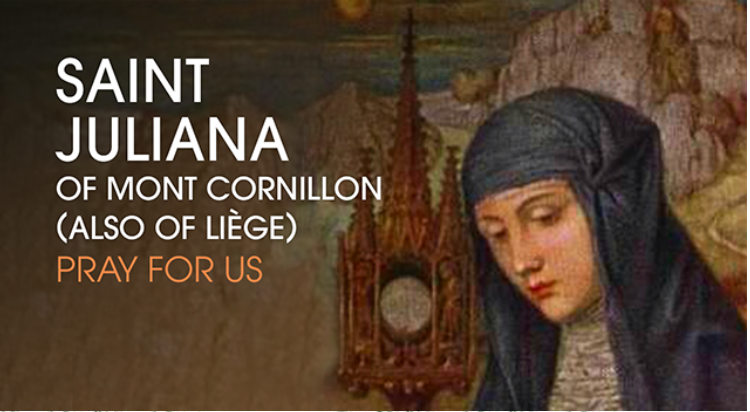
Saint of the Day – April 6th – Saint Juliana of Mont Cornillon

Blessed Juliana of Mont Cornillon, also known as Juliana of Liege (1193-1258) was born near Liege, Belgium. She was orphaned at the age of five and placed in the convent of Mt. Cornillon near Liege. She made rapid progress in virtue and grew in love for the Passion of Christ, the Blessed Virgin Mary, and the Blessed Sacrament. At the age of thirteen she became a nun and devoted herself to caring for the sick in the convent hospital. She eventually became the superioress of her community.

Taught in repeated visions that Our Lord wanted a liturgical feast in honor of the Holy Eucharist to be established, Juliana worked diligently to have the feast of Corpus Christi instituted for the Universal Church, a task for which she endured much opposition. She was forced to flee her convent after its general superior excited the populace against her and her visions. She was later vindicated by the bishop and returned to her rightful place, only to be forced to flee a final time, ending her life in seclusion.

The feast of Corpus Christi was finally instituted six years after her death by Pope Urban IV, who also commissioned Saint Thomas Aquinas to prepare the magnificent texts for the feast’s Office and Mass. Her feast day is April 6.


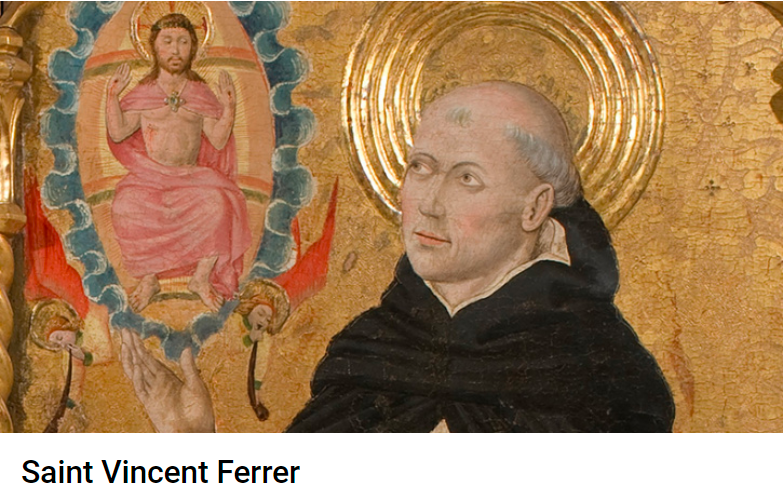
Saint of the Day – April 5th – Saint Vincent Ferrer

Saint Vincent (January 23, 1350 – April 5, 1419)

The polarization in the Church today is a mild breeze compared with the tornado that ripped the Church apart during the lifetime of this saint. If any saint is a patron of reconciliation, Vincent Ferrer is.

Despite parental opposition, he entered the Dominican Order in his native Spain at 19. After brilliant studies, he was ordained a priest by Cardinal Peter de Luna—who would figure tragically in his life.

Of a very ardent nature, Vincent practiced the austerities of his Order with great energy. He was chosen prior of the Dominican house in Valencia shortly after his ordination.

The Western schism divided Christianity first between two, then three, popes. Clement VII lived at Avignon in France, Urban VI in Rome. Vincent was convinced the election of Urban was invalid, though Catherine of Siena was just as devoted a supporter of the Roman pope. In the service of Cardinal de Luna, Vincent worked to persuade Spaniards to follow Clement. When Clement died, Cardinal de Luna was elected at Avignon and became Benedict XIII.

Vincent worked for him as apostolic penitentiary and Master of the Sacred Palace. But the new pope did not resign as all candidates in the conclave had sworn to do. He remained stubborn, despite being deserted by the French king and nearly all of the cardinals.

Vincent became disillusioned and very ill, but finally took up the work of simply “going through the world preaching Christ,” though he felt that any renewal in the Church depended on healing the schism. An eloquent and fiery preacher, he spent the last 20 years of his life spreading the Good News in Spain, France, Switzerland, the Low Countries and Lombardy, stressing the need of repentance and the fear of coming judgment. He became known as the “Angel of the Judgment.”

Vincent tried unsuccessfully, in 1408 and 1415, to persuade his former friend to resign. He finally concluded that Benedict was not the true pope. Though very ill, he mounted the pulpit before an assembly over which Benedict himself was presiding, and thundered his denunciation of the man who had ordained him a priest. Benedict fled for his life, abandoned by those who had formerly supported him. Strangely, Vincent had no part in the Council of Constance, which ended the schism.

Reflection

The split in the Church at the time of Vincent Ferrer should have been fatal—36 long years of having two “heads.” We cannot imagine what condition the Church today would be in if, for that length of time, half the world had followed a succession of popes in Rome, and half an equally “official” number of popes in say, Rio de Janeiro. It is an ongoing miracle that the Church has not long since been shipwrecked on the rocks of pride and ignorance, greed and ambition. Contrary to Lowell’s words, “Truth forever on the scaffold, wrong forever on the throne,” we believe that “truth is mighty, and it shall prevail”—but it sometimes takes a long time.


Saint Vincent Ferrer is the Patron Saint of:

Builders
Businessmen
Reconciliation

//Franciscan Media//


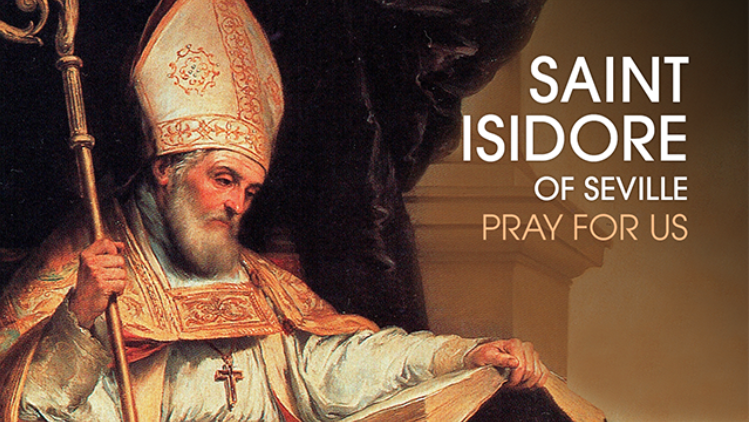
Saint of the Day – April 4th – Saint Isidore of Seville

Saint Isidore (C. 560 – APRIL 4, 636)

The 76 years of Isidore’s life were a time of conflict and growth for the Church in Spain. The Visigoths had invaded the land a century and a half earlier, and shortly before Isidore’s birth they set up their own capital. They were Arians—Christians who said Christ was not God. Thus, Spain was split in two: One people (Catholic Romans) struggled with another (Arian Goths).

Isidore reunited Spain, making it a center of culture and learning. The country served as a teacher and guide for other European countries whose culture was also threatened by barbarian invaders.

Born in Cartagena of a family that included three other sibling saints—Leander, Fulgentius and Florentina—he was educated by his elder brother, whom he succeeded as bishop of Seville.

An amazingly learned man, he was sometimes called “The Schoolmaster of the Middle Ages” because the encyclopedia he wrote was used as a textbook for nine centuries. He required seminaries to be built in every diocese, wrote a Rule for religious orders, and founded schools that taught every branch of learning. Isidore wrote numerous books, including a dictionary, an encyclopedia, a history of Goths, and a history of the world—beginning with creation! He completed the Mozarabic liturgy, which is still in use in Toledo, Spain. For all these reasons, Isidore has been suggested as patron of the Internet. Several others—including Anthony of Padua—also have been suggested.

He continued his austerities even as he approached age 80. During the last six months of his life, he increased his charities so much that his house was crowded from morning till night with the poor of the countryside.

Reflection

Our society can well use Isidore’s spirit of combining learning and holiness. Loving, understanding and knowledge can heal and bring a broken people back together. We are not barbarians like the invaders of Isidore’s Spain. But people who are swamped by riches and overwhelmed by scientific and technological advances can lose much of their understanding love for one another.

Saint Isidore of Seville is the Patron Saint of:

Internet
Computers

//Franciscan Media//


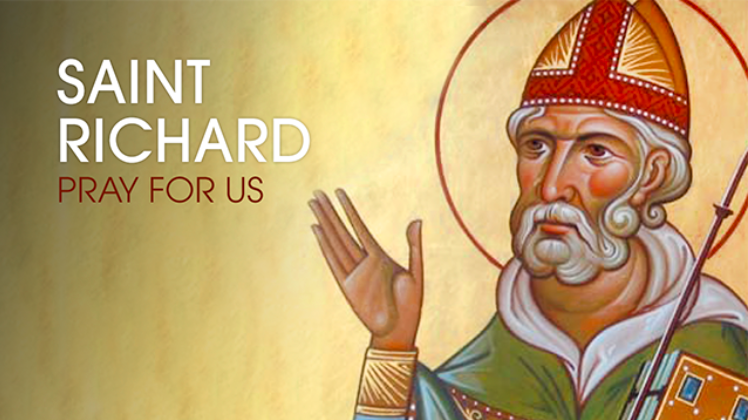
Saint of the Day – April 3rd – Saint Richard of Chichester

St. Richard of Chichester (1197-1253), also known as St. Richard de Wyche, was born in Worcestershire, England to a land-owning squire. His father died when he was young, causing the family to suffer hardship for many years. The situation became dire enough for Richard to suspend his studies to take over the family estates and make them profitable again. He went on to Oxford to study for the priesthood, and was so poor that he and two companions shared a set of clothes which they took turns wearing to class. He obtained degrees at the universities in Paris and Bologna before being appointed as the Chancellor of Oxford University.

Richard became well-known for his learning and sanctity. As a result he next became Chancellor for the Archbishop of Canterbury, St. Edmund Rich, to whom he was a faithful companion and advisor. Years later St. Richard was ordained the Bishop of Chichester. In this position he entered into power struggles with King Henry III, who withheld his diocesan revenues and blocked his access to the cathedral. St. Richard had many accomplishments as bishop, including establishing greater order and reverence to the liturgy, vigorously defending the rights of the Church, assisting the poor and the oppressed, and preaching a crusade against the Saracens at the request of the Pope.

Richard died of fever surrounded by his closest friends at about 56 years of age. He was buried in the Chichester Cathedral and his shrine became a popular place of pilgrimage before being destroyed by King Henry VIII. St. Richard’s feast day is April 3rd.

//The Catholic Company//


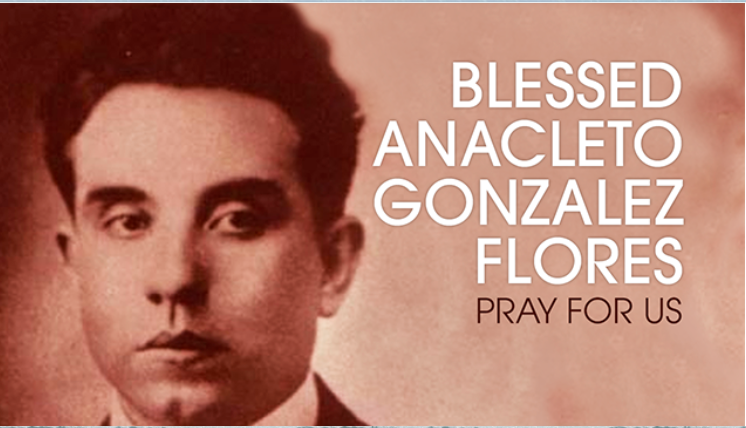
Saint of the Day – April 1 – Blessed Anacleto Gonzalez Flores

Bl. Anacleto Gonzalez Flores (1888–1927) was the second of twelve children born to a poor family in Jalisco, Mexico. He was baptized the day after his birth. As he grew, a priest recognized his intelligence and recommended that he enter the seminary. Anacleto studied there for a time before discerning that he was not called to the priesthood. Instead he became an attorney, husband, and father, as well as an activist for his Catholic faith. He was a prolific writer and dedicated catechism teacher, and attended daily Mass. He joined the Catholic Association of Young Mexicans (ACJM) in addition to starting another Catholic lay organization committed to resisting the fierce persecution of the Catholic Church under the infamous Mexican dictator, Calles. Initially he participated only in the non-violent resistance against Calles, until four members of the ACJM were murdered in 1926. Their deaths spurred Anacleto to lend support to the armed resistance movement. Anacleto did not take up arms but instead gave speeches to encourage Catholics to support the Cristeros, the Catholic army fighting against Calles.

Anacleto was captured during the Cristero War on April 1, 1927, and was brutally tortured before being martyred by firing squad. His feast day is April 1st.

//The Catholic Company//


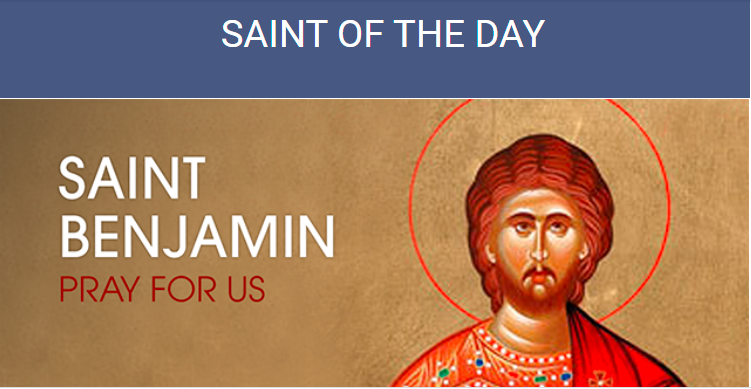
Saint of the Day – March 31 – Saint Benjamin

St. Benjamin (d. 424 A.D.) was a deacon martyred in Persia during a forty-year-long Christian persecution under two tyrannical Persian kings. He was imprisoned for a year due to his Christian faith and then released with the help of the Eastern Roman Emperor Theodosius II. As a condition of his release he was ordered to no longer publicly proclaim his faith. Benjamin declared that it was his duty to preach the Gospel of Jesus Christ and he refused to be silenced. He continued preaching Christ crucified, and, when word reached the king, he was arrested again. In response, Benjamin asked the king what opinion he would have of any of his subjects if they were to renounce their allegiance to the king and join in war against him; in the same way Benjamin could not renounce his allegiance to Christ. This comment enraged the king, and he ordered Benjamin to endure cruel tortures. Sharpened reeds were repeatedly jammed underneath his fingernails, toenails, and other tender parts of the body. He died when a knotted stake was jammed into his bowels. St. Benjamin’s feast day is celebrated on March 31st.

//The Catholic Company//


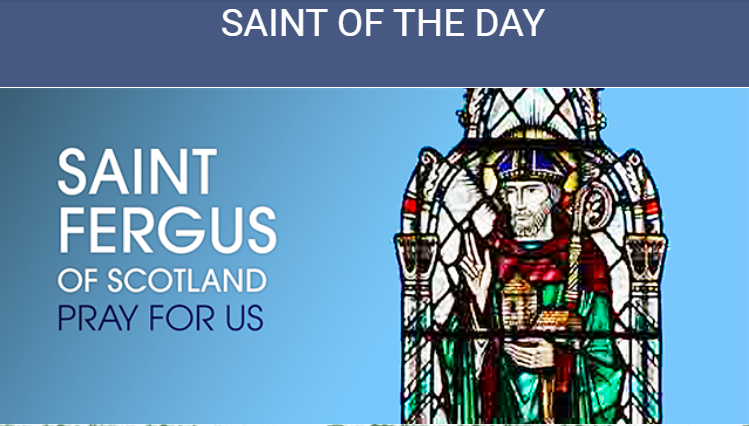
Saint of the Day – March 30 – Saint Fergus of Scotland

St. Fergus of Scotland (d. 730 A.D.), also known as St. Fergustian or Fergus the Pict, Bishop of the Gaels, was a bishop serving in the north of Scotland. Little is known of his life. He is believed to have been trained as a bishop in Ireland, ministering there for many years before traveling as a missionary to Scotland. He went throughout the Scottish countryside preaching the Gospel, setting up churches dedicated to St. Patrick of Ireland, and working to convert the pagan people to Christianity. He also traveled to St. Peter’s Basilica to participate in the Council of Rome in 721 A.D. He died around the year 730 A.D. and is buried in Glamis, Angus, in Scotland. Nearby is St. Fergus’ Well. The site is believed to be where St. Fergus presided over religious services before the first church of Glamis was built. His feast day is March 30th.

//The Catholic Company//