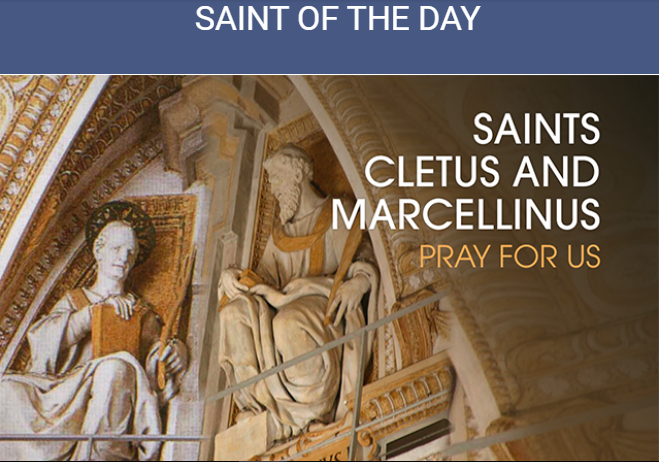
St. Cletus (1st c.) and St. Marcellinus (3rd c.) were both Romans, popes, and martyrs who ruled the Holy See during the terrible persecution of Christians at the hands of the Roman Empire. St. Cletus was a convert and disciple of St. Peter the Apostle who became the third Bishop of Rome from 76 to 89 A.D., under the reigns of Roman Emperors Vespasian and Titus. His name appears in the Roman Canon of the Mass. St. Marcellinus was the twenty-ninth Bishop of Rome from 296 to 304 A.D. during the infamous persecution of the Roman Emperor Diocletian, on the eve of the legalization of Christianity across the Empire. Statues of these two popes of the early Church sit on opposite corners of the portico ceiling of Saint Peter’s Basilica in Rome. They share a feast day on April 26th.
Most of what we know about Mark comes directly from the New Testament. He is usually identified with the Mark of Acts 12:12. When Saint Peter escaped from prison, he went to the home of Mark’s mother.
Paul and Barnabas took him along on the first missionary journey, but for some reason Mark returned alone to Jerusalem. It is evident, from Paul’s refusal to let Mark accompany him on the second journey despite Barnabas’s insistence, that Mark had displeased Paul. Because Paul later asks Mark to visit him in prison, we may assume the trouble did not last long.
The oldest and the shortest of the four Gospels, the Gospel of Mark emphasizes Jesus’s rejection by humanity while being God’s triumphant envoy. Probably written for gentile converts in Rome—after the death of Peter and Paul sometime between A.D. 60 and 70—Mark’s Gospel is the gradual manifestation of a “scandal”: a crucified Messiah.
Evidently a friend of Mark—calling him “my son”—Peter is only one of this Gospel’s sources, others being the Church in Jerusalem (Jewish roots), and the Church at Antioch (largely gentile).
Like another Gospel writer Luke, Mark was not one of the 12 apostles. We cannot be certain whether he knew Jesus personally. Some scholars feel that the evangelist is speaking of himself when describing the arrest of Jesus in Gethsemane: “Now a young man followed him wearing nothing but a linen cloth about his body. They seized him, but he left the cloth behind and ran off naked” (Mark 14:51-52).
Others hold Mark to be the first bishop of Alexandria, Egypt. Venice, famous for the Piazza San Marco, claims Mark as its patron saint; the large basilica there is believed to contain his remains.
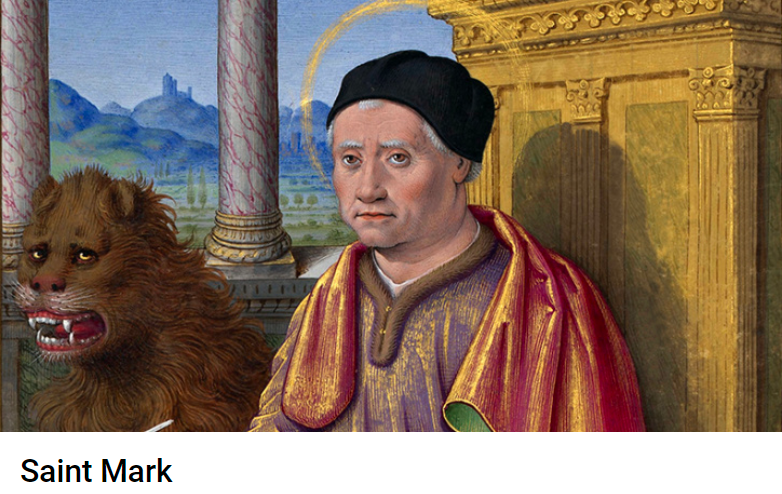
A winged lion is Mark’s symbol. The lion derives from Mark’s description of John the Baptist as a “voice of one crying out in the desert” (Mark 1:3), which artists compared to a roaring lion. The wings come from the application of Ezekiel’s vision of four winged creatures to the evangelists.
Reflection
Mark fulfilled in his life what every Christian is called to do: proclaim to all people the Good News that is the source of salvation. In particular, Mark’s way was by writing. Others may proclaim the Good News by music, drama, poetry, or by teaching children around a family table.
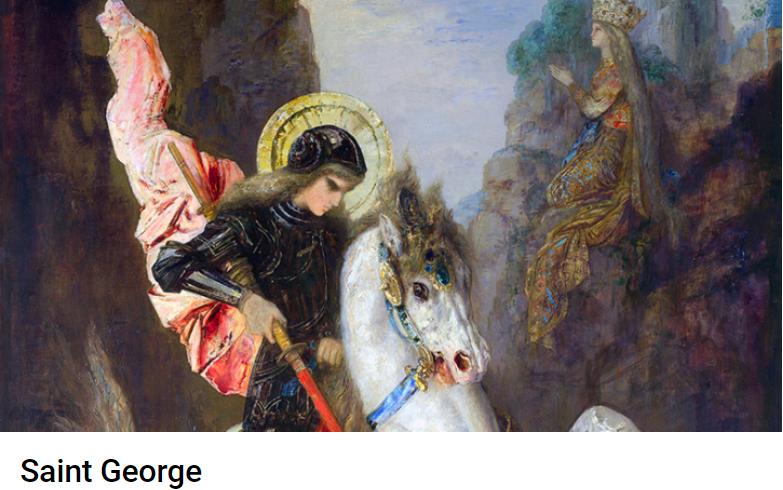
Saint George is the object of a vast amount of imagination. There is every reason to believe that he was a real martyr who suffered at Lydda in Palestine, probably before the time of Constantine. The Church adheres to his memory, but not to the legends surrounding his life. That he was willing to pay the supreme price to follow Christ is what the Church believes. And it is enough.
The story of George’s slaying the dragon, rescuing the king’s daughter, and converting Libya is a 12th-century Italian fable. George was a favorite patron saint of crusaders, as well as of Eastern soldiers in earlier times. He is a patron saint of England, Portugal, Germany, Aragon, Catalonia, Genoa, Milan and Bologna.
Reflection
Human nature seems to crave more than cold historical data. Americans have Washington and Lincoln, but we somehow need Paul Bunyan, too. The life of Saint Francis of Assisi is inspiring enough, but for centuries the Italians have found his spirit in the legends of the Fioretti, too. Santa Claus is the popular extension of the spirit of Saint Nicholas. The legends about Saint George are part of this yearning. Both fact and legend are human ways of illumining the mysterious truth about the One who alone is holy.
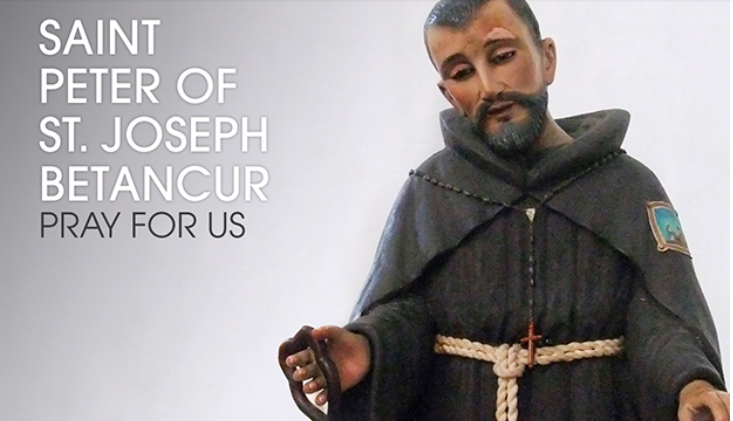
St. Peter of St. Joseph Betancur, or Pedro de San José Betancur (1626-1667), also known as Hermano Pedro, was born into poverty in the Canary Islands. He was a shepherd until the age of 24 at which time he traveled to Guatemala, then the capital of New Spain, hoping to connect with a relative and to begin training to be a priest. The journey so impoverished him that he entered a bread line served by the Franciscans. He took up work in a textile factory and later entered a Jesuit college to study for the priesthood. Being too poor to continue his studies, he instead became a Franciscan tertiary. He dedicated his life to helping the poor and oppressed in jails and hospitals, as well as ministering to African slaves, Native Americans, and anyone else in need. He also founded a hospital, a school for the poor, and a homeless shelter. He also preached to the rich, inviting them to repent of their sins. Because of his effective apostolate he became known as “St. Francis of the Americas.” People were attracted to his way of life and followed him, leading to the founding of the Bethlehemite Brothers and Sisters. In addition to serving the poor, they had the charism of special devotion to the Divine Child and the Blessed Virgin, and offered prayer and sacrifices for the Holy Souls in Purgatory. Each night St. Peter would carry a heavy wooden cross through the streets as a form of penance and evangelization. It is also said that he was the first to start the Posadas procession during Advent. He died in 1667 and was canonized by Pope St. John Paul II as the first saint from Central America. His feast day is April 18.
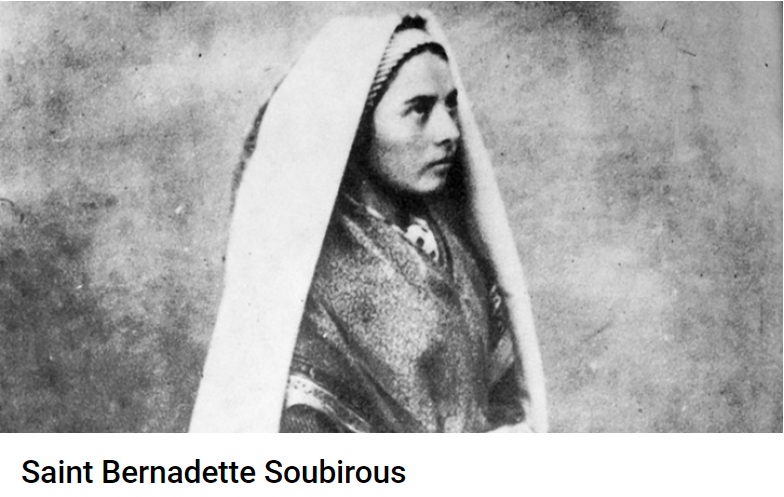
Bernadette Soubirous was born in 1844, the first child of an extremely poor miller in the town of Lourdes in southern France. The family was living in the basement of a dilapidated building when on February 11, 1858, the Blessed Virgin Mary appeared to Bernadette in a cave above the banks of the Gave River near Lourdes. Bernadette, 14 years old, was known as a virtuous girl though a dull student who had not even made her first Holy Communion. In poor health, she had suffered from asthma from an early age.
There were 18 appearances in all, the final one occurring on the feast of Our Lady of Mt. Carmel, July 16. Although Bernadette’s initial reports provoked skepticism, her daily visions of “the Lady” brought great crowds of the curious. The Lady, Bernadette explained, had instructed her to have a chapel built on the spot of the visions. There, the people were to come to wash in and drink of the water of the spring that had welled up from the very spot where Bernadette had been instructed to dig.
According to Bernadette, the Lady of her visions was a girl of 16 or 17 who wore a white robe with a blue sash. Yellow roses covered her feet, a large rosary was on her right arm. In the vision on March 25 she told Bernadette, “I am the Immaculate Conception.” It was only when the words were explained to her that Bernadette came to realize who the Lady was.
Few visions have ever undergone the scrutiny that these appearances of the Immaculate Virgin were subject to. Lourdes became one of the most popular Marian shrines in the world, attracting millions of visitors. Miracles were reported at the shrine and in the waters of the spring. After thorough investigation, Church authorities confirmed the authenticity of the apparitions in 1862.
During her life, Bernadette suffered much. She was hounded by the public as well as by civic officials until at last she was protected in a convent of nuns. Five years later, she petitioned to enter the Sisters of Notre Dame of Nevers. After a period of illness she was able to make the journey from Lourdes and enter the novitiate. But within four months of her arrival she was given the last rites of the Church and allowed to profess her vows. She recovered enough to become infirmarian and then sacristan, but chronic health problems persisted. She died on April 16, 1879, at the age of 35.
Bernadette Soubirous was canonized in 1933.
Reflection
Millions of people have come to the spring Bernadette uncovered for healing of body and spirit, but she found no relief from ill health there. Bernadette moved through life, guided only by blind faith in things she did not understand—as we all must do from time to time.
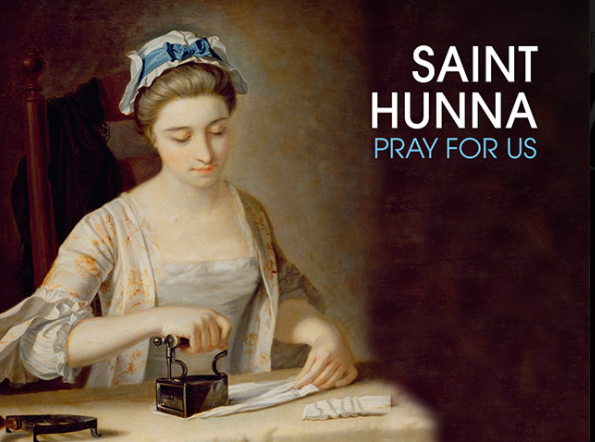
St. Hunna (d. 679 A.D.) was born in Alsace, France. She was the virtuous daughter of a duke, and she married a similarly virtuous nobleman. Hunna and her husband did not indulge in unnecessary luxuries according to their high state in life, and instead detached themselves from their riches by opening their home to the poor and assisting them in their need. St. Deodatus, a bishop who resigned from his See, came to live with the holy couple for a time. St. Hunna and her husband greatly profited from his religious instruction and grew in sanctity as a result. When Hunna bore a son, she named him after St. Deodatus. This child, raised by such holy parents, later joined a monastery and also became a saint. After her husband’s death Hunna continued to spend her life serving the poor, especially women. No task was too menial for her. She tended to the poor and the sick and regularly, including their laundry and mending, even to the point of exhaustion. For this she was nicknamed the “Holy Washerwoman.” She also gave away her wealth and property to build churches and monasteries. So many miracles were attributed to her that Pope Leo X canonized her in 1520. St. Hunna is the patron saint of laundresses and her feast day is April 15.
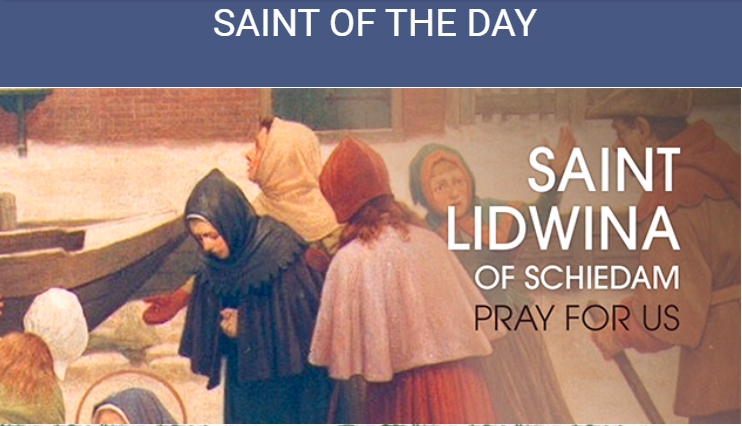
St. Lidwina of Schiedam (1380-1433) was born to a poor family in Holland. She had a devotion to the Blessed Mother and would often pray before the miraculous image of Our Lady of Schiedam. One winter, when she was 15 years old, she fell while ice skating and broke a rib, which she never recovered from. Gangrene spread throughout her body, which became as one big sore, and she was bed-ridden for the rest of her life. No medicine was able to help her. Her gradual physical deterioration was so grotesque that many suspected her of being possessed by the devil. However, when a priest brought her an unconsecrated Host, she was able to discern that it was not the Body and Blood of Christ. She experienced great suffering in this way until she was 53, but God rewarded her with the gift of heightened prayer, mystical visions, and spiritual consolations. Although she was not cured, many miraculous healings were attributed to her intercession. She fasted continuously, eventually surviving on only the Eucharist, and after her death on Easter Sunday the sweet odor of sanctity filled her room. Her grave became a pilgrimage site over which a chapel was erected. St. Lidwina of Schiedam is the patron of the chronically ill and ice skaters. Her feast day is April 14th.
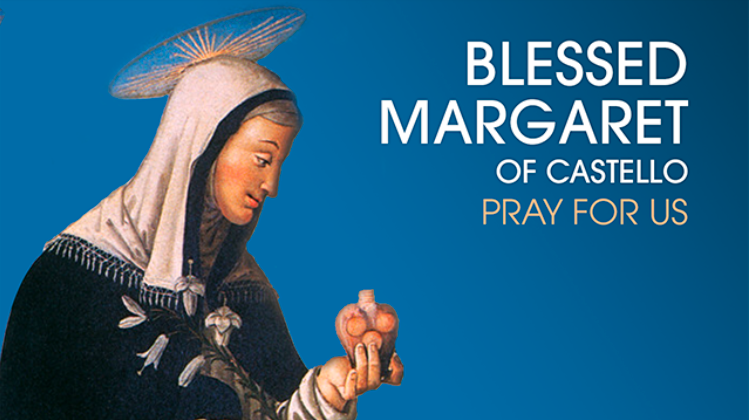
Bl. Margaret of Castello (1287–1320) was born to noble Italian parents who were awaiting the birth of the child of their dreams. Instead, they bore a daughter who was blind, dwarfed, lame, and hunchbacked. Margaret’s parents were horrified by the physical appearance of their newborn child, so they hid her and kept her existence secret. A servant had her baptized and named her Margaret, meaning, “Pearl.” When she was six years of age she was nearly discovered, so that her father confined her to a cell inside the wall of a church with her necessities given through a window. The parish priest took it upon himself to educate Margaret. She lived in this way until age sixteen, when her parents took her on pilgrimage to a shrine famous for miraculous healings. There they prayed earnestly for their daughter to be cured of her deformities, which they loathed. When no cure came, her parents abandoned her in the streets and returned home, never to see her again. Margaret begged for food and was helped by the town’s poor who took turns sheltering her in their homes. She became a Dominican Tertiary and took up the work of serving the sick, dying, and imprisoned. Margaret was known for her great joy, sanctity, and profound mystical experiences. She died at the age of 33, and hundreds of miracles were credited to her intercession both before and after her death. Her body is incorrupt. She is the patron against poverty, and of the disabled, handicapped, and unwanted. Her feast day is April 13th.
One needn’t live a long life to leave a deep imprint. Teresa of Los Andes is proof of that.
As a young girl growing up in the early 1900’s in Santiago, Chile, Juana Fernandez read an autobiography of a French-born saint—Thérèse, popularly known as the Little Flower. The experience deepened her desire to serve God and clarified the path she would follow. At age 19 Juana became a Carmelite nun, taking the name of Teresa.
The convent offered the simple lifestyle Teresa desired and the joy of living in a community of women completely devoted to God. She focused her days on prayer and sacrifice. “I am God’s,” she wrote in her diary. “He created me and is my beginning and my end.”
Toward the end of her short life, Teresa began an apostolate of letter-writing, sharing her thoughts on the spiritual life with many people. At age 20 she contracted typhus and quickly took her final vows. She died a short time later, during Holy Week.
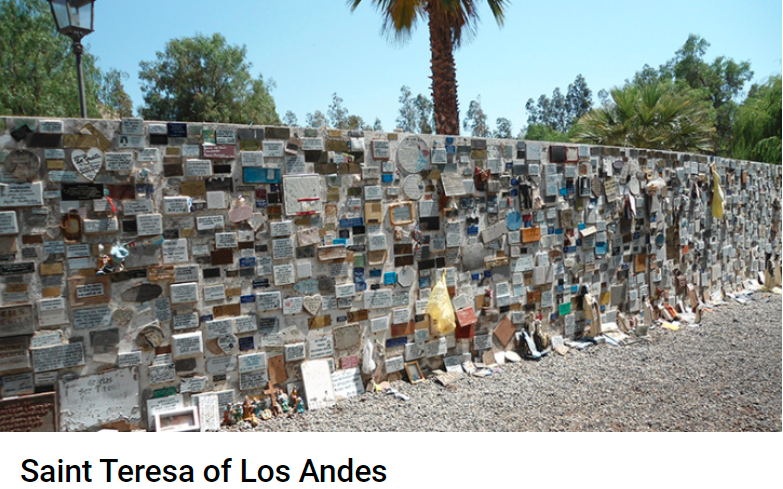
Known as the “Flower of the Andes,” Teresa remains popular with the estimated 100,000 pilgrims who visit her shrine in Los Andes each year. Canonized in 1993 by Pope John Paul II, she is Chile’s first saint.
Reflection
The special graces given Saint Teresa reflect the mysterious wisdom of God at work in individuals whether young or old. It appears God has his own logic when it comes to who gets what in the realm of grace. All we can say is; “Praised be the Lord.”
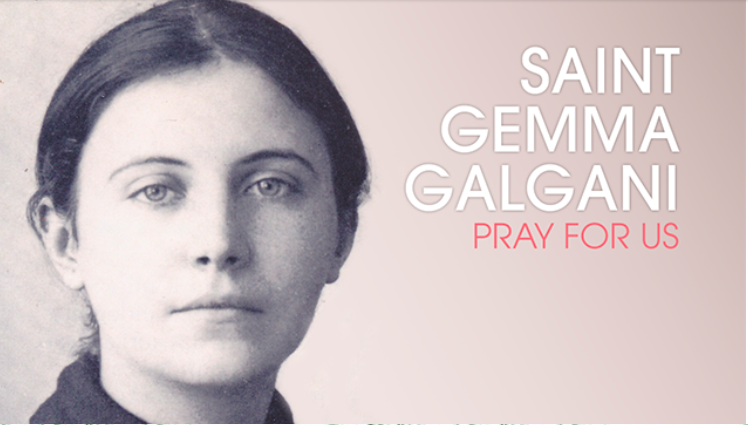
St. Gemma Galgani (1878-1903) was born in Italy, the fifth of eight children born to a prosperous pharmacist. When she was young, Gemma’s mother and three of her siblings died of tuberculous. When she was 18 her father died as well, leaving Gemma to help care for her younger siblings. She rejected two marriage proposals and became a housekeeper while trying to enter the religious life as a Passionist. She was rejected due to her poor heath, and later became a Tertiary member of the order. Gemma developed spinal meningitis but was miraculously healed, which she attributed to the Sacred Heart of Jesus through the intercession of St. Gabriel of Our Lady of Sorrows and St. Margaret Mary Alacoque. Throughout her life she united herself with the Passion of Christ and experienced great suffering as a result, but not without receiving many remarkable graces as well. She experienced many mystical visions and was often visited by her guardian angel, Jesus, and the Virgin Mary. For this she was known as a great mystic, and, according to her spiritual director, developed the stigmata at age 21. After a selfless life of love given to God for the conversion of sinners, she died on the Vigil of Easter at the age of 25. She is the patron saint of pharmacists, loss of parents, back illnesses, temptations, and those seeking purity of heart. Her feast day is April 11th.