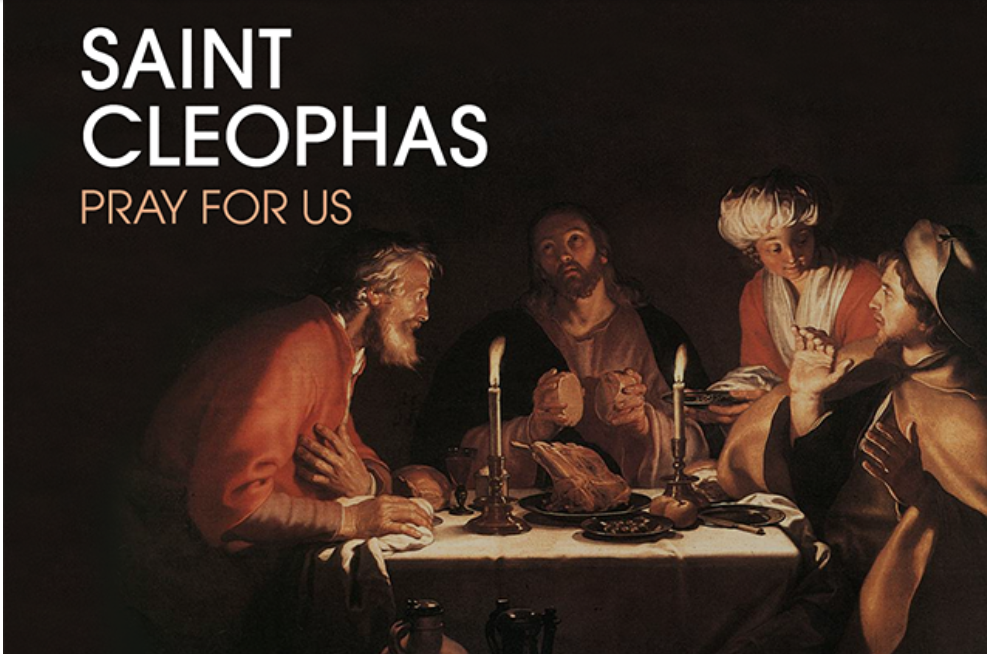
St. Cleophas (1st c.) was one of Jesus’ seventy disciples, and one of the two disciples who were traveling along the road to Emmaus after the crucifixion and resurrection of Jesus in Jerusalem, as recounted in Luke’s Gospel. The resurrected Jesus appeared and walked along the road with St. Cleophas and his companion, explaining the events of his Passion and how they fulfilled the Holy Scriptures. According to one tradition, Cleophas (also known as Alphaeus), was a relative of Jesus; he was the brother of St. Joseph, and therefore was Jesus’ uncle. Cleophas was the husband of St. Mary of Cleophas, and they had three sons we know by name: St. Simon, St. James the Less, and St. Jude. St. Cleophas, through his daughter Mary Salome, was also grandfather to St. James the Greater and St. John. Therefore three of his sons and two of his grandsons were among the Twelve Apostles. According to tradition, St. Cleophas was martyred by the Jewish authorities in the same home in which he received Jesus as a guest. His feast day is September 25th.
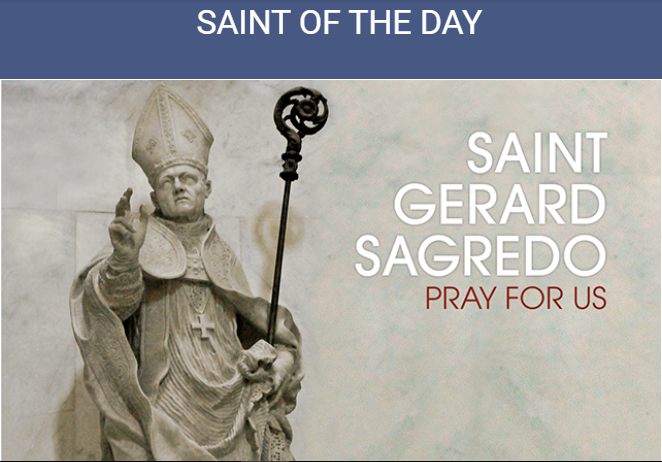
St. Gerard Sagredo (980–1046 A.D.) was born in Venice, Italy. From an early age he desired to dedicate his life to God, and as a young man became a Benedictine monk. He first served as abbot at a monastery in Venice, but left to make a pilgrimage to the Holy Land. While passing through Hungary he met the Hungarian king, St. Stephen, who asked him to stay in his country to evangelize and minister to his people. St. Gerard agreed, and was named Bishop of Csanád and the royal tutor of the Hungarian prince. He ministered tirelessly among the Hungarian people and helped to convert the whole country to Christianity, for which he is called the “Apostle of Hungary.” After the death of King St. Stephen there was a pagan uprising against the Christians, and St. Gerard was martyred for the faith along with two others. His death took place on a hill in Budapest which is now named after him; according to one tradition he was placed in a barrel lined with spikes, and rolled down the hill. He was declared a saint in 1083 by Pope St. Gregory VII. St. Gerard Sagredo is the patron saint of Hungary, and his feast day is September 24th.
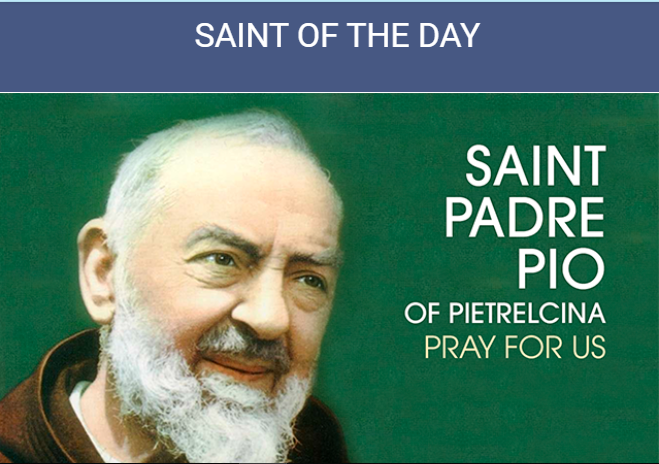
St. Padre Pio of Pietrelcina (1887–1968) was born to peasant farmers in southern Italy. By the time he was 5 years old he practiced a life of penance and made the decision to give himself completely to God. He grew up working in the fields, and at the age of 19 joined the Capuchin Franciscan friars. His Franciscan spirituality was characterized by a life of poverty, love of nature, and charity to those in need, especially to those who were his “spiritual children.” St. Padre Pio had many spiritual gifts and was a great miracle-worker. These were well-documented from multiple reliable sources and included bilocation, levitation, reading souls, and physical healing by touch. Word of his holiness spread and people both pious and curious flocked to see him, especially to have him hear their confession. He is the first priest known to have received the stigmata, for which he suffered suspicion and investigation. Because of the unusual supernatural phenomena surrounding his life, he is considered one of the great visionaries and mystics of the Church. Padre Pio died in 1968 at the age of 81. He was canonized by Pope St. John Paul II in 2002. Because of the many miracles he performed during his life, he is commonly invoked as a healing saint for various ailments. His feast day is September 23rd.
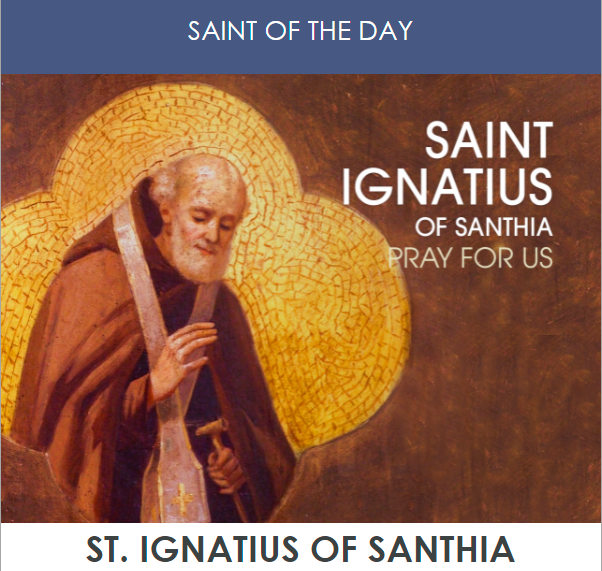
St. Ignatius of Santhia (1686-1770) was born in Italy to an upper-class family. He received his early education from a devout priest, a relative of his mother, who inspired him to join the priesthood. He studied philosophy and theology, and after his ordination served as a diocesan priest for six years. St. Ignatius earned a reputation as an excellent preacher of retreats and missions, and he had a promising future within the diocese. His family and parishioners were surprised and disappointed when he decided to join the Capuchin Franciscans in Turin as a poor, humble friar. However, St. Ignatius flourished in the poverty and simplicity of the Franciscan way of life. He became well-known for his wisdom and sanctity, and many people from all walks of life came to him for confession and spiritual direction. He had a great devotion to the Blessed Virgin Mary and prayed the rosary faithfully. He served God with humble obedience and inspired this virtue in the Franciscan novices over whom he had charge. He spent his last years on a sickbed where he continued to hear confessions and give direction to his visitors. St. Ignatius of Santhia’s feast day is September 22nd.
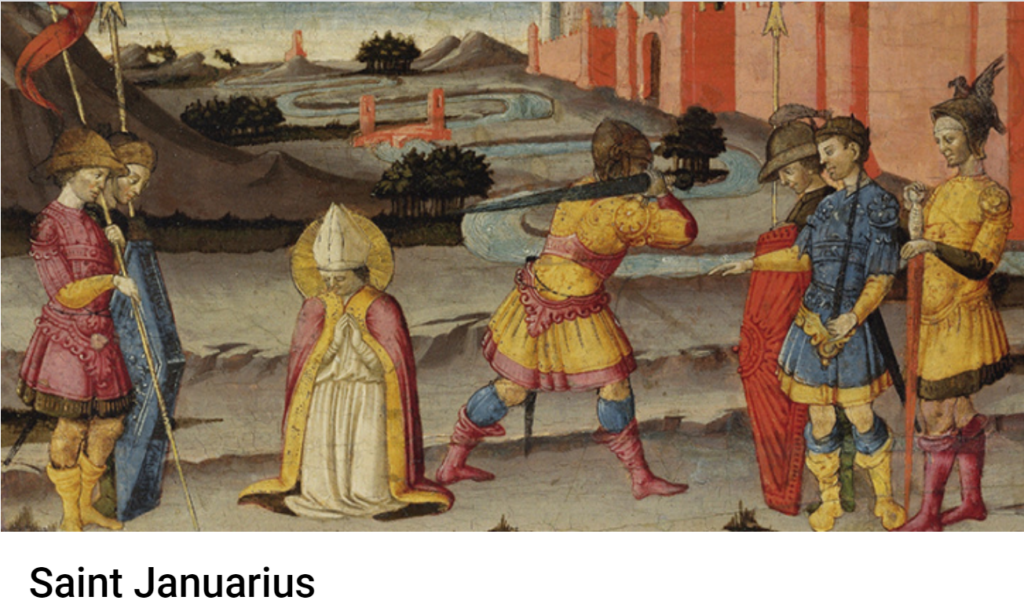
Little is known about the life of Januarius. He is believed to have been martyred in the Emperor Diocletian’s persecution of 305. Legend has it that Januarius and his companions were thrown to the bears in the amphitheater of Pozzuoli, but the animals failed to attack them. They were then beheaded, and Januarius’ blood ultimately brought to Naples.
“A dark mass that half fills a hermetically sealed four-inch glass container, and is preserved in a double reliquary in the Naples cathedral as the blood of St. Januarius, liquefies 18 times during the year…Various experiments have been applied, but the phenomenon eludes natural explanation….” [From the Catholic Encyclopedia]
Reflection
It is defined Catholic doctrine that miracles can happen and are recognizable. Problems arise, however, when we must decide whether an occurrence is unexplainable in natural terms, or merely unexplained. We do well to avoid an excessive credulity but, on the other hand, when even scientists speak about “probabilities” rather than “laws” of nature, it is something less than imaginative for Christians to think that God is too “scientific” to work extraordinary miracles to wake us up to the everyday miracles of sparrows and dandelions, raindrops and snowflakes.
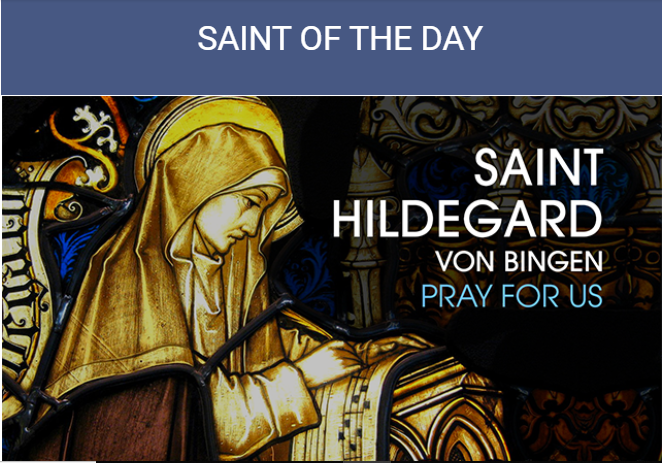
St. Hildegard von Bingen (1098–1179) was born to a large and noble German family. She began to have mystical visions at the age of three which continued throughout her life. Her parents, promising her to the service of God, sent her to be educated at the Benedictine Abbey by an anchoress when she was about eight years of age. At the age of fourteen she became a consecrated nun attached to the Abbey, where she lived a quiet life of prayer for many years. At the age of 38, after the anchoress’ death, she was chosen as the new leader of a growing group of nuns. Hildegard led a remarkable and unusual life for a woman of her day. She was an avid composer of sacred music and liturgy, in addition to poems and plays. She also wrote heavily on theology, natural medicine, and natural science. At the age of 42, at the command of God, Hildegard began writing down what she saw in her visions. Her works were widely read, even by the Pope, and leaders around the world sought her council. Her fame as a mystic and prophetess grew, earning her the name “Sibyl of the Rhine.” More nuns flocked to join her, causing Hildegard to establish a new monastery at Rupertsberg. She wrote proficiently on the harmony of created nature and man’s need to live in balance with it, especially in virtue, morality, and the love of God, which led Pope Benedict XVI to declare her the fourth female Doctor of the Church in 2012 alongside Teresa of Avila, Catherine of Siena, and Thérèse of Lisieux. Because her works were far ahead of her time she is regarded as a historical phenomenon. Hildegard of Bingen is considered the founder of scientific natural history in Germany. Her feast day is September 17th.
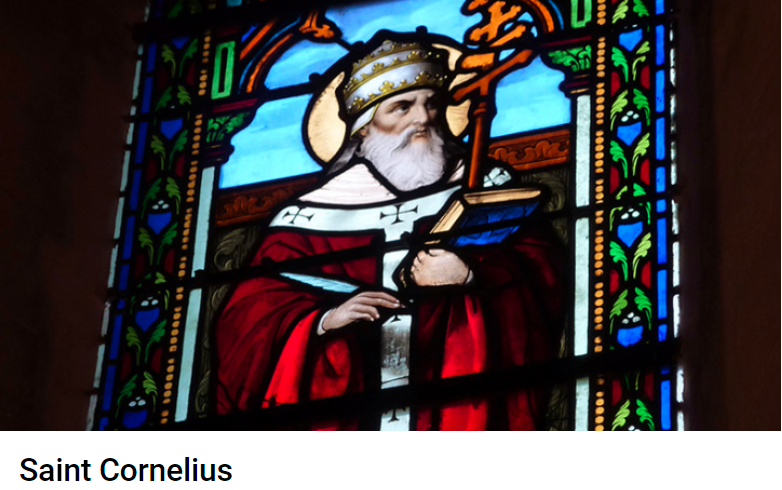
There was no pope for 14 months after the martyrdom of Saint Fabian because of the intensity of the persecution of the Church. During the interval, the Church was governed by a college of priests. Saint Cyprian, a friend of Cornelius, writes that Cornelius was elected pope “by the judgment of God and of Christ, by the testimony of most of the clergy, by the vote of the people, with the consent of aged priests and of good men.”
The greatest problem of Cornelius’s two-year term as pope had to do with the Sacrament of Penance and centered on the readmission of Christians who had denied their faith during the time of persecution. Two extremes were finally both condemned. Cyprian, primate of North Africa, appealed to the pope to confirm his stand that the relapsed could be reconciled only by the decision of the bishop.
In Rome, however, Cornelius met with the opposite view. After his election, a priest named Novatian (one of those who had governed the Church) had himself consecrated a rival bishop of Rome—one of the first antipopes. He denied that the Church had any power to reconcile not only the apostates, but also those guilty of murder, adultery, fornication, or second marriage! Cornelius had the support of most of the Church (especially of Cyprian of Africa) in condemning Novatianism, though the sect persisted for several centuries. Cornelius held a synod at Rome in 251 and ordered the “relapsed” to be restored to the Church with the usual “medicines of repentance.”
The friendship of Cornelius and Cyprian was strained for a time when one of Cyprian’s rivals made accusations about him. But the problem was cleared up.
A document from Cornelius shows the extent of organization in the Church of Rome in the mid-third century: 46 priests, seven deacons, seven subdeacons. It is estimated that the number of Christians totaled about 50,000. He died as a result of the hardships of his exile in what is now Civitavecchia.
Reflection
It seems fairly true to say that almost every possible false doctrine has been proposed at some time or other in the history of the Church. The third century saw the resolution of a problem we scarcely consider—the penance to be done before reconciliation with the Church after mortal sin. Men like Cornelius and Cyprian were God’s instruments in helping the Church find a prudent path between extremes of rigorism and laxity. They are part of the Church’s ever-living stream of tradition, ensuring the continuance of what was begun by Christ, and evaluating new experiences through the wisdom and experience of those who have gone before.
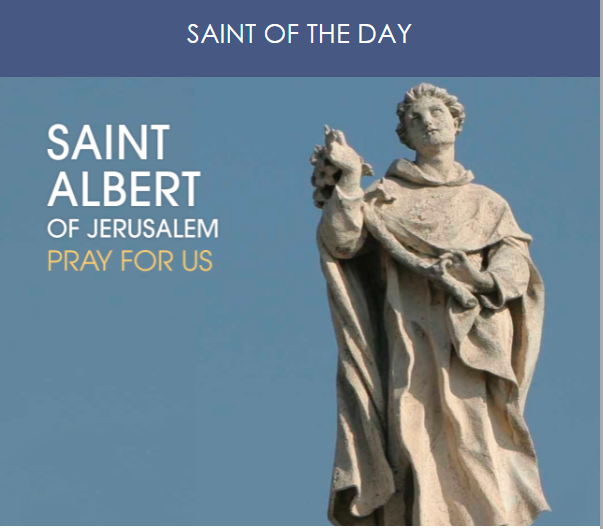
St. Albert of Jerusalem (d. 1215) was born to a noble family in Italy, and was well educated in theology and law. He went on to become a priest and bishop and served in important posts as a peacemaker; he served as a mediator between Pope Clement III and the Holy Roman Emperor, between the Kingdom of Jerusalem and the Kingdom of Cyprus, and between the Knights Templar and the Armenian Kingdom of Cilicia. In 1205 he was made Patriarch of Jerusalem by Pope Innocent III during the time when the Saracens had control of the city. In this position he was respected by all for his sanctity and intelligence. Because of the Muslim presence in Jerusalem, Albert took up residence in Acre overlooking the great city, as well as Mt. Carmel where a group of holy hermits lived. Albert was asked by St. Brocard, who was prior of the group of hermits, to draw up a rule of life for them which became the beginning of the Carmelite Order. In 1214 Albert was summoned to serve in the General Lateran Council, but was murdered before he could attend. The Master of the Hospital of the Holy Spirit, whom he had rebuked and deposed for immorality, stabbed him to death on September 14th in the Church of Saint John of Acre, while he was part of the procession on the Feast of the Exaltation of the Holy Cross. His feast day is September 14th.
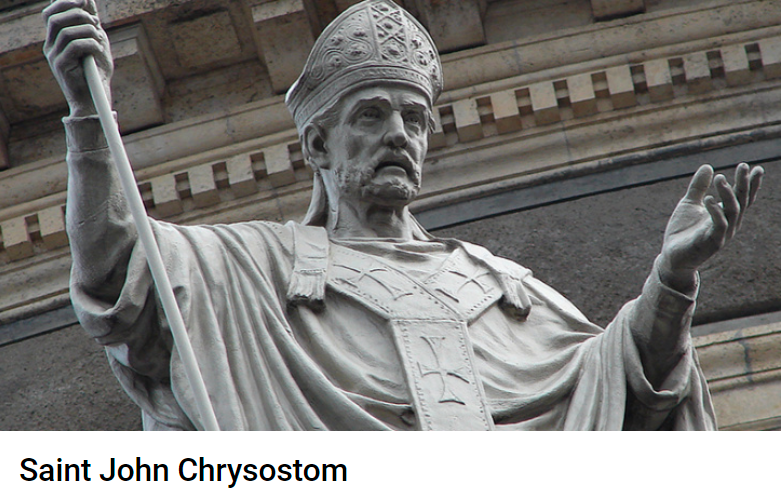
The ambiguity and intrigue surrounding John, the great preacher (his name means “golden-mouthed”) from Antioch, are characteristic of the life of any great man in a capital city. Brought to Constantinople after a dozen years of priestly service in Syria, John found himself the reluctant victim of an imperial ruse to make him bishop in the greatest city of the empire. Ascetic, unimposing but dignified, and troubled by stomach ailments from his desert days as a monk, John became a bishop under the cloud of imperial politics.
If his body was weak, his tongue was powerful. The content of his sermons, his exegesis of Scripture, were never without a point. Sometimes the point stung the high and mighty. Some sermons lasted up to two hours.
His lifestyle at the imperial court was not appreciated by many courtiers. He offered a modest table to episcopal sycophants hanging around for imperial and ecclesiastical favors. John deplored the court protocol that accorded him precedence before the highest state officials. He would not be a kept man.
His zeal led him to decisive action. Bishops who bribed their way into office were deposed. Many of his sermons called for concrete steps to share wealth with the poor. The rich did not appreciate hearing from John that private property existed because of Adam’s fall from grace any more than married men liked to hear that they were bound to marital fidelity just as much as their wives were. When it came to justice and charity, John acknowledged no double standards.
Aloof, energetic, outspoken, especially when he became excited in the pulpit, John was a sure target for criticism and personal trouble. He was accused of gorging himself secretly on rich wines and fine foods. His faithfulness as spiritual director to the rich widow, Olympia, provoked much gossip attempting to prove him a hypocrite where wealth and chastity were concerned. His actions taken against unworthy bishops in Asia Minor were viewed by other ecclesiastics as a greedy, uncanonical extension of his authority.
Theophilus, archbishop of Alexandria, and Empress Eudoxia were determined to discredit John. Theophilus feared the growth in importance of the Bishop of Constantinople and took occasion to charge John with fostering heresy. Theophilus and other angered bishops were supported by Eudoxia. The empress resented his sermons contrasting gospel values with the excesses of imperial court life. Whether intended or not, sermons mentioning the lurid Jezebel and impious Herodias were associated with the empress, who finally did manage to have John exiled. He died in exile in 407.
Reflection
John Chrysostom’s preaching, by word and example, exemplifies the role of the prophet to comfort the afflicted and to afflict the comfortable. For his honesty and courage, he paid the price of a turbulent ministry as bishop, personal vilification, and exile.
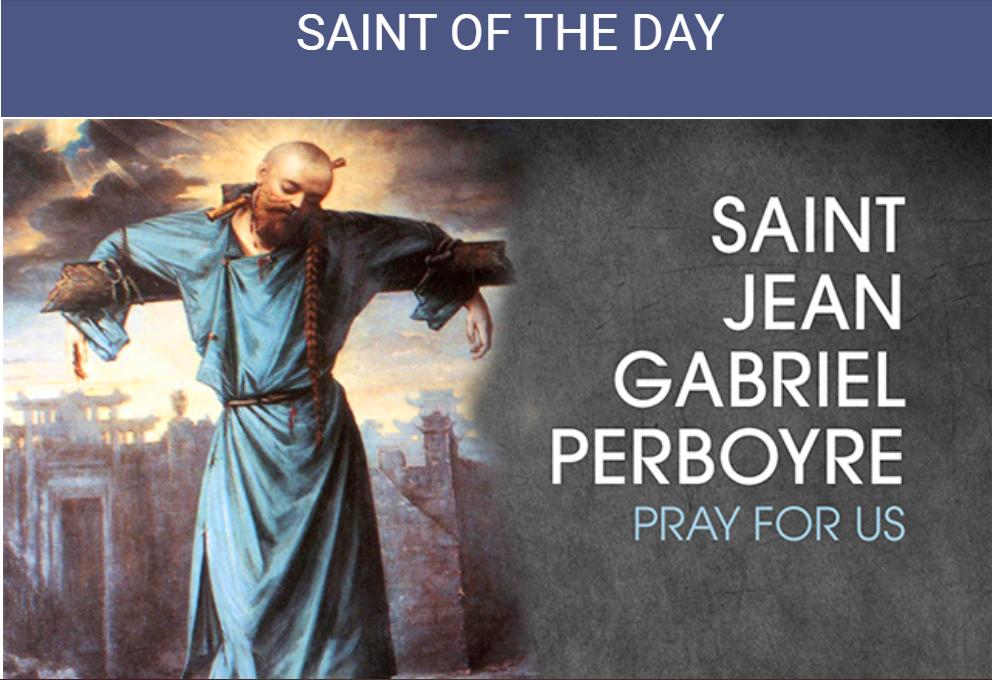
St. Jean-Gabriel Perboyre (1802-1840) was one of eight children born to a farming family in France. He was a pious child and served as a model of virtue for his childhood companions. He discerned a call to the priesthood and joined the Vincentians along with a younger brother, with the full support of his parents. He served as a seminary professor for many years, and his sanctity impressed even his superiors. He longed to serve in the missions to China, but his poor health prevented him and his brother was sent instead. He prayed and begged to also be sent to preach in China and to suffer martyrdom there. After his brother died on the voyage to China, Jean-Gabriel was allowed to take his place in the mission. He arrived in China in 1835 and his labors there were met with great success. In 1839 persecutions broke out against the Christian missionaries, and Jean-Gabriel was one of the first to be arrested. The events leading to his death bear a striking resemblance to the Passion and Death of Christ. He was betrayed to the authorities by one of his new converts for thirty pieces of silver, stripped of his garments and clothed with rags, bound, and dragged from tribunal to tribunal. At each trial, he was brutally treated and tortured. He was finally condemned to death along with seven other criminals on September 11, 1840. He was martyred by being strangled to death as he hung on a cross. His feast day is September 11th.