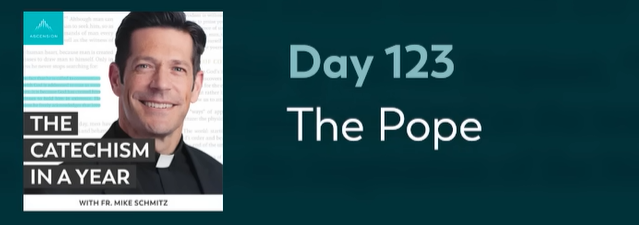
In addition to Christ’s priestly office, lay people are called to participate in Christ’s prophetic and kingly offices. They take part in Christ’s prophetic office by evangelizing and proclaiming Christ by word and with the testimony of their lives. Fr. Mike explains that the laity participate in Christ’s kingly office in their hearts. They do this when they rule themselves and conquer sin, acting as virtuous leaders in the Church and society. Fr. Mike also reminds us that lay people should strive to be guided by Christian conscience in all their actions in the Church and human society. Today’s readings are Catechism paragraphs 904-913.
Saint Hilary of Arles’ Story (c. 401 – May 5, 449)
It’s been said that youth is wasted on the young. In some ways, that was true for today’s saint.
Born in France in the early fifth century, Hilary came from an aristocratic family. In the course of his education he encountered his relative, Honoratus, who encouraged the young man to join him in the monastic life. Hilary did so. He continued to follow in the footsteps of Honoratus as bishop. Hilary was only 29 when he was chosen bishop of Arles.
The new, youthful bishop undertook the role with confidence. He did manual labor to earn money for the poor. He sold sacred vessels to ransom captives. He became a magnificent orator. He traveled everywhere on foot, always wearing simple clothing.
That was the bright side. Hilary encountered difficulty in his relationships with other bishops over whom he had some jurisdiction. He unilaterally deposed one bishop. He selected another bishop to replace one who was very ill–but, to complicate matters, did not die! Pope Saint Leo the Great kept Hilary a bishop but stripped him of some of his powers.
Hilary died at 49. He was a man of talent and piety who in due time, had learned how to be a bishop.
Reflection
Saint Hilary teaches us to respect authority even if found in a young person. Age is not the issue: prudence and wisdom are.
The term “laity” refers to all the faithful, except those in Holy Orders and those who belong to a religious state approved by the Church. We learn about the special vocation lay people have to seek the Kingdom of God as they engage in temporal affairs. They live in the world and bring the Gospel to places priests and religious cannot access. Father Mike explains that in this way, the lay faithful not only participate in the Church but are the Church. The laity participate in Christ’s priestly vocation by making every part of their lives an offering to God. Today’s readings are Catechism paragraphs 897-903.
There are three offices that belong to the episcopal college: the teaching office, the sanctifying office, and the governing office. Fr. Mike gives us an overview of the functions within these offices and clarifies the charism of infallibility in matters of faith and morals. As we learn about the authority of the episcopal college, Fr. Mike encourages us to approach the teachings of the Church with docility. Today’s readings are Catechism paragraphs 888-896.
In the Gospel, there are many points. So, start with the minor ones and then go on to the big ones. Jesus taught us how to study Scripture. He also taught us what we must do before Mass. What must we do before Mass? A famous word from one of the great spiritual directors is “Shut-Up!” That’s because every time the apostles talked about the Bible, they got it wrong. Every time our Lord asked them a question, they got it wrong. The apostles were discussing Scripture one day while in Jerusalem and when our Lord showed up, He asked them, “What are you doing?” They said, “Talking about Scripture.” What did He tell them? “You got it wrong!” Then, for the better part of two hours, He taught them Scripture, because He is Scripture. And in the presence of God, they listened. He explained to them the meaning of the Bible. Scripture study is not people sitting around a table and asking, “What do you think this is?” It’s not that. The Church teaches what Scripture is . . . not what we’d like it to be. It’s a lot more complicated than just reading a book and saying, “Oh yeah. I can do that.” You have to listen to the experts.
What resulted from the apostles’ time with Jesus? During the Breaking of Bread (the Mass), their eyes were opened, and they recognized Him. This is our faith. Jesus is physically present on the altar and at the altar during the Holy Sacrifice of the Mass. What happens when we see our Lord in the Breaking of Bread during the Holy Sacrifice of the Mass? The same as what happened to two of Jesus’ disciples as they were going to Emmaus which was near Jerusalem. They were tired, but in the middle of the night they walked seven miles, most of it uphill. Now most people are afraid to go outside at night even though we have great law enforcement. Back then, there was no 911. And the Roman soldiers didn’t patrol at night. So, you were on your own . . . good luck! But the disciples were no longer tired. Instead, they were filled with joy and couldn’t wait to tell people, “We have seen the Lord. We recognized Him in the Breaking of Bread.”
This is what we preach for conversion. Transubstantiation and the Real Presence of our Lord in the Most Blessed Sacrament. This is our Faith. This is what we preach. This is what brings people to church. And this is how we get converts to the Faith. A good friend of mine, a Catholic priest, took Philosophy 101. He said that during the first week of class they learned that “a thing is what it is or it isn’t.” There is no in-between. Would you want to eat a slightly poisonous salad? Would you want to get slightly sick on Listeria? No. Either the food is good or it’s not. Either it is or it isn’t. A wrench is a wrench or it’s not. You can’t use a pencil as a wrench. It won’t work. So, either you believe what Scripture says or you don’t. Christ is present in the Eucharist. His true Real Presence is what draws people to the Faith. We recognize Him with the eyes of faith and intellect. Sometimes it affects the whole body . . . sometimes not. But we recognize Him. In church, everything is pointed to the Real Presence. That’s why we kneel, stand, and genuflect. Some people rather blasphemously call it Catholic aerobics – up and down, up and down. By the way, do you know why we stand for the Gospel? We stand out of respect for the Word of God because the Gospel contains the actual words of Christ. So, we stand out of respect for His words, and we pray with our hearts. This is what we proclaim. This is what we profess. And this is what we teach. Paul came to that conclusion. Paul taught people, and he admonished them that “Whoever eats and drinks the body of Christ unworthily is guilty of His death.” If it’s just a symbol or just a community builder as some blasphemous people say, how can we be convicted of His death? How can we be like Judas and be guilty of His death? If His Body and Blood is just a symbol, then what’s the big deal?
So, this is what we believe. This is what we profess. And this is what we tell people. This is the good news. What happened to the apostles and what happened to the two disciples enroute to Emmaus, is the same joy and the same Presence we have before us.
How will you apply this message to your life? _______________________________
You can read all of Father Fitzgibbons’ sermons by going to annunciationcatholicalbemarle.com and clicking on “Blog” then “Categories” then “Sermon Notes.” On a cell phone: click on “Blog” then “Menu” and then “Categories.” Sermon Notes are also available on the church Facebook page at facebook.com/ola.catholic.church. Click on “Groups” and then “Sermon Notes.”
James, Son of Alphaeus: We know nothing of this man except his name, and, of course, the fact that Jesus chose him to be one of the 12 pillars of the New Israel, his Church. He is not the James of Acts, son of Clopas, “brother” of Jesus and later bishop of Jerusalem and the traditional author of the Letter of James. James, son of Alphaeus, is also known as James the Lesser to avoid confusing him with James the son of Zebedee, also an apostle and known as James the Greater.
Philip: Philip came from the same town as Peter and Andrew, Bethsaida in Galilee. Jesus called him directly, whereupon he sought out Nathanael and told him of the “one about whom Moses wrote” (Jn 1:45).
Like the other apostles, Philip took a long time coming to realize who Jesus was. On one occasion, when Jesus saw the great multitude following him and wanted to give them food, he asked Philip where they should buy bread for the people to eat. Saint John comments, “[Jesus] said this to test him, because he himself knew what he was going to do” (Jn 6:6). Philip answered, “Two hundred days’ wages worth of food would not be enough for each of them to have a little [bit]” (Jn 6:7).
John’s story is not a put-down of Philip. It was simply necessary for these men who were to be the foundation stones of the Church to see the clear distinction between humanity’s total helplessness apart from God and the human ability to be a bearer of divine power by God’s gift.
On another occasion, we can almost hear the exasperation in Jesus’s voice. After Thomas had complained that they did not know where Jesus was going, Jesus said, “I am the way. If you know me, then you will also know my Father. From now on you do know him and have seen him” (Jn 14:6a, 7). Then Philip said, “Master,show us the Father, and that will be enough for us” (Jn 14:8). Enough! Jesus answered, “Have I been with you for so long a time and you still do not know me, Philip? Whoever has seen me has seen the Father” (Jn 14:9a).
Possibly because Philip bore a Greek name or because he was thought to be close to Jesus, some gentile proselytes came to him and asked him to introduce them to Jesus. Philip went to Andrew, and Andrew went to Jesus. Jesus’s reply in John’s Gospel is indirect; Jesus says that now his “hour” has come, that in a short time he will give his life for Jew and gentile alike.
Reflection
As in the case of the other apostles, we see in James and Philip human men who became foundation stones of the Church, and we are reminded again that holiness and its consequent apostolate are entirely the gift of God, not a matter of human achieving. All power is God’s power, even the power of human freedom to accept his gifts. “You will be clothed with power from on high,” Jesus told Philip and the others. Their first commission had been to expel unclean spirits, heal diseases, announce the kingdom. They learned, gradually, that these externals were sacraments of an even greater miracle inside their persons—the divine power to love like God.
What is the purpose of the Pope? Today, we focus on the role of the Pope in the Catholic Church as the Vicar of Christ and pastor of the entire Church. The Catechism teaches us that the institution of the papacy dates back to that powerful moment in the Gospel when Jesus changed Simon’s name to Peter, the “rock”, and handed him the keys of the Church. Fr. Mike unpacks this pivotal moment and helps us understand why the Pope is so foundational to the Faith. Today’s readings are Catechism paragraphs 880-887.
Athanasius led a tumultuous but dedicated life of service to the Church. He was the great champion of the faith against the widespread heresy of Arianism, the teaching by Arius that Jesus was not truly divine. The vigor of his writings earned him the title of doctor of the Church.
Born of a Christian family in Alexandria, Egypt, and given a classical education, Athanasius became secretary to Alexander, the bishop of Alexandria, entered the priesthood and was eventually named bishop himself. His predecessor, Alexander, had been an outspoken critic of a new movement growing in the East—Arianism.
When Athanasius assumed his role as bishop of Alexandria, he continued the fight against Arianism. At first, it seemed that the battle would be easily won and that Arianism would be condemned. Such, however, did not prove to be the case. The Council of Tyre was called and for several reasons that are still unclear, the Emperor Constantine exiled Athanasius to northern Gaul. This was to be the first in a series of travels and exiles reminiscent of the life of Saint Paul. After Constantine died, his son restored Athanasius as bishop. This lasted only a year, however, for he was deposed once again by a coalition of Arian bishops. Athanasius took his case to Rome, and Pope Julius I called a synod to review the case and other related matters.
Five times Athanasius was exiled for his defense of the doctrine of Christ’s divinity. During one period of his life, he enjoyed 10 years of relative peace—reading, writing, and promoting the Christian life along the lines of the monastic ideal to which he was greatly devoted. His dogmatic and historical writings are almost all polemic, directed against every aspect of Arianism.
Among his ascetical writings, his Life of St. Anthony achieved astonishing popularity and contributed greatly to the establishment of monastic life throughout the Western Christian world.
Reflection
Athanasius suffered many trials while he was bishop of Alexandria. He was given the grace to remain strong against what probably seemed at times to be insurmountable opposition. Athanasius lived his office as bishop completely. He defended the true faith for his flock, regardless of the cost to himself. In today’s world we are experiencing this same call to remain true to our faith, no matter what.
There are three primary roles among Christ’s faithful: the hierarchy, the laity, and consecrated life. Fr. Mike explains the difference between these three roles, emphasizing that they are equal in dignity but different in the way they support the Church’s mission. We also learn that all of Christ’s faithful share in the priestly, prophetical, and kingly office of Christ. Lastly, Fr. Mike reviews the mission and characters of ecclesial ministry. Today’s readings are Catechism paragraphs 871-879.