Momma always said, “Son, you don’t like something? Well, offer it up!”
Today, Fr. Mike explores the traditional understanding of offering up your pain, embracing your suffering, and making sacrifices in the spiritual life.
By taking up our cross and following Christ, we gain a new way of seeing sickness and frailty. Along with this newness of vision, the Church is given the command from her founder to heal the sick. Since its beginning, the Church has anointed the sick among us, praying for their healing and salvation. Amid their sufferings, the suffering can endure, uniting themselves to Christ’s own afflictions for the sake of the Church. Today’s readings are Catechism paragraphs 1506-1513.
Sickness and suffering bring us face-to-face with our fragility and limitations. While they might cause some to lose hope and become bitter, we can also endure them in such a way as to grow in maturity and trust in God. Jesus not only heals the sick in the Gospels but also plunges into suffering’s depths. In this redemptive work, we know Jesus as the physician of soul and body. Today’s readings are Catechism paragraphs 1499-1505.
Sometimes they’re things we don’t want to do… but we have to do them anyway. Sometimes you make it through saying, “I’ll learn to like it.” But what about if you never do?
Today, Fr. Mike gives us a word of encouragement to find joy even in the midst of suffering and to avoid falling into despair or resentment as we walk toward eternity.
The question of evil, suffering and brokenness in our world can be a hard one to grapple with. Sometimes, when we’re in a place of darkness, the question can arise, “Would it be better if I had never been born?”
Today Fr. Mike tackles these incredibly tough questions and offers some insights into why God created you, and why it is good that you exist.
Together, with Fr. Mike, we explore the nature of God as Almighty. Fr. Mike discusses three important points to keep in mind about the reality of God’s power. The first is that God’s power is universal. God rules over everything; it is an infinite power. He is loving, he adopts us as his sons and daughters and shows us his mercy. Fr. Mike concludes with a reflection on God’s mysterious power in relation to the reality of the problem of evil and suffering in our world. Today’s readings are Catechism paragraphs 268-278.
“You Can Create Your Own Chapter in the ‘Lives of the Saints’”
Father Peter Fitzgibbons
November 19-20, 2022
Gospel: Luke 23:35-43
35 The people stayed there watching. As for the leaders, they jeered at Him with the words, ‘He saved others, let Him save himself if He is the Christ of God, the Chosen One.’ 36 The soldiers mocked Him too, coming up to Him, offering Him vinegar, 37 and saying, ‘If you are the king of the Jews, save yourself.’ 38 Above Him there was an inscription: ‘This is the King of the Jews’. 39 One of the criminals hanging there abused Him: ‘Are you not the Christ? Save yourself and us as well.’ 40 But the other spoke up and rebuked him. ‘Have you no fear of God at all?’ he said. ‘You got the same sentence as He did, 41 but in our case we deserved it: we are paying for what we did. But this Man has done nothing wrong.’ 42 Then he said, ‘Jesus, remember me when you come into your kingdom.’ 43 He answered him, ‘In truth I tell you, today you will be with Me in paradise.’
One of my favorite things to read about is the lives of the saints because it gives me great hope. The saints cover a wide range and multitude of vocations, lifestyles, and difficulties. That gives me hope that someday I also might be a saint. I was reading about one this week. During World War II, a bomber pilot was flying a mission over Italy and was about to release his bomb when he saw a flying monk – not the flying nun – at 17,000 feet in the air. The monk was pointing at something. The boom window opened, and the bombs dropped but not where they were supposed to drop. Later, when the pilot did his after-action report, he told the commanding general what happened. The general said, “That’s nice.” The pilot was put in the Army’s “nut hut” for a while. He’d been on one too many flights. But other pilots kept seeing the same thing and also missing the target for their bombs. Finally, an Italian general, an ally, saw the flying monk. After the war, he went to that tiny Italian town and while he was there looking around, he saw the monk that he had seen while flying at 17,000 feet. You know who that was? Padre Pio. The general, who was Protestant, became Catholic. Padre Pio was given the gift of bilocation (the ability to be present in more than one place at the same time). Padre Pio promised his people that the allies would not bomb the town . . . and they didn’t. Saint Martin de Porres, a Dominican brother from South America, was also given the gift of bilocation. I had the gift of bilocation, a twin, but that usually just got us into trouble. Before I’d go home, I would ask my twin brother, Paul, if he had ticked anybody off. I was getting too old to smack people around. But there have been all sorts of saints. They had extraordinary gifts given to them. Saint Teresa of Avila levitated while in prayer. Saint Junípero Serra was known as the flying priest. Saint Therese de Lisieux and Saint Francis of Assisi both saw their guardian angels. These great gifts were given to the saints, and they are wonderful. The temptation of the devil is for you to think, “Oh, I can’t be like them.” Yes, you can. We have the same means they had to achieve what they did. They were given all these great graces – the ability to levitate, bilocate, and to fly at 17,000 feet – but they were given to them for the good of others and not as a reward or an “atta boy.” So how did they achieve those graces that they would bring to others? Through a life of prayer.
One of the greatest gifts we have is our gift of suffering. Our sufferings can be our greatest prayer. Suffering can be transformative and be conduit of God’s gifts to others like the saints. And as we gain the gift of old age, we have even more sufferings. Our minds write checks that our bodies cannot cash. I was talking to a marine the other day was sick and in the hospital. He didn’t want to ask for help because he believed that demonstrated weakness. I told him, “No it takes courage to ask for help when you need it.” When I had Covid, I told myself, “I’m going to say my prayers and say the Rosary while I walk. I’m going to walk at night in the church and walk before Mass. That didn’t work well. It hurt, and I almost passed out several times. But I rubbed the 101st patch and was determined to do it. No. It is not a sign of weakness to accept help. Covid was my prayer. Did I sit in my office every day? No. I couldn’t concentrate because I hadn’t been sleeping. That suffering became my prayer.
The saints suffered too. They spent a lot of time in prayer. They experienced a great deal of suffering which, again, can be transformative. Look at the Good Thief on the cross. He had a bad life and was sentenced to capital punishment. Remember, later they broke his legs…not a fun way to go. Yet he still went to Heaven through his sufferings. Heaven was once stolen, and it can be stolen again. God gave the saints great gifts – for others and not for themselves … because God’s love is in us not only to transform us but for the salvation of other souls. . .to transform them to be with Him and to cooperate with Him.
I miss all the fun I had in the military. . . all the travel, the strange, exotic lands, all the excitement. There’s nothing like being in 136 degrees and a sandstorm wearing a flak vest and helmet. Those were the days! It was very slimming. But that experience now helps me with my work with veterans because they can talk to me. I can help them understand. There is no other priest in the diocese who can do that. Although they are holy, veterans won’t talk to them unless they have the credentials. So, your suffering is a good way to open up other souls to you and bring them to God. No other person can talk to an alcoholic other than a recovering alcoholic, or to a drug addict by a former drug addict. And the only one who can talk to sinners is a recovered sinner. . .one who is recovering each day by taking up their cross.
The most important thing we can do is to cooperate with God’s Will and allow God to use us through our sufferings, our talents, and our abilities to show His love so that others may come to know our Good Lord working in us. Whatever field or time of life we may be in, this is our mission. And it is how we create our own chapter in the lives of the saints.
How will you apply this message to your life? _____________________________
You can read all of Father Fitzgibbons’ sermons by going to annunciationcatholicalbemarle.com and clicking on “Blog” then “Categories” then “Sermon Notes.” On a cell phone: click on “Blog” then “Menu” and then “Categories”
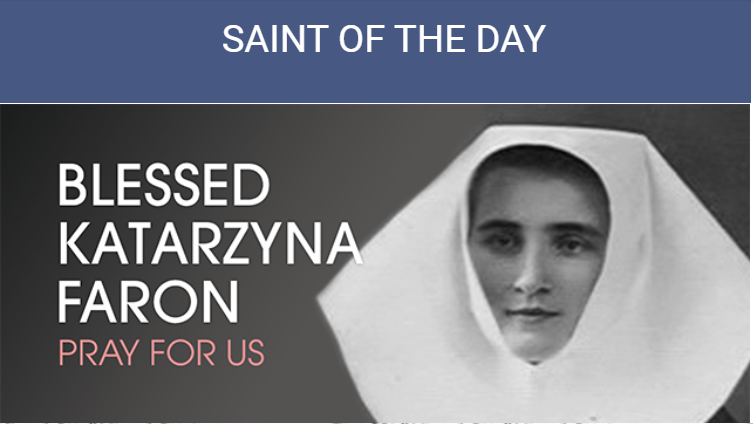
Bl. Katarzyna Celestyna (Catherine Celestine) Faron (1913-1944) was born in Zabrzez, Poland. At the age of five she was orphaned and raised by pious, childless relatives. Desiring the religious life, she entered the Congregation of the Sisters Servants of Mary Immaculate in 1930. She served in the community as a kindergarten teacher and catechist. After the breakout of World War II she became the leader of her religious house, ran an orphanage, and helped the poor. She was eventually arrested by the Gestapo, charged with conspiracy against the Nazis, and sent to the Auschwitz concentration camp on the feast of Epiphany in 1943, where she was assigned to manual labor digging ditches. She praised God in all her suffering and resigned herself to following his will. Due to the poor conditions she developed typhoid fever and tuberculosis. Because she completed the nine First Fridays devotion to the Sacred Heart of Jesus, she trusted that she wouldn’t die without Holy Communion, as Our Lord promised. On December 8, 1943, the feast of the Immaculate Conception, she received Holy Communion as viaticum which was secretly brought to the camp by a prisoner priest.
While on her deathbed Catherine prayed intensely for various intentions on a rosary made of bread. According to witnesses she offered her sufferings for the conversion of a priest who had fallen away from the Church, who later did return to the true Faith. Bl. Katarzyn finally died from her illness on Easter morning. She is one of the 108 beatified Polish Catholic Martyrs killed during World War II by Nazi Germany. Her feast day is April 9th.
Jesus said that the Son of Man will be lifted up. He also said, “When I am lifted up from the Earth, I will draw all men to myself.” And, He does. However, He doesn’t draw people up to Him on the cross just for them to say, “Gee, that must hurt.” This is not a spectator sport. Rather, our good Lord reaches down from the cross and says, “Take My hand and come up to Me, because this is the way to salvation. Join Me on the cross.” Paul finally learned that lesson. He wrote, “Now, I rejoice in sufferings for Your sake, and in my flesh I complete what is lacking in Christ’s afflictions for the sake of His body, that is, the Church.” Our sufferings, all the crosses we carry and the crosses we carry for others are redemptive. They are not only for ourselves, but for others. We join Christ in the sacrifice like the good thief on the cross. We unite ourselves to Him, so that He will raise us up. You do that when you make your Morning Offering: “I offer you my prayers, works, joys, and sufferings of this day.” All those crosses God allows us to carry…Ugh. I don’t know about you, but I’m not crazy about mine.
We also join Christ in the sacrifice during the Mass by true and active participation. So, what is true and active participation? It’s not those who sing the loudest, pray the loudest, or run a ministry. Whatever that is. The term “ministry” really means nothing. It only applies to Holy Orders, but it has been so overused, it means nothing now. True and active participation is the giving of your human nature to the priest who acts in the person of Christ on the altar. He takes your human nature in the offertory, immolates them, and makes them one with the sacrifice of Christ. He immolates them on the altar as part of the sacrifice of God’s love for us. That is true and active participation. This is how we unite ourselves and become one with the sufferings of Christ just as the Blessed Mother, Saint John, Mary the wife of Clopas, and Mary of Magdala did at the foot of the cross…especially the Blessed Mother…her human nature was suffering for Him. For us, it’s only intellectual, so it doesn’t matter whether you feel it or not. That has nothing to do with its effectiveness. However, it’s only when you do that you are one with Christ on the cross.
There will always be temptations from the cross. Just as Christ was tempted many times to come down from the cross, we will be too. What were the first three temptations? “All religion is just a show.” “If you have good music, a praise band or whatever, people will come.” Our Lord says this is not a show. This is an act of love. “Well, you know with religion, you gotta give people food and stuff.” “Everybody will be happy if they take your stuff and give it to somebody else.” “It’s all power.” “It’s all Socialism.” “True religious charity is just giving them bread…they will be fine.” How many fat people are there in prison? A lot. It’s not that they lack food. Their problem is that they practice evil. Now, there are a lot of people outside of prison who practice evil, but they haven’t been caught yet. It’s all about power. “Well, if we had fairer laws, then we wouldn’t have any problems.” That’s not true. We have more laws than lawyers know about. Oh, by the way, drugs are illegal. Did you know that? Apparently, a lot of people don’t. Read the sheriff’s blotter report, and that’s just the tip of the iceberg.
Another temptation is to deny the divine message. You see, we are much brighter in the 21st Century. We know better, because we are so enlightened and so highly educated. We can’t write in cursive, but we are really educated. We know what God’s word truly means. Before, they weren’t too sure, because they were all stupid. When Christ proclaimed that marriage was between one man and one woman unless separated by death, everyone left Him except the 12 apostles. People didn’t like that. Also, when Peter tried to sway Christ from going to the cross, He called Peter, “Satan.”
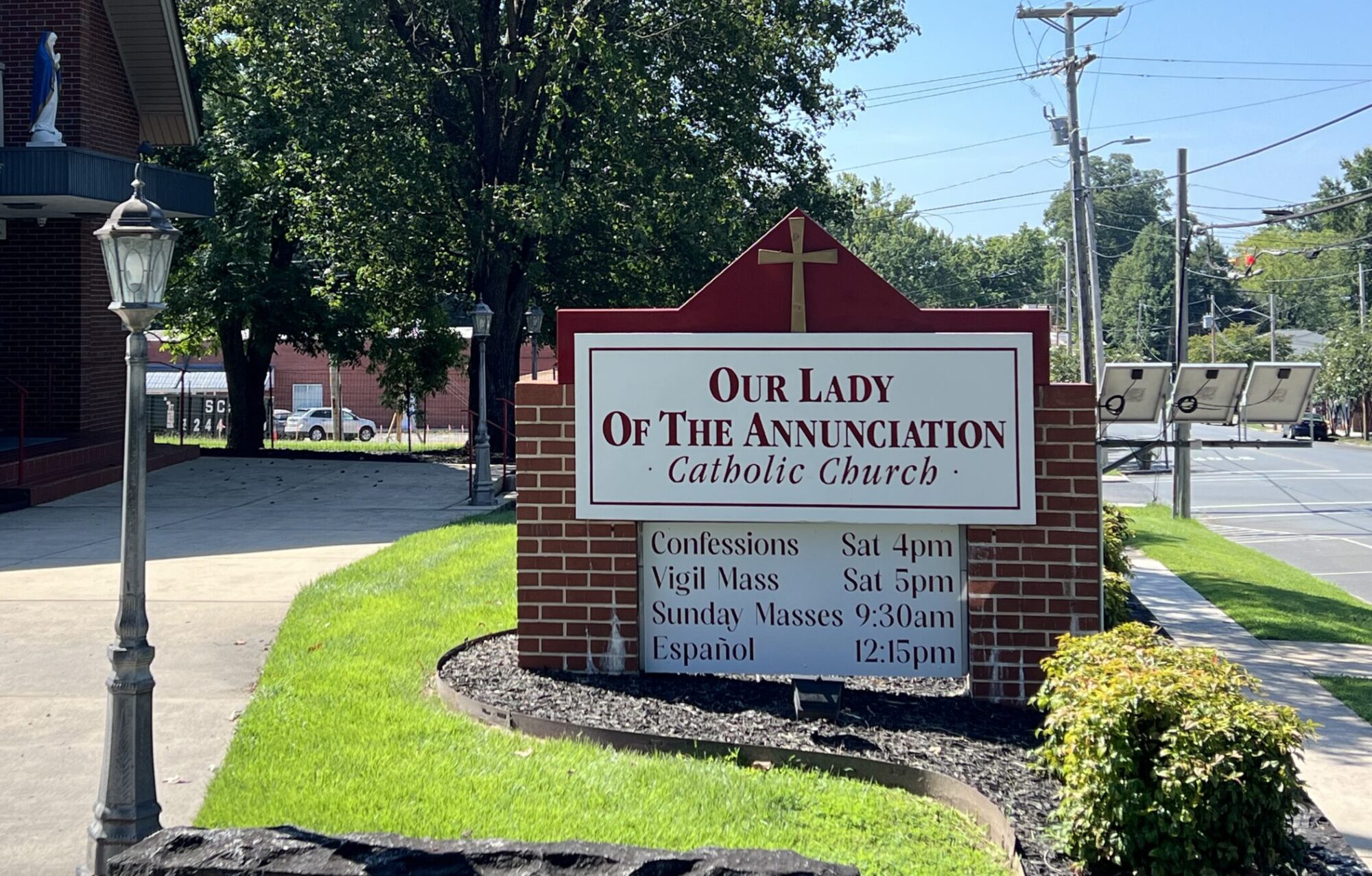
The third type of temptation is the Eucharist. “Unless you eat the flesh of the Son of man and drink His blood, you have no life in you.” “Oh, He didn’t really mean that.” That’s what He said, and He meant it. The words really mean that. Everyone left Him except the 12 apostles. The last temptation was, “Come down from the cross, and we will believe in you.” In His heart, Christ was saying, “You don’t understand. You’ve forgotten your education.” “If the Church changes its laws, everyone will come back.” Really? We have Mass in English. We have Mass in Spanish (Spanglish). We have Mass on Saturdays at 5 pm. We have Mass on Sundays at 9:30 and 12:15. We have confessions face-to-face, although not here, because it’s not safe for the priests anymore. So, where is everybody?
Temptations in one form or another will assail us. “Am I doing something wrong because I’m tempted?” No, you are doing something right, because you are tempted. Our Lord says, “Come up to Me. Come up. I am trying to give you eternal happiness. I am trying to give your soul peace.” So, we have a tug of war with Christ on the cross. He wants to pull us up, and we want to pull Him down. Instead, we can unite ourselves in the sacrifice of Christ in the Morning Offering prayer, resignation to our exterior and interior crosses, and resignation of the will…the most difficult cross. In the midst of temptation, the good thief on the cross accepted the suffering for his sins, and was united with Christ. What did Christ tell him? “Today, you will be with Me in paradise.”
How will you apply this message to your life? Will you unite yourself in the sacrifice of Christ by saying the Morning Offering prayer? Will you accept your interior and exterior crosses and join Christ in His suffering?
You can read all of Father Fitzgibbons’ sermons by going to https://annunciationcatholicalbemarle.com/ and clicking on “Blog” then “Categories” and then “Sermon Notes. From a cell phone, click on “Blog” then “Menu” and then “Categories” (located at the end of page). There is also a search box if looking for a specific topic.
46 They came to Jericho. And as he was leaving Jericho with his disciples and a sizable crowd, Bartimaeus, a blind man, the son of Timaeus, sat by the roadside begging. 47 On hearing that it was Jesus of Nazareth, he began to cry out and say, “Jesus, son of David, have pity on me.” 48 And many rebuked him, telling him to be silent. But he kept calling out all the more, “Son of David, have pity on me.” 49 Jesus stopped and said, “Call him.” So they called the blind man, saying to him, “Take courage; get up, he is calling you.” 50 He threw aside his cloak, sprang up, and came to Jesus. 51 Jesus said to him in reply, “What do you want me to do for you?” The blind man replied to him, “Master, I want to see.” 52 Jesus told him, “Go your way; your faith has saved you.” Immediately he received his sight and followed him on the way.
Throughout His life, Jesus never denied anyone who asked for the miracle of healing. Because He loves us, He never said “No.” We all have maladies. And, sometimes we think that He does not hear us if nothing happens when we pray for relief. It may seem like He is falling down on the job, but we will never know how many of our burdens He carried for us until we finally meet Him. If He says “No” or “Not Now”, you can be sure that it’s for another good reason.
The apostles had their own trials and sufferings. Paul suffered from a thorn in the flesh, and he prayed to the Lord three times to relieve him of the pain. But, Christ told Paul “My grace is sufficient for you, for power is made perfect in weakness.” (2 Corinthians 12).
Saint Therese of Lisieux endured her share of suffering. She lost her mother when she was just four years old, and she suffered from depression. It was her love of God that enabled Therese to always put others first by through self-sacrifice. These daily sacrifices of self were her gifts to Our Lord. Both Paul and Therese understood that the more one is weak, without selfish desires, the closer we grow to Him.
Saint Teresa of Avila also endured trials and tribulations. Teresa entered a Carmelite convent during a time when women did so if they had nowhere else to go. Often, Teresa felt that she was surrounded by hostility and gossip. When she complained about this, Jesus said, “Teresa, that’s how I treat my friends”. Teresa responded, “No wonder you have so few friends.”
The suffering we bear is a prayer for our penance and for others. We can imitate His suffering at His passion if we keep our focus on the crucifix. Our pain keeps us humble and holy. It also opens our hearts to others who suffer in the same way and enables us to connect with them because of our shared experiences. Christ wants us to be His representatives and bring people to Him. But, you cannot reach an alcoholic, veteran, inmate, or sexual assault victim unless you’ve been to the same level of hell as they. Only then can you reach them and offer them hope and peace in their suffering. We can tell them how we have dealt with a similar trial or suffering.
Enduring pain and suffering can be relentless and unpleasant. Therefore, we must seek the sacraments to increase our faith and love. Also, we need to pray unceasingly. How? At the start of each day, pray the Morning Offering so that everything you do during the day is for Him:
O Jesus, through the Immaculate Heart of Mary,
I offer You my prayers, works,
Joys and sufferings of this day
For all the intentions of YourSacred Heart,
In union with theHoly Sacrifice of the Mass
Offered throughout the world, In reparation for my sins,
For the intentions of all myRelatives and friends, and
Also for the intentions ofThe Holy Father. Amen
How will you apply this message to your life? Will you share in His passion by offering up your suffering to the Lord? Will you seek the sacraments to increase your faith and love? Will you pray unceasingly?