Fr. Mike examines the two senses of Scripture: the literal sense and the spiritual sense. Together, we further unpack the meaning of the literal sense of Scripture and the three subdivisions of the spiritual sense: the allegorical, the moral, and the anagogical senses. Fr. Mike provides us with scriptural examples of each of the four senses for us to fully comprehend the richness of God’s Word. Today’s readings are Catechism paragraphs 115-119.
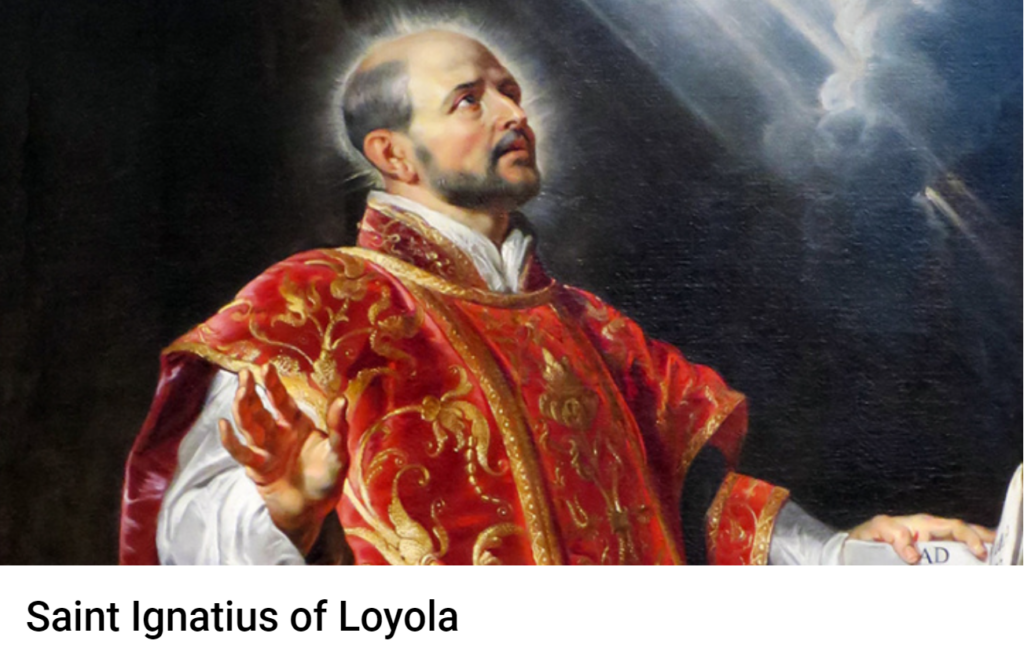
The founder of the Jesuits was on his way to military fame and fortune when a cannon ball shattered his leg. Because there were no books of romance on hand during his convalescence, Ignatius whiled away the time reading a life of Christ and lives of the saints. His conscience was deeply touched, and a long, painful turning to Christ began. Having seen the Mother of God in a vision, he made a pilgrimage to her shrine at Montserrat near Barcelona. He remained for almost a year at nearby Manresa, sometimes with the Dominicans, sometimes in a pauper’s hospice, often in a cave in the hills praying. After a period of great peace of mind, he went through a harrowing trial of scruples. There was no comfort in anything—prayer, fasting, sacraments, penance. At length, his peace of mind returned.
It was during this year of conversion that Ignatius began to write down material that later became his greatest work, the Spiritual Exercises.
He finally achieved his purpose of going to the Holy Land, but could not remain, as he planned, because of the hostility of the Turks. Ignatius spent the next 11 years in various European universities, studying with great difficulty, beginning almost as a child. Like many others, his orthodoxy was questioned; Ignatius was twice jailed for brief periods.
In 1534, at the age of 43, he and six others—one of whom was Saint Francis Xavier—vowed to live in poverty and chastity and to go to the Holy Land. If this became impossible, they vowed to offer themselves to the apostolic service of the pope. The latter became the only choice. Four years later Ignatius made the association permanent. The new Society of Jesus was approved by Pope Paul III, and Ignatius was elected to serve as the first general.
When companions were sent on various missions by the pope, Ignatius remained in Rome, consolidating the new venture, but still finding time to found homes for orphans, catechumens, and penitents. He founded the Roman College, intended to be the model of all other colleges of the Society.
Ignatius was a true mystic. He centered his spiritual life on the essential foundations of Christianity—the Trinity, Christ, the Eucharist. His spirituality is expressed in the Jesuit motto, Ad majorem Dei gloriam—“for the greater glory of God.” In his concept, obedience was to be the prominent virtue, to assure the effectiveness and mobility of his men. All activity was to be guided by a true love of the Church and unconditional obedience to the Holy Father, for which reason all professed members took a fourth vow to go wherever the pope should send them for the salvation of souls.
Reflection
Luther nailed his theses to the church door at Wittenberg in 1517. Seventeen years later, Ignatius of Loyola founded the Society that was to play so prominent a part in the Catholic Reformation. He was an implacable foe of Protestantism. Yet the seeds of ecumenism may be found in his words: “Great care must be taken to show forth orthodox truth in such a way that if any heretics happen to be present they may have an example of charity and Christian moderation. No hard words should be used nor any sort of contempt for their errors be shown.” One of the greatest ecumenists was the 20th-century German Jesuit, Cardinal Augustin Bea.
The only thing we should have pride in is the mercy of our good Lord. From His pierced heart, flows the river of Sacramental love so that we may have life and have it to the fullest in this life and in the next. It is our means of salvation. What we should be proud of, and the only thing, is our Savior’s love. It’s not a sin or a debauchery.
Now, let me tell you what you must do to get to heaven. You have to do one thing, and it’s extraordinary. You know what it is? You may be thinking, “Oh, God! Father, please, I’m having enough problems with the ordinary stuff! What the heck are the extraordinary things?” Well, although it’s extraordinary, it’s not hard. God doesn’t ask us to do hard things. The extraordinary thing we have to do is do ordinary things ordinarily; in other words, do routine things routinely. Do the same things day after day after day.
Jesus said, “If you love Me and wish to be My follower, take up your cross every day and follow Me.” So, we take up our cross and follow Him. Now, our goal is progress…not perfection. This includes saying our prayers, not choking the you-know-what out of someone who desperately needs it, and practicing spiritual and corporal works of mercy. When I say “practicing,” I mean practicing just like doctors practice medicine. It’s not perfect, but they keep trying. Another way to carry our cross is by going to Mass every Sunday and on Holy Days, and maybe even on other days of the week. The doors are open, and on weekdays, we don’t take up a collection. So, you’re welcome to come in and get extra credit. You also can carry your cross by going to Confession once a year…every three months is better. Who wants to walk around with all that doodoo staining your soul that affects the body, mind, and spirit. You’ll have a much better attitude. We have much better vision and self-awareness when our souls are bathed in the most precious blood of Christ. These are the ordinary things we can do ordinarily…the routine things we can do routinely, and that’s the extraordinary part.
Because we do ordinary things, some may be tempted, and it’s a grave temptation, to stop, because they think that they are not progressing, they think they aren’t good at it, or they believe it’s not benefitting them. All of that is a lie by the devil. “I don’t think my medicine is helping me get well, so I’m going to stop taking it.” That’s not going to lead to a good outcome. Likewise, if we stop doing ordinary spiritual works of mercy, that also won’t lead to a good outcome. The extraordinary part is when we keep doing it and doing it…whether we enjoy it or not. We embrace the suck. I don’t enjoy eating fish. But, I have to eat it, because it was prescribed by my doctor. That’s doing an ordinary thing ordinarily. If I don’t follow my doctor’s advice, it’s a sin against the Fourth Commandment and a sin against the Fifth Commandment, because I would be endangering my life unnecessarily.
Is doing ordinary things ordinarily a lot of fun? No. “Father, you’re a professional.” Yes. “Do you always enjoy your prayers?” No. If you catch me in the morning around 7:30, I’ll be over here saying my prayers. You will notice, if you see me day after day, that I’m not walking on air. I’m not levitating. I’m not in mystical ecstasy every time I say the Rosary. I’m not always happy. Do my prayers always thrill me? Oh, heck no! Do I want to listen to one more whiner who comes in to complain? “Oh, Father, it’s too hot in church!” Oh, shut up. Do I want to listen to that? No. But, remember, everything we do should be focused on Him, our Beloved. The things we do are acts of love to our dear Lord and are not done to please ourselves. When you are tempted to stop doing ordinary things ordinarily, the focus is on you. I’m not much but I’m all I think about…that’s one of my favorite sayings. Whatever we do, whatever our gifts of love for our Lord are, big or small, they are acts of love and devotion to our Savior.
Now, as you know, in the Oval Office at the White House, there’s a phone that goes from the United States to the Soviet Union in case there is a nuclear war so that people don’t end up in a mushroom cloud. In the Vatican, there is also such a phone. Remember the bat phone? It’s kind of like that. This phone doesn’t go from the Vatican to the United States or to Russia. It goes from the Vatican to Heaven. It’s not used, but occasionally the housekeepers come along and dust it like any other piece of furniture. This phone had never rang, but, one day it did. Whoa! I doubt it was a wrong number. Everyone was too scared to touch it. No one but the pope could answer the phone, so, they found the Holy Father, brought him in, and he picked up the phone. The pope said, “Yes, Lord. Yes, Lord.” The pope smiled and put the phone down. By that time, everyone in the Vatican had gathered around. “Holiness, who was it? Speak to us!” The pope said, “It was God.” “What did He say?” The pope responded, “He’s coming back soon.” “Holiness, what should we do?” The pope answered, “Look busy!”
How will you apply this message to your life? Are you doing routine things routinely? Are you coming to weekend Mass and going to Confession at least once a year? Are you practicing corporal and spiritual works of mercy?
You can read all of Father Fitzgibbons’ sermons by going to https://annunciationcatholicalbemarle.com/ and clicking on “Blog” then “Categories” and then “Sermon Notes.” From a cell phone, click on “Blog” then “Menu” and then “Categories” (located at the end of page). There is also a search box if you are looking for a specific topic.
Saint Julie Billiart (July 12, 1751 – April 8, 1816)
Born in Cuvilly, France, into a family of well-to-do farmers, young Marie Rose Julie Billiart showed an early interest in religion and in helping the sick and poor. Though the first years of her life were relatively peaceful and uncomplicated, Julie had to take up manual work as a young teen when her family lost its money. However, she spent her spare time teaching catechism to young people and to the farm laborers.
A mysterious illness overtook her when she was about 30. Witnessing an attempt to wound or even kill her father, Julie was paralyzed and became a complete invalid. For the next two decades, she continued to teach catechism lessons from her bed, offered spiritual advice, and attracted visitors who had heard of her holiness.
When the French Revolution broke out in 1789, revolutionary forces became aware of her allegiance to fugitive priests. With the help of friends, she was smuggled out of Cuvilly in a haycart. She then spent several years hiding in Compiegne, being moved from house to house despite her growing physical pain. She even lost the power of speech for a time.
But this period also proved to be a fruitful spiritual time for Julie. It was at this time she had a vision in which she saw Calvary surrounded by women in religious habits and heard a voice saying, “Behold these spiritual daughters whom I give you in an institute marked by the cross.”
As time passed and Julie continued her mobile life, she made the acquaintance of an aristocratic woman, Françoise Blin de Bourdon, who shared Julie’s interest in teaching the faith. In 1803, the two women began the Institute of Notre Dame, which was dedicated to the education of the poor, young Christian girls, and the training of catechists. The following year, the first Sisters of Notre Dame made their vows. That was the same year that Julie recovered from the illness: She was able to walk for the first time in 22 years.
Though Julie had always been attentive to the special needs of the poor and that always remained her priority, she also became aware that other classes in society needed Christian instruction. From the founding of the Sisters of Notre Dame until her death, Julie was on the road, opening a variety of schools in France and Belgium that served the poor and the wealthy, vocational groups, teachers. Ultimately, Julie and Françoise moved the motherhouse to Namur, Belgium.
Julie died there in 1816. She was canonized in 1969.
Reflection
Julie’s immobility in no way impeded her activities. In spite of her suffering, she managed to co-found a teaching order that tended to the needs of both the poor and the well-to-do. Each of us has limitations, but the worst malady any of us can suffer is the spiritual paralysis that keeps us from doing God’s work on earth.
In my meditation on the Gospel this morning, I changed my sermon a bit. I was meditating on how the military asks for volunteers. Jesus said, “Come, follow Me.” The military’s way of asking for volunteers is “Hey you!” Love to. Thanks for asking!. Officers were also subject to “hey you!” I may have had captain or major’s rank, but sometimes I still became “hey you.” When a job needed to be done, who did it depended on your level on the food chain. Hey you! Oh, thank you. I’d love to.
Our Lord called the apostles by name to be His followers, to become holy, and to bring that holiness to us. Now, if you look at their resumes, they were fishermen. They did not get master’s degrees in Theology or Canon Law. They did not even earn certificates for lay ministry. They didn’t do any of that, yet they brought Christ’s love to the world. Their bravery in the face of their own deaths is a testament to that love. Christ call us all the same way. He calls us by name. Each of us were made in the likeness of God, and He died especially for each one of us. He calls each of us by name. Not “hey you” plural, but “hey you” singular. He wants you to follow Him. He wants you to become holy and to bring His love to the world. He wants every one of His children who do not know Him to know the fullness of truth found in the Catholic Faith. First follow Him, become holy, and then bring it to the world. You may say, “Father, I don’t have any advanced degrees.” Mine are honorary. So, don’t worry about it. It doesn’t matter.
Do you know who the most educated apostle was? It was Matthew. He could read and write in three languages. The most educated of all was not even an apostle. Know who it was? Luke. He was a physician, but was transformed. Peter converted over 5,000 people, and they all heard his message in their own languages. When you speak the language of God, of eternal love, and truth, everyone hears you. St. John Vianney couldn’t learn Latin. He just couldn’t get it. Latin is not a hard language, even I managed to learn it. But, not St. Vianney. He was basically put in a parish in the village of Ars so that he could basically just sit there. He was the village idiot, and look what happened. You could say that about all Catholic priests. However, St. Vianney could read souls. Theresa de Lisieux, a doctor of the Church, did not finish high school. Yet, if you read her autobiography, she cited scripture 127 times. If you read other so-called Catholic books, they don’t cite scripture very much at all. It’s not about knowledge, it’s about love.
You may say, “Well, my past is not perfect.” None of ours are. He takes each of us and our abilities to be conduits of His love. Sometimes your past is your greatest asset. Who did Christ send to the nations? The persecuted Gentiles. Who did he send to recover alcoholics from their disease? Two other alcoholics. Your past with Christ’s love can be your greatest asset in evangelization.
We have approximately 110 priests in the Charlotte diocese. A lot of them have advanced degrees. These priests are very educated, and they are very good at so much. But, none of them can do what I can do…besides be obnoxious – that’s my strong suit. None of them have been where I’ve been. My work at the Veterans Hospital depends on my military background. These men and women can tell me their stories before they pass, because I’ve been where they’ve been. The other priests can all give the Sacraments, but they cannot give what I can give…understanding veterans and helping them lay down their crosses. That’s only because of what I’ve been through, by giving it to God, and letting Him use it. This is what God calls you to do.
Your past can be your greatest asset for bringing God’s love to the world. There’s no need to be ashamed of it, because it can be a great tool. First become holy and then bring that holiness to others. Christ calls you just like He called the apostles. Wherever God puts you, He put you there for a reason. He is very good at personnel management. Whatever part of the body of Christ you are called to be in, make yourself available. You are the only one who can do that job in that place and at that time. So, whatever your past, whatever you have done, Christ says through you, I can call others.
How will you apply this message to your life? Will you use your past and unique abilities to bring God’s love to the world?
Spiritual Direction from Father…
I want to give you some advice, some spiritual direction, during this pandemic/epidemic and period of constant agitation. Most people will overreact; “Oh, this is terrible! It’s the worse time we’ve ever been through!” No, it hasn’t been. They like to ramp up the hysterics. Back in the 1940’s, you hated to see a boy riding a bicycle up to your house, because that is how they delivered bad news that your loved one wasn’t coming home. So, we’ve had far worse times – we just forget. I would suggest to help you get through these rough times is 1) Pray a heck of a lot more; and 2) Do not use social media. Let me put this way so that you can remember it: Social is the media and social is the disease. If there is a cure of cancer, someone will let you know. Nothing good comes from social media with the exception of our church’s webpage. We are probably the only church that doesn’t have a “donate button.” My staff asked, “Should we put a donation button on there?” No. There’s a lot of good things on our website. Stay off the news stations. They know nothing, and they don’t tell you the full truth. All military officers lie to you. How do I know? I was one. We were taught how to lie on a professional level as part of the charm course we had to go through. In Stanly County, they say we have 100 deaths from COVID. But, that tells you nothing. We have a hospital, a prison, and seven nursing homes in the county. How many people died there? “We cannot tell you.” Then the figures are meaningless. How many had comorbidities? Yes, they are dead, and I feel bad for them, I really do. Some died long before they should have. But just throwing numbers out there is scaring the living bejesus out of Stanly County residents and is irresponsible. You aren’t telling them anything. Stay away from the news stations and watch cartoons like the “Road Runner.” I always liked the “Road Runner.” Listen to easy listening music. Do something. Just turn it off. There’s no need for that. They aren’t going to tell you anything you really need to know that’s going to be life-changing. It’s just going to make you more miserable.
The Bible in a Year with Fr. Mike Schmitz – Day 156: Jesus Casts Out Demons As we continue to read about Jesus’ ministry, Fr. Mike focuses today on Jesus’ power to cast out demons and reminds us that there is an ongoing spiritual battle for our souls. Today’s readings are Mark 5-6 and Psalm 21. Please note: The Bible contains adult themes that may not be suitable for children – parental discretion is advised.