“The Sound and Smell of Love” Father Peter Fitzgibbons
April 12 – 13, 2025
Gospel: Luke 23:1-49
Holy Mother Church instructs her priests to proclaim a short sermon after reading the Passion. So, this will be short, but very good.
In the Passion, we see the frailty of human nature. Some say, “If we only had power, we could make everything right.” Pontius Pilate had absolute power as the Roman governor. He had a Roman legion of 12,000 soldiers at his command. So when the crowd began to rebel, on Pilate’s order, the soldiers could have killed everyone without any repercussions for him. They could have taken care of business, and nothing would have happened. But Pilate caved even though he had absolute power. Five days later, the Jews were calling for his crucifixion.
People say, “I love God.” Then why don’t you go to church? What about your sin? “Well, when I sin, I only hurt myself.” Really? Sin hurts a lot of people. I would like everyone to search for “Jesus Christ Superstar” on YouTube. It’s an old Broadway play, and in one part, there is the scourging of Jesus. Listen to the flogging of Jesus. How brutal it was. Listen to Pilate counting the 39 strokes. They couldn’t give him 40 because that would have been illegal.
If you read and listen to the Passion and meditate on it, you hear the story of love freely given, even though we didn’t deserve it. In “Jesus Christ Superstar,” there is a part on the soundtrack when our Lord is on the Cross, and if you listen carefully, you hear the drip, drip, drip of blood. Police officers, EMTs, and medical folks will tell you that blood has a smell. It has a copper smell that makes some people sick. But when we listen, and if we think about it, we can say that love has a smell. It is God’s love. I was thinking about that earlier this morning – the house I grew up in smelled like apple pie. Love has a smell, and it also has a sound. Listen to the track of “Jesus Christ Superstar” and listen to the drops of blood. It is love being poured out one drop at a time for us.
When you hear the Passion proclaimed, you hear the effects of our sin. All sin – mortal, venial, and material – is an alienation of God. Yet when you read the culmination of the Passion, you cannot deny one statement of fact – that God loves us. Look upon the Crucifix and know that God loves you. In the next-to-last words our Lord said in this life before He was resurrected and went to the Father to open the Gates of Heaven, was a prayer for us. “Father, forgive them, for they know not what they do!”
How will you apply this message to your life? _________________________________________
You can read all of Father Fitzgibbons’ sermons by going to AnnunciationCatholicAlbemarle.com, clicking on “Blog,” then “Categories,” and then “Sermon Notes.” On a cell phone: click on “Blog” and then “Menu.” Scroll to the bottom and click on “Categories.” Sermon Notes are also available on the Church’s Facebook page at OLA.Catholic.Church. Click on “Groups” and then “Sermon Notes.
We have a young man in our parish who is in his fourth week at Paris Island, and you know, I may be enjoying it a bit too much! “Oh, Father, it’s so hard there!” No, not really. It’s unpleasant, but it’s not that hard. Your worst day at Paris Island is infinitely better than your best day in Vietnam, Iraq, or Afghanistan. It’s not that bad. You won’t get hurt unless you do something extremely stupid. However, never underestimate the power of people to be stupid. We can become, what one writer says, overly sensitive, which is a grave character defect. We are sensitive about some things but not sensitive about others. I get these emails at the Veterans Hospital (VA) about proper pronoun usage. “Oh! You called me by the wrong pronoun!” Well, I thought ‘jerk’ fit you pretty well. Do you know what I’ve been called in my life? In the military anything soldiers said that was prefaced with ‘sir’ and that ended with ‘sir’ was appropriate, and I would take it. “Sir, you are a bleeping idiot, Sir.” Understood. Very good. Carry on.
“Oh, oh, the opera of anxiety!” Really? All that drama with the psychiatric condition you have. Really? We are highly sensitive about the wrong things. Today you heard a short recitation of the Passion of our Lord Jesus Christ. For the Roman soldiers, this was just another day at the office. They did this all the time. They were trained professionals, just ask Saint John. There was nothing special about Jesus’ death except that the Roman soldiers recognized it at the end. Until then, Jesus was just another schmuck who had been sentenced to death, and they were just doing their job. They did three that day; it wasn’t a big deal. But we are here, and we are sensitive to His Passion.
Now, I’m old, and I’m lucky to be so because a lot of people have wanted to kill me during my life and not just my family. Go to YouTube and watch “Jesus Christ Superstar.” One part of the story is about Pilot counting the lashes that were inflicted on our Lord during the scourging at the pillar. One thing about lashing – when you are hit with a belt, it stings. However, the Romans used a flagellum that had nail spikes attached to each cord which would dig into and rip away the flesh. As a result, the wounds would not coagulate with the blood, so the bleeding would continue. Eventually, you would die of suffocation because you lacked the strength to hold yourself upright. That was one of the things the Romans inflicted upon people, and it was not a fun way to go. That is suffering. It’s not when someone hurts our feelings, “Oh, my goodness! I’m so hurt! They didn’t call me by my proper pronoun!” Grow up! You have no idea about hurt and about pain. If you read the Passion, and I especially like ‘Jesus Christ Superstar’, you get an idea of what happened and begin to understand the pain that Christ endured. After our Lord’s Passion, we cannot say, “My sin only hurts me. I don’t hurt anyone else, just me.” Uh no. “I have no sin.” Then you don’t need to come to church. Don’t anybody start running for the doors!
Love has a sound. Think about the Passion and meditate on it. The sound of love is the drip, drip, drip of blood that flowed from the sacred wounds of our Lord on the Cross and onto the ground. That is the sound of love being poured out for us. Mary was the first one to be washed in the blood. Love also has a smell. It is the smell of blood. At our Lord’s Passion, they smelled, they heard, and they saw divine love. This is the price of sin that we try to minimize so much. Not only the white lies – the color coded sins which I never studied – but any sin. This is how much God loves us.
Look at the Passion, and you will see the price of love. All that misery translates into what we need . . . His love for us, and the love to restore us to God’s friendship. Do you have any idea of the agony He endured? The Romans were pretty good at their jobs and intentionally prolonged death. Think about the agony our good Lord endured when He didn’t have to, but He did so out of love for us. Look at the Crucifix and that is how much God loves us. It’s what our sins have caused. That’s the price of sin that our Lord paid for us because we could not. Think about how much we have taken for granted the depth of our sins and the magnitude of His love.
How will you apply this message to your life?_________________________________________
You can read all of Father Fitzgibbons’ sermons by going to annunciationcatholicalbemarle.com and clicking on “Blog” then “Categories” then “Sermon Notes.” On a cell phone: click on “Blog” and then “Menu.” Scroll to the bottom and click on “Categories.” Sermon Notes are also available on the Church’s Facebook page at ola.catholic.church. Click on “Groups” and then “Sermon Notes.”
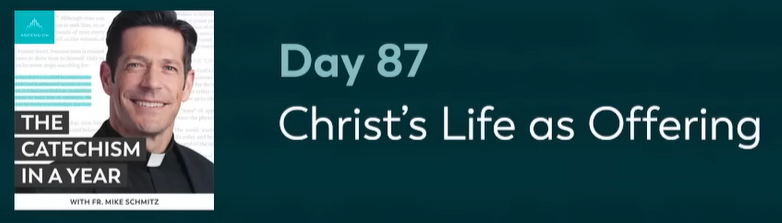
Jesus Christ’s entire life was an offering to God the Father, and he freely embraced God’s will and his plan for salvation. We learn that the Eucharist memorializes Jesus’ free offering of himself. In the garden, the night before his Passion and death, Jesus suffered real agony as he contemplated his death, yet he accepted his death as redemptive. Fr. Mike invites us to participate in this redemption by attending Mass and receiving the Eucharist. Today’s readings are Catechism paragraphs 606-612.
In this reading, we learn that all sinners are the authors of Christ’s Passion. We do not blame the Jews for the Crucifixion of Jesus as we know that it is our own sins that caused his Passion and death. Fr. Mike tells us that the Jews are not collectively responsible for Jesus’ death, and they should not be spoken of as rejected or cursed. We’re reminded that when we choose sin and deny Christ by our deeds, we crucify him anew in our hearts. Today’s readings are Catechism paragraphs 595-598.
Fr. Mike begins his examination of the Paschal Mystery of Christ’s passion, death, and ultimate Resurrection. He emphasizes that all of Scripture points to this Paschal Mystery, and that through our faith, we can try to examine the circumstances of Jesus’ life to fully understand our own redemption. We also explore Jesus’ relationship with Israel and our own relationship with our Jewish forefathers. Today’s readings are Catechism paragraphs 571-576.
Pop quiz: Do you know what hypostatic union is? I didn’t think so. Hypostatic union is the union of the two natures in Christ. Christ is one “Who” or one person and two “What’s.” We, however, have just one “what.” Our nature is human, and it’s the only one we have. Christ has two natures – one that is human and one that is divine. The human nature He took from the Blessed Mother was assumed and lost in His divine nature. That’s why in the Holy Sacrifice of the Mass, when I’m preparing the gift, you see me pour wine into the chalice and then one drop of water. That blood and water is a symbol of His human nature being assumed and lost into the divine nature of Christ. If that drop of water is not in there, it is not the proper matter, and the chalice cannot be transubstantiated, i.e., it cannot change into the Body and Blood of Jesus Christ. For the Sacrament to be valid, there must be proper matter and form. The proper matter consists of the wine and the drop of water. The proper form is to say the words that Christ said. If one of those two things is missing, the Sacrament is invalid.
Sometimes people complain that they no longer get the wine. Well, you never got the wine. When it was possible, and only in this country did it happen and probably won’t happen ever again, you were offered the Most Precious Blood of Christ. You were not offered the consecrated wine. You were offered the wine with water that had been transubstantiated or changed into the Most Precious Blood of our Savior. Anything else would be blasphemous. Priests were trained, unless they were sick during that time, to say the correct words. People have an appreciation for that because anything else would be blasphemous. Blasphemy is holding something sacred up for mockery or ridicule. During the transfiguration, our Good Lord exposed and made present to the three apostles His true nature in Christ. He lowered the veil of His humanity so that they could see some of His divinity. They could see on Earth what will happen in Heaven, and so can we. If you have any doubts about getting to Heaven, come see me and I’ll help you out. It’s my job.
Moses and Elijah were talking to God face-to-face as one man talks to another. There was no knowledge gap because, like God’s presence, Heaven is the eternal now. God has no time. They talked about the events about to happen in 10 days. So, how did Peter, James, and John know who Moses and Elijah were? Of course, Christ may have called them by name. But they were also enlightened and could see. It was a gift. One of the great miracles was the manifestation God when the apostles heard His voice, “This is my Son, the Chosen One.” It was no coincidence that this miracle occurred 10 days before the Passion. It was to prepare them for the scandal of the Passion. Our good Lord comes and gives us consolations although not as often as we would like them. He comforts us when we need it . . . sometimes before a great tribulation and sometimes afterward. I don’t get consolations as often as I would like. Maybe you do, but I don’t. I’m a real whiner in prayer. I don’t normally admit that in public, however I just did.
What happens after He gives us His consolation? The great temptation of the devil: “You are not doing something right, so God is allowing this to happen.” “He is punishing you.” “He withdrew Himself from you; therefore, you are bad.” And none of that is true. It’s the great lie of the devil. “If you prayed right, God would be with you all the time.” No. If you thought God was elevating you all the time, you’d be in a mental hospital. It’s not true. We do not constantly live in God’s consolation like what Peter, James, and John experienced. But we do have the consolation that He is always present to us. So, God will come to us every now and then, not as often as we want, but more often than we think. He comes to us to show His love. He loves us not because we’ve said the right word or combination of words in prayer. No. God comes and consoles us because He loves us. God comes to even the most hardened sinner. Why? Because He loves them too. His Son died on the cross for them too. God wants them to turn around and embrace Him. He did not make them to be condemned to hell. He made them, and all of us, so that we could know Him and love Him.
If you want more heavenly consolations, the tangible and non-blasphemous ones, pray for them. It couldn’t hurt. You can pray for anything you want; just don’t be discouraged if you don’t get it. But keep praying. I’m still not a Monsignor after 38 years in the priesthood, and I haven’t given up. I’ll be writing my Christmas card to the bishop on the back of a $100 bill. It’s the Rhode Island way.
Keep praying but be careful about the temptations of satan. Pray even if you don’t feel it. Feelings are so fickle and are not a basis of spiritual life. People say, “I don’t feel consoled” and “I don’t feel this or that.” I don’t care what you feel. Feelings are not reality. Reality is that God is always with us. Where else is God supposed to be other than with us? “I feel alone.” That’s a temptation. Where is your guardian angel? Your guardian angel is always with you. The Church is always praying for you. So, you are not alone. You are not unprayed for, and you are not unloved. That is another great temptation and an easy one for us to fall into because like Peter, James, and John, we want our heaven here on Earth.
Do not be discouraged if you don’t receive the consolations that you think you should have. It doesn’t mean you are bad. It doesn’t mean you are praying wrong. It doesn’t mean you have to give more to the church although that would be a good thing. . . you should do it anyway. Just saying! Right after Communion is the best time to receive certain gifts. We need and appreciate them. Remember when your parents let you walk to school all by yourself? You didn’t know that half the neighborhood was watching as you walked to school. You didn’t see the trooper behind the tree watching all the kids as they walked to school. You thought you were so grown up, right? No! The neighbors and the state troopers made sure you were safe and got to school okay. So do not be discouraged with your passions. Do not be discouraged with your ordinary walk in life or think that God is not with you. Because that is a lie.
How will you apply this message to your life?
You can read all of Father Fitzgibbons’ sermons by going to http://AnnunciationCatholicAlbemarle.com/ and clicking on “Blog” then “Categories” and then “Sermon Notes.” Sermon notes can also be found on the church Facebook page by searching for “Facebook Our Lady of the Annunciation Albemarle”
You may remember my sermon on Holy Thursday that was so wonderfully entitled “When a one man band gets hit in the butt with a beer truck, the music stops.” Our Lord gave the apostles and their successors the ability to carry on with the Holy Sacrifice of the Mass throughout the ages so that the fruits He won through His death could be passed on. He told the apostles if you forgive their sins, they are forgiven. That happens every generation with every priest. Any priest who says the Mass has the power to give these gifts and to forgive sins. We have to hear the sins by the way. Jesus told the apostles, “If you forgive the sins of any, they are forgiven, if you retain the sins of any, they are retained.” So, how do we know? Because people tell us. The sins we hold bound and do not offer forgiveness for are those you are not sorry for and those you are not going to try to stop. If you come in and say you are living with two girlfriends as husband and wife, and you are not going to stop, I cannot forgive you because you are attached to the sin. So, you have now heard part of the penance course.
Also in the gospel, and the main point I want to get at, is that the transfiguration took place about ten days before the Passion. Our Lord showed us what the saints are like in Heaven. They are recognizable, and they know the future because Heaven is the eternal now. We are in time, but Heaven is not. Our good Lord shows us what the saints would be like after the resurrection of the body and the General Judgement should we pass that final exam. The questions come from Matthew Chapter 25… I’ll give you a heads-up so you can prepare for it. He shows us what it will be like and how to get there. He shows us that we will have a body and that it will be recognizable and that it can move through walls. “It’s a ghost!” No, it’s not. It has physicality to it. Touch my hand. Touch my feet. In the gospel, Jesus asks for food, and He ate it. Now, we won’t need food in heaven, which I find quite disappointing. My mother has been gone for several decades, and I was looking forward to her apple pie. Even her sisters say they can’t bake like my mother did. Thanks, a lot! So, there will be no food in heaven, but we know that we will have our body with us.
Heaven is a place. A physical body needs a place in paradise to be in the presence of God. Our Lord also teaches us how we can get there. Probe the nail prints in My hands and the spear marks in My side. Bishop Sheen said that God will judge us by the resemblance of His Son in us. He will look at us. He will look at the three parts of man having suffered with My Son for the admission of sin for the sake of others. He will look at the body, soul, and spirit. Not everybody will have physical suffering to the extent Christ had, but everyone will have emotional or spiritual sufferings. Some suffer greatly depending upon the time, the place, and the person. This is what our God the Father will look for – to see the marks of His Son. This is how we become like Jesus, God’s resurrected Child.
We will have our body reunited to our soul. Remember, the soul and the body cooperated with Christ, therefore they both will receive the reward. The soul and body cooperated in sin, so they both need to do the punishment. Our Lord not only showed us what Heaven would be like, He also showed us how to get there. As Saint John said in his epistle, “If we love Him, keep His commandments.” A lot of people forget that one part. If you love Him, keep His commandments. After all, His commandments are not burdensome.
How will you apply this message to your life? Do you love Him? Are you keeping His commandments?
You can read all of Father Fitzgibbons’ sermons by going to https://annunciationcatholicalbemarle.com/ and clicking on “Blog” then “Categories” and then “Sermon Notes. From a cell phone, click on “Blog” then “Menu” and then “Categories” (located at the end of page). There is also a search box if you are looking for a specific topic.
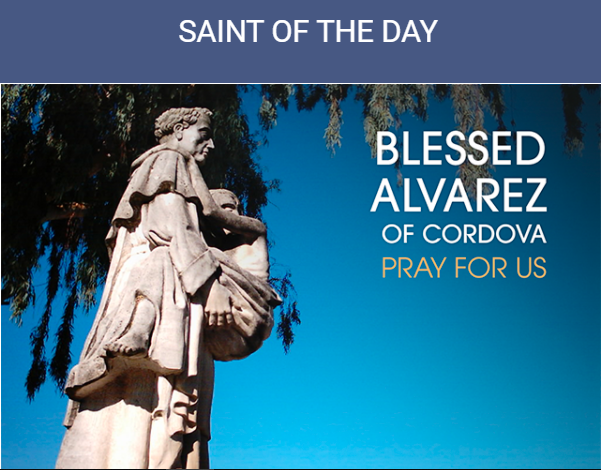
Bl. Alvarez of (Córdoba) Cordova (1350-1430) was born to a noble family in Zamora, Spain. He joined the Dominican Order and preached throughout Spain, and served at the court of Queen Catherine. He went on pilgrimage to the Holy Land, and upon his return preached the crusades against the Muslims. He founded the famous priory of Scala Caeli (Ladder of Heaven) at Cordova, a convent of strict observance, and it is said that angels helped provide its building materials. He erected pictures of the holy places in Jerusalem in its gardens, popularizing the custom of the Stations of the Cross. He lived a life of great austerity and begged for alms even though he could easily obtain what he needed from the royal court. Numerous miracles are attributed to him. It is told that he once found a dying beggar, wrapped him in a blanket, and carried him back to the convent. Upon unwrapping the cloth he found only a crucifix. Blessed Alvarez was dedicated to Christ’s Passion and helped spread devotion to the Way of the Cross throughout western Europe. He also successfully led a resistance against the anti-pope and brought Spain under allegiance to the true pope in Rome. His feast day is February 19.
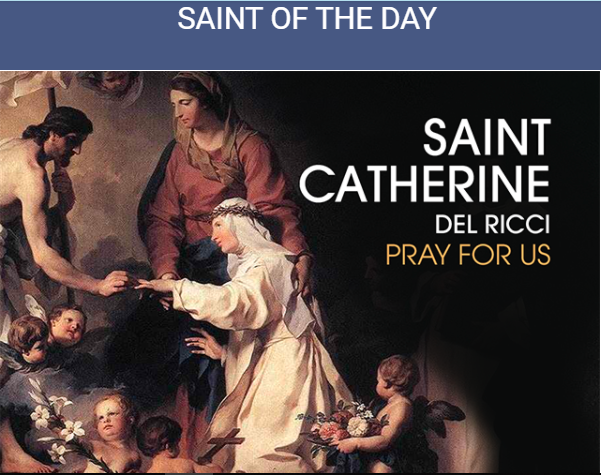
St. Catherine del Ricci (1522-1590) was born with the name Alessandra in Florence, Italy, to a respectable merchant family. Her mother died while she was very young, so that from her childhood Alessandra took the Blessed Virgin Mary as her mother. She was given to prayer and religious fervor, and at the age of fourteen decided to enter a strict Third Order Dominican convent, taking Catherine as her religious name. She developed into a great mystic with an intense devotion to the Passion of Christ.
For many years Catherine would go into ecstasy from noon every Thursday through 4 p.m. on Friday, experiencing in a mystical manner the sufferings of Christ during his Passion. She was also given the spiritual gift of the stigmata; Christ’s wounds would appear on her body through the course of the ecstasy. After enduring much humiliation for years on account of these sufferings, she was eventually accepted as a holy woman and later became prioress.
Catherine’s advice was widely sought on many spiritual and practical matters. Despite being cloistered, she kept up a loving correspondence with many relatives, friends, and her spiritual children. Among those in her correspondence were three future popes, Pope Marcellus II, Pope Clement VIII, and Pope Leo XI. Her feast day is February 13.
As we finish the Gospel of Matthew, Fr. Mike takes us through Christ’s passion, explaining the meaning of “Barabbas”, the importance of saints, and temptation towards false truth. He also explains the context of the gospels, and how we fit into them in the new and eternal covenant. Today’s readings are Matthew 27-28 and Proverbs 19:25-29.