God has given the Church his law as “the way of life and truth.” We, therefore, have the right to be taught and guided while maintaining a spirit of docility in love. In this, Fr. Mike reminds us that the Church is our caring mother. Her care extends into the five precepts of the Church, those laws establishing the very minimum needed to remain an active member of the Body of Christ. These have to do with attending Mass, receiving the sacraments, fasting, and providing for the needs of the Church. Today’s readings are Catechism paragraphs 2037-2043.
There is great depth to the movement of the celebration of the Mass. Fr. Mike highlights the role of Christ as the head and high priest and the role of the laity as the body of Christ at Mass. Fr. Mike also emphasizes the importance of the altar at Mass, reminding us that the heart of religion is worship, and the heart of worship is sacrifice. Lastly, Fr. Mike explains how God’s love requires a response from each of us, making it both inclusive and exclusive love. Today’s readings are Catechism paragraphs 1348-1355.
Celebrating the sacrament of the Eucharist has been part of the Tradition of the Catholic Church for 2,000 years. Fr. Mike unpacks the citation from St. Justin Martyr’s First Apology, which beautifully describes the structure of the Mass in AD 155 and captures how the Early Church had the same understanding of the Eucharist as we do today. Today’s readings are Catechism paragraphs 1341-1347.
The Karate Kid didn’t know waxing a car would teach him karate, but Miyagi knew. In a similar way the Church, in her wisdom, teaches us certain motions—kneeling at Mass, making the sign of the Cross, etcetera—so we may learn the deeper virtues that will lead us to holiness. In this video, Fr. Mike encourages us to keep going through the motions, if that’s all it feels like we’re doing at Mass, because it’s in times of desolation that our faith grows the most.
Why do we go to Mass every Sunday? Is it because of what we “get out of it”? Is it the way it makes us feel? Is it out of love for God? Or something even deeper and more profound?
Today, Fr. Mike explains the Church’s teaching on Sunday Mass obligation, and why this is the way that God has asked us to worship him.
Last week, Fr. Mark-Mary invited us to not just show up for Mass, but actually pray the Mass—participate in the Mass. But… what does that actually look like? Today, Fr. Mark-Mary gives us 5 concrete ways to enter more fully into the celebration of Holy Mass.
For practicing Catholics who attend Mass every Sunday, it can be easy to get caught up in the routine instead of consciously entering into the sacrament. When this happens, although we remain physically present, we start to become emotionally distant from what’s actually taking place on the altar, while missing some of the main aspects of our faith. Today, Fr. Mark-Mary shares some ways we can dive deeper into the Mass through prayer. You can read the institution narratives that Fr. Mark-Mary mentions in the following passages: Matthew 26:20-29 Mark 14:17-25 Luke 22:14-20 1 Corinthians 11:23-25
You may remember my sermon on Holy Thursday that was so wonderfully entitled “When a one man band gets hit in the butt with a beer truck, the music stops.” Our Lord gave the apostles and their successors the ability to carry on with the Holy Sacrifice of the Mass throughout the ages so that the fruits He won through His death could be passed on. He told the apostles if you forgive their sins, they are forgiven. That happens every generation with every priest. Any priest who says the Mass has the power to give these gifts and to forgive sins. We have to hear the sins by the way. Jesus told the apostles, “If you forgive the sins of any, they are forgiven, if you retain the sins of any, they are retained.” So, how do we know? Because people tell us. The sins we hold bound and do not offer forgiveness for are those you are not sorry for and those you are not going to try to stop. If you come in and say you are living with two girlfriends as husband and wife, and you are not going to stop, I cannot forgive you because you are attached to the sin. So, you have now heard part of the penance course.
Also in the gospel, and the main point I want to get at, is that the transfiguration took place about ten days before the Passion. Our Lord showed us what the saints are like in Heaven. They are recognizable, and they know the future because Heaven is the eternal now. We are in time, but Heaven is not. Our good Lord shows us what the saints would be like after the resurrection of the body and the General Judgement should we pass that final exam. The questions come from Matthew Chapter 25… I’ll give you a heads-up so you can prepare for it. He shows us what it will be like and how to get there. He shows us that we will have a body and that it will be recognizable and that it can move through walls. “It’s a ghost!” No, it’s not. It has physicality to it. Touch my hand. Touch my feet. In the gospel, Jesus asks for food, and He ate it. Now, we won’t need food in heaven, which I find quite disappointing. My mother has been gone for several decades, and I was looking forward to her apple pie. Even her sisters say they can’t bake like my mother did. Thanks, a lot! So, there will be no food in heaven, but we know that we will have our body with us.
Heaven is a place. A physical body needs a place in paradise to be in the presence of God. Our Lord also teaches us how we can get there. Probe the nail prints in My hands and the spear marks in My side. Bishop Sheen said that God will judge us by the resemblance of His Son in us. He will look at us. He will look at the three parts of man having suffered with My Son for the admission of sin for the sake of others. He will look at the body, soul, and spirit. Not everybody will have physical suffering to the extent Christ had, but everyone will have emotional or spiritual sufferings. Some suffer greatly depending upon the time, the place, and the person. This is what our God the Father will look for – to see the marks of His Son. This is how we become like Jesus, God’s resurrected Child.
We will have our body reunited to our soul. Remember, the soul and the body cooperated with Christ, therefore they both will receive the reward. The soul and body cooperated in sin, so they both need to do the punishment. Our Lord not only showed us what Heaven would be like, He also showed us how to get there. As Saint John said in his epistle, “If we love Him, keep His commandments.” A lot of people forget that one part. If you love Him, keep His commandments. After all, His commandments are not burdensome.
How will you apply this message to your life? Do you love Him? Are you keeping His commandments?
You can read all of Father Fitzgibbons’ sermons by going to https://annunciationcatholicalbemarle.com/ and clicking on “Blog” then “Categories” and then “Sermon Notes. From a cell phone, click on “Blog” then “Menu” and then “Categories” (located at the end of page). There is also a search box if you are looking for a specific topic.
Jesus said that the Son of Man will be lifted up. He also said, “When I am lifted up from the Earth, I will draw all men to myself.” And, He does. However, He doesn’t draw people up to Him on the cross just for them to say, “Gee, that must hurt.” This is not a spectator sport. Rather, our good Lord reaches down from the cross and says, “Take My hand and come up to Me, because this is the way to salvation. Join Me on the cross.” Paul finally learned that lesson. He wrote, “Now, I rejoice in sufferings for Your sake, and in my flesh I complete what is lacking in Christ’s afflictions for the sake of His body, that is, the Church.” Our sufferings, all the crosses we carry and the crosses we carry for others are redemptive. They are not only for ourselves, but for others. We join Christ in the sacrifice like the good thief on the cross. We unite ourselves to Him, so that He will raise us up. You do that when you make your Morning Offering: “I offer you my prayers, works, joys, and sufferings of this day.” All those crosses God allows us to carry…Ugh. I don’t know about you, but I’m not crazy about mine.
We also join Christ in the sacrifice during the Mass by true and active participation. So, what is true and active participation? It’s not those who sing the loudest, pray the loudest, or run a ministry. Whatever that is. The term “ministry” really means nothing. It only applies to Holy Orders, but it has been so overused, it means nothing now. True and active participation is the giving of your human nature to the priest who acts in the person of Christ on the altar. He takes your human nature in the offertory, immolates them, and makes them one with the sacrifice of Christ. He immolates them on the altar as part of the sacrifice of God’s love for us. That is true and active participation. This is how we unite ourselves and become one with the sufferings of Christ just as the Blessed Mother, Saint John, Mary the wife of Clopas, and Mary of Magdala did at the foot of the cross…especially the Blessed Mother…her human nature was suffering for Him. For us, it’s only intellectual, so it doesn’t matter whether you feel it or not. That has nothing to do with its effectiveness. However, it’s only when you do that you are one with Christ on the cross.
There will always be temptations from the cross. Just as Christ was tempted many times to come down from the cross, we will be too. What were the first three temptations? “All religion is just a show.” “If you have good music, a praise band or whatever, people will come.” Our Lord says this is not a show. This is an act of love. “Well, you know with religion, you gotta give people food and stuff.” “Everybody will be happy if they take your stuff and give it to somebody else.” “It’s all power.” “It’s all Socialism.” “True religious charity is just giving them bread…they will be fine.” How many fat people are there in prison? A lot. It’s not that they lack food. Their problem is that they practice evil. Now, there are a lot of people outside of prison who practice evil, but they haven’t been caught yet. It’s all about power. “Well, if we had fairer laws, then we wouldn’t have any problems.” That’s not true. We have more laws than lawyers know about. Oh, by the way, drugs are illegal. Did you know that? Apparently, a lot of people don’t. Read the sheriff’s blotter report, and that’s just the tip of the iceberg.
Another temptation is to deny the divine message. You see, we are much brighter in the 21st Century. We know better, because we are so enlightened and so highly educated. We can’t write in cursive, but we are really educated. We know what God’s word truly means. Before, they weren’t too sure, because they were all stupid. When Christ proclaimed that marriage was between one man and one woman unless separated by death, everyone left Him except the 12 apostles. People didn’t like that. Also, when Peter tried to sway Christ from going to the cross, He called Peter, “Satan.”
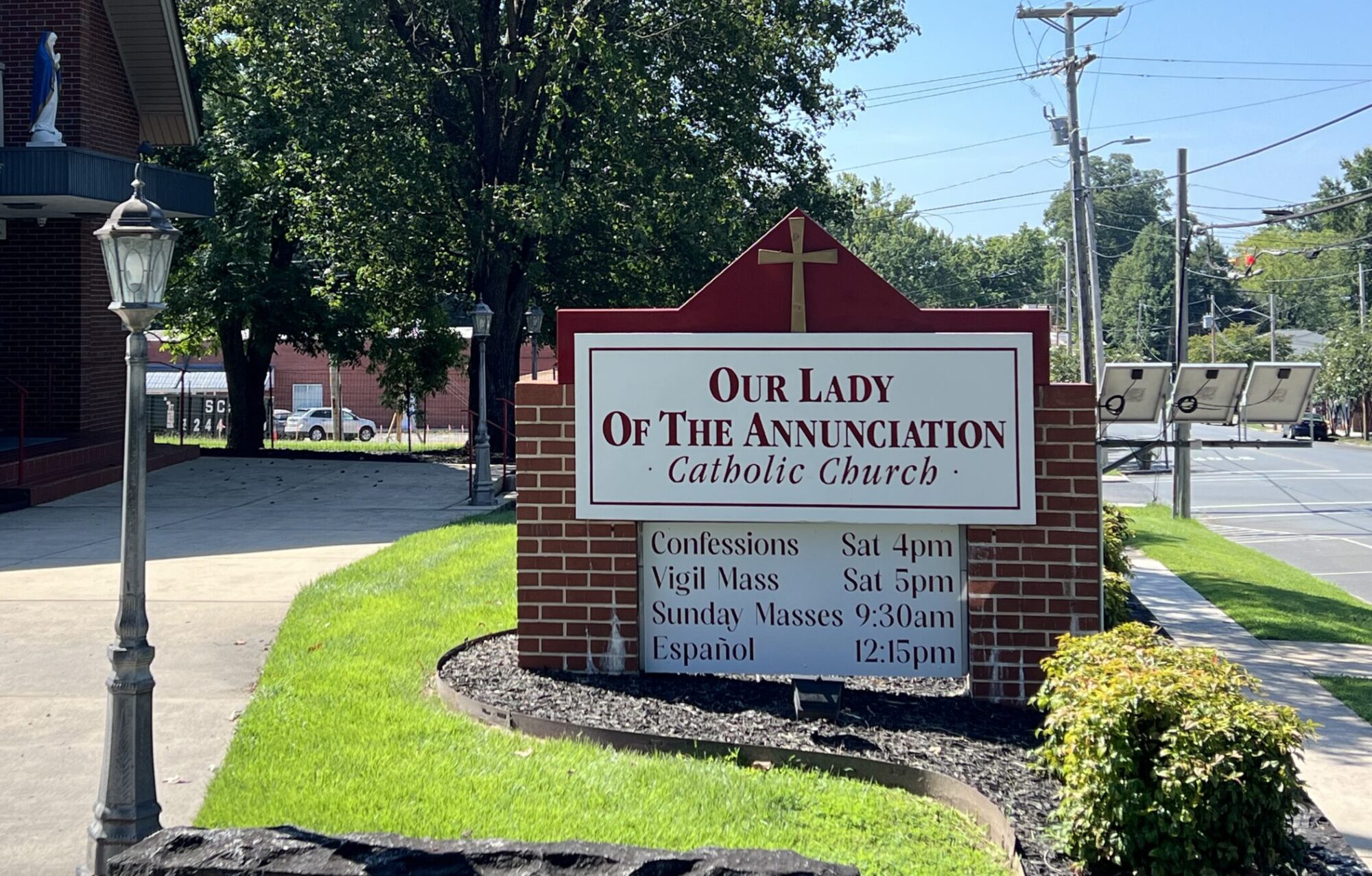
The third type of temptation is the Eucharist. “Unless you eat the flesh of the Son of man and drink His blood, you have no life in you.” “Oh, He didn’t really mean that.” That’s what He said, and He meant it. The words really mean that. Everyone left Him except the 12 apostles. The last temptation was, “Come down from the cross, and we will believe in you.” In His heart, Christ was saying, “You don’t understand. You’ve forgotten your education.” “If the Church changes its laws, everyone will come back.” Really? We have Mass in English. We have Mass in Spanish (Spanglish). We have Mass on Saturdays at 5 pm. We have Mass on Sundays at 9:30 and 12:15. We have confessions face-to-face, although not here, because it’s not safe for the priests anymore. So, where is everybody?
Temptations in one form or another will assail us. “Am I doing something wrong because I’m tempted?” No, you are doing something right, because you are tempted. Our Lord says, “Come up to Me. Come up. I am trying to give you eternal happiness. I am trying to give your soul peace.” So, we have a tug of war with Christ on the cross. He wants to pull us up, and we want to pull Him down. Instead, we can unite ourselves in the sacrifice of Christ in the Morning Offering prayer, resignation to our exterior and interior crosses, and resignation of the will…the most difficult cross. In the midst of temptation, the good thief on the cross accepted the suffering for his sins, and was united with Christ. What did Christ tell him? “Today, you will be with Me in paradise.”
How will you apply this message to your life? Will you unite yourself in the sacrifice of Christ by saying the Morning Offering prayer? Will you accept your interior and exterior crosses and join Christ in His suffering?
You can read all of Father Fitzgibbons’ sermons by going to https://annunciationcatholicalbemarle.com/ and clicking on “Blog” then “Categories” and then “Sermon Notes. From a cell phone, click on “Blog” then “Menu” and then “Categories” (located at the end of page). There is also a search box if looking for a specific topic.
On occasion, as I go about my day, I have people come up and say, “Father, may I ask you a question?” Sure! Sometimes, people have very good questions. Now, these questions generally fall into one of two categories. The first category includes the faithful who are seeking understanding. This happened on Tuesday when someone asked me, “Father, why do we call you father? I never really knew why.” The first good reason is my mother told me to, and if you don’t obey her, you know what happens. The second reason is scriptural. Paul said in his epistle: “I am your spiritual father. I beget you in Christ. I baptized you and gave you spiritual life.” Then, there is this other group of people who try to see if I’m the village idiot. I’m not, but I qualify for the top ten. I call this game “stump the chump.” “Father, where does it say in scripture that we are supposed to kneel?” Well, that’s easy enough… Matthew 27, Psalm 95, Romans 14, and Revelation just to name a few. I mean, come on! Really? I’m not the brightest bulb on the circuit, but that’s an easy one. They are trying to get me to prove that Catholicism is wrong. That or try to convert me. I already know I’m not going to convince them to become Catholic. “Have you ever heard about the precious blood?” You know…I believe I have. I stayed awake that day at seminary. These are all “gotcha questions.
How do you tell people about Christ? The best way to evangelize is not by giving someone a bunch of information. They could get that online or look in the Catechism of the Catholic Church…it’s all in there. So, how do you tell people about Christ? Do we tell them to read the book? Well, the book doesn’t contain everything about Jesus Christ. The book is a “what” not a “Who.” But, we can pass on the “Who” to people by telling them what Jesus has done for us. If giving people a book brought people to Christ, we could give everyone a copy of the Catechism and fill the church with converts. But that doesn’t happen. If that worked, we could all read a medical book and be the epitome of health. We have to tell people what’s in the book and bring it to real life. We have to tell them about God’s grace and what He has done in our lives. Today’s gospel shows us how to evangelize. Jesus cured that leper from a death sentence. He went away and could not stop telling people how Jesus had restored his life. Like the leper, we also have to tell people what God has done for us.
We see proof of God’s love so often that sometimes we become immune to it and ungrateful. Each time you go to Mass, you receive the Most Precious Body and Blood just like the apostles did at the Last Supper. You can come to church during the day and speak to our Lord in the Most Blessed Sacrament as one person speaks to another. But, because we have become so accustomed to the gift of His love, we forget to be thankful. I’m thankful for a lot of things. I’m thankful for indoor plumbing. I’m thankful for clean clothes. I’m thankful that McDonalds is open 24-7. I’m thankful about not having to go outside in a rain storm to take a shower. That’s nice and a big change. I’m thankful for many things even those that are unpleasant like the COVID test. I get it every week, so I don’t want to hear any whining. “Oh! That’s terrible!” Well, thank God we have that test. “But why, Father?” We could have the Chinese test instead. Come on! We are also grateful for the geniuses who have worked tirelessly night and day to develop these tests and vaccines so that we can maintain our health and delay what will eventually come.
God has given us our life, and when we lose it by sin, He gives it back to us. This is how we tell people about the truth and meaning of our faith. Not in an obnoxious way, but by telling them what the Lord has done in our lives and the great gift He has given us…the gift of Himself. Not that we deserve it, but because He loves us. He brought me back to life through my baptism. He feeds me the Precious Body and Blood in Holy Communion. When my soul is dead with sin, and I may lose Heaven if those sins are not forgiven, He gives my life back to me through the Sacrament of Penance. He forgives and He forgets. My soul is washed in His blood.
The Blessed Mother was the first to be washed in His blood. She was standing beneath the cross and was spattered with it. When they took Him down from the cross and laid Him on her lap, she was covered with His blood. Once you are dead, your blood stops coagulating. So, Mary was covered with the blood of Christ. “Why do you honor Mary?” She was the first human being to be covered in the Precious Blood. She was also the first to receive a miracle. Remember the wedding at Cana? That was a direct intercession of God. “Son, they have no more wine.” Boom. And, there was wine.
This is how we tell people about our faith. We don’t use obnoxious evangelization techniques when we talk to them. We just tell them about what God has done for us. But, we keep trying to reinvent the wheel. If we do it differently, will things be better? No. We do what works. What happened when God performed His miracles? The recipients of those miracles told others. And, what happened? Look at the last line in today’s Gospel. Jesus went to deserted places, but people kept coming to Him from all sides.
How will you apply this message to your life? Are you grateful for His love or have you become immune to it? Will you tell others what God has done in your life?
You can read all of Father Fitzgibbons’ sermons by going to https://annunciationcatholicalbemarle.com/ and clicking on “Blog” then “Categories” and then “Sermon Notes. From a cell phone, click on “Blog” then “Menu” and then “Categories” (located at the end of the page). There is also a search box if you are looking for a specific topic.