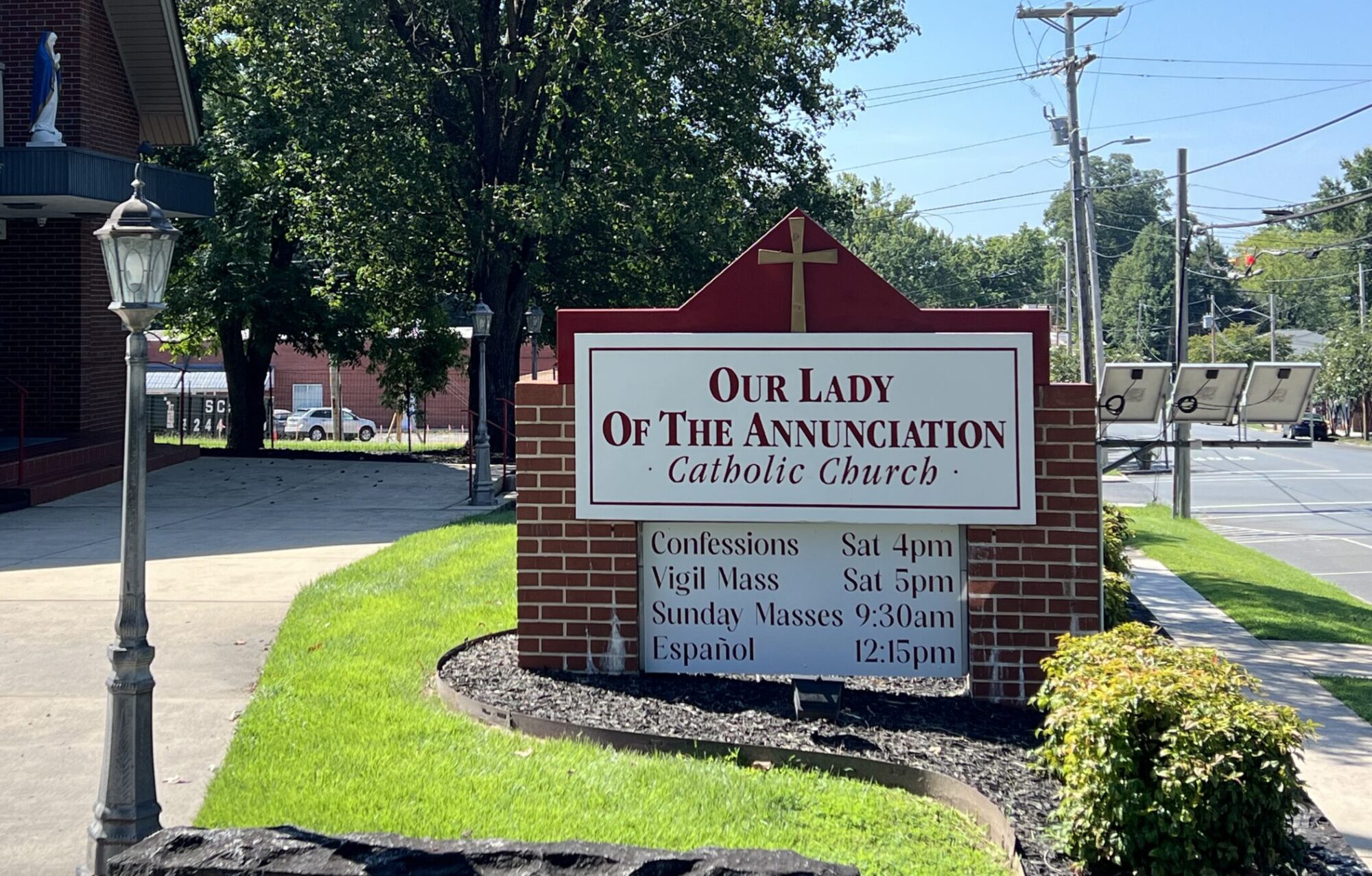
Saint of the Day – October 24 – Saint Anthony Mary Claret
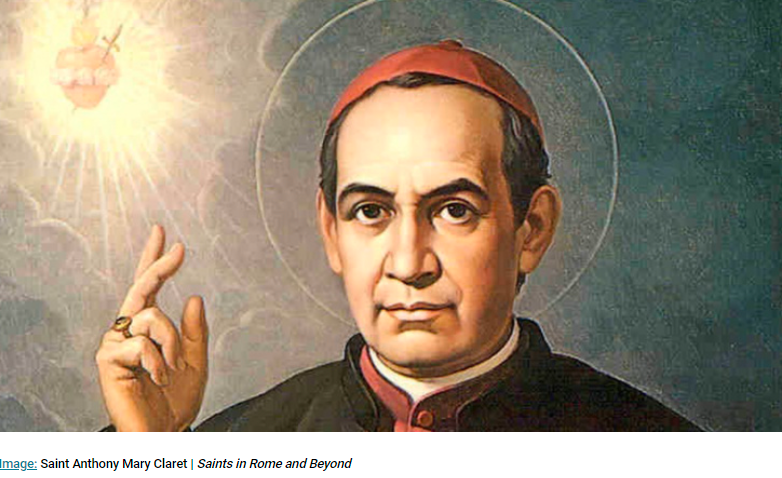
Saint Anthony Mary Claret’s Story (DECEMBER 23, 1807 – OCTOBER 24, 1870)
The “spiritual father of Cuba” was a missionary, religious founder, social reformer, queen’s chaplain, writer and publisher, archbishop, and refugee. He was a Spaniard whose work took him to the Canary Islands, Cuba, Madrid, Paris, and to the First Vatican Council.
In his spare time as weaver and designer in the textile mills of Barcelona, Anthony learned Latin and printing: The future priest and publisher was preparing. Ordained at 28, he was prevented by ill health from entering religious life as a Carthusian or as a Jesuit, but went on to become one of Spain’s most popular preachers.
Anthony spent 10 years giving popular missions and retreats, always placing great emphasis on the Eucharist and devotion to the Immaculate Heart of Mary. It was said that his rosary was never out of his hand. At age 42, he founded a religious institute of missionaries beginning with five young priests, known today as the Claretians.
Anthony was appointed to head the much-neglected archdiocese of Santiago in Cuba. He began its reform by almost ceaseless preaching and hearing of confessions, and suffered bitter opposition mainly for opposing concubinage and giving instruction to black slaves. A hired assassin—whose release from prison Anthony had obtained—slashed open his face and wrist. Anthony succeeded in getting the would-be assassin’s death sentence commuted to a prison term. His solution for the misery of Cubans was family-owned farms producing a variety of foods for the family’s own needs and for the market. This invited the enmity of the vested interests who wanted everyone to work on a single cash crop—sugar. Besides all his religious writings are two books he wrote in Cuba: Reflections on Agriculture and Country Delights.
He was recalled to Spain for a job he did not relish—being chaplain for the queen. Anthony went on three conditions: He would reside away from the palace; he would come only to hear the queen’s confession and instruct the children; and he would be exempt from court functions. In the revolution of 1868, he fled to Paris with the queen’s party, where he preached to the Spanish colony.
All his life Anthony was interested in the Catholic press. He founded the Religious Publishing House, a major Catholic publishing venture in Spain, and wrote or published 200 books and pamphlets.
At Vatican I, where he was a staunch defender of the doctrine of infallibility, Anthony won the admiration of his fellow bishops. Cardinal Gibbons of Baltimore remarked of him, “There goes a true saint.” At the age of 63, he died in exile near the border of Spain.
Reflection
Jesus foretold that those who are truly his representatives would suffer the same persecution as he did. Besides 14 attempts on his life, Anthony had to undergo such a barrage of the ugliest slander that the very name Claret became a byword for humiliation and misfortune. The powers of evil do not easily give up their prey. No one needs to go looking for persecution. All we need to do is be sure we suffer because of our genuine faith in Christ, not for our own whims and lack of prudence.
Saint Anthony Mary Claret is a Patron Saint of:
Weavers
//Franciscan Media//
Saint of the Day – August 14 – Saint Maximilian Mary Kolbe
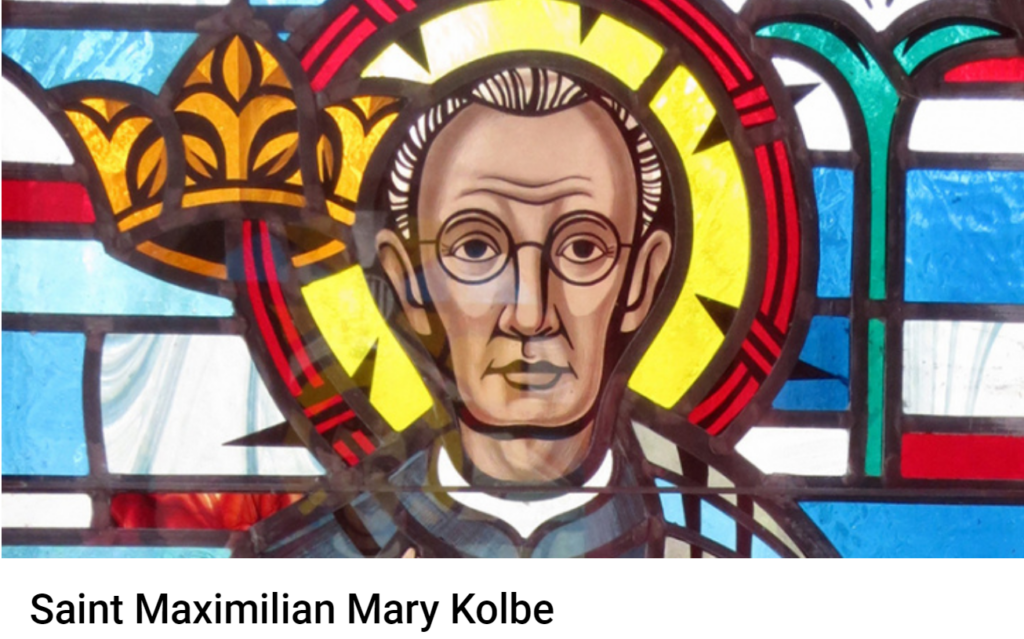
Saint Maximilian Mary Kolbe’s Story
“I don’t know what’s going to become of you!” How many parents have said that? Maximilian Mary Kolbe’s reaction was, “I prayed very hard to Our Lady to tell me what would happen to me. She appeared, holding in her hands two crowns, one white, one red. She asked if I would like to have them—one was for purity, the other for martyrdom. I said, ‘I choose both.’ She smiled and disappeared.” After that he was not the same.
He entered the minor seminary of the Conventual Franciscans in Lvív–then Poland, now Ukraine– near his birthplace, and at 16 became a novice. Though Maximilian later achieved doctorates in philosophy and theology, he was deeply interested in science, even drawing plans for rocket ships.
Ordained at 24, Maximilian saw religious indifference as the deadliest poison of the day. His mission was to combat it. He had already founded the Militia of the Immaculata, whose aim was to fight evil with the witness of the good life, prayer, work, and suffering. He dreamed of and then founded Knight of the Immaculata, a religious magazine under Mary’s protection to preach the Good News to all nations. For the work of publication he established a “City of the Immaculata”—Niepokalanow—which housed 700 of his Franciscan brothers. He later founded another one in Nagasaki, Japan. Both the Militia and the magazine ultimately reached the one-million mark in members and subscribers. His love of God was daily filtered through devotion to Mary.
In 1939, the Nazi panzers overran Poland with deadly speed. Niepokalanow was severely bombed. Kolbe and his friars were arrested, then released in less than three months, on the feast of the Immaculate Conception.
In 1941, Fr. Kolbe was arrested again. The Nazis’ purpose was to liquidate the select ones, the leaders. The end came quickly, three months later in Auschwitz, after terrible beatings and humiliations.
A prisoner had escaped. The commandant announced that 10 men would die. He relished walking along the ranks. “This one. That one.”
As they were being marched away to the starvation bunkers, Number 16670 dared to step from the line.
“I would like to take that man’s place. He has a wife and children.”
“Who are you?”
“A priest.”
No name, no mention of fame. Silence. The commandant, dumbfounded, perhaps with a fleeting thought of history, kicked Sergeant Francis Gajowniczek out of line and ordered Fr. Kolbe to go with the nine. In the “block of death” they were ordered to strip naked, and their slow starvation began in darkness. But there was no screaming—the prisoners sang. By the eve of the Assumption, four were left alive. The jailer came to finish Kolbe off as he sat in a corner praying. He lifted his fleshless arm to receive the bite of the hypodermic needle. It was filled with carbolic acid. They burned his body with all the others. Fr. Kolbe was beatified in 1971 and canonized in 1982.
Reflection
Father Kolbe’s death was not a sudden, last-minute act of heroism. His whole life had been a preparation. His holiness was a limitless, passionate desire to convert the whole world to God. And his beloved Immaculata was his inspiration.
Saint Maximilian Mary Kolbe is a Patron Saint of:
Addicts
Recovery from drug addiction
Saint of the Day – July 29 – Saints Martha, Mary, & Lazarus
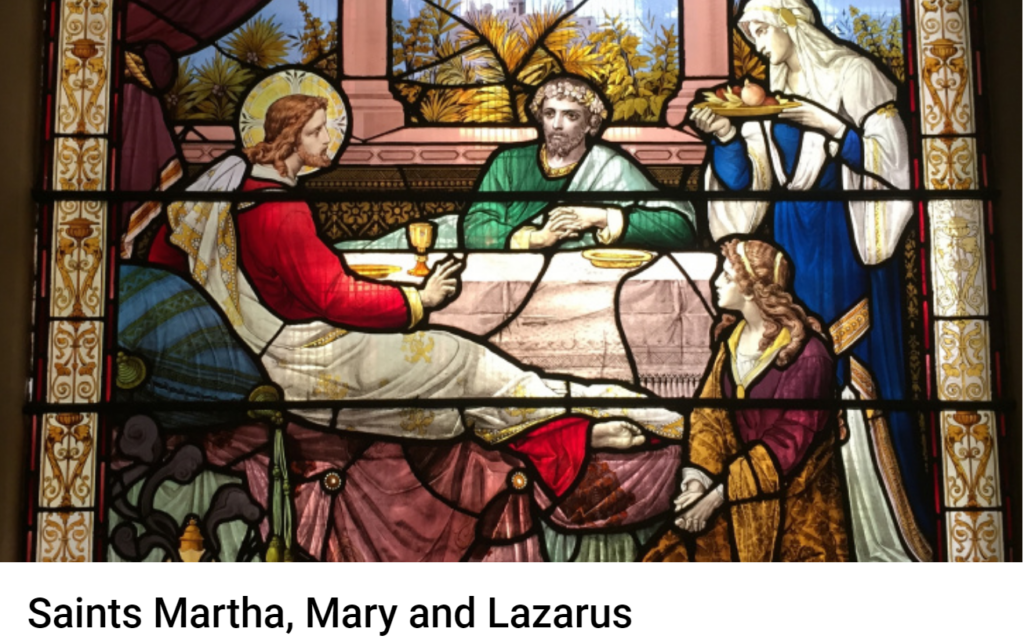
Saints Martha, Mary and Lazarus’ story (1st Century)
Martha, Mary, and their brother Lazarus were evidently close friends of Jesus. He came to their home simply as a welcomed guest, rather than as one celebrating the conversion of a sinner like Zacchaeus or one unceremoniously received by a suspicious Pharisee. The sisters felt free to call on Jesus at their brother’s death, even though a return to Judea at that time seemed to spell almost certain death.
Martha’s great glory is her simple and strong statement of faith in Jesus after her brother’s death. “Jesus told her, ‘I am the resurrection and the life; whoever believes in me, even if he dies, will live, and everyone who lives and believes in me will never die. Do you believe this?’ She said to him, ‘Yes, Lord. I have come to believe that you are the Messiah, the Son of God, the one who is coming into the world’” (John 11:25-27).
No doubt Martha was an active sort of person. On one occasion, she prepares the meal for Jesus and possibly his fellow guests and forthrightly states the obvious: All hands should pitch in to help with the dinner. The Lord recognizes that Martha is “worried about many things,” also noting that Mary, who has spent the preparation time at Jesus’ feet listening to his words “has chosen the better part.” John 12:1-8 describes Mary’s anointing of Jesus’ feet at Bethany, an act which he praised highly.
Immediately after we are told that the chief priests plotted to kill Lazarus “because many of the Jews were turning away and believing in Jesus because of him.” Lazarus was the one of whom the Jews said, “See how much he loved him.” In their sight Jesus raised his friend Lazarus from the dead.
Legends abound about the life of Lazarus after the death and resurrection of Jesus. He is supposed to have left a written account of what he saw in the next world before he was called back to life. Some say he followed Peter into Syria. Another story is that despite being put into a leaking boat by the Jews at Jaffa, he, his sisters, and others landed safely in Cyprus. There he died peacefully after serving as bishop for 30 years.
It is certain there was early devotion to the saint. Around the year 390, the pilgrim lady Etheria talks of the procession that took place on the Saturday before Palm Sunday at the tomb where Lazarus had been raised from the dead. In the West, Passion Sunday was called Dominica de Lazaro, and Augustine tells us that in Africa the Gospel of the raising of Lazarus was read at the office of Palm Sunday.
Reflection
In its 2021 decree on combining veneration of Mary and Lazarus with Martha, the Congregation for Divine Worship and the Sacraments said, “In the household of Bethany, the Lord Jesus experienced the family spirit and friendship of Martha, Mary and Lazarus, and for this reason the Gospel of John states that he loved them. Martha generously offered him hospitality, Mary listened attentively to his words and Lazarus promptly emerged from the tomb at the command of the one who humiliated death.”
Saint Martha is a Patron Saint of:
Cooks
Homemakers
Restaurant servers
Saints Martha, Mary, and Lazarus are Patron Saints of:
Siblings
//Franciscan Media//
Saint of the Day – May 24 – Saint Mary Magdalene de’ Pazzi
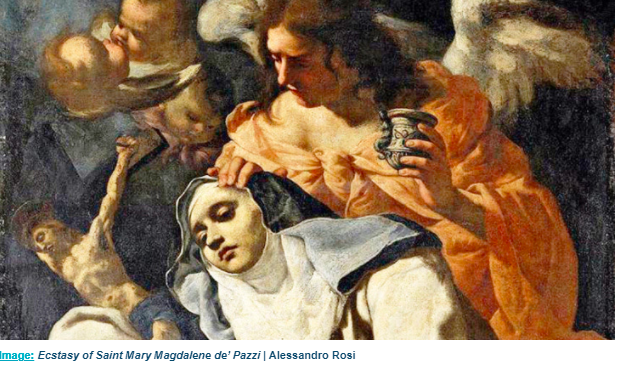
Saint Mary Magdalene de’ Pazzi’s Story
Mystical ecstasy is the elevation of the spirit to God in such a way that the person is aware of this union with God while both internal and external senses are detached from the sensible world. Mary Magdalene de’ Pazzi was so generously given this special gift of God that she is called the “ecstatic saint.”
Catherine de’ Pazzi was born into a noble family in Florence in 1566. The normal course would have been for her to have married into wealth and enjoyed comfort, but Catherine chose to follow her own path. At 9, she learned to meditate from the family confessor. She made her first Communion at the then-early age of 10, and made a vow of virginity one month later. At 16, Catherine entered the Carmelite convent in Florence because she could receive Communion daily there.
Catherine had taken the name Mary Magdalene and had been a novice for a year when she became critically ill. Death seemed near, so her superiors let her make her profession of vows in a private ceremony from a cot in the chapel. Immediately after, Mary Magdalene fell into an ecstasy that lasted about two hours. This was repeated after Communion on the following 40 mornings. These ecstasies were rich experiences of union with God and contained marvelous insights into divine truths.
As a safeguard against deception and to preserve the revelations, her confessor asked Mary Magdalene to dictate her experiences to sister secretaries. Over the next six years, five large volumes were filled. The first three books record ecstasies from May of 1584 through Pentecost week the following year. This week was a preparation for a severe five-year trial. The fourth book records that trial and the fifth is a collection of letters concerning reform and renewal. Another book, Admonitions, is a collection of her sayings arising from her experiences in the formation of women religious.
The extraordinary was ordinary for this saint. She read the thoughts of others and predicted future events. During her lifetime, Mary Magdalene appeared to several persons in distant places and cured a number of sick people.
It would be easy to dwell on the ecstasies and pretend that Mary Magdalene only had spiritual highs. This is far from true. It seems that God permitted her this special closeness to prepare her for the five years of desolation that followed when she experienced spiritual dryness. She was plunged into a state of darkness in which she saw nothing but what was horrible in herself and all around her. She had violent temptations and endured great physical suffering. Mary Magdalene de’ Pazzi died in 1607 at age 41, and was canonized in 1669. Her liturgical feast is celebrated on May 25.
Reflection
Intimate union, God’s gift to mystics, is a reminder to all of us of the eternal happiness of union he wishes to give us. The cause of mystical ecstasy in this life is the Holy Spirit, working through spiritual gifts. The ecstasy occurs because of the weakness of the body and its powers to withstand the divine illumination, but as the body is purified and strengthened, ecstasy no longer occurs. See Teresa of Avila’s Interior Castle, and John of the Cross’ Dark Night of the Soul, for more about various aspects of ecstasies.
//Franciscan Media//
Saint of the Day – March 16th
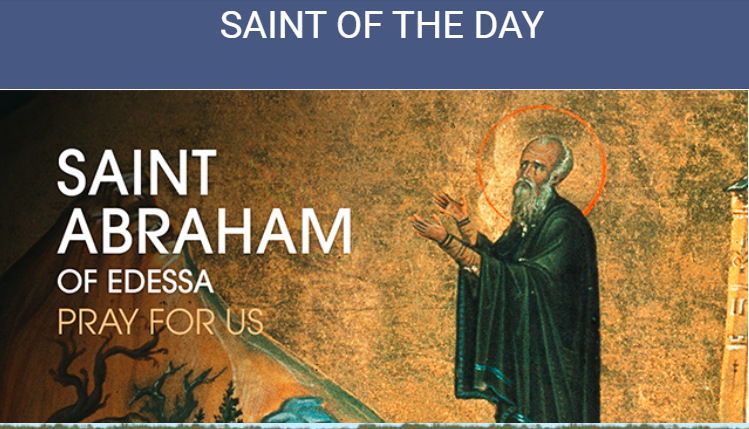
St. Abraham of Edessa (300-360 A.D.), also known as Abraham of Kidunaia, was a rich nobleman from Mesopotamia. He married according to his parents’ wishes, despite his desire to give himself totally to God. After the wedding ceremony he fled to a cave and hid himself, leaving only a small window to receive food. He lived there as a hermit, and after the death of his parents gave his inheritance to the poor.
The Bishop of Edessa ordained him as a priest and sent him to lead a notoriously sinful city. There Abraham was beaten and maligned for three years until his prayers prevailed and every citizen came to him for baptism. He then returned to his hermitage and lived there the rest of his life.
After his brother’s death his young niece was left to his care. He set her up to live as a religious in a cell next to his, which she did for twenty years until she succumbed to the seduction of a rogue hermit. She was so ashamed of her sin that she despaired of God’s mercy and became a prostitute. St. Abraham prayed for his niece earnestly for two years; then, discovering her location, left his cell and came to her disguised as a suitor. When they were alone he revealed his identity to her, and, pleading with her throughout the night, prevailed upon her to return with him to her life of prayer and penance. She came back to her cell, which Abraham relocated directly behind his own for her protection, and became St. Mary of Edessa. St. Abraham’s feast day is March 16th.
//The Catholic Company//
The Bible in a Year – Day 22 – Go to Joseph
The Bible in a Year (with Fr. Mike Schmitz)
Day 22: Go to Joseph
Fr. Mike shows us how the faithfulness of Joseph in the Old Testament foreshadows the faithfulness of St. Joseph, the husband of Mary, in the New Testament. Today’s readings are Genesis 41-42; Job 33-34 and Proverbs 4:1-9.
Click on link:
The Bible in a Year – Day 313 – The Ark of the New Covenant

As we begin reading the Gospel of Luke, Fr. Mike draws our attention to Mary. He clarifies the difference between Zechariah’s response and Mary’s response to the angel Gabriel, and also explains why Mary is the Ark of the new Covenant. We learn that through Mary, God begins to fulfill his promises to the people of Israel. Today’s readings are Luke 1-2, and Proverbs 25:24-26.
Click on link: https://youtu.be/urplVNHhRLg

The Bible in a Year – Day 316 – Absolute Surrender

Fr. Mike discusses our call to deny ourselves and take up our cross, specifically focusing on God’s call to renounce all that is ours and trust in him. He also highlights the story of Mary and Martha and encourages us not to allow the cares of life to choke the life of God out of our lives as Martha allowed her troubles and anxieties to do. Today’s readings are from Luke 9-10 and Proverbs 26:4-6.
Click on link: https://youtu.be/fJ4gt4sW5Y4