We can expect people to be mean sometimes—especially on social media. But what we don’t always expect is for people who claim to be Christians to be those mean people. It’s always difficult for us to react in a charitable way when people are rude or mean to us, but what we must remember is that—as Christians—we are examples of Christ by bearing the name of his people. Today, Jackie gives some advice on dealing with mean people.
The temptation of the devil is fear. Pontius Pilate was afraid. Really? A Roman governor with a Roman army that had no objections to killing people? That was their job. There were no cameras, no Miranda rights, and no defense attorneys. He could have swept everything up, and nobody would have said anything, anytime. He was afraid, although he didn’t realize why he was afraid. He asked our Lord, “What is truth?” while he was looking at truth in the face. The truth is a person – not an “it” but a “Who.” Remember Philosophy 101: there is only one truth – not your truth – but THE truth. Pilate said, “Ecce homo” – “Behold the man.” In contrast, what did John the Baptist say when he saw Christ? “Ecce Agnus Dei” – “Behold the lamb of God.” John was not afraid.
During His Passion, our Lord was scourged and was in absolute agony. The Romans were very good at their job. They had done this for centuries and knew how to prolong suffering. So, no one can hear, no one can look at the crucifix, and no one can read accounts about the Passion and still say, “My sin doesn’t affect anyone. It only hurts me. It’s a personal sin.” In one sense yes, but in another sense no. “It’s just a small sin. It’s just a white sin kinda like a white lie.” I studied theology, and I actually have the degree. The paperwork is somewhere. When you look at the crucifix, you see the effects of sin. But, you also see how much Christ loves us. This is the face of love. He suffered all of this just for you. Not “you” in the general sense, but “you” in the particular sense. “I suffered this just for you; that’s how much I love you. My act of love is always before the Father for you.” This act of love never ends. This act of love is perfect, but can be even more perfect if we respond to it. Follow Him and one day you will enjoy happiness in Heaven.
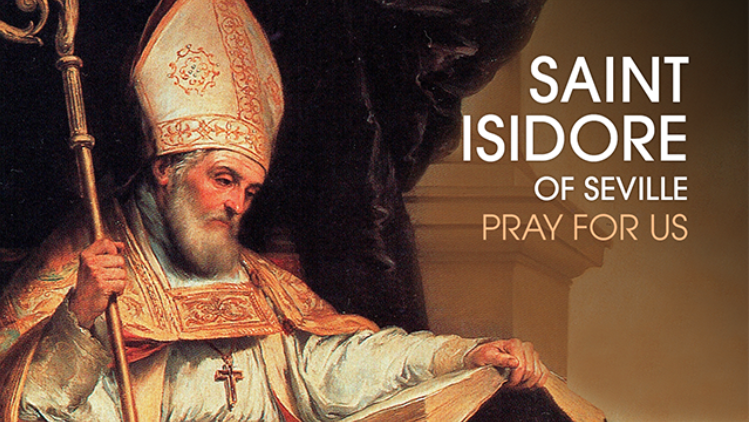
The 76 years of Isidore’s life were a time of conflict and growth for the Church in Spain. The Visigoths had invaded the land a century and a half earlier, and shortly before Isidore’s birth they set up their own capital. They were Arians—Christians who said Christ was not God. Thus, Spain was split in two: One people (Catholic Romans) struggled with another (Arian Goths).
Isidore reunited Spain, making it a center of culture and learning. The country served as a teacher and guide for other European countries whose culture was also threatened by barbarian invaders.
Born in Cartagena of a family that included three other sibling saints—Leander, Fulgentius and Florentina—he was educated by his elder brother, whom he succeeded as bishop of Seville.
An amazingly learned man, he was sometimes called “The Schoolmaster of the Middle Ages” because the encyclopedia he wrote was used as a textbook for nine centuries. He required seminaries to be built in every diocese, wrote a Rule for religious orders, and founded schools that taught every branch of learning. Isidore wrote numerous books, including a dictionary, an encyclopedia, a history of Goths, and a history of the world—beginning with creation! He completed the Mozarabic liturgy, which is still in use in Toledo, Spain. For all these reasons, Isidore has been suggested as patron of the Internet. Several others—including Anthony of Padua—also have been suggested.
He continued his austerities even as he approached age 80. During the last six months of his life, he increased his charities so much that his house was crowded from morning till night with the poor of the countryside.
Reflection
Our society can well use Isidore’s spirit of combining learning and holiness. Loving, understanding and knowledge can heal and bring a broken people back together. We are not barbarians like the invaders of Isidore’s Spain. But people who are swamped by riches and overwhelmed by scientific and technological advances can lose much of their understanding love for one another.
“When You Wrestle With Pigs in the Mud, You’re Gonna Get Dirty“
Father Peter Fitzgibbons
March 20-21, 2021
Gospel: John 11: 1-45
I’ve hear a lot these days that we live in a “cancel culture.” Do you know what that is? It’s when people say mean things about you and try to erase your very existence. However, I disagree that we are living in a cancel culture. I was in a cancel culture. I was in the U.S. Army for 24 years and served in three wars. They tried to put an expiration date on my birth certificate, and they were pretty darn good at it too. That’s cancel culture. We are not living in a cancel culture. What we have here is an evil culture. People are trying to do evil under the appearance of good. They are claiming what was evil is now good. These sins are included in the four sins in scripture that cry out to Heaven for vengeance. Members of the cancel culture scream at you just as they screamed at our Lord and crucified Him. There’s nothing new under the sun as scripture says. And there’s not. The good news for us is that we don’t have to be that way. But, if you wrestle with pigs in the mud, the pigs doesn’t mind, but you’re going to get dirty.
Let me ask you a question. Do you know what the secret to happiness is? Want me to tell you? Our Lord has told us to be holy. He said, “Peace I leave with you; My peace I give to you.” This is a peace that the world cannot take away. So, if we seek and strive for holiness and to be one with our good Lord each day, we will have a happiness that no one can take away. That doesn’t mean you won’t have your share of sorrows and troubles. We all have our illnesses, and we all have our struggles. Our loved ones have been taken from this world to Heaven. That happens to us all. It doesn’t mean Christ stopped loving us. It means we are sharing in some of His Passion for the sake of the Body of His church, for our own redemption, and for the souls of others. We know deep down that as long as we do not turn away from our Lord through mortal sin or unrepented venial sin, He will always be there. Even though we cannot feel it, He is always present with us. Our peace and joy will come later after our trial on Earth is done. Our suffering is redemptive.
Saint John Paul II was suffering from end-stage Parkinson’s. He loved classical music, so they brought in a world famous orchestra and conductor to play for him. I don’t know his name…it’s not ZZ Top, so it’s beyond me. Because of the steroids he was on for the Parkinson’s, he was bloated, shaking and drooling. He could barely move. The last piece the orchestra played was his favorite, and the orchestra played it so beautifully, it would have made angels weep. When the orchestra finished playing, the conductor turned around and looked nervously at the Pope. The conductor was a little scared, because they were playing for the pope. The Holy Father could barely move, but he looked at the conductor and gave him a thumbs up. Even in his suffering, you knew he was a man of God. He had a happiness about him no matter what happened. He had the weight of the whole Church on his shoulders. He had a fatal illness that is terribly debilitating. But, he still had peace. And, that’s what we can have, because we have Christ. However, because we have Christ, we have an obligation to help others.
So, how do we fight this so-called cancel culture? We must try to be even more holy and to pray for people. Some of them are like those in I see in the gated community, a state sponsored residence with its own security system. Those incarcerated never had a chance. They were abused in childhood, so the chances were less than average that they would have a good life. They had a lot of things working against them. Granted, they chose to do evil, but they had a lot more crosses than we do. That’s not an excuse, but it’s a mitigating factor. How do we help those people who are evil and who try to say what we believe is evil and must change? Even the Catholic Church says sometimes what we believe must change. That’s not true. They are lying. They aren’t wrong…they are lying. Educated people who know better are lying. How do we change that? Have a little chat with them? Even though I’m almost 68, I’m still a soldier, and part of me would love to say, “Let’s go outside and discuss this.” No. Our Lord said to love them, sacrifice for them, and pray for them. They were taught from a young age that sin was good. We see the outcomes of sin and evil. We don’t have to be like them. But, instead of fighting with them, we need to love them.
Those who advocate evil are just like little children who don’t get their way, and they throw a tantrum. That’s me some days. Ever had a child…or a husband…throw a temper tantrum? What happens? Like our guardian angels, and like any good parent, we slowly take them in our arms, close to our heart. They are all worn out from their temper tantrum and break down in tears. So, we hold them close to our heart, giving them comfort and love. That’s what we are to do with this cancel culture. We can hold out our arms to them, no matter what they say to us, and no matter what they try to do to us. We can pray for them, sacrifice for them, and slowly bring them in to our heart.
This culture is not cancel…I know what cancel is. Cancel is evil. We are living in an evil age. Actually, every age is evil. But, we don’t have to be like that. Remember, when you grow close to Jesus, you have both a gift and a command to go out and bring others in and to change the culture. What’s very sad about people who are caught up in the cancel culture is that they don’t see how blind they are. They are like someone who has had too much to drink. The cops stop them, and they say, “I only had two beers!” Really? That math is wrong. They can’t stand up, never mind drive. “I’m okay!” They don’t see it…they are blind. It’s just like alcohol blinds the alcoholic and dope blinds the dope addict. And, the only cure for that is divine love.
During my time working in hospitals, I’ve learned that the only proper way to treat a disease is to find out what the disease is. So, we shouldn’t say it’s a cancel culture when it’s an evil one. People who are not eradicating evil are promoting it. There’s a big difference. Saint Mother Teresa tried to eradicate evil, and look at the love she spread. So this is what we do. We don’t have to be like them; instead, we need to love them, to pray for them, and to sacrifice for them.
How will you apply this message to your life? Will you, like Saint Mother Teresa, try to eradicate evil by spreading God’s love?
You can read all of Father Fitzgibbons’ sermons by going to https://annunciationcatholicalbemarle.com/ and clicking on “Blog” then “Categories” and then “Sermon Notes. From a cell phone, click on “Blog” then “Menu” and then “Categories” (located at the end of page). There is also a search box if looking for a specific topic.
Jesus said that the Son of Man will be lifted up. He also said, “When I am lifted up from the Earth, I will draw all men to myself.” And, He does. However, He doesn’t draw people up to Him on the cross just for them to say, “Gee, that must hurt.” This is not a spectator sport. Rather, our good Lord reaches down from the cross and says, “Take My hand and come up to Me, because this is the way to salvation. Join Me on the cross.” Paul finally learned that lesson. He wrote, “Now, I rejoice in sufferings for Your sake, and in my flesh I complete what is lacking in Christ’s afflictions for the sake of His body, that is, the Church.” Our sufferings, all the crosses we carry and the crosses we carry for others are redemptive. They are not only for ourselves, but for others. We join Christ in the sacrifice like the good thief on the cross. We unite ourselves to Him, so that He will raise us up. You do that when you make your Morning Offering: “I offer you my prayers, works, joys, and sufferings of this day.” All those crosses God allows us to carry…Ugh. I don’t know about you, but I’m not crazy about mine.
We also join Christ in the sacrifice during the Mass by true and active participation. So, what is true and active participation? It’s not those who sing the loudest, pray the loudest, or run a ministry. Whatever that is. The term “ministry” really means nothing. It only applies to Holy Orders, but it has been so overused, it means nothing now. True and active participation is the giving of your human nature to the priest who acts in the person of Christ on the altar. He takes your human nature in the offertory, immolates them, and makes them one with the sacrifice of Christ. He immolates them on the altar as part of the sacrifice of God’s love for us. That is true and active participation. This is how we unite ourselves and become one with the sufferings of Christ just as the Blessed Mother, Saint John, Mary the wife of Clopas, and Mary of Magdala did at the foot of the cross…especially the Blessed Mother…her human nature was suffering for Him. For us, it’s only intellectual, so it doesn’t matter whether you feel it or not. That has nothing to do with its effectiveness. However, it’s only when you do that you are one with Christ on the cross.
There will always be temptations from the cross. Just as Christ was tempted many times to come down from the cross, we will be too. What were the first three temptations? “All religion is just a show.” “If you have good music, a praise band or whatever, people will come.” Our Lord says this is not a show. This is an act of love. “Well, you know with religion, you gotta give people food and stuff.” “Everybody will be happy if they take your stuff and give it to somebody else.” “It’s all power.” “It’s all Socialism.” “True religious charity is just giving them bread…they will be fine.” How many fat people are there in prison? A lot. It’s not that they lack food. Their problem is that they practice evil. Now, there are a lot of people outside of prison who practice evil, but they haven’t been caught yet. It’s all about power. “Well, if we had fairer laws, then we wouldn’t have any problems.” That’s not true. We have more laws than lawyers know about. Oh, by the way, drugs are illegal. Did you know that? Apparently, a lot of people don’t. Read the sheriff’s blotter report, and that’s just the tip of the iceberg.
Another temptation is to deny the divine message. You see, we are much brighter in the 21st Century. We know better, because we are so enlightened and so highly educated. We can’t write in cursive, but we are really educated. We know what God’s word truly means. Before, they weren’t too sure, because they were all stupid. When Christ proclaimed that marriage was between one man and one woman unless separated by death, everyone left Him except the 12 apostles. People didn’t like that. Also, when Peter tried to sway Christ from going to the cross, He called Peter, “Satan.”
The third type of temptation is the Eucharist. “Unless you eat the flesh of the Son of man and drink His blood, you have no life in you.” “Oh, He didn’t really mean that.” That’s what He said, and He meant it. The words really mean that. Everyone left Him except the 12 apostles. The last temptation was, “Come down from the cross, and we will believe in you.” In His heart, Christ was saying, “You don’t understand. You’ve forgotten your education.” “If the Church changes its laws, everyone will come back.” Really? We have Mass in English. We have Mass in Spanish (Spanglish). We have Mass on Saturdays at 5 pm. We have Mass on Sundays at 9:30 and 12:15. We have confessions face-to-face, although not here, because it’s not safe for the priests anymore. So, where is everybody?
Temptations in one form or another will assail us. “Am I doing something wrong because I’m tempted?” No, you are doing something right, because you are tempted. Our Lord says, “Come up to Me. Come up. I am trying to give you eternal happiness. I am trying to give your soul peace.” So, we have a tug of war with Christ on the cross. He wants to pull us up, and we want to pull Him down. Instead, we can unite ourselves in the sacrifice of Christ in the Morning Offering prayer, resignation to our exterior and interior crosses, and resignation of the will…the most difficult cross. In the midst of temptation, the good thief on the cross accepted the suffering for his sins, and was united with Christ. What did Christ tell him? “Today, you will be with Me in paradise.”
How will you apply this message to your life? Will you unite yourself in the sacrifice of Christ by saying the Morning Offering prayer? Will you accept your interior and exterior crosses and join Christ in His suffering?
You can read all of Father Fitzgibbons’ sermons by going to https://annunciationcatholicalbemarle.com/ and clicking on “Blog” then “Categories” and then “Sermon Notes. From a cell phone, click on “Blog” then “Menu” and then “Categories” (located at the end of page). There is also a search box if looking for a specific topic.
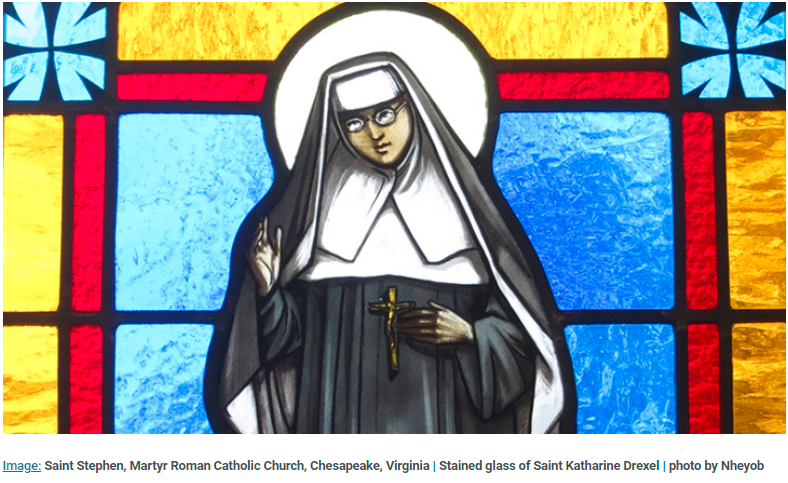
Katharine Drexel (November 26, 1858 – March 3, 1955)
If your father is an international banker and you ride in a private railroad car, you are not likely to be drawn into a life of voluntary poverty. But if your mother opens your home to the poor three days each week and your father spends half an hour each evening in prayer, it is not impossible that you will devote your life to the poor and give away millions of dollars. Katharine Drexel did that.
Born in Philadelphia in 1858, she had an excellent education and traveled widely. As a rich girl, Katharine also had a grand debut into society. But when she nursed her stepmother through a three-year terminal illness, she saw that all the Drexel money could not buy safety from pain or death, and her life took a profound turn.
Katharine had always been interested in the plight of the Indians, having been appalled by what she read in Helen Hunt Jackson’s A Century of Dishonor. While on a European tour, she met Pope Leo XIII and asked him to send more missionaries to Wyoming for her friend Bishop James O’Connor. The pope replied, “Why don’t you become a missionary?” His answer shocked her into considering new possibilities.
Back home, Katharine visited the Dakotas, met the Sioux leader Red Cloud and began her systematic aid to Indian missions.
Katharine Drexel could easily have married. But after much discussion with Bishop O’Connor, she wrote in 1889, “The feast of Saint Joseph brought me the grace to give the remainder of my life to the Indians and the Colored.” Newspaper headlines screamed “Gives Up Seven Million!”
After three and a half years of training, Mother Drexel and her first band of nuns—Sisters of the Blessed Sacrament for Indians and Colored—opened a boarding school in Santa Fe. A string of foundations followed. By 1942, she had a system of black Catholic schools in 13 states, plus 40 mission centers and 23 rural schools. Segregationists harassed her work, even burning a school in Pennsylvania. In all, she established 50 missions for Indians in 16 states.
Two saints met when Mother Drexel was advised by Mother Cabrini about the “politics” of getting her order’s Rule approved in Rome. Her crowning achievement was the founding of Xavier University in New Orleans, the first Catholic university in the United States for African Americans.
At 77, Mother Drexel suffered a heart attack and was forced to retire. Apparently her life was over. But now came almost 20 years of quiet, intense prayer from a small room overlooking the sanctuary. Small notebooks and slips of paper record her various prayers, ceaseless aspirations, and meditations. She died at 96 and was canonized in 2000.
Reflection
Saints have always said the same thing: Pray, be humble, accept the cross, love and forgive. But it is good to hear these things in the American idiom from one who, for instance, had her ears pierced as a teenager, who resolved to have “no cake, no preserves,” who wore a watch, was interviewed by the press, traveled by train, and could concern herself with the proper size of pipe for a new mission. These are obvious reminders that holiness can be lived in today’s culture as well as in that of Jerusalem or Rome.
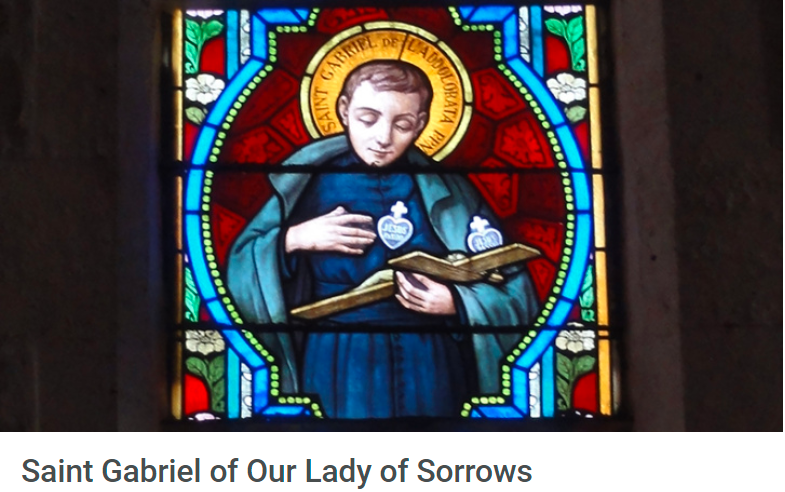
St. Gabriel Possenti (1838-1862), also known as St. Gabriel of Our Lady of Sorrows, was born in Italy into a large family and baptized Francis, Saint Gabriel lost his mother when he was only four years old. He was educated by the Jesuits and, having been cured twice of serious illnesses, came to believe that God was calling him to the religious life. Young Francis wished to join the Jesuits but was turned down, probably because of his age, not yet 17. Following the death of a sister to cholera, his resolve to enter religious life became even stronger and he was accepted by the Passionists. Upon entering the novitiate he was given the name Gabriel of Our Lady of Sorrows.
Ever popular and cheerful, Gabriel quickly was successful in his effort to be faithful in little things. His spirit of prayer, love for the poor, consideration of the feelings of others, exact observance of the Passionist Rule as well as his bodily penances—always subject to the will of his wise superiors— made a deep impression on everyone.
His superiors had great expectations of Gabriel as he prepared for the priesthood, but after only four years of religious life symptoms of tuberculosis appeared. Ever obedient, he patiently bore the painful effects of the disease and the restrictions it required, seeking no special notice. He died peacefully on February 27, 1862, at age 24, having been an example to both young and old.
Saint Gabriel of Our Lady of Sorrows was canonized in 1920.
Reflection
When we think of achieving great holiness by doing little things with love and grace, Therese of Lisieux comes first to mind. Like her, Gabriel died painfully from tuberculosis. Together they urge us to tend to the small details of daily life, to be considerate of others’ feelings every day. Our path to sanctity, like theirs, probably lies not in heroic doings but in performing small acts of kindness every day.
Saint Gabriel of Our Lady of Sorrows is the Patron Saint of:
How can you love God more? How can you experience more of His love? The answer is really very simple. By loving yourself less. God is love Himself. He has no need of our love and is totally self-sufficient. But, God wants to give us His love. Unfortunately, God, being the perfection of all virtues, including politeness and courtesy, won’t break into our souls. We have to open our souls up to Him. If our souls are closed off by self-centeredness, He cannot come in. He wants to give us His immense love and to fill our souls completely with Himself.
We can grow in the love of God by taking on little penances and pious practices. Doing so will help, but two things are important. They have to be small, and they have to be practical. Too often, people say they will grow in the love of God by doing a lot of grandiose things. But, it’s impractical, because they won’t do it. Instead, take little steps. The first step to take is to realize that we need to improve. That’s actually a big step, because many people are satisfied with maximizing the minimums. “Father, I go to Mass on Sundays and Holy Days.” “I go to confession once a year.” “I don’t eat meat on Fridays during Lent.” “I obey the Ten Commandments.” “I don’t rob banks.” Okay. But, there’s a lot more in the book our Lord tells us to do. You know that, right? We tend to maximize the minimums. “Father, I am good.” Well, I don’t know about that. The Lord said not to call anybody “good.” We are called to be perfect. That’s in the black part of the Bible, not the white part. Be perfect as your Heavenly Father is perfect. “I’m here at Mass.” You are physically here but is your mind? Look! Squirrel. Distraction during prayer is normal; just come back to it.
Giving yourself totally over to God, to overcome self-centeredness is what we always must work toward. Our first parents disobeyed God, and we continue to do the same thing. “I won’t let God in until I need Him.” “I will only go to church if the Mass is in English, or Spanish, or Latin, and only if it’s at 12:00 on my day off, if I’m not too tired, or if it’s over by 5:30 because I have dinner reservations somewhere.” We use all these stipulations, and the Church has unfortunately bought into to it. “I will only go to confession if there are reconciliation rooms.” So, parishes have spent thousands of dollars creating reconciliation rooms. Come on! I hear confessions…I wish I heard a lot more.
We must take up our cross every day and follow Him. The ego is a terrible thing and destroys people. In any 12 Step program, you must have ego deflation at depth. Where did they get that I wonder. From the Catholic Church? Go figure. How do we overcome our ego and self-centeredness? By doing little things. “I need to pray more.” Well, then pray more. Say the rosary. By the time you get to Coy’s laundry mat or to the court house, you have plenty of time to say a decade of the rosary. There are five stop lights, so you have plenty of time to say it. You have to sit there anyway. You can’t zip right through the traffic lights, although they made it less likely to be caught when they have moved the police station. My point is that you have plenty of time to do little things. “I want to lose weight and to eat better.” Then do it, one step at a time.
God has no limit on His love. We are the ones who limit His love with our self-centeredness. We determine our salvation. God says, “I will give you the way to salvation if you let Me into your soul.” We say, “I’ll get back to you. Thank you very much. Appreciate the offer.” We want to cling to ourselves. One of my good friends who recently passed away, a judge, used to say, “I’m not much, but I’m all I think about.” I deserve to speed, because I’m important. I have business to attend to. That would be me. However, I should mention that a lot of cops are not Catholic. We want what we want when we want it. That’s what we all have to fight…our self-centeredness. “You can’t tell me what to do. “I deserve this.” That kind of thinking shuts God out.
We have to be humble. In fact, we are commanded to be humble. The 4th and 5th Commandments command us to obey our physicians and caregivers. You don’t go to your physician’s office and say, “Oh, what the heck do they know.” Doctors are very intelligent, so listen to them and do what they tell you. That’s humility. “I don’t want a colonoscopy.” That’s humility, especially when I had mine. I know everyone in that department. I work there. I knew them all. Having a colonoscopy is not a side of me they wanted to see, but what the heck…if you’ve seen one, you’ve seen them all. As Saint Therese de Lisieux said, when you are humble, you are small and safe. As long as you continue doing small acts of penance, day after day, you are growing in God’s love and opening the door to your soul so that He can come in. God will not force his way in. He does not need our love. God is self-sufficient. But, He wants to give His love to us, because that is His nature. We are the ones with selfish self-centeredness and close the door on love. But, if we focus on the little things, we will grow spiritually and gradually open the door more and more to allow the love of our good Lord into our souls.
The Law of Physics says that two objects cannot occupy the same space at the same time. If our souls are full of ourselves, God cannot get in. God isn’t going to push us aside. He isn’t going to make us love Him. We have to decide to love Him by renouncing ourselves and our attachment to things. You will discover that once you become detached from things, you will have far more joy and pleasures than you ever could have imagined. Saint Augustine and Saint Thomas both said that if there is any labor involved, love is no labor at all. It’s all a joy. Each sacrifice is a joy. Each sacrifice makes a way for greater enjoyment and greater love. It creates a way for a greater union with the Almighty and, therefore, a greater union with one another. So, we are the ones who determine how much we will love. The secret of loving God and experiencing His love is really easy. We just have to love ourselves a heck of a lot less.
How will you apply this message to your life? Are you maximizing the minimum? Will you fight to overcome self-centeredness and make room for God in your heart and soul?
You can read all of Father Fitzgibbons’ sermons by going to https://annunciationcatholicalbemarle.com/ and clicking on “Blog” then “Categories” and then “Sermon Notes. From a cell phone, click on “Blog” then “Menu” and then “Categories” (located at the end of the page). There is also a search box if you are looking for a specific topic.
38) In the course of his teaching he said,p “Beware of the scribes, who like to go around in long robes and accept greetings in the marketplaces, 39) seats of honor in synagogues, and places of honor at banquets.40) They devour the houses of widows and, as a pretext, recite lengthy prayers. They will receive a very severe condemnation.” 41) He sat down opposite the treasury and observed how the crowd put money into the treasury. Many rich people put in large sums. 42) A poor widow also came and put in two small coins worth a few cents. 43) Calling his disciples to himself, he said to them, “Amen, I say to you, this poor widow put in more than all the other contributors to the treasury. 44) For they have all contributed from their surplus wealth, but she, from her poverty, has contributed all she had, her whole livelihood.”
Teachers tend to repeat the points of the lesson they want their students to remember. Our Lord teaches us again and again that we must love Him and His people. The Ten Commandments are basic instructions on how to love, while the Catechism contains more in-depth instructions. In neither can you love totally and without reservation until you give up the love of self.
So, what does that kind of love look like? In John 15:13, Jesus said, “No one has greater love than this, to lay down one’s life for one’s friends.” In Matthew 18:21, Jesus tells Peter that he must forgive his brother “Not seven times; I say, seventy time seven times.” We can also find that kind of love on the crucifix. His Passion is a reminder of just how much He loves us. Christ said “Father forgive them, they know not what they do (Luke 23:34). Every Mass is a total expression and outpouring of His love. It shows us how much we are loved and how much we are to love others.
We don’t pay close enough attention to the lessons Christ teaches us. Often, we forget the lessons already learned about who and how we are to love. It’s as if we have Attention Deficit Disorder. As fallen people, we try to figure out how much we can get away with and do as little as possible and still get into heaven. However, I doubt that you would be very happy if your spouse said s/he loved you only partially.
How will you apply this message to your life? Will you give up your love of self? Will you love totally and without reservation?
Father’s After-Thoughts….
Veterans’ Day is Monday. George Orwell said: “People sleep peaceably in their beds at night only because rough men stand ready to do violence on their behalf.” On June 6, 1944, D-Day, our soldiers crossed the English Channel and landed on the beaches of Normandy, France to help liberate Western Europe from the German Nazis. A soldier once told me that the water was bloody when they made their way up to the beach. Another said that they had to step over dead bodies in the water to get to shore.
Some say that time heals all wounds; but that is not true…at least for many combat veterans. Their wounds are deep and, many times, are kept hidden for a lifetime. It becomes much more difficult, even impossible to cope with the pain when their wives are no longer there to help. Since the Civil War, 20 veterans commit suicide every day. Please pray for those who have served and who are still serving in combat zones that they find peace and solace. And, when you meet a veteran, be sure to thank them for their service.