Saint of the Day – February 7 – Saint Richard the King
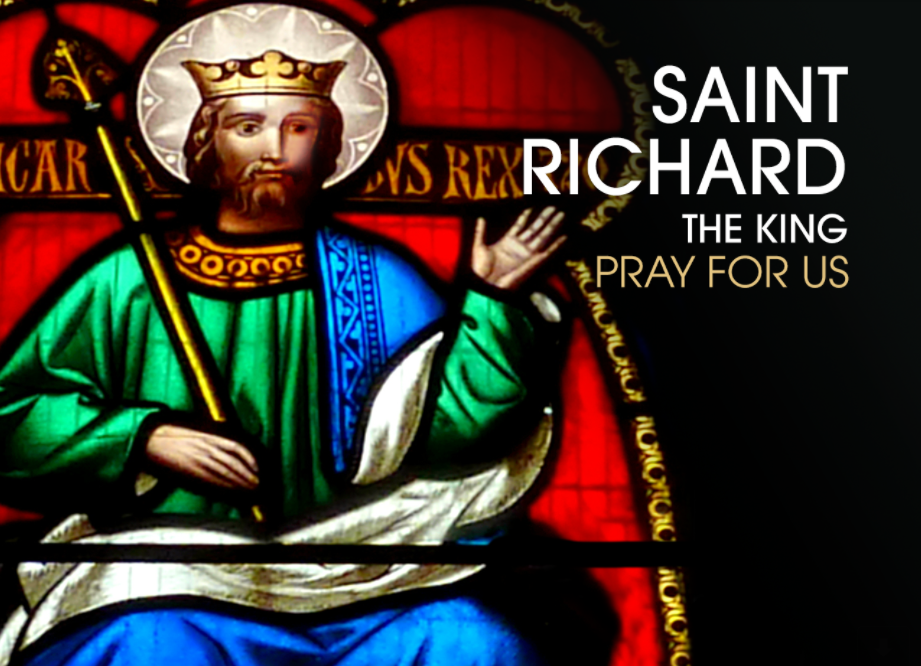
St. Richard the King (c. 720 A.D.), also known as Richard the Pilgrim, was a Saxon king born in Wessex, England, who was related by blood to the royal house of Kent. His brother-in-law was St. Boniface, and three of his children are numbered among the saints: St. Willibald, St. Winnebald, and St. Walburga. When Willibald was gravely ill as a child, Richard’s prayers for his son are said to have saved his life. He wrapped his child in a blanket and took him to the foot of a large crucifix erected near their village, and the child recovered. When Willibald was grown, he convinced his father and brother to accompany him on a missionary pilgrimage to Rome and the Holy Land. St. Richard agreed, renounced his royal estate, and embarked on the journey with his two sons, while his daughter entered a convent. In Italy he became sick and died, and was buried in Tuscany at the Church of San Frediano. Numerous miracles are reported to have occurred at his tomb. Some of his relics were transported to Eichstatt, Germany, where his son Winnebald would become Bishop. His feast day is celebrated on February 7th.
//Catholic Company//
Saint of the Day – October 12 – Saint Edwin
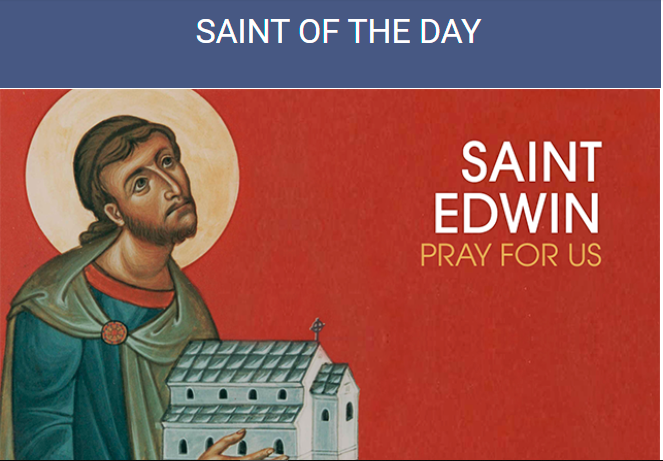
St. Edwin (585-633 A.D.) was the son of the pagan King of Deira who reigned in present-day England. After his father was deposed from his throne, Edwin spent his childhood in exile to escape rival kings who considered his bloodline a threat to their rule. One day a stranger prophesied that Edwin would reclaim his father’s throne if he promised to obey what would later be taught to him regarding his own eternal salvation. Eventually Edwin rose to power and regained the Kingdom of Deira which expanded to encompass all of Northumbria. After the death of his first wife, he married a Catholic princess. He permitted his wife to practice her faith freely and to have their children baptized. He also welcomed St. Paulinus, Archbishop of York, into his kingdom and accepted his religious instruction. Edwin became increasingly drawn to Christianity after a series of providential events, but he did not convert until St. Paulinus revealed to Edwin that he was the same stranger who, years before, prophesied about his future. Edwin then repented of his sins, accepted baptism, and became an exemplary Catholic king who contributed to the spread of Christianity across his kingdom. St. Edwin died in battle against a pagan army and is therefore considered to be a martyr for the Faith. His feast day is October 12.
//Catholic Company//
Saint of the Day – July 13 – Saint Henry
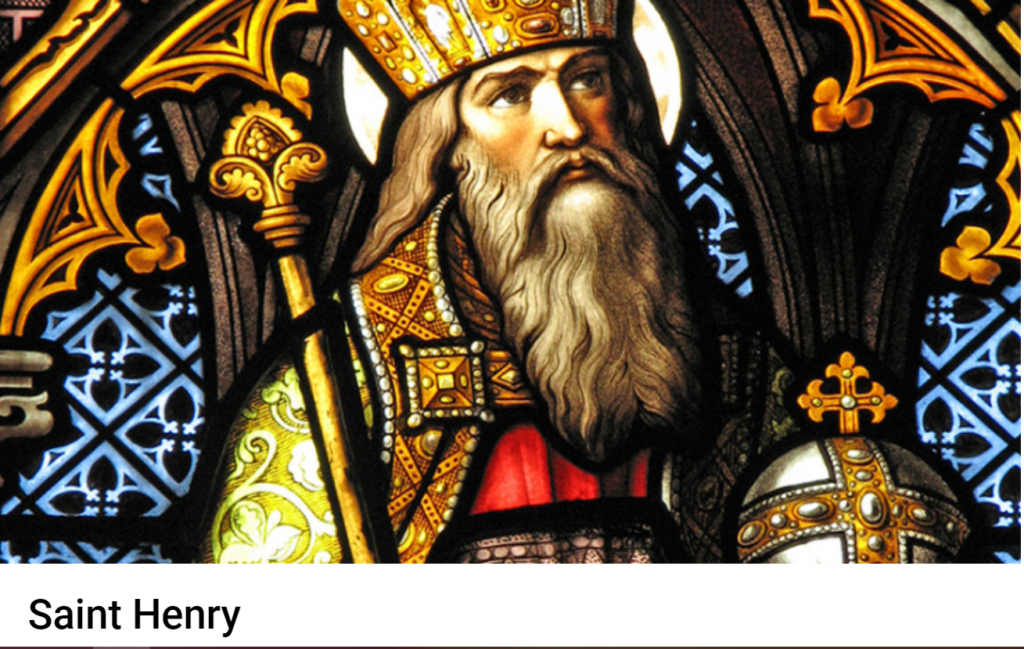
Saint Henry’s Story
As German king and Holy Roman Emperor, Henry was a practical man of affairs. He was energetic in consolidating his rule. He crushed rebellions and feuds. On all sides he had to deal with drawn-out disputes so as to protect his frontiers. This involved him in a number of battles, especially in the south in Italy; he also helped Pope Benedict VIII quell disturbances in Rome. Always his ultimate purpose was to establish a stable peace in Europe.
According to eleventh-century custom, Henry took advantage of his position and appointed as bishops men loyal to him. In his case, however, he avoided the pitfalls of this practice and actually fostered the reform of ecclesiastical and monastic life. He was canonized in 1146.
Reflection
All in all, this saint was a man of his times. From our standpoint, he may have been too quick to do battle and too ready to use power to accomplish reforms. But granted such limitations, he shows that holiness is possible in a busy secular life. It is in doing our job that we become saints.
//Franciscan Media//
The Bible in a Year – Day 107 – Samuel’s Speech
As we continue reading from 1 Samuel, Fr. Mike points out how God gave the people a king like they wanted, even though it was not part of his plan. This reveals to us that even when we choose things that God does not want for us, he is still with us. The readings are 1 Samuel 11-12 and Psalm 55.
Click on the link:
https://bibleinayear.fireside.fm/day-107

The Bible in a Year – Day 109 – A Heart of Obedience
As we continue to read about Saul’s vanity and disobedience, Fr. Mike emphasizes the importance of the virtue of obedience in our relationship with God. He also points out how God chose David to be anointed as king because David was a man after God’s own heart. Today’s readings are 1 Samuel 15-16 and Psalm 61.
Click on the link:
https://bibleinayear.fireside.fm/day-109

The Bible in a Year – Day 124 – King David Rules
Today we read about the moment David is made king over all Israel. Fr. Mike reveals that as David begins his rule, he has both strengths and weaknesses. Today we read 2 Samuel 5, 1 Chronicles 7-8, and Psalm 27.
Click on the link:
https://bibleinayear.fireside.fm/day-124

The Bible in a Year – Day 168 – Wicked Kings
Follow along with the official Bible in a Year Reading Plan: https://tinyurl.com/yht9rheb Fr. Mike highlights the wickedness and unfaithfulness of king Ahab, king Jehoram and king Azaiah. We learn that their selfish and disobedient actions have severe consequences. Today’s readings are 1 Kings 21, 2 Chronicles 21-22, and Song of Solomon 7.
Click on link:
https://youtu.be/92MMUzHBMJg

The Bible in a Year – Day 189 – Follow the Lord
Fr. Mike explains why it’s important to focus on our own journey with the Lord over those around us while highlighting the leadership of king Josiah. He also reminds us how the mistakes of past kings had led Israel down a dark path. Today’s readings are 2 Kings 23, 2 Chronicles 34, and Proverbs 8:1-21.
Click on link:
https://youtu.be/Gt_un7ZivbE

The Bible in a Year – Day 190 – Judah is Overrun
As we near the end of 2 Kings, Fr. Mike takes us through Babylon’s conquest of Judah, under the leadership of King Nebuchadnezzar. He touches on the importance of wisdom in the Book of Proverbs, and revisits the sons of Josiah in order to explain why the people of Israel are so lost. Today’s readings are 2 Kings 24, 2 Chronicles 35, and Proverbs 8:22-36.
Click on linlk:
https://youtu.be/tEhRzERfU8Q