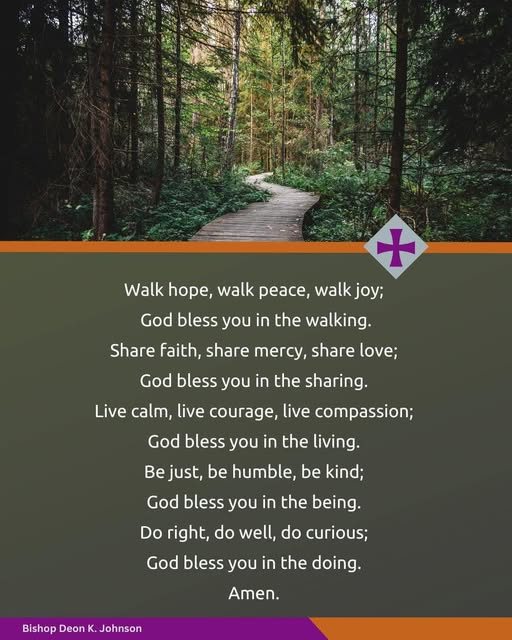
Walk, Share, Live, Be, and Do
What’s Inside a Humble Heart?
“But the Lord said to Samuel, ‘Do not look on his appearance or on the height of his stature, because I have rejected him; for the Lord sees not as man sees; man looks on the outward appearance, but the Lord looks on the heart.’” – 1 Samuel 16:7
What does God see when he looks into our hearts? Does he see a humble, contrite and broken heart, that he will not spurn?
Today Fr. Mike Schmitz shares a word of encouragement from the book of 1 Samuel for how to shape our hearts so that the Lord can be present to them and abide in them.
https://www.youtube.com/@AscensionPresents
Prideful? Here’s How to Stop and Be Humble
Today Fr. Mike encourages us to consider pursuing this one antidote in combatting pride and to helping you grow in humility today!
Sermon Notes – July 25 – We Repeat What We Do Not Repair

“We Repeat What We Do Not Repair”
Father Peter Fitzgibbons
July 24 – 25, 2021
Gospel: John 6:1-15
It is said that lessons must be repeated until they are learned which means, for most of us, lessons need to be constantly repeated. Sometimes, you think you’ve learned a lesson, but you learned it incorrectly. Other times, we see things and know right away this means this and that means that. We’ve taken something away from the lesson that wasn’t really there. Oops! We need to be better students and learners. Do you know which virtue “learning” is connected to? Justice. I remember one man, a seminarian and now a priest, who asked me for advice. I told him to always take his books into the chapel before the Blessed Sacrament. If you are going to read about the Man, then be with the Man. Good idea…I have a few now and again.
In the story about God’s miracle involving the loaves and fishes, 5,000 men were there who could not find places to sit…that’s a lot of men. There were no women and children there…apparently, they had not been vaccinated. Now, this scripture was written in Hebrew, so 5,000 was a number beyond all counting… an infinite number. Philip told our Lord that “Two hundred days’ wages worth of food would not be enough for each of them to have a little bit.” So, was Philip like Stuart Varney, a market watcher? Did he watch the market and know the cost of food? No, Philip was using a hyperbole…a number beyond comprehension. After everyone had eaten, the apostles collected 12 baskets of leftover food. The number 12 is another mystical number in Hebrew representing the 12 nations of Israel. So, it was a huge number beyond counting, demonstrating the power of Christ and what He can do. And, what did they learn from the miracle? They learned the wrong thing. They thought He was the “bread king.” “Hey, He fed us, so He’s going to give us stuff we didn’t have to work for. Cool! We will make Him king, and we’ll get all the stuff we want.” This was another temptation of Christ. Remember, the first temptation? After spending 40 days of fasting in the desert, Satan said to Him, “If You are the Son of God, tell these stones to become bread.” After seeing the miracle with the loaves and fishes, did people want holiness and their souls filled? No, they wanted their stomachs filled. They wanted stuff. The temptation of Christ was to give people stuff even though He came for the salvation of souls. First things first.
People come every day and want stuff from the church. Their stories are really fun, but it’s not what we can give. In Acts, Peter said, “Silver and gold I have none; but what I have, I give you. Pick up your mat and walk.” At first, even the apostles didn’t get the lesson. He came down to redeem you. That was the lesson to take away. After all the miracles our good Lord did, how many were there with Him at the end? They did not learn the lesson until they were enlightened by grace. They had the knowledge, because they had heard Him. They weren’t idiots, but they didn’t know what the knowledge meant. This is when we have to go to prayer to listen and to be enlightened. You may have the knowledge, but that doesn’t guarantee you know what it means.
I was reading an article this morning about the old Latin Mass. “People did not participate in the Latin Mass.” Or, in the order of the Mass we do now, “People must participate. They have to run up and down the aisle. We have to do a better job.” I say, at best, that is blasphemy and at worst, it’s sacrilegious, because you know nothing about the Mass. If you took a picture at Calvary, how many people were running around? Do you think the Blessed Mother was crucifying Jesus? No. They stood there and shared in His suffering. They became part of His suffering through love. Whose human nature suffered on the cross? The Blessed Mother’s. Whose human nature suffered along with Him? That of Saint John the Apostle, Mary the wife of Clopas, and Mary Magdalene. This is what the faithful do, because in the Holy Sacrifice of the Mass, you give your human nature to me, as the priest functioning in the person of Christ, and you are just like Saint John, Mary, and Mary at the cross suffering with Christ. You cannot get more participation than that. The people who say these things never offered Mass, and they probably aren’t priests. If they are, they are stupid ones. When I offer Mass in nursing homes, I don’t get much singing and all that. Sometimes, the mentally challenged residents will yell out during Mass, “Father, I have an idea!” We’ll talk about it after Mass. Do they participate? Yes, as much as they can.
People have heard the lesson and they have the knowledge, but they have no idea what it means. In order to have knowledge, we have to be humble, and we have to become small. As Saint Therese of Lisieux said, “When I am small, I am safe.” We must surrender to judgement. Sometimes, we tell God, “I cannot do this…I don’t understand.” Well, I don’t understand a lot of things. Each day I’m mystified by something, and that’s okay. I don’t have to understand everything. I know a lot of bright people I can call up or text, not while I’m driving, and probably get some guidance. Why does God allow this? Why did God allow this to happen? It’s always good to ask, not for understanding, but for the strength to bear what we cannot endure. Sometimes, our lives and our crosses seem too much to bear. To learn the proper lessons our Lord is teaching us today is a precursor to the Eucharist. Lord, speak for your servant is listening.
How will you apply this message to your life? You may have the knowledge, but do you know what it means? Go to prayer to listen and to be enlightened.
You can read all of Father Fitzgibbons’ sermons by going to https://annunciationcatholicalbemarle.com/ and clicking on “Blog” then “Categories” and then “Sermon Notes.” From a cell phone, click on “Blog” then “Menu” and then “Categories” (located at the end of page). There is also a search box if you are looking for a specific topic.
Saint of the Day – March 3rd
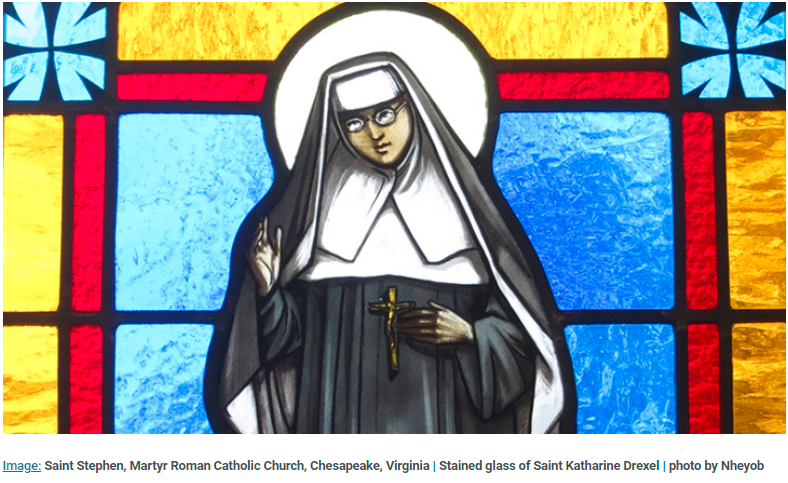
Katharine Drexel (November 26, 1858 – March 3, 1955)
If your father is an international banker and you ride in a private railroad car, you are not likely to be drawn into a life of voluntary poverty. But if your mother opens your home to the poor three days each week and your father spends half an hour each evening in prayer, it is not impossible that you will devote your life to the poor and give away millions of dollars. Katharine Drexel did that.
Born in Philadelphia in 1858, she had an excellent education and traveled widely. As a rich girl, Katharine also had a grand debut into society. But when she nursed her stepmother through a three-year terminal illness, she saw that all the Drexel money could not buy safety from pain or death, and her life took a profound turn.
Katharine had always been interested in the plight of the Indians, having been appalled by what she read in Helen Hunt Jackson’s A Century of Dishonor. While on a European tour, she met Pope Leo XIII and asked him to send more missionaries to Wyoming for her friend Bishop James O’Connor. The pope replied, “Why don’t you become a missionary?” His answer shocked her into considering new possibilities.
Back home, Katharine visited the Dakotas, met the Sioux leader Red Cloud and began her systematic aid to Indian missions.
Katharine Drexel could easily have married. But after much discussion with Bishop O’Connor, she wrote in 1889, “The feast of Saint Joseph brought me the grace to give the remainder of my life to the Indians and the Colored.” Newspaper headlines screamed “Gives Up Seven Million!”
After three and a half years of training, Mother Drexel and her first band of nuns—Sisters of the Blessed Sacrament for Indians and Colored—opened a boarding school in Santa Fe. A string of foundations followed. By 1942, she had a system of black Catholic schools in 13 states, plus 40 mission centers and 23 rural schools. Segregationists harassed her work, even burning a school in Pennsylvania. In all, she established 50 missions for Indians in 16 states.
Two saints met when Mother Drexel was advised by Mother Cabrini about the “politics” of getting her order’s Rule approved in Rome. Her crowning achievement was the founding of Xavier University in New Orleans, the first Catholic university in the United States for African Americans.
At 77, Mother Drexel suffered a heart attack and was forced to retire. Apparently her life was over. But now came almost 20 years of quiet, intense prayer from a small room overlooking the sanctuary. Small notebooks and slips of paper record her various prayers, ceaseless aspirations, and meditations. She died at 96 and was canonized in 2000.
Reflection
Saints have always said the same thing: Pray, be humble, accept the cross, love and forgive. But it is good to hear these things in the American idiom from one who, for instance, had her ears pierced as a teenager, who resolved to have “no cake, no preserves,” who wore a watch, was interviewed by the press, traveled by train, and could concern herself with the proper size of pipe for a new mission. These are obvious reminders that holiness can be lived in today’s culture as well as in that of Jerusalem or Rome.
Sermon Notes – Maximizing the Minimum

“Maximizing the Minimum“
Father Peter Fitzgibbons
February 20 – 21, 2021
Gospel: Mark 1: 12-15
How can you love God more? How can you experience more of His love? The answer is really very simple. By loving yourself less. God is love Himself. He has no need of our love and is totally self-sufficient. But, God wants to give us His love. Unfortunately, God, being the perfection of all virtues, including politeness and courtesy, won’t break into our souls. We have to open our souls up to Him. If our souls are closed off by self-centeredness, He cannot come in. He wants to give us His immense love and to fill our souls completely with Himself.
We can grow in the love of God by taking on little penances and pious practices. Doing so will help, but two things are important. They have to be small, and they have to be practical. Too often, people say they will grow in the love of God by doing a lot of grandiose things. But, it’s impractical, because they won’t do it. Instead, take little steps. The first step to take is to realize that we need to improve. That’s actually a big step, because many people are satisfied with maximizing the minimums. “Father, I go to Mass on Sundays and Holy Days.” “I go to confession once a year.” “I don’t eat meat on Fridays during Lent.” “I obey the Ten Commandments.” “I don’t rob banks.” Okay. But, there’s a lot more in the book our Lord tells us to do. You know that, right? We tend to maximize the minimums. “Father, I am good.” Well, I don’t know about that. The Lord said not to call anybody “good.” We are called to be perfect. That’s in the black part of the Bible, not the white part. Be perfect as your Heavenly Father is perfect. “I’m here at Mass.” You are physically here but is your mind? Look! Squirrel. Distraction during prayer is normal; just come back to it.
Giving yourself totally over to God, to overcome self-centeredness is what we always must work toward. Our first parents disobeyed God, and we continue to do the same thing. “I won’t let God in until I need Him.” “I will only go to church if the Mass is in English, or Spanish, or Latin, and only if it’s at 12:00 on my day off, if I’m not too tired, or if it’s over by 5:30 because I have dinner reservations somewhere.” We use all these stipulations, and the Church has unfortunately bought into to it. “I will only go to confession if there are reconciliation rooms.” So, parishes have spent thousands of dollars creating reconciliation rooms. Come on! I hear confessions…I wish I heard a lot more.
We must take up our cross every day and follow Him. The ego is a terrible thing and destroys people. In any 12 Step program, you must have ego deflation at depth. Where did they get that I wonder. From the Catholic Church? Go figure. How do we overcome our ego and self-centeredness? By doing little things. “I need to pray more.” Well, then pray more. Say the rosary. By the time you get to Coy’s laundry mat or to the court house, you have plenty of time to say a decade of the rosary. There are five stop lights, so you have plenty of time to say it. You have to sit there anyway. You can’t zip right through the traffic lights, although they made it less likely to be caught when they have moved the police station. My point is that you have plenty of time to do little things. “I want to lose weight and to eat better.” Then do it, one step at a time.
God has no limit on His love. We are the ones who limit His love with our self-centeredness. We determine our salvation. God says, “I will give you the way to salvation if you let Me into your soul.” We say, “I’ll get back to you. Thank you very much. Appreciate the offer.” We want to cling to ourselves. One of my good friends who recently passed away, a judge, used to say, “I’m not much, but I’m all I think about.” I deserve to speed, because I’m important. I have business to attend to. That would be me. However, I should mention that a lot of cops are not Catholic. We want what we want when we want it. That’s what we all have to fight…our self-centeredness. “You can’t tell me what to do. “I deserve this.” That kind of thinking shuts God out.
We have to be humble. In fact, we are commanded to be humble. The 4th and 5th Commandments command us to obey our physicians and caregivers. You don’t go to your physician’s office and say, “Oh, what the heck do they know.” Doctors are very intelligent, so listen to them and do what they tell you. That’s humility. “I don’t want a colonoscopy.” That’s humility, especially when I had mine. I know everyone in that department. I work there. I knew them all. Having a colonoscopy is not a side of me they wanted to see, but what the heck…if you’ve seen one, you’ve seen them all. As Saint Therese de Lisieux said, when you are humble, you are small and safe. As long as you continue doing small acts of penance, day after day, you are growing in God’s love and opening the door to your soul so that He can come in. God will not force his way in. He does not need our love. God is self-sufficient. But, He wants to give His love to us, because that is His nature. We are the ones with selfish self-centeredness and close the door on love. But, if we focus on the little things, we will grow spiritually and gradually open the door more and more to allow the love of our good Lord into our souls.
The Law of Physics says that two objects cannot occupy the same space at the same time. If our souls are full of ourselves, God cannot get in. God isn’t going to push us aside. He isn’t going to make us love Him. We have to decide to love Him by renouncing ourselves and our attachment to things. You will discover that once you become detached from things, you will have far more joy and pleasures than you ever could have imagined. Saint Augustine and Saint Thomas both said that if there is any labor involved, love is no labor at all. It’s all a joy. Each sacrifice is a joy. Each sacrifice makes a way for greater enjoyment and greater love. It creates a way for a greater union with the Almighty and, therefore, a greater union with one another. So, we are the ones who determine how much we will love. The secret of loving God and experiencing His love is really easy. We just have to love ourselves a heck of a lot less.
How will you apply this message to your life? Are you maximizing the minimum? Will you fight to overcome self-centeredness and make room for God in your heart and soul?
You can read all of Father Fitzgibbons’ sermons by going to https://annunciationcatholicalbemarle.com/ and clicking on “Blog” then “Categories” and then “Sermon Notes. From a cell phone, click on “Blog” then “Menu” and then “Categories” (located at the end of the page). There is also a search box if you are looking for a specific topic.

The Bible in a Year – Day 240 – Remaining Humble
Fr. Mike touches on Proverbs 16:3, which is about giving everything in our lives to the service of the Lord. He also emphasizes how important it is to humble ourselves before the Lord, so to avoid becoming like the false prophets Jeremiah talks about today. Today’s readings are Jeremiah 23, Daniel 4-5, and Proverbs 16:1-4.
Click on link: https://youtu.be/bPhv87fcq1I