//Office of Family Life – Diocese of Charlotte//
416 N 2nd St, Albemarle NC 28001 | (704) 982-2910
//Office of Family Life – Diocese of Charlotte//

The Catechism reveals the theological virtues of faith, hope, and love as additional “wellsprings” of prayer for us to connect with the Father. Fr. Mike explains that we must enter into prayer with faith, pray in hope, and love as God loves us. Fr. Mike also addresses the Catechism’s view on praying in the present, not looking at the past or future. Today’s readings are Catechism paragraphs 2656-2662.
Click on link: https://youtu.be/hI7zlMafJy0?si=fucXaKGIM69eVuOt
//Diocese of Charlotte – Office of Family Life//
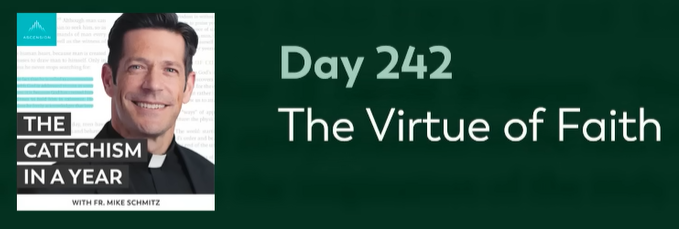
The origin, motive, and object of the theological virtues are God himself. Today, we dive into the theological virtues, beginning with the virtue of Faith. Fr. Mike unpacks the meaning and purpose of the virtue of Faith and emphasizes that Faith is deeply rooted in trust in God. Lastly, Fr. Mike reminds us that Faith should be lived out along with Hope, and Love, and also professed to those who do know yet know God. Today’s readings are Catechism paragraphs 1812-1816.
Click on link: https://youtu.be/CBL3LGHBCUA?si=KZOMnrHHPJcMwYhj
When is it okay for us to give up? Is it ever okay?
You may have seen the movie Rudy. Its eponymous protagonist is a not-so-athletic college football player who spent years taking hits and practicing with his team, only to see a few moments on the field. Those short moments, however, left him with a tremendous feeling of accomplishment and pride, knowing that he committed to something and saw it through, even when it seemed hopeless.
The question: is that always the right approach? Maybe if Rudy had dedicated that time to learning something he was naturally better at, he could have become an expert in his field. The choice Rudy made was made out of passion: he loved the game to the point of dedicating his college career to it, and not caring if the outcome wasn’t what he had expected.
But what about bigger dreams? The dream of getting married, having kids, getting into a certain religious order, entering into a certain profession? Is there ever a point where you just have to give it up?
There are a few things it’s never okay to give up. It’s never okay to give up hope itself. Hope is trust in the Lord extended into the future, knowing that he will always be with you in whatever circumstances you find yourself in. It’s also never okay to give up faith, God’s promises, or life itself.
However, it is okay—and sometimes wise—to reevaluate certain outcomes, and realize that maybe it’s time to adjust your expectations. How do you know when to do that? When reality makes it obvious.
For Rudy, that might have meant recognizing that he wasn’t going to be a starter on his football team. It’s still okay for him to want to be a part of the team in some way, and maybe get playing time one day, but reality must be acknowledged and accepted in these situations, or else we risk chasing empty expectations.
This doesn’t mean you have to give up on your dreams, or that you can’t do anything: it just means you can’t do everything. Maybe your dream is to have a family, but you and your spouse can’t get pregnant. You might not be able to conceive, but you can still adopt, or be a foster parent. Accepting the reality of your current situation means having a dream, realizing it’s place in your life, and then asking, “Okay God, now what do you want me to do?”
The outcome may not be what you had expected or planned, but if it’s with the Lord, it will still be good. And once we accept this reality, we will start to see that the real work is being done in our character, and that’s the power of trying. It may not make you the kind of person you had planned to be, but it will make you the kind of person that God wants you to be.
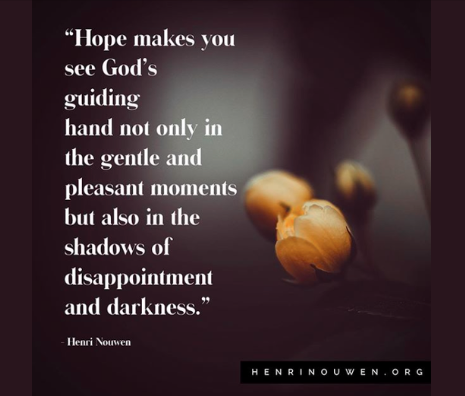
//Contemplative Monk//
Fr. Mike explains why hope is the best remedy for suicidal thoughts. If you know someone struggling with such thoughts, don’t hesitate to reach out to them with reasons to have hope. If someone you know or love has committed suicide, pray for them and don’t lose hope for their soul. If you struggle with suicidal thoughts, don’t be ashamed to seek help. Fr. Mike shares these words of encouragement and more in this video.
National Suicide Prevention Lifeline, 1-800-273-8255. Online chat is available at https://suicidepreventionlifeline.org
“There’s Nothing to Fear but Fear Itself”
Father Peter Fitzgibbons
October 23 – 24, 2021
Gospel: Mark 10:46-52
I was having my car washed the other day because I’m lazy and old. I always go to the same place, and while I was at the carwash, I saw one of the workers who I’ve met a few times. The man said, “Hmmm…you served in the Army?” Yes. “You were in the 101st Airborne?” Yes, for about three years. . . He must have seen the 101st sticker on my car. The man said, “I saw a movie about them when they were in Vietnam. I couldn’t do what they did.” Well, they weren’t Superman; they were just boys from the neighborhood. However, we had been convinced that we were Superman, and we certainly acted like it with a big red “S” on our chest and thinking we could do anything. I wanted to ask the man at the carwash who had told him that he couldn’t do it. I mean, I’m not Schwarzenegger, and I made it. So, who told you that you couldn’t do it?
It was the same thing that told our first parents they were naked. God asked Adam and Eve, “Who told you that you were naked?” Why did God create us? What’s the first question in the old Catechism? By the way, the Catechism is the best teaching tool we have in the Church. God made us because He loves us and so that we can be with Him forever. He is always calling us to everlasting life. The Gospel tells us, “Go to Him. He is calling you.” Our Lord calls us to Him. Bartimaeus did not take time to think about his fears, and even though he was blind, he went to Jesus. Which is interesting because it doesn’t say that somebody helped him…he just ran to Jesus. Ask a blind man to go somewhere without help. But he did. It is possible. So, don’t say, “I can’t do it.”
Our Lord calls us to holiness. And what is holiness? It’s a return to our original state. The original state of man and the state we are called to is not sin. The original state of man and the one that Jesus wants to transform us to is the state of Adam and Eve before the fall. It was the state of the Blessed Virgin Mary. They were truly human. It is sin that makes us less than human. Sin was never supposed to be in our souls.
The saints prove it is possible to return to holiness. . .to strive for holiness and to achieve the greatest amount of holiness we can in this life and perfection in the next. The saints prove it is possible, and they were just like us. They weren’t supermen or superwomen. They were just like us, but they took advantage of the graces that God offers. God calls us, no matter our state or vocation, to offer us the grace we need to return to holiness. He doesn’t ask us to do the impossible. He offers us the necessary grace to do it, but we must reach out and take that grace and cooperate with it.
Each time we come to Mass and receive Holy Communion or go to Confession, we grow in faith, hope, and charity which are what we call the Theological or infused virtues. We do not get them by prayer or works. They are infused in us through worthy reception of the Sacraments and are activated by works and prayer. Go to Mass. Go to Confession. Acquired virtues you get by doing works. Acquired and Theological virtues give us the power to turn away from sin and live for God. Use the virtues you have. An example is the virtue of music that Frankie has by reading that coded musical language that nobody understands. She has the gift of being able to play the organ and piano so well, but if she stops playing, she will lose the gift. We must exercise our gifts…we have to use them. When you do, don’t be afraid by the lack of results or reception. We are doing it for God Himself. Do not fear. He is calling you. Run to Him.
We take counsel of our fears, and we should never do that because fear is always a lie. The worse thing I ever lived through never happened. We are afraid we might lose something, that it will be too hard, that we can’t do it, or that we won’t have any fun. Anybody can do brain surgery if you are willing to go to medical school. Take it one step at a time. You won’t be asked to do brain surgery on the first day. You’ll have to wait six or seven years before you can. Do not be afraid. The Master is calling you. He is calling us to share in the blessings and joys of heaven. “Does He know all my faults?” Yeah, I’m pretty sure He does. “Does He know I’m not perfect?” Yeah, I’m pretty sure He knows that too. He wants to help make you perfect. We become perfect in heaven. We progress each day taking up our cross and following Him. . . Each day by bearing our sufferings. . .Each day by asking for the grace we need to carry our cross.
Remember the spiritual lie: “Oh I’m good…my relationship is good.” Did you know that’s the worse spot to be in? You have too much confidence in yourself, and that’s when you should be very afraid. Self-satisfaction is saying, “I’m fine just the way I am.” The good Lord will say, “Fine.” Come back when you’re not.” Grow ever closer to Him. We have nothing to fear. Get up and go to Him. In our fallen state, just like Bartimaeus, we will be restored to the way we are supposed to be. So, in the words of Gospel, “You have nothing to fear from Him. Get up. He is calling you.”
Father’s Afterthoughts:
I don’t recommend anyone imitating my style. It is particular. I give some people nicknames like “Face” that just come to me. I really should up my meds. On Friday I was up at the VA. I knocked on a patient’s door and called out to him. The patient, Tommy, had been asleep and grumbled as he was trying to wake up. So, in my most commanding voice, I said “On your feet soldier!!” That got Tommy’s mind right. It snapped him right back to the old days. With other patients, you can’t do that, but with Tommy I can. You know Congress made me an officer and a gentleman? Never, ever trust those people!
How will you apply this message to your life?
You can read all of Father Fitzgibbons’ sermons by going to https://annunciationcatholicalbemarle.com/ and clicking on “Blog” then “Categories” and then “Sermon Notes.” Sermon notes can also be found on the church Facebook page by searching for “Facebook Our Lady of the Annunciation Albemarle”

“There is Hope”
Father Peter Fitzgibbons
July 10 – 11, 2021
Gospel: Mark 6:7-13
I came here 18 years ago. God bless you for doing that penance on Earth. You are gaining in purgatory here on Earth. I remember an article in the local paper about a gentleman from Misenheimer. Unfortunately, he received a cancer diagnosis. This was in the paper, so it’s public knowledge. This man decided not to go with conventional treatment, but with alternative medicine like living in a yurt in Misenheimer. And, as they say in medicine, he did not have an optimal outcome and died shortly thereafter. I don’t know what he was clinging to, but he had some hope and the knowledge that he wouldn’t have to go through the rigors of chemo, radiation, and surgery. If the diagnosis was dire, maybe this was one thing that unconventional medicine could do for him. At one time, shark cartilage was all the rage for people with cancer. It didn’t help the patient or the shark one bit. But, it gave cancer patients a glimmer of hope…there was something there, and they grasped at it. When we are afraid and hurt so much, we want something to heal us.
There is so much evil, anger, and strife in the world. We blame our co-dependent behavior on mental illness. But, we don’t have to be like that. None of us have to be like we were. . .wicked. A lot of Protestant sects are dying out. They try to make each other more relevant by legitimizing mental illness which is a diagnosis for gender dysphoria. They are co-signing these behaviors. Our good Lord told us that “I am the way, the truth, and the life.” Follow Him, and you will find peace in your soul. Our Lord offers hope. This hope is not theoretical or intuitive, but a certainty. The hope He offers us is a promise. We have a program that our Lord has given us, and we know exactly what we must do. If we do what He asks us to do, these things will happen.
God’s promise has been demonstrated over history. For example, if you take your medicine, you will see positive results. If I take a tiny, little pill in the morning, my blood pressure is fine all day. This is a demonstrable result. If I don’t take that pill for a long time, bad things will happen to me. Our Lord gives us hope to enable us to carry our crosses day-by-day. Some crosses are predominate and have always been with us, while others change over time with old age and infirmities. Whatever crosses we bear, whether it is gender dysphoria or addiction, the good Lord gives us the grace to triumph over them. This is not a wish, and it’s not a hope as the world sees hope. It is a certainty that if you do what Christ says, you will get what He promises.
Your crosses are many, and I know they are heavy. Our faith gives us not only a hope, but a way of making that hope a reality, bringing peace to our soul, making sense of the sufferings we endure, and giving us the strength to bear whatever cross our good Lord has asked us to bear for love of Him, for our salvation, and the salvation of others. This is the faith. This is the Church and the deposit of faith that gives us hope. There is no other way. If you look at history, everyone who has tried something different has failed. In the words of G.K. Chesterton, “It’s not that Christianity has been tried and found wanting, but that it has been found difficult and left untried.”
You have hope, and you are demonstrating that hope by your presence here today. You come for God’s grace through the Most Holy Sacrifice of the Mass so that you can carry your daily crosses and be good followers of Christ. When you demonstrate your hope, you are teaching others, because they see it in you. It’s a day-to-day thing. Give that hope to someone else.
As a young man, I read the biographies of the saints and how their lives were transformed. I don’t read fiction. . .I’m a little old for fairytales. I like to read about what people did so that I can learn from them. Saint Ignatius of Loyola, founded the Jesuit Order. Now, I was trained by the Dominicans, so this is a stretch for me to say this. What did he do? Saint Ignatius was a professional soldier…a hit man. He was a hired gun. Give him a lot of money and, although he wasn’t Italian, he would put the whack on people especially because of their religion. And, look at what happened to him. He had a great conversion. The head of the gestapo in Rome, Italy, was Herbert Kappler. He put the whack on people. . . a lot. After the war, a priest visited him, and he became Catholic. Dr. Bernard Nathanson performed over 10,000 abortions. He also converted to Catholicism after a priest visited him.
My correspondence is different from most. I received a letter in the mail the other day from the local, state-run, residential community known as the Albemarle Correction Facility, a medium security prison that I visit. This one man, who didn’t know me, reached out to me. The envelope was addressed to “Priest Peter Fitzgibbons.” Close enough…at least he’s getting there. He told me that he had grown up Catholic, but had fallen off the wagon a bit. . .or a lot. He’s a “state employee” now and eats state-issued fish. Ugh! If you’re out in the parking lot when they are cooking fish, and the wind is just right, you know it. I’m a hospital chaplain, so smells don’t usually bother me, but that one does. Anyhow, this inmate wants to come back to the Church. He’s had enough. There are a couple of other inmates that I’ve brought in to the Faith. They also were at a point where they’d had enough and reached out to me in hope. You know who touched them in prison? It wasn’t me…I’m only there once a month. Other inmates who’d had enough and came back to Jesus. They saw hope realized in other people.
Our testimony to the world is the faith that we have been given, the faith that we have been called to hand down, and the faith that we teach by example. We are living testimonies of the power of Christ by carrying our cross every day. We may fall down, but we have the strength to get back up and carry on. This is the hope and reality we can pass on by our actions. It is how we teach and how we give hope to others. We can give other people hope with their struggles just as you found hope with the crosses you carry. But, we can’t if we are angry and bitter. What’s wrong with you? Jesus was a man of peace. Our good Lord loves them and wants to transform them. You are not your sins. You are not your crosses. You are children of God. God has given us the truth, the means, and the infallible teaching of how to achieve the daily transformation we need in order to get to heaven. Sometimes, these transformations are amazingly quick, and at other times they are sustaining. “Well, Father you have been a priest for a long time.” Yes. “I see you haven’t changed much.” But, can you imagine what I’d be like without my prayers every day, my confessions, and daily Mass? Can you imagine what I’d be like? I’d rather not…You cannot unsee some things. Our transformation is always happening in us and won’t be complete until we die.
How will you apply this message to your life? Renew your hope in Him so that you can teach others by your example.
You can read all of Father Fitzgibbons’ sermons by going to https://annunciationcatholicalbemarle.com/ and clicking on “Blog” then “Categories” and then “Sermon Notes.” From a cell phone, click on “Blog” then “Menu” and then “Categories” (located at the end of page). There is also a search box if you are looking for a specific topic.
When is it okay for us to give up? Is it ever okay?
You may have seen the movie Rudy. Its eponymous protagonist is a not-so-athletic college football player who spent years taking hits and practicing with his team, only to see a few moments on the field. Those short moments, however, left him with a tremendous feeling of accomplishment and pride, knowing that he committed to something and saw it through, even when it seemed hopeless.
The question: is that always the right approach? Maybe if Rudy had dedicated that time to learning something he was naturally better at, he could have become an expert in his field. The choice Rudy made was made out of passion: he loved the game to the point of dedicating his college career to it, and not caring if the outcome wasn’t what he had expected.
But what about bigger dreams? The dream of getting married, having kids, getting into a certain religious order, entering into a certain profession? Is there ever a point where you just have to give it up?
There are a few things it’s never okay to give up. It’s never okay to give up hope itself. Hope is trust in the Lord extended into the future, knowing that he will always be with you in whatever circumstances you find yourself in. It’s also never okay to give up faith, God’s promises, or life itself.
However, it is okay—and sometimes wise—to reevaluate certain outcomes, and realize that maybe it’s time to adjust your expectations. How do you know when to do that? When reality makes it obvious.
For Rudy, that might have meant recognizing that he wasn’t going to be a starter on his football team. It’s still okay for him to want to be a part of the team in some way, and maybe get playing time one day, but reality must be acknowledged and accepted in these situations, or else we risk chasing empty expectations.
This doesn’t mean you have to give up on your dreams, or that you can’t do anything: it just means you can’t do everything. Maybe your dream is to have a family, but you and your spouse can’t get pregnant. You might not be able to conceive, but you can still adopt, or be a foster parent. Accepting the reality of your current situation means having a dream, realizing it’s place in your life, and then asking, “Okay God, now what do you want me to do?”
The outcome may not be what you had expected or planned, but if it’s with the Lord, it will still be good. And once we accept this reality, we will start to see that the real work is being done in our character, and that’s the power of trying. It may not make you the kind of person you had planned to be, but it will make you the kind of person that God wants you to be.