Holiness is not something we can achieve on our own—is it a grace we ask of God, and he promises that he will grant it to us. But often, the first step is acknowledging your weaknesses, accepting their existence, and handing them to God in total surrender.
Fr. Mike and Sr. Miriam explore that journey in this clip from Fr. Mike’s conversation w/ Sr. Miriam about Advent, healing, and forgiveness.
Fr. Mike examines the next characteristic of the Church, the Church is holy, and he emphasizes two important ideas. The first is that the Church is unfailingly holy only because of God’s gracious gift to us. The second is that each and every one of the activities of the Church are for two purposes: the sanctification of men in Christ and the glorification of God. We conclude with a reminder from St. Therese on the importance of charity, that love of God is the “vocation which includes all others.” Today’s readings from the Catechism are paragraphs 823-829.
In this new paragraph—”The Church is One, Holy, Catholic, and Apostolic”—the Catechism explains how and why the Church is “One”. Fr. Mike highlights the many manifestations of the good that Jesus works through the Church, and he also urges us to cling to the “visible bonds of unity” that Christ offers us. Today’s readings are Catechism paragraphs 811-816.
The Church has no other light than Christ’s, and the Holy Spirit is the source of all its holiness. We believe that the Church is “holy,” “catholic,” “one,” and “apostolic.” Fr. Mike explains that Jesus has promised to guide the Church in the truth. Members of the Church are called and uniquely belong to the Lord. We also learn that the word ‘church’ has three inseparable meanings: the liturgical assembly, the local community, and the universal community of believers. The Church draws her life from the body of Christ and so becomes Christ’s body. Today’s readings are Catechism paragraphs 748-752.
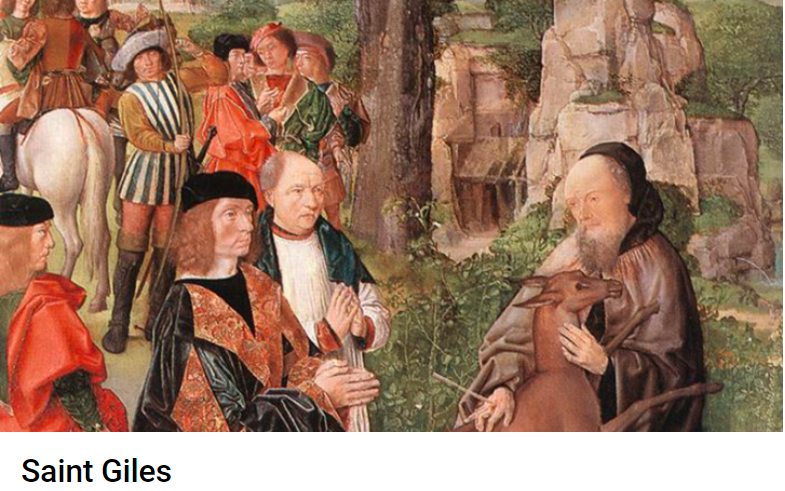
Despite the fact that much about Saint Giles is shrouded in mystery, we can say that he was one of the most popular saints in the Middle Ages. Likely, he was born in the first half of the seventh century in southeastern France. That is where he built a monastery that became a popular stopping-off point for pilgrims making their way to Compostela in Spain, and the Holy Land.
In England, many ancient churches and hospitals were dedicated to Giles. One of the sections of the city of Brussels is named after him. In Germany, Giles was included among the so-called 14 Holy Helpers, a popular group of saints to whom people prayed, especially for recovery from disease, and for strength at the hour of death. Also among the 14 were Saints Christopher, Barbara, and Blaise. Interestingly, Giles was the only non-martyr among them. Devotion to the “Holy Helpers” was especially strong in parts of Germany and in Hungary and Sweden. Such devotion made his popularity spread. Giles was soon invoked as the patron of the poor and the disabled.
The pilgrimage center that once drew so many fell into disrepair some centuries after Giles’ death.
Reflection
Saint Giles may not have been a martyr but, as the word martyr means, he was a true witness to the faith. This is attested to by the faith of the People of God in the Middle Ages. He became one of the “holy helpers” and can still function in that role for us today.
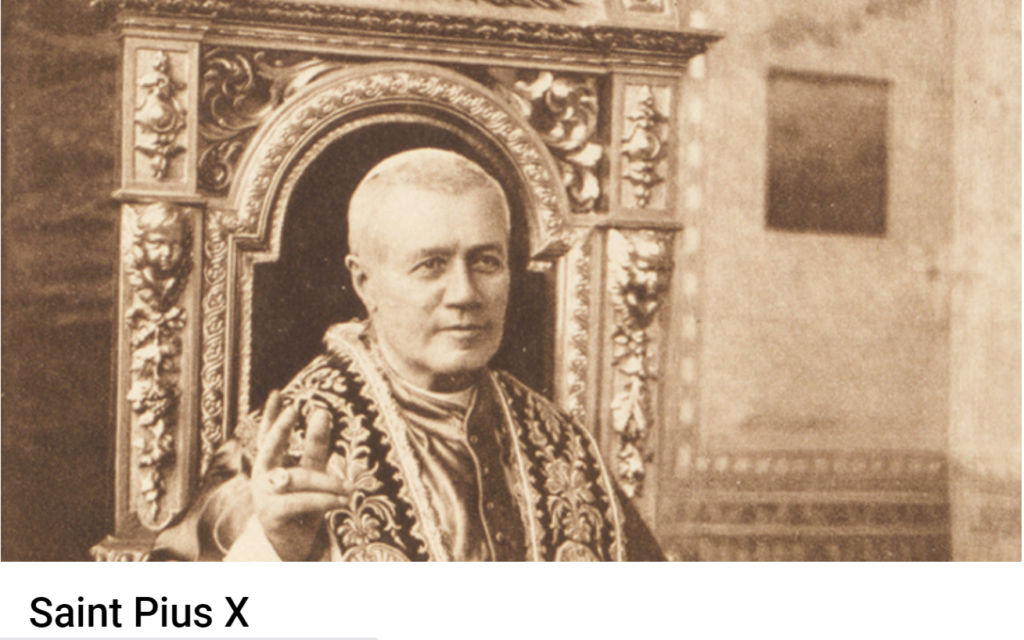
Pope Pius X is perhaps best remembered for his encouragement of the frequent reception of Holy Communion, especially by children.
The second of 10 children in a poor Italian family, Joseph Sarto became Pius X at age 68. He was one of the 20th century’s greatest popes.
Ever mindful of his humble origin, Pope Pius stated, “I was born poor, I lived poor, I will die poor.” He was embarrassed by some of the pomp of the papal court. “Look how they have dressed me up,” he said in tears to an old friend. To another, “It is a penance to be forced to accept all these practices. They lead me around surrounded by soldiers like Jesus when he was seized in Gethsemani.”
Interested in politics, Pope Pius encouraged Italian Catholics to become more politically involved. One of his first papal acts was to end the supposed right of governments to interfere by veto in papal elections—a practice that reduced the freedom of the 1903 conclave which had elected him.
In 1905, when France renounced its agreement with the Holy See and threatened confiscation of Church property if governmental control of Church affairs were not granted, Pius X courageously rejected the demand.
While he did not author a famous social encyclical as his predecessor had done, he denounced the ill treatment of indigenous peoples on the plantations of Peru, sent a relief commission to Messina after an earthquake, and sheltered refugees at his own expense.
On the 11th anniversary of his election as pope, Europe was plunged into World War I. Pius had foreseen it, but it killed him. “This is the last affliction the Lord will visit on me. I would gladly give my life to save my poor children from this ghastly scourge.” He died a few weeks after the war began, and was canonized in 1954.
Reflection
His humble background was no obstacle in relating to a personal God and to people whom he loved genuinely. Pius X gained his strength, his gentleness and warmth for people from the source of all gifts, the Spirit of Jesus. In contrast, we often feel embarrassed by our backgrounds. Shame makes us prefer to remain aloof from people whom we perceive as superior. If we are in a superior position, on the other hand, we often ignore simpler people. Yet we, too, have to help “restore all things in Christ,” especially the wounded people of God.
No time to pray? Then pray more. There’s a reason it’s an essential part of Christian life. That’s Father Mark-Mary’s advice, and he’s in good company, in fact he’s in saintly company. He recounts a story when Fr. Benedict Groeschel told St. Mother Teresa that he didn’t have time for a daily holy hour, and Mother Teresa told him then he should make two holy hours a day. She understood that prayer isn’t just a nice thing, prayer is a necessary thing. This advice points to the reality that if we have a busy day, we need to pray more—not less. We want to build great things for the Lord, but they must be built on a solid foundation of prayer and communication with God. In their daily journey to become more holy, this lesson has become vital to Father Mark-Mary and the Franciscan Friars of the Renewal.
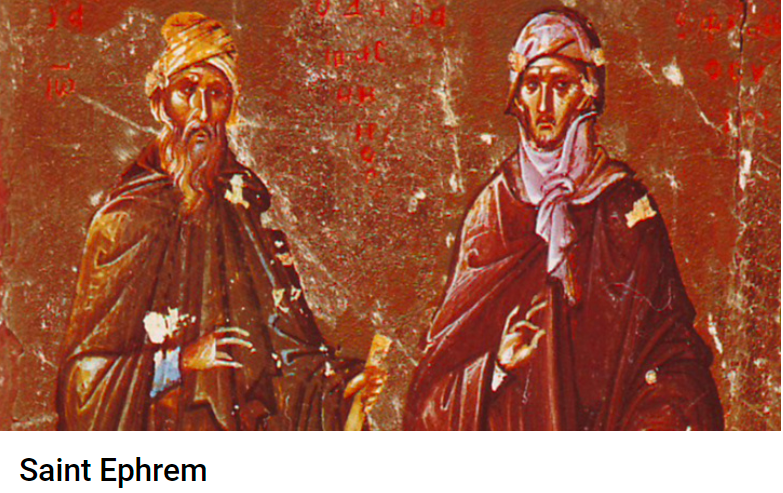
Poet, teacher, orator, and defender of the faith, Ephrem is the only Syriac Christian recognized as a doctor of the Church. He took upon himself the special task of opposing the many false doctrines rampant at his time, always remaining a true and forceful defender of the Catholic Church.
Born in Nisibis, Mesopotamia, he was baptized as a young man and became famous as a teacher in his native city. When the Christian emperor had to cede Nisibis to the Persians, Ephrem fled as a refugee to Edessa, along with many other Christians. He is credited with attracting great glory to the biblical school there. He was ordained a deacon but declined becoming a priest. Ephrem was said to have avoided presbyteral consecration by feigning madness!
He had a prolific pen, and his writings best illumine his holiness. Although he was not a man of great scholarship, his works reflect deep insight and knowledge of the Scriptures. In writing about the mysteries of humanity’s redemption, Ephrem reveals a realistic and humanly sympathetic spirit and a great devotion to the humanity of Jesus. It is said that his poetic account of the Last Judgment inspired Dante.
It is surprising to read that he wrote hymns against the heretics of his day. He would take the popular songs of the heretical groups and using their melodies, compose beautiful hymns embodying orthodox doctrine. Ephrem became one of the first to introduce song into the Church’s public worship as a means of instruction for the faithful. His many hymns have earned him the title “Harp of the Holy Spirit.”
Ephrem preferred a simple, austere life, living in a small cave overlooking the city of Edessa. It was here that he died around 373.
Reflection
Many Catholics still find singing in church a problem, probably because of the rather individualistic piety that they inherited. Yet singing has been a tradition of both the Old and the New Testaments. It is an excellent way of expressing and creating a community spirit of unity as well as of joy. An ancient historian testifies that Ephrem’s hymns “lent luster to the Christian assemblies.” We need some modern Ephrems—and cooperating singers—to do the same for our Christian assemblies today.
Today, Holy Mother Church celebrates the Solemnity of Pentecost which is when the Holy Spirit came upon the Apostles. It’s also the birthday of the Church. Now, let me ask you a question. When did you first receive the Holy Spirit? At Baptism. Remember, when I baptize you, it is done in the name of the Father, the Son, and the Holy Spirit. When is the next time you receive the gift of the Holy Spirit? At Confession. After that? Holy Communion. Now, you may be thinking, “You also receive the Holy Spirit at Confirmation.” Yeah, you do. You receive Jesus, and you receive God the Father. That 3 in 1 and 1 in 3 thing. You receive the fullness of the Spirit. In each Sacrament, you receive the whole God.
The Sacraments are given for different purposes depending on your particular mission in the Body of Christ. At Baptism, you were given the gift of God Himself. In each Sacrament, you get the gift of the whole God…not just a slice of Him. You get the Father, the Son, and the Holy Spirit. In Baptism, Christ asked for, and you, through your parents, gave Him your human nature. The human nature He took from Mary in the body He was born with, taught with, healed with, suffered with, and redeemed us with is now in Heaven. So, how does He continue His mission to teach, heal, and sanctify the world? It goes on through us by living a good Catholic life. In whatever part of the Body of Christ He has assigned us, we work for His glory and the salvation of souls. So, if you are in hell, you are a self- made man.
Christ takes our human nature at Baptism, so, we are part of His new body which is the Church. Each of us has a place in the body of Christ to do the work of bringing Him to the world. Through the gifts of the Holy Spirit, He helps us accomplish that mission. There are seven gifts (wisdom, understanding, counsel, fortitude, knowledge, piety, and fear of the Lord) and 12 fruits (charity, joy, peace, patience, kindness, goodness, long-suffering, humility, faithfulness, modesty, self-control, and chastity). The whole purpose of giving us the Holy Spirit through the Sacraments is to bring God’s love to the world and to make that love manifest in whatever part of the Body we are in. The graces of the Holy Spirit strengthen us so that we can carry out that mission.
Part of my job as a priest is working at the veterans’ hospital in Hospice. Hospice is a part of the hospital where people who are very sick and in the last six months of their lives are cared for by specially trained doctors and nurses. They have all sorts of terrible diseases. We had one patient who had Progressive Supranuclear Palsy which is a rare disease that the patient contracted while working as a doctor in Vietnam. His brain turned into jelly, and there is no treatment. It’s so sad. The hospice staff try to make their patients as comfortable and pain-free as possible. A few years ago, there was a nice area with a kitchen and dining room where hospice patients could come out of their rooms and eat together. Other veterans from across the hospital would come down and have lunch with them. It was so much fun to laugh and talk with them. I would pick up trays and do whatever I could for them. You know what a sign of God’s love looks like? There was a hospice patient at the luncheon who couldn’t feed himself…he was that sick. Another man who, after this incident died about two weeks later, was also at the luncheon. But, instead of eating his own lunch, he spent that time feeding the patient who couldn’t feed himself. One would think that if you’re dying, it would be all about you. But, this is what God’s love looks like. This was an act of the Holy Spirit. The staff would have fed that patient, but he did it. He didn’t have to do it, but he wanted to. He made sure that man ate before he did. That is a sign of the Holy Spirit in action and God’s love is in the world.
Another thing they have done in Hospice, and hopefully will do again once COVID is over, is that when veterans are actively dying and don’t have family members there, volunteers come and sit with them all night and all day so that they don’t have to die alone. Usually, the veterans are very old and don’t have anybody. But, a veteran should never die alone. In the military, you never leave a fallen comrade. I’ve always thought that this is a sign of Christ, along with their guardian angel, being with them as they leave this life. You see the love of Christ in those volunteers. They don’t need to teach us…their actions teach us everything. It’s all through the promptings of the Holy Spirit who moves and works within us – not always the way want; otherwise, I’d be a monsignor!
I’ll tell you a story about the nursing staff. Don’t let this get back to them. World War II veterans are very old, and when they are nearing the time of their passing, all of the memories of what they had to do during the war come back. Mine will come back too when it’s my time. It’s just part of what we went through. It comes back for a lot of the men who saw combat. Many times, it was their wives who helped them keep it all together, and if their wives are no longer with them, it’s a real hardship for them. I remember this one man who was in his nineties and about to leave us asked the nurse if she would hold his hand until he fell asleep. The memories had come back, and his wife had done that for him. That’s not in any nurse’s job description. But, she sacrificed her own time to sit with that man while he faced his nightmares. I’ve sat with veterans as they were passing from this life…that’s what we do. We offer spontaneous acts of love. I’ve seen you do it. Your acts of generosity are acts of the Holy Spirit. You are showing Christ’s love. If you ask anyone why they do it, they would probably say that they don’t know, but it felt like the right thing to do. Do they get paid for it? No. It was just the right thing to do. These are the actions of the Holy Spirit using our human natures to show Christ’s love to the world. But, so that we can repeat these acts of love, we must be refreshed in the Holy Spirit by frequently participating in the Sacrament of Penance and Holy Communion.
What is so beautiful about these acts of love is that you do it without thinking. It’s just a normal response. You don’t stop and think about what you should or shouldn’t do…you just do it. That’s the action of the Holy Spirit letting the Spirit work in you to bring the love of Christ to the world. And, believe it or not, someone will see and be taught God’s word simply through your acts of love
How will you apply this message to your life? Refresh yourself in the Holy Spirit by frequently participating in the Sacrament of Penance and Holy Communion
You can read all of Father Fitzgibbons’ sermons by going to https://annunciationcatholicalbemarle.com/ and clicking on “Blog” then “Categories” and then “Sermon Notes.” From a cell phone, click on “Blog” then “Menu” and then “Categories” (located at the end of page). There is also a search box if you are looking for a specific topic.