https://www.youtube.com/@CatholicSaintsandFeasts
Saint of the day – Saint Francis of Paola – April 2
Saint of the day -Saint John Climacus – March 30
Saint of the Day – Saint Nicholas of Flue – March 21
Saint of the Day -Saint Conrad of Piacenza – February 19
Saint of the Day – November 7 – Saint Didacus
Saint Didacus’ Story (c. 1400 – November 12, 1463)
Didacus is living proof that God “chose what is foolish in the world to shame the wise; God chose what is weak in the world to shame the strong.”
As a young man in Spain, Didacus joined the Secular Franciscan Order and lived for some time as a hermit. After Didacus became a Franciscan brother, he developed a reputation for great insight into God’s ways. His penances were heroic. He was so generous with the poor that the friars sometimes grew uneasy about his charity.
Didacus volunteered for the missions in the Canary Islands and labored there energetically and profitably. He was also the superior of a friary there.
In 1450, he was sent to Rome to attend the canonization of Saint Bernardine of Siena. When many of the friars gathered for that celebration fell ill, Didacus stayed in Rome for three months to nurse them. After he returned to Spain, he pursued a life of contemplation full-time. He showed the friars the wisdom of God’s ways.
As he was dying, Didacus looked at a crucifix and said: “O faithful wood, O precious nails! You have borne an exceedingly sweet burden, for you have been judged worthy to bear the Lord and King of heaven” (Marion A. Habig, OFM, The Franciscan Book of Saints, p. 834).
San Diego, California, is named for this Franciscan, who was canonized in 1588.
Reflection
We cannot be neutral about genuinely holy people. We either admire them or we consider them foolish. Didacus is a saint because he used his life to serve God and God’s people. Can we say the same for ourselves?
Saint of the Day – July 24 – Saint Sharbel Makhlouf
Saint Sharbel Makhlouf’s Story (May 8, 1828 – December 24, 1898)
Although this saint never traveled far from the Lebanese village of Beka-Kafra where he was born, his influence has spread widely.
Joseph Zaroun Maklouf was raised by an uncle because his father, a mule driver, died when Joseph was only three. At the age of 23, Joseph joined the Monastery of St. Maron at Annaya, Lebanon, and took the name Sharbel in honor of a second-century martyr. He professed his final vows in 1853, and was ordained six years later.
Following the example of the fifth-century Saint Maron, Sharbel lived as a hermit from 1875, until his death. His reputation for holiness prompted people to seek him to receive a blessing and to be remembered in his prayers. He followed a strict fast and was very devoted to the Blessed Sacrament. When his superiors occasionally asked him to administer the sacraments to nearby villages, Sharbel did so gladly.
He died in the late afternoon on Christmas Eve. Christians and non-Christians soon made his tomb a place of pilgrimage and of cures. Pope Paul VI beatified Sharbel in 1965, and canonized him 12 years later.
Reflection
John Paul II often said that the Church has two lungs—East and West—and it must learn to breathe using both of them. Remembering saints like Sharbel helps the Church to appreciate both the diversity and unity present in the Catholic Church. Like all the saints, Sharbel points us to God and invites us to cooperate generously with God’s grace, no matter what our situation in life may be. As our prayer life becomes deeper and more honest, we become more ready to make that generous response.
Saint of the Day – July 11 – Saint Benedict
Saint Benedict’s Story (c. 480 – c. 547)
It is unfortunate that no contemporary biography was written of a man who has exercised the greatest influence on monasticism in the West. Benedict is well recognized in the later Dialogues of Saint Gregory, but these are sketches to illustrate miraculous elements of his career.
Benedict was born into a distinguished family in central Italy, studied at Rome, and early in life was drawn to monasticism. At first he became a hermit, leaving a depressing world—pagan armies on the march, the Church torn by schism, people suffering from war, morality at a low ebb.
He soon realized that he could not live a hidden life in a small town any better than in a large city, so he withdrew to a cave high in the mountains for three years. Some monks chose Benedict as their leader for a while, but found his strictness not to their taste. Still the shift from hermit to community life had begun for him. He had an idea of gathering various families of monks into one “Grand Monastery” to give them the benefit of unity, fraternity, and permanent worship in one house. Finally he began to build what was to become one of the most famous monasteries in the world—Monte Cassino, commanding three narrow valleys running toward the mountains north of Naples.
The Rule that gradually developed prescribed a life of liturgical prayer, study, manual labor, and living together in community under a common abbot. Benedictine asceticism is known for its moderation, and Benedictine charity has always shown concern for the people in the surrounding countryside. In the course of the Middle Ages, all monasticism in the West was gradually brought under the Rule of St. Benedict.
Today the Benedictine family is represented by two branches: the Benedictine Federation encompassing the men and women of the Order of St. Benedict; and the Cistercians, men and women of the Order of Cistercians of the Strict Observance.
Reflection
The Church has been blessed through Benedictine devotion to the liturgy, not only in its actual celebration with rich and proper ceremony in the great abbeys, but also through the scholarly studies of many of its members. Liturgy is sometimes confused with guitars or choirs, Latin or Bach. We should be grateful to those who both preserve and adapt the genuine tradition of worship in the Church.
Saint Benedict is the Patron Saint of:
Europe
Kidney Disease
Monastics
Poisoning
Schoolchildren
Saint of the Day – January 15 – Saint Paul, The Hermit
Saint Paul the Hermit’s Story (c. 233 – c. 345)
It is unclear what we really know of Paul’s life, how much is fable, how much is fact.
Paul was reportedly born in Egypt, where he was orphaned by age 15. He was also a learned and devout young man. During the persecution of Decius in Egypt in the year 250, Paul was forced to hide in the home of a friend. Fearing a brother-in-law would betray him, he fled in a cave in the desert. His plan was to return once the persecution ended, but the sweetness of solitude and heavenly contemplation convinced him to stay.
He went on to live in that cave for the next 90 years. A nearby spring gave him drink, a palm tree furnished him clothing and nourishment. After 21 years of solitude, a bird began bringing him half of a loaf of bread each day. Without knowing what was happening in the world, Paul prayed that the world would become a better place.
Saint Anthony of Egypt attests to his holy life and death. Tempted by the thought that no one had served God in the wilderness longer than he, Anthony was led by God to find Paul and acknowledge him as a man more perfect than himself. The raven that day brought a whole loaf of bread instead of the usual half. As Paul predicted, Anthony would return to bury his new friend.
Thought to have been about 112 when he died, Paul is known as the “First Hermit.” His feast day is celebrated in the East; he is also commemorated in the Coptic and Armenian rites of the Mass.
Reflection
The will and direction of God are seen in the circumstances of our lives. Led by the grace of God, we are free to respond with choices that bring us closer to and make us more dependent upon the God who created us. Those choices might at times seem to lead us away from our neighbor. But ultimately they lead us back both in prayer and in fellowship to one another.
Saint of the Day – August 30 – Saint Fiacre
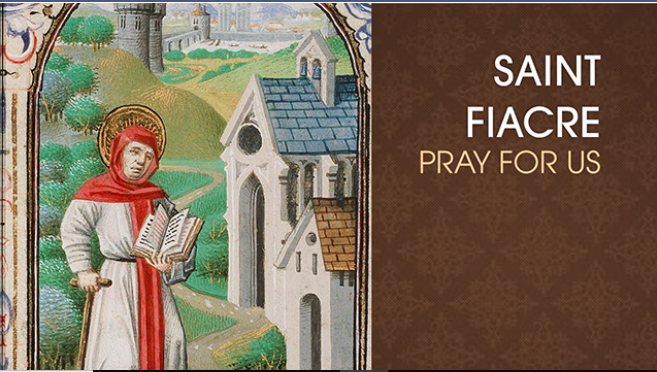
St. Fiacre (d. 670 A.D.) was born in Ireland and was raised from childhood in an Irish monastery. There he grew in knowledge as well as holiness, and became a priest. He retired to a hermitage to live in prayer and solitude, but men began to flock to him to imitate his way of life and become his disciples. To escape them, Fiacre left Ireland to establish a new hermitage in France. He went to the bishop and asked for land to plant a garden to grow food as well as herbs for medicinal healing, a science which he studied in the monastery. The bishop agreed to give Fiacre as much land as he could entrench. Fiacre picked a plot of land and walked around its perimeter, dragging his shovel behind him. Wherever his spade touched the ground, the land was miraculously cleared and the soil became entrenched. St. Fiacre lived a life of great mortification in prayer, fasting, vigils, and manual labor in his garden. Disciples gathered around him again, and soon formed a monastery. St. Fiacre then built an oratory in honor of the Virgin Mary, a hospice in which he received strangers, and a cell for his own dwelling. His fame for performing miracles became widespread, and his garden became a place of pilgrimage for centuries for those seeking healing. St. Fiacre is best known as the patron of gardeners, florists, and cab drivers. His feast day is August 30th.
St. Fiacre, pray for us!
//Catholic Company//