When is it okay for us to give up? Is it ever okay?
You may have seen the movie Rudy. Its eponymous protagonist is a not-so-athletic college football player who spent years taking hits and practicing with his team, only to see a few moments on the field. Those short moments, however, left him with a tremendous feeling of accomplishment and pride, knowing that he committed to something and saw it through, even when it seemed hopeless.
The question: is that always the right approach? Maybe if Rudy had dedicated that time to learning something he was naturally better at, he could have become an expert in his field. The choice Rudy made was made out of passion: he loved the game to the point of dedicating his college career to it, and not caring if the outcome wasn’t what he had expected.
But what about bigger dreams? The dream of getting married, having kids, getting into a certain religious order, entering into a certain profession? Is there ever a point where you just have to give it up?
There are a few things it’s never okay to give up. It’s never okay to give up hope itself. Hope is trust in the Lord extended into the future, knowing that he will always be with you in whatever circumstances you find yourself in. It’s also never okay to give up faith, God’s promises, or life itself.
However, it is okay—and sometimes wise—to reevaluate certain outcomes, and realize that maybe it’s time to adjust your expectations. How do you know when to do that? When reality makes it obvious.
For Rudy, that might have meant recognizing that he wasn’t going to be a starter on his football team. It’s still okay for him to want to be a part of the team in some way, and maybe get playing time one day, but reality must be acknowledged and accepted in these situations, or else we risk chasing empty expectations.
This doesn’t mean you have to give up on your dreams, or that you can’t do anything: it just means you can’t do everything. Maybe your dream is to have a family, but you and your spouse can’t get pregnant. You might not be able to conceive, but you can still adopt, or be a foster parent. Accepting the reality of your current situation means having a dream, realizing it’s place in your life, and then asking, “Okay God, now what do you want me to do?”
The outcome may not be what you had expected or planned, but if it’s with the Lord, it will still be good. And once we accept this reality, we will start to see that the real work is being done in our character, and that’s the power of trying. It may not make you the kind of person you had planned to be, but it will make you the kind of person that God wants you to be.
In the Gospel, there are many points. So, start with the minor ones and then go on to the big ones. Jesus taught us how to study Scripture. He also taught us what we must do before Mass. What must we do before Mass? A famous word from one of the great spiritual directors is “Shut-Up!” That’s because every time the apostles talked about the Bible, they got it wrong. Every time our Lord asked them a question, they got it wrong. The apostles were discussing Scripture one day while in Jerusalem and when our Lord showed up, He asked them, “What are you doing?” They said, “Talking about Scripture.” What did He tell them? “You got it wrong!” Then, for the better part of two hours, He taught them Scripture, because He is Scripture. And in the presence of God, they listened. He explained to them the meaning of the Bible. Scripture study is not people sitting around a table and asking, “What do you think this is?” It’s not that. The Church teaches what Scripture is . . . not what we’d like it to be. It’s a lot more complicated than just reading a book and saying, “Oh yeah. I can do that.” You have to listen to the experts.
What resulted from the apostles’ time with Jesus? During the Breaking of Bread (the Mass), their eyes were opened, and they recognized Him. This is our faith. Jesus is physically present on the altar and at the altar during the Holy Sacrifice of the Mass. What happens when we see our Lord in the Breaking of Bread during the Holy Sacrifice of the Mass? The same as what happened to two of Jesus’ disciples as they were going to Emmaus which was near Jerusalem. They were tired, but in the middle of the night they walked seven miles, most of it uphill. Now most people are afraid to go outside at night even though we have great law enforcement. Back then, there was no 911. And the Roman soldiers didn’t patrol at night. So, you were on your own . . . good luck! But the disciples were no longer tired. Instead, they were filled with joy and couldn’t wait to tell people, “We have seen the Lord. We recognized Him in the Breaking of Bread.”
This is what we preach for conversion. Transubstantiation and the Real Presence of our Lord in the Most Blessed Sacrament. This is our Faith. This is what we preach. This is what brings people to church. And this is how we get converts to the Faith. A good friend of mine, a Catholic priest, took Philosophy 101. He said that during the first week of class they learned that “a thing is what it is or it isn’t.” There is no in-between. Would you want to eat a slightly poisonous salad? Would you want to get slightly sick on Listeria? No. Either the food is good or it’s not. Either it is or it isn’t. A wrench is a wrench or it’s not. You can’t use a pencil as a wrench. It won’t work. So, either you believe what Scripture says or you don’t. Christ is present in the Eucharist. His true Real Presence is what draws people to the Faith. We recognize Him with the eyes of faith and intellect. Sometimes it affects the whole body . . . sometimes not. But we recognize Him. In church, everything is pointed to the Real Presence. That’s why we kneel, stand, and genuflect. Some people rather blasphemously call it Catholic aerobics – up and down, up and down. By the way, do you know why we stand for the Gospel? We stand out of respect for the Word of God because the Gospel contains the actual words of Christ. So, we stand out of respect for His words, and we pray with our hearts. This is what we proclaim. This is what we profess. And this is what we teach. Paul came to that conclusion. Paul taught people, and he admonished them that “Whoever eats and drinks the body of Christ unworthily is guilty of His death.” If it’s just a symbol or just a community builder as some blasphemous people say, how can we be convicted of His death? How can we be like Judas and be guilty of His death? If His Body and Blood is just a symbol, then what’s the big deal?
So, this is what we believe. This is what we profess. And this is what we tell people. This is the good news. What happened to the apostles and what happened to the two disciples enroute to Emmaus, is the same joy and the same Presence we have before us.
How will you apply this message to your life? _______________________________
You can read all of Father Fitzgibbons’ sermons by going to annunciationcatholicalbemarle.com and clicking on “Blog” then “Categories” then “Sermon Notes.” On a cell phone: click on “Blog” then “Menu” and then “Categories.” Sermon Notes are also available on the church Facebook page at facebook.com/ola.catholic.church. Click on “Groups” and then “Sermon Notes.”
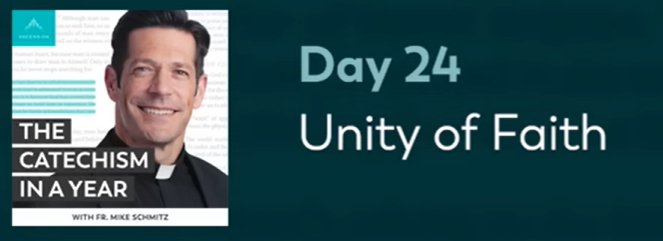
As we wrap up the current section, we learn about the unity of faith and how the Church is meant to be united in Christ through apostolic succession. In addition, Fr. Mike reminds us that, as Catholics, we don’t just believe in formulas. We believe in the realities those formulas express. Lastly, Fr. Mike encourages us to trust in the Church, who guards the truths of the Faith and passes them down through the ages. Today’s readings are Catechism paragraphs 170-175.
While faith is deeply personal, it is not isolated act. Today, Fr. Mike reflects on the reality that our Faith is a communal Faith that it is lived out it and passed down in the context of community. We also learn that Faith is truly the beginning of eternal life. Despite the sufferings of this world, when we walk by Faith we get to experience a taste of heaven here and now. Today’s readings are Catechism paragraphs 163-169.
In our Catechism readings today, Fr. Mike reflects on the motives of credibility for believing in God. We learn that God offers us signs and proofs that show us that he truly is who he says he is. Fr. Mike also clarifies the difference between doubting the Faith and struggling with it. He assures us that wrestling with faith is a normal human experience. Today’s readings are Catechism paragraphs 156-162.
As we dive into a new chapter today, we learn about how we are called to respond to God’s Revelation. In particular, we discover that Mary and Abraham are models of faith who show us how to be obedient by submitting our intellect and will to God. Fr. Mike assures us that even though God doesn’t usually give us the whole picture of our lives, he gives us just enough light to take the next step in faith. Today’s readings are Catechism paragraphs 142-149.
The Karate Kid didn’t know waxing a car would teach him karate, but Miyagi knew. In a similar way the Church, in her wisdom, teaches us certain motions—kneeling at Mass, making the sign of the Cross, etcetera—so we may learn the deeper virtues that will lead us to holiness. In this video, Fr. Mike encourages us to keep going through the motions, if that’s all it feels like we’re doing at Mass, because it’s in times of desolation that our faith grows the most.
It’s not unusual to experience discouragement on the road to holiness, especially when we live in a world that is filled with temptations and persecution. With God on our side, nothing the devil can do will ever prevail over us. However, it’s the moment we become too discouraged to ask God for help that the devil is waiting for. So how can we prevent this from happening?
Today, Fr. Mike explains the root of discouragement in our faith journey, and how to keep leaning on God through that struggle.
I was having my car washed the other day because I’m lazy and old. I always go to the same place, and while I was at the carwash, I saw one of the workers who I’ve met a few times. The man said, “Hmmm…you served in the Army?” Yes. “You were in the 101st Airborne?” Yes, for about three years. . . He must have seen the 101st sticker on my car. The man said, “I saw a movie about them when they were in Vietnam. I couldn’t do what they did.” Well, they weren’t Superman; they were just boys from the neighborhood. However, we had been convinced that we were Superman, and we certainly acted like it with a big red “S” on our chest and thinking we could do anything. I wanted to ask the man at the carwash who had told him that he couldn’t do it. I mean, I’m not Schwarzenegger, and I made it. So, who told you that you couldn’t do it?
It was the same thing that told our first parents they were naked. God asked Adam and Eve, “Who told you that you were naked?” Why did God create us? What’s the first question in the old Catechism? By the way, the Catechism is the best teaching tool we have in the Church. God made us because He loves us and so that we can be with Him forever. He is always calling us to everlasting life. The Gospel tells us, “Go to Him. He is calling you.” Our Lord calls us to Him. Bartimaeus did not take time to think about his fears, and even though he was blind, he went to Jesus. Which is interesting because it doesn’t say that somebody helped him…he just ran to Jesus. Ask a blind man to go somewhere without help. But he did. It is possible. So, don’t say, “I can’t do it.”
Our Lord calls us to holiness. And what is holiness? It’s a return to our original state. The original state of man and the state we are called to is not sin. The original state of man and the one that Jesus wants to transform us to is the state of Adam and Eve before the fall. It was the state of the Blessed Virgin Mary. They were truly human. It is sin that makes us less than human. Sin was never supposed to be in our souls.
The saints prove it is possible to return to holiness. . .to strive for holiness and to achieve the greatest amount of holiness we can in this life and perfection in the next. The saints prove it is possible, and they were just like us. They weren’t supermen or superwomen. They were just like us, but they took advantage of the graces that God offers. God calls us, no matter our state or vocation, to offer us the grace we need to return to holiness. He doesn’t ask us to do the impossible. He offers us the necessary grace to do it, but we must reach out and take that grace and cooperate with it.
Each time we come to Mass and receive Holy Communion or go to Confession, we grow in faith, hope, and charity which are what we call the Theological or infused virtues. We do not get them by prayer or works. They are infused in us through worthy reception of the Sacraments and are activated by works and prayer. Go to Mass. Go to Confession. Acquired virtues you get by doing works. Acquired and Theological virtues give us the power to turn away from sin and live for God. Use the virtues you have. An example is the virtue of music that Frankie has by reading that coded musical language that nobody understands. She has the gift of being able to play the organ and piano so well, but if she stops playing, she will lose the gift. We must exercise our gifts…we have to use them. When you do, don’t be afraid by the lack of results or reception. We are doing it for God Himself. Do not fear. He is calling you. Run to Him.
We take counsel of our fears, and we should never do that because fear is always a lie. The worse thing I ever lived through never happened. We are afraid we might lose something, that it will be too hard, that we can’t do it, or that we won’t have any fun. Anybody can do brain surgery if you are willing to go to medical school. Take it one step at a time. You won’t be asked to do brain surgery on the first day. You’ll have to wait six or seven years before you can. Do not be afraid. The Master is calling you. He is calling us to share in the blessings and joys of heaven. “Does He know all my faults?” Yeah, I’m pretty sure He does. “Does He know I’m not perfect?” Yeah, I’m pretty sure He knows that too. He wants to help make you perfect. We become perfect in heaven. We progress each day taking up our cross and following Him. . . Each day by bearing our sufferings. . .Each day by asking for the grace we need to carry our cross.
Remember the spiritual lie: “Oh I’m good…my relationship is good.” Did you know that’s the worse spot to be in? You have too much confidence in yourself, and that’s when you should be very afraid. Self-satisfaction is saying, “I’m fine just the way I am.” The good Lord will say, “Fine.” Come back when you’re not.” Grow ever closer to Him. We have nothing to fear. Get up and go to Him. In our fallen state, just like Bartimaeus, we will be restored to the way we are supposed to be. So, in the words of Gospel, “You have nothing to fear from Him. Get up. He is calling you.”
Father’s Afterthoughts: I don’t recommend anyone imitating my style. It is particular. I give some people nicknames like “Face” that just come to me. I really should up my meds. On Friday I was up at the VA. I knocked on a patient’s door and called out to him. The patient, Tommy, had been asleep and grumbled as he was trying to wake up. So, in my most commanding voice, I said “On your feet soldier!!” That got Tommy’s mind right. It snapped him right back to the old days. With other patients, you can’t do that, but with Tommy I can. You know Congress made me an officer and a gentleman? Never, ever trust those people!
How will you apply this message to your life?
You can read all of Father Fitzgibbons’ sermons by going to https://annunciationcatholicalbemarle.com/ and clicking on “Blog” then “Categories” and then “Sermon Notes.” Sermon notes can also be found on the church Facebook page by searching for “Facebook Our Lady of the Annunciation Albemarle”
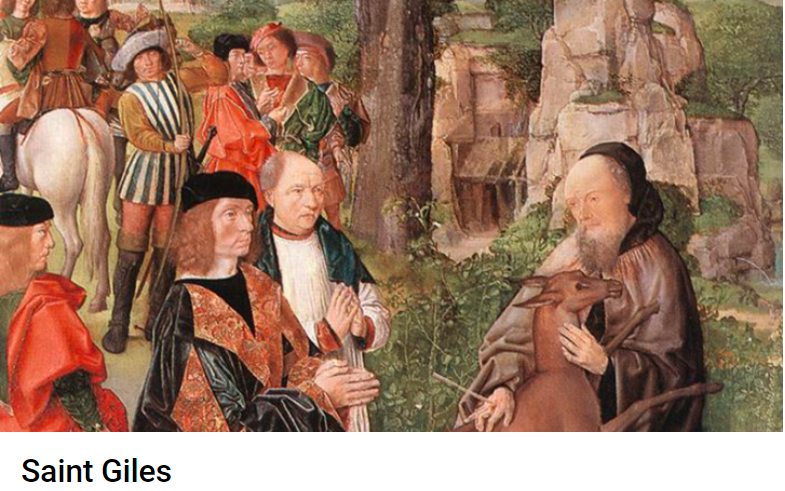
Despite the fact that much about Saint Giles is shrouded in mystery, we can say that he was one of the most popular saints in the Middle Ages. Likely, he was born in the first half of the seventh century in southeastern France. That is where he built a monastery that became a popular stopping-off point for pilgrims making their way to Compostela in Spain, and the Holy Land.
In England, many ancient churches and hospitals were dedicated to Giles. One of the sections of the city of Brussels is named after him. In Germany, Giles was included among the so-called 14 Holy Helpers, a popular group of saints to whom people prayed, especially for recovery from disease, and for strength at the hour of death. Also among the 14 were Saints Christopher, Barbara, and Blaise. Interestingly, Giles was the only non-martyr among them. Devotion to the “Holy Helpers” was especially strong in parts of Germany and in Hungary and Sweden. Such devotion made his popularity spread. Giles was soon invoked as the patron of the poor and the disabled.
The pilgrimage center that once drew so many fell into disrepair some centuries after Giles’ death.
Reflection
Saint Giles may not have been a martyr but, as the word martyr means, he was a true witness to the faith. This is attested to by the faith of the People of God in the Middle Ages. He became one of the “holy helpers” and can still function in that role for us today.