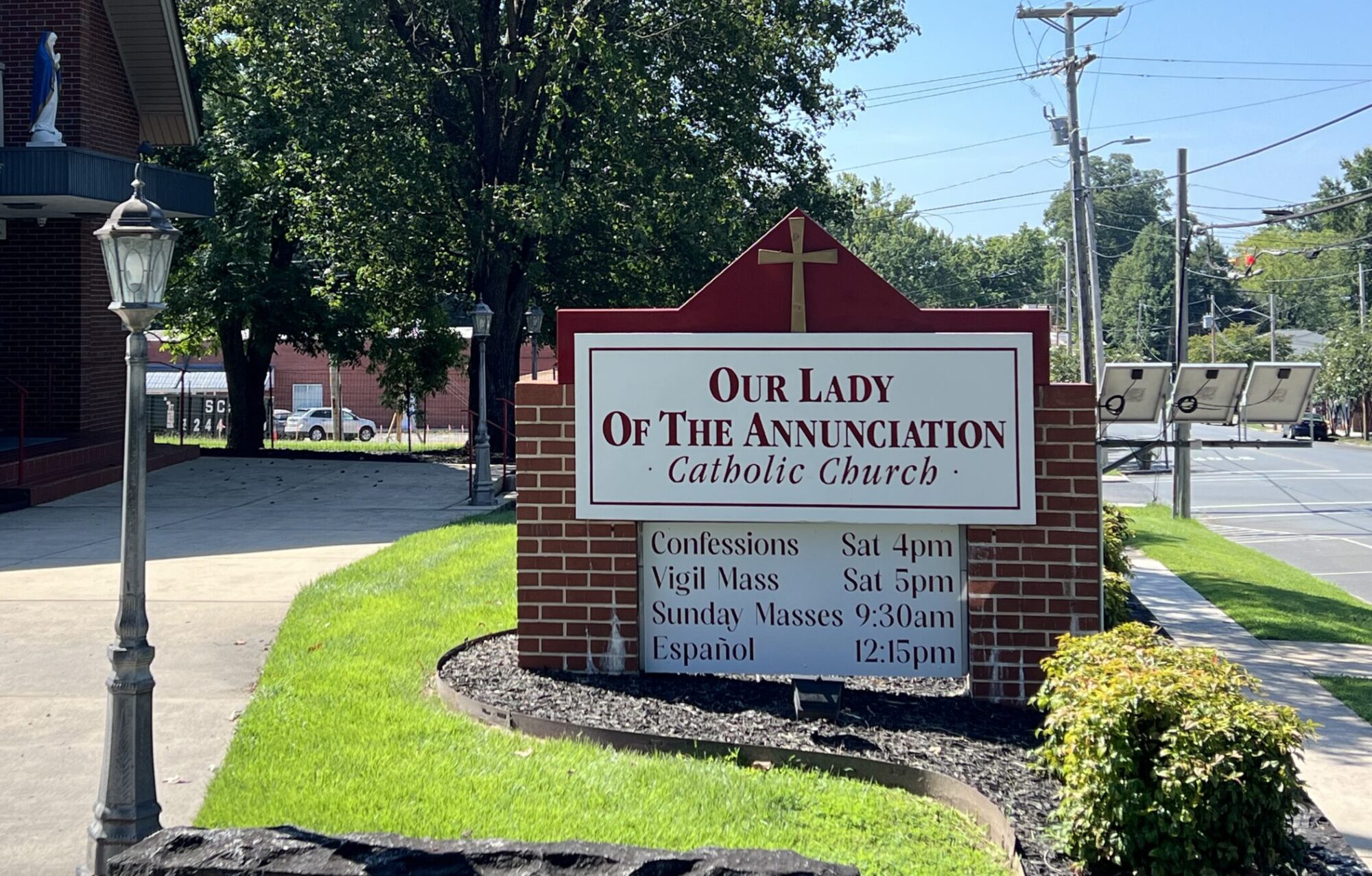
Sermon Notes – December 25, 2025 – I got God for Christmas

“I got God for Christmas”

Father Peter Fitzgibbons

December 25, 2025

Gospel: John 1:1-18

Last week, I had to call 911 for a lady who thought she had been bitten by a snake. That was a lot of fun. But it was not the first time – I have called 911 several times for other people. I hope you never have to call 911, because when you do, you are upset, anxious, excited, and all wrapped up in the situation. When you call 911, the operators are very good, and they get all of your information. After you hang up the phone, you wait, and you wait, and you wait. Soon, you begin to wonder why they aren’t there already. As the crow flies, the EMTs are only two miles away. Less than three miles away, there are five fire stations: three regular and two volunteer. Also, less than a mile away, there are two cop shops: sheriff and police. After you call, you begin tapping your fingers and wondering when they will arrive. After what seems like an eternity, you hear sirens in the distance. So, you know they are on their way. They are coming, and they are coming, and they are coming, very slowly, but they are coming. “This is an emergency! Someone is hurt. I need help!” However, the police and rescue squads are constrained by the speeds at which they can drive in the city. That’s the theory, but I have seen sheriff deputies and EMTs whizz by the church. When I see an ambulance scream by on the way to the hospital, I know someone is in really bad shape. When the police, fire department, EMTs, or rescue personnel finally arrive, the healing can begin. They take charge and assure you that they will do everything they can to improve the situation. They work their magic, and your anxiety level lessens.

The same is true about our salvation and redemption. When our first parents hurt themselves and us badly by Original Sin, we needed help. But amazingly, we did not call 911 or GOD. God did that Himself because the offense was so grave that we alone couldn’t make amends. It was a divine offense. In the garden, we walked with God and talked to God. Then we gave God the shaft because we wanted to do what we wanted. But God loves us so much that He didn’t want us to wander away from Him. He said, “I will send you a savior” to remedy the divine offense. This divine offense could be fixed by only one Person – His divine Son, the 2nd Person in the Blessed Trinity. He came to be our Savior. On this day, we commemorate His appearance in the world made visible in the form of human flesh that He took from the Blessed Mother.

When you look at the manger scene, which was originally created by Saint Francis of Assisi, you can foretell the future. Our Lord came to be our Savior and to be sacrificed as atonement for our sins. The wood of the manger became the wood of the Cross 33 years later. The hay He laid on was food for the animals and became our food in the Holy Eucharist. There’s enough just on that for two sermons, but we don’t have the time. He came as our Savior, and that’s what we rejoice in. Today, as we celebrate His coming, our healing has begun. The straying from God is over. God has come to heal the damage in our souls due to sin, to remove the cancer, and to help us live so that we can go to where we were created to be, which is Heaven. He came to heal us and to reconcile us to God. That is the beauty of this day and the great joy we should have.

Who do you see around the Christ Child? You see Mary, Joseph, and the shepherds. The wise men wouldn’t come until much later. But wouldn’t you love to have been there at the beginning of the First Century? Well, you don’t have to be envious. Know why? Because you have Him right there in the Tabernacle, although not under the appearance of human flesh, but of the Host. You have Him right here at Mass. What is our Savior’s greatest gift to us? His greatest gift to us is Himself. He offers Himself to us in the Sacraments, which is the greatest gift at Christmas. If you ask, “What did you get for Christmas?” My answer is, “I got God.”

How will you apply this message to your life? _________________________________________

You can read all of Father Fitzgibbons’ sermons by going to AnnunciationCatholicAlbemarle.com, clicking on “Blog” then “Categories” and then “Sermon Notes.” On a cell phone: click on “Blog” and then “Menu.” Scroll to the bottom and click on “Categories.” Sermon Notes are also available on the Church’s Facebook page at OLA.Catholic.Church. Click on “Groups” and then “Sermon Notes.”
Sermon Notes – June 22, 2025 – “A Funny Thing About Catholics . . .”

“A Funny Thing About Catholics . . .”

Father Peter Fitzgibbons

June 21-22, 2025

Gospel:  Luke 9:11B-17

A funny and interesting thing about Catholics is that we don’t sing that well, but we are extraordinarily good-looking.  Another interesting thing about us is that we hold somewhat odd Christian beliefs.  “What do you mean?”  We believe what Scripture tells us – just the black part, not the white.  People will ask, “Where do you Catholics find that in Scripture?”   I will tell you because I did go to school and passed a lot of tests.  I have a document to prove it.  But before you ask that question, remember that Christ came down to establish a church and not to write a book.  Christ said, “You are Peter, and upon this rock I will build my church” (Matthew 16:18).  He did not come here to write a book.  The Catholic Church wrote the Bible, and it wasn’t codified until the fourth century.  By that time, the Catholic Church had spread throughout the entire Roman Empire.  So, you need to put things into perspective before asking questions. 

We believe what Jesus said, “If you do not eat the flesh of the Son of man and drink His blood, you have no life in you” (John 6:53).  We believe what Jesus said.  “Well, that just means to spiritually commune.”  No.  In Greek and English, the word “eat” means the same thing.  That’s one translation they got right.  It means to physically chew, masticate, and consume.  People thought He was preaching about cannibalism, and that’s why everyone left Him except the 12 Apostles.  “If you do not eat the flesh of the Son of man and drink His blood, you have no life in you.”  He offers us all that life through the Apostles, bishops, and priests whom He ordained at the Last Supper to give us that means of life so that we may have life and have it to the fullest.  But He also cautions us.  Saint Paul wrote, “Whoever, therefore, eats the bread or drinks the cup of the Lord in an unworthy manner will be guilty of profaning the body and blood of the Lord (1 Corinthians 11:27).   They are guilty of His death.  Nobody is going to the guillotine if they do, but it is a mortal sin, and you cut yourself off from salvation.  This is the core of our Faith.  

So, the Eucharist is more than about appearances, unity, and making us all one.  Ah-Ah-Ah.  No.  You do that while sitting around a campfire singing Kumbaya.  That’s not what the Body and Blood of Christ was made for.  It was made for our salvation and to give us the divine life that we lost by our sins.  That’s why the penalty is so great if we receive the Blessed Sacrament unworthily.  And that’s why we have all these “rules.”   “Well, how can He do all that?”  Let me see, He created the world out of nothing, raised people from the dead. . . would you like me to go on?   Why are you denying the power of Christ?  That’s what He said.   

Now, when I was young, I had to walk to school uphill both ways in a snowstorm in July.  One of my friends was complaining that it was going to reach 100 degrees that day.  I didn’t want to be too much of a smart aleck because she is my Italian food connection, but I said, “The highest temperature I experienced was in the 130s”.  That conversation stopped rather quickly.  “Oh, it’s hot!”  You have no idea what hot is.  Wait till later, if you don’t live right, and then you will find out what real hot is. 

When we get sick, we visit the pharmacy, and they provide us with medicine.  At one time, I guess the prevailing wisdom was that if the medicine tasted like garbage, it was better for you.  “Oh, this must be really good because it tastes so bad!”   But now pharmaceuticals have changed, and people use them like candy even though they are narcotics.  “Oh, this tastes so good!”  You cannot taste what is underneath, but just because we cannot taste the medicine does not mean it isn’t working.  I do not taste or feel the medicine I take in the morning. However, when I check my blood pressure on the machine in the Family Life Center, I know it is functioning properly.  You cannot taste God’s healing in your medicine.   But it’s there.  So, if we accept that, why can we not accept Christ saying, “This is My Body” and “This is My Blood”? 

Sometimes, when we have wonderful things in our lives, we tend to take them for granted, for example, our family and friends.   I have to look down at my family because I outlived them all.  Look at your family and those whom you love most.  Sometimes, we take them for granted.   Mass is offered every day, and we take it for granted.  Our Lord is present in the Most Blessed Sacrament, and we take Him for granted.  By the way, do you know what happens in the Mass?  We teach children in Faith Formation a six-syllable word: transubstantiation.   During the Mass, when the priest, acting in the persona of Christ, says, “This is My body” and “This is My blood,” the wine and blood become the body and blood of Christ.  “Well, transubstantiation is a big word, Father.”  But you know how to use an iPhone, don’t you?  Okay, I don’t, but I know people who do.  We have the great opportunity to spend time with God Incarnate.  If we are in a State of Grace, we have the wonderful opportunity every day, and twice a day on special occasions, to receive the Most Precious Body and Blood of our Savior given to us by the hands of the priest so that we may be fed by Christ just like the Apostles.   God gives us healing and His very Self so that we may have life and have it to the fullest. 

How will you apply this message to your life? _________________________________________

You can read all of Father Fitzgibbons’ sermons by going to AnnunciationCatholicAlbemarle.com, clicking on “Blog,” then “Categories,” and then “Sermon Notes.”  On a cell phone: click on “Blog” and then “Menu.”  Scroll to the bottom and click on “Categories.”  Sermon Notes are also available on the Church’s Facebook page at OLA.Catholic.Church.  Click on “Groups” and then “Sermon Notes.


The Rosary in a Year – Day 178 – Open the Door

In Tanner’s painting, Christ and the Disciples Before the Last Supper, we see Jesus and a few disciples before they enter the upper room to eat the Passover. In moments, the institution of the Eucharist will occur. Fr. Mark-Mary invites us to experience the incredible love Jesus is inviting them into before they enter and share the Passover meal. Today’s focus is the mystery of the Institution of the Eucharist and we will be praying one decade of the Rosary.

https://www.youtube.com/@TheRosaryinaYear


The Rosary in a Year – Day 158 – Wash All of Me

Jesus gives himself totally to us in the Eucharist, body, blood, soul, and divinity. Today’s art, The Last Supper, by Juan de Juanes (Vicente Juan Masip) includes the bowl and urn used for the washing of feet, reminding us of Peter’s request that Jesus wash him entirely. This is the attitude, Fr. Mark-Mary says, that we should bring as we receive the Eucharist. Today’s focus is the mystery of the Institution of the Eucharist and we will be praying one decade of the Rosary.

https://www.youtube.com/@TheRosaryinaYear


The Rosary in a Year – Day 138 – Rest in All Things

Even at the Last Supper, anticipating his passion, Jesus is at peace, as depicted in today’s mosaic by Giacomo Raffaelli. Jesus can be at peace because he knows who he is and he knows who his Father is. In this mystery, we’re invited to find rest in Jesus through trust and surrender to the Father. Today’s focus is the mystery of the Institution of the Eucharist and we will be praying one decade of the Rosary.

https://www.youtube.com/@TheRosaryinaYear


The Rosary in a Year – Day 98 – An Abyss of Love

Aided by a meditation from St. Catherine of Siena’s Dialogue, we reflect on the profound gift of the Eucharist. Jesus tells each and every one of us how deeply he loves us as he says, ”I have earnestly desired to eat this Passover with you,” a love we partake of each time we approach the Eucharist. Today’s focus is the mystery of the Institution of the Eucharist and we will be praying one decade of the Rosary.

https://www.youtube.com/@TheRosaryinaYear


The Catechism in a Year – Day 362 – Our Daily Bread

Asking God for our “daily bread” is a petition for him to fill our physical and spiritual hunger. Fr. Mike breaks down this simple yet profound petition that reminds us of our reliance on God for all our needs. In this part of the Lord’s prayer, we turn to God with childlike hearts, trusting that he will nourish us with all the appropriate material goods and, above all, with the Eucharist. Today’s readings are Catechism paragraphs 2828-2837.

Click on link: https://youtu.be/pPQIorBCULc?si=URYl6v5DOfnW2byH


The Catechism in a Year – Day 339 – Prayer of Praise

We examine both prayers of praise and also the “nuggets” for this section on the forms of prayer. Fr. Mike emphasizes that praise is giving God glory for who he is. He also emphasizes that the Eucharist is the ultimate prayer of praise, and that every time we pray we are joining our lives to the saints and prophets who have gone before us. Today’s readings are Catechism paragraphs 2639-2649.

Click on link: https://youtu.be/h8y5BlGk2LA?si=9gYwDqdK6OnNZrri


The Catechism in a Year – Day 282 – The Sunday Obligation

Why are Catholics obligated to attend Mass every Sunday? The Catechism teaches us today about the centrality of the Sunday celebration of the Eucharist in the life of the Church. Fr. Mike emphasizes that Sunday Mass is at the heart of our worship because it is the participation in the representation of the Paschal Mystery. He invites us to honor the Sunday obligation out of love for Jesus. Today’s readings are Catechism paragraphs 2177-2183.

Click on link: https://youtu.be/6xy6GkQVQ44?si=2FxoZ_C9o1POpJiQ


Saint of the Day – August 3 – Saint Peter Julian Eymard

Saint Peter Julian Eymard’s Story (February 4, 1811 – August 1, 1868)

Born in La Mure d’Isère in southeastern France, Peter Julian’s faith journey drew him from being a priest in the Diocese of Grenoble in 1834, to joining the Marists in 1839, to founding the Congregation of the Blessed Sacrament in 1856.

In addition to those changes, Peter Julian coped with poverty, his father’s initial opposition to Peter’s vocation, serious illness, a Jansenistic overemphasis on sin, and the difficulties of getting diocesan and later papal approval for his new religious community.

His years as a Marist, including service as a provincial leader, saw the deepening of his Eucharistic devotion, especially through his preaching of Forty Hours in many parishes. Inspired at first by the idea of reparation for indifference to the Eucharist, Peter Julian was eventually attracted to a more positive spirituality of Christ-centered love. Members of the men’s community which Peter founded alternated between an active apostolic life and contemplating Jesus in the Eucharist. He and Marguerite Guillot founded the women’s Congregation of the Servants of the Blessed Sacrament.

Peter Julian Eymard was beatified in 1925 and canonized in 1962, one day after Vatican II’s first session ended.

Reflection

In every century, sin has been painfully real in the life of the Church. It is easy to give in to despair, to speak so strongly of human failings that people may forget the immense and self-sacrificing love of Jesus, as his death on the cross and his gift of the Eucharist make evident. Peter Julian knew that the Eucharist was key to helping Catholics live out their baptism and preach by word and example the Good News of Jesus Christ.