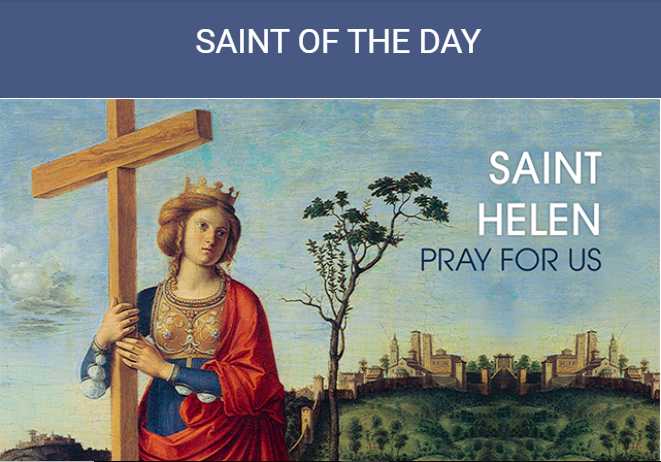
St. Helen, also known as St. Helena (d. 327 A.D.), was a woman of humble means from Asia Minor. She married the future Roman Emperor Constantius Chlorus, and their son Constantine was born c. 272. Constantius divorced Helen in c. 293 to marry Emperor Maximian’s daughter for the sake of political gain. When her son Constantine became the Roman Emperor, St. Helen was given the imperial title “Augusta” and was treated like royalty. After Constantine legalized Christianity across the Roman Empire, St. Helen, a Christian convert, went to the Holy Land in search of the actual cross on which Christ was crucified, despite being in her 80s. She questioned local Christians and Jews and learned that the cross was buried under the Temple of Venus. Helen had the temple demolished and excavated. There she discovered the Holy Sepulcher, three crosses, the board with Pilate’s inscription, and the nails which pierced Jesus’ Sacred Body. In order to determine which cross was the Lord’s, the Bishop of Jerusalem touched them to a corpse, causing the man to come back to life. A second miraculous healing of a sick woman confirmed the discovery of the True Cross. Christians flocked to Jerusalem to venerate the Holy Cross. St. Helen then visited all the holy places of Jesus’ life and built many churches over their locations, including Bethlehem, the Mount of Olives, and the Garden of Gethsemane. St. Helen is the patron of divorced people, empresses, difficult marriages, converts, and archeologists. Her feast day is August 18th.
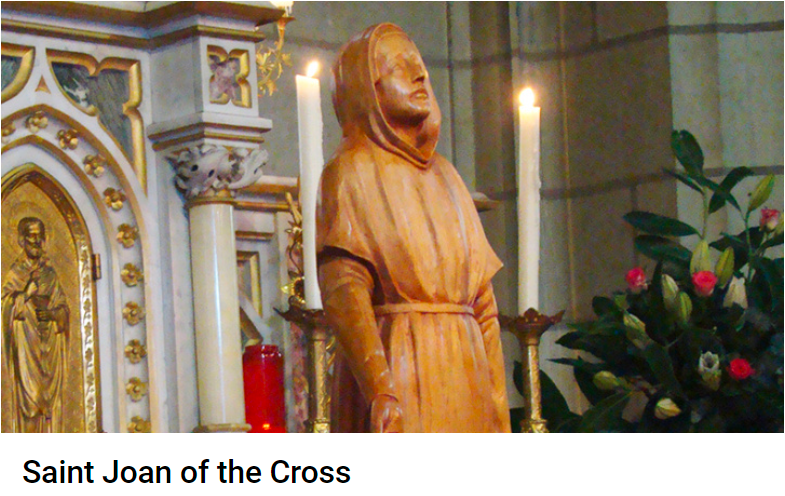
An encounter with a shabby old woman many dismissed as insane prompted Saint Joan to dedicate her life to the poor. For Joan, who had a reputation as a businesswoman intent on monetary success, this was a significant conversion.
Born in 1666, in Anjou, France, Joan worked in the family business—a small shop near a religious shrine—from an early age. After her parents’ death she took over the shop. She quickly became known for her greediness and insensitivity to the beggars who often came seeking help.
That was until she was touched by the strange woman who claimed she was on intimate terms with the deity. Joan, who had always been devout, even scrupulous, became a new person. She began caring for needy children. Then the poor, elderly, and sick came to her. Over time, she closed the family business so she could devote herself fully to good works and penance.
She went on to found what came to be known as the Congregation of Saint Anne of Providence. It was then she took the religious name of Joan of the Cross. By the time of her death in 1736 she had founded 12 religious houses, hospices, and schools. Pope John Paul II canonized her in 1982.
Reflection
The downtown areas of most major cities hold a population of “street people.” Well-dressed folks usually avoid making eye contact, probably for fear of being asked for a handout. That was Joan’s attitude until the day one of them touched her heart. Most people thought the old woman was crazy, but she put Joan on the road to sainthood. Who knows what the next beggar we meet might do for us?
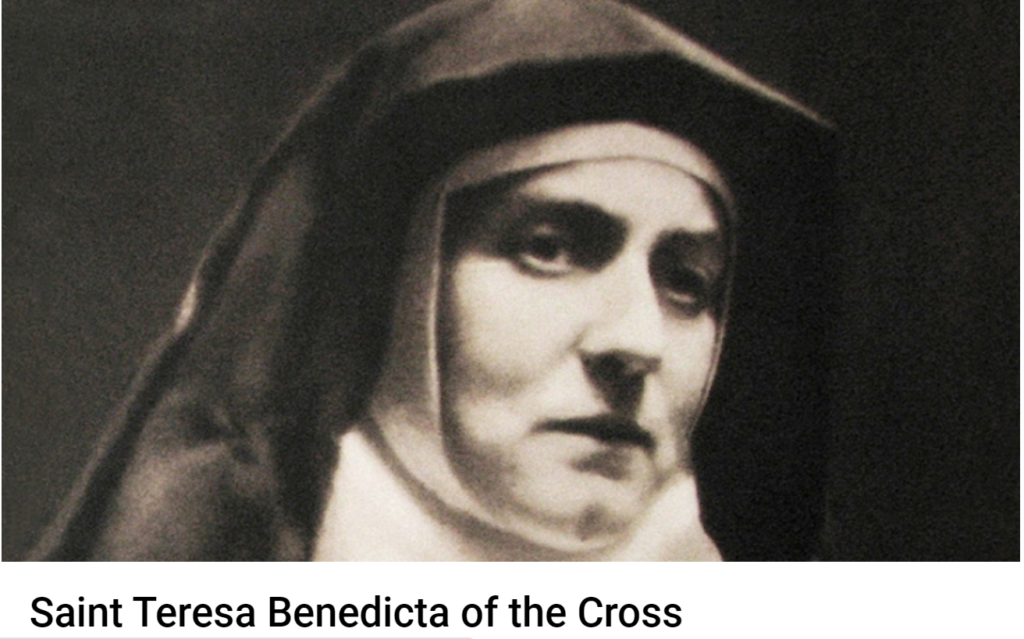
A brilliant philosopher who stopped believing in God when she was 14, Edith Stein was so captivated by reading the autobiography of Teresa of Avila that she began a spiritual journey that led to her baptism in 1922. Twelve years later she imitated Saint Teresa by becoming a Carmelite, taking the name Teresa Benedicta of the Cross.
Born into a prominent Jewish family in Breslau, Germany—now Wroclaw, Poland—Edith abandoned Judaism in her teens. As a student at the University of Göttingen, she became fascinated by phenomenology–an approach to philosophy. Excelling as a protégé of Edmund Husserl, one of the leading phenomenologists, Edith earned a doctorate in philosophy in 1916. She continued as a university teacher until 1922, when she moved to a Dominican school in Speyer; her appointment as lecturer at the Educational Institute of Munich ended under pressure from the Nazis.
After living for four years in the Cologne Carmel, Sister Teresa Benedicta moved to the Carmelite monastery in Echt, Netherlands, in 1938. The Nazis occupied that country in 1940. In retaliation for being denounced by the Dutch bishops, the Nazis arrested all Dutch Jews who had become Christians. Teresa Benedicta and her sister Rosa, also a Catholic, died in a gas chamber in Auschwitz on August 9, 1942.
Pope John Paul II beatified Teresa Benedicta of the Cross in 1987 and canonized her 12 years later.
Reflection
The writings of Edith Stein fill 17 volumes, many of which have been translated into English. A woman of integrity, she followed the truth wherever it led her. After becoming a Catholic, Edith continued to honor her mother’s Jewish faith. Sister Josephine Koeppel, O.C.D., translator of several of Edith’s books, sums up this saint with the phrase, “Learn to live at God’s hands.”
Saint Teresa Benedicta of the Cross is a Patron Saint of:
The only thing we should have pride in is the mercy of our good Lord. From His pierced heart, flows the river of Sacramental love so that we may have life and have it to the fullest in this life and in the next. It is our means of salvation. What we should be proud of, and the only thing, is our Savior’s love. It’s not a sin or a debauchery.
Now, let me tell you what you must do to get to heaven. You have to do one thing, and it’s extraordinary. You know what it is? You may be thinking, “Oh, God! Father, please, I’m having enough problems with the ordinary stuff! What the heck are the extraordinary things?” Well, although it’s extraordinary, it’s not hard. God doesn’t ask us to do hard things. The extraordinary thing we have to do is do ordinary things ordinarily; in other words, do routine things routinely. Do the same things day after day after day.
Jesus said, “If you love Me and wish to be My follower, take up your cross every day and follow Me.” So, we take up our cross and follow Him. Now, our goal is progress…not perfection. This includes saying our prayers, not choking the you-know-what out of someone who desperately needs it, and practicing spiritual and corporal works of mercy. When I say “practicing,” I mean practicing just like doctors practice medicine. It’s not perfect, but they keep trying. Another way to carry our cross is by going to Mass every Sunday and on Holy Days, and maybe even on other days of the week. The doors are open, and on weekdays, we don’t take up a collection. So, you’re welcome to come in and get extra credit. You also can carry your cross by going to Confession once a year…every three months is better. Who wants to walk around with all that doodoo staining your soul that affects the body, mind, and spirit. You’ll have a much better attitude. We have much better vision and self-awareness when our souls are bathed in the most precious blood of Christ. These are the ordinary things we can do ordinarily…the routine things we can do routinely, and that’s the extraordinary part.
Because we do ordinary things, some may be tempted, and it’s a grave temptation, to stop, because they think that they are not progressing, they think they aren’t good at it, or they believe it’s not benefitting them. All of that is a lie by the devil. “I don’t think my medicine is helping me get well, so I’m going to stop taking it.” That’s not going to lead to a good outcome. Likewise, if we stop doing ordinary spiritual works of mercy, that also won’t lead to a good outcome. The extraordinary part is when we keep doing it and doing it…whether we enjoy it or not. We embrace the suck. I don’t enjoy eating fish. But, I have to eat it, because it was prescribed by my doctor. That’s doing an ordinary thing ordinarily. If I don’t follow my doctor’s advice, it’s a sin against the Fourth Commandment and a sin against the Fifth Commandment, because I would be endangering my life unnecessarily.
Is doing ordinary things ordinarily a lot of fun? No. “Father, you’re a professional.” Yes. “Do you always enjoy your prayers?” No. If you catch me in the morning around 7:30, I’ll be over here saying my prayers. You will notice, if you see me day after day, that I’m not walking on air. I’m not levitating. I’m not in mystical ecstasy every time I say the Rosary. I’m not always happy. Do my prayers always thrill me? Oh, heck no! Do I want to listen to one more whiner who comes in to complain? “Oh, Father, it’s too hot in church!” Oh, shut up. Do I want to listen to that? No. But, remember, everything we do should be focused on Him, our Beloved. The things we do are acts of love to our dear Lord and are not done to please ourselves. When you are tempted to stop doing ordinary things ordinarily, the focus is on you. I’m not much but I’m all I think about…that’s one of my favorite sayings. Whatever we do, whatever our gifts of love for our Lord are, big or small, they are acts of love and devotion to our Savior.
Now, as you know, in the Oval Office at the White House, there’s a phone that goes from the United States to the Soviet Union in case there is a nuclear war so that people don’t end up in a mushroom cloud. In the Vatican, there is also such a phone. Remember the bat phone? It’s kind of like that. This phone doesn’t go from the Vatican to the United States or to Russia. It goes from the Vatican to Heaven. It’s not used, but occasionally the housekeepers come along and dust it like any other piece of furniture. This phone had never rang, but, one day it did. Whoa! I doubt it was a wrong number. Everyone was too scared to touch it. No one but the pope could answer the phone, so, they found the Holy Father, brought him in, and he picked up the phone. The pope said, “Yes, Lord. Yes, Lord.” The pope smiled and put the phone down. By that time, everyone in the Vatican had gathered around. “Holiness, who was it? Speak to us!” The pope said, “It was God.” “What did He say?” The pope responded, “He’s coming back soon.” “Holiness, what should we do?” The pope answered, “Look busy!”
How will you apply this message to your life? Are you doing routine things routinely? Are you coming to weekend Mass and going to Confession at least once a year? Are you practicing corporal and spiritual works of mercy?
You can read all of Father Fitzgibbons’ sermons by going to https://annunciationcatholicalbemarle.com/ and clicking on “Blog” then “Categories” and then “Sermon Notes.” From a cell phone, click on “Blog” then “Menu” and then “Categories” (located at the end of page). There is also a search box if you are looking for a specific topic.
Jesus said that the Son of Man will be lifted up. He also said, “When I am lifted up from the Earth, I will draw all men to myself.” And, He does. However, He doesn’t draw people up to Him on the cross just for them to say, “Gee, that must hurt.” This is not a spectator sport. Rather, our good Lord reaches down from the cross and says, “Take My hand and come up to Me, because this is the way to salvation. Join Me on the cross.” Paul finally learned that lesson. He wrote, “Now, I rejoice in sufferings for Your sake, and in my flesh I complete what is lacking in Christ’s afflictions for the sake of His body, that is, the Church.” Our sufferings, all the crosses we carry and the crosses we carry for others are redemptive. They are not only for ourselves, but for others. We join Christ in the sacrifice like the good thief on the cross. We unite ourselves to Him, so that He will raise us up. You do that when you make your Morning Offering: “I offer you my prayers, works, joys, and sufferings of this day.” All those crosses God allows us to carry…Ugh. I don’t know about you, but I’m not crazy about mine.
We also join Christ in the sacrifice during the Mass by true and active participation. So, what is true and active participation? It’s not those who sing the loudest, pray the loudest, or run a ministry. Whatever that is. The term “ministry” really means nothing. It only applies to Holy Orders, but it has been so overused, it means nothing now. True and active participation is the giving of your human nature to the priest who acts in the person of Christ on the altar. He takes your human nature in the offertory, immolates them, and makes them one with the sacrifice of Christ. He immolates them on the altar as part of the sacrifice of God’s love for us. That is true and active participation. This is how we unite ourselves and become one with the sufferings of Christ just as the Blessed Mother, Saint John, Mary the wife of Clopas, and Mary of Magdala did at the foot of the cross…especially the Blessed Mother…her human nature was suffering for Him. For us, it’s only intellectual, so it doesn’t matter whether you feel it or not. That has nothing to do with its effectiveness. However, it’s only when you do that you are one with Christ on the cross.
There will always be temptations from the cross. Just as Christ was tempted many times to come down from the cross, we will be too. What were the first three temptations? “All religion is just a show.” “If you have good music, a praise band or whatever, people will come.” Our Lord says this is not a show. This is an act of love. “Well, you know with religion, you gotta give people food and stuff.” “Everybody will be happy if they take your stuff and give it to somebody else.” “It’s all power.” “It’s all Socialism.” “True religious charity is just giving them bread…they will be fine.” How many fat people are there in prison? A lot. It’s not that they lack food. Their problem is that they practice evil. Now, there are a lot of people outside of prison who practice evil, but they haven’t been caught yet. It’s all about power. “Well, if we had fairer laws, then we wouldn’t have any problems.” That’s not true. We have more laws than lawyers know about. Oh, by the way, drugs are illegal. Did you know that? Apparently, a lot of people don’t. Read the sheriff’s blotter report, and that’s just the tip of the iceberg.
Another temptation is to deny the divine message. You see, we are much brighter in the 21st Century. We know better, because we are so enlightened and so highly educated. We can’t write in cursive, but we are really educated. We know what God’s word truly means. Before, they weren’t too sure, because they were all stupid. When Christ proclaimed that marriage was between one man and one woman unless separated by death, everyone left Him except the 12 apostles. People didn’t like that. Also, when Peter tried to sway Christ from going to the cross, He called Peter, “Satan.”
The third type of temptation is the Eucharist. “Unless you eat the flesh of the Son of man and drink His blood, you have no life in you.” “Oh, He didn’t really mean that.” That’s what He said, and He meant it. The words really mean that. Everyone left Him except the 12 apostles. The last temptation was, “Come down from the cross, and we will believe in you.” In His heart, Christ was saying, “You don’t understand. You’ve forgotten your education.” “If the Church changes its laws, everyone will come back.” Really? We have Mass in English. We have Mass in Spanish (Spanglish). We have Mass on Saturdays at 5 pm. We have Mass on Sundays at 9:30 and 12:15. We have confessions face-to-face, although not here, because it’s not safe for the priests anymore. So, where is everybody?
Temptations in one form or another will assail us. “Am I doing something wrong because I’m tempted?” No, you are doing something right, because you are tempted. Our Lord says, “Come up to Me. Come up. I am trying to give you eternal happiness. I am trying to give your soul peace.” So, we have a tug of war with Christ on the cross. He wants to pull us up, and we want to pull Him down. Instead, we can unite ourselves in the sacrifice of Christ in the Morning Offering prayer, resignation to our exterior and interior crosses, and resignation of the will…the most difficult cross. In the midst of temptation, the good thief on the cross accepted the suffering for his sins, and was united with Christ. What did Christ tell him? “Today, you will be with Me in paradise.”
How will you apply this message to your life? Will you unite yourself in the sacrifice of Christ by saying the Morning Offering prayer? Will you accept your interior and exterior crosses and join Christ in His suffering?
You can read all of Father Fitzgibbons’ sermons by going to https://annunciationcatholicalbemarle.com/ and clicking on “Blog” then “Categories” and then “Sermon Notes. From a cell phone, click on “Blog” then “Menu” and then “Categories” (located at the end of page). There is also a search box if looking for a specific topic.
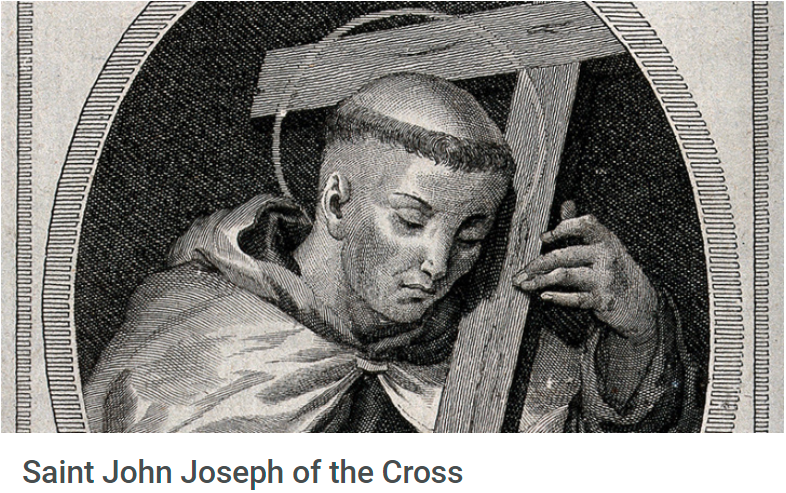
Self-denial is never an end in itself but is only a help toward greater charity—as the life of Saint John Joseph shows.
John Joseph was very ascetic even as a young man. At 16, he joined the Franciscans in Naples; he was the first Italian to follow the reform movement of Saint Peter Alcantara. John Joseph’s reputation for holiness prompted his superiors to put him in charge of establishing a new friary even before he was ordained.
Obedience moved John Joseph to accept appointments as novice master, guardian and, finally, provincial. His years of mortification enabled him to offer these services to the friars with great charity. As guardian he was not above working in the kitchen or carrying the wood and water needed by the friars.
When his term as provincial expired, John Joseph dedicated himself to hearing confessions and practicing mortification, two concerns contrary to the spirit of the dawning Age of Enlightenment. John Joseph of the Cross was canonized in 1839.
Reflection
John Joseph’s mortification allowed him to be the kind of forgiving superior intended by Saint Francis. Self-denial should lead us to charity—not to bitterness; it should help us clarify our priorities and make us more loving. John Joseph is living proof of Chesterton’s observation: “It is always easy to let the age have its head; the difficult thing is to keep one’s own” (G. K. Chesterton, Orthodoxy, page 101).
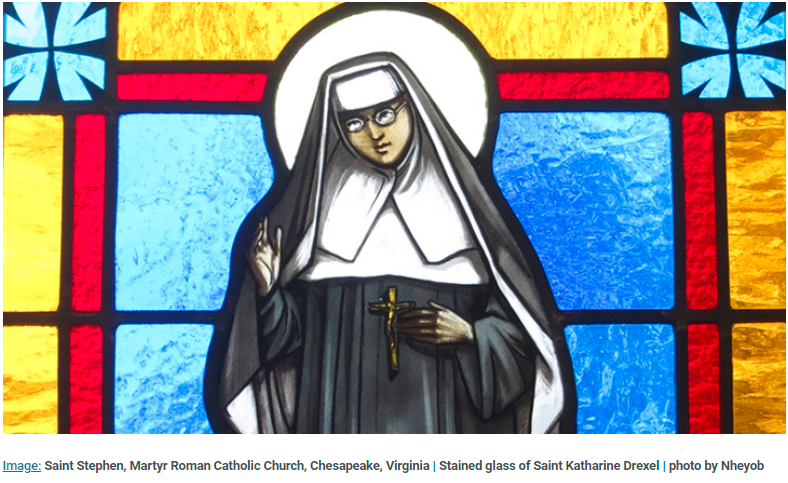
Katharine Drexel (November 26, 1858 – March 3, 1955)
If your father is an international banker and you ride in a private railroad car, you are not likely to be drawn into a life of voluntary poverty. But if your mother opens your home to the poor three days each week and your father spends half an hour each evening in prayer, it is not impossible that you will devote your life to the poor and give away millions of dollars. Katharine Drexel did that.
Born in Philadelphia in 1858, she had an excellent education and traveled widely. As a rich girl, Katharine also had a grand debut into society. But when she nursed her stepmother through a three-year terminal illness, she saw that all the Drexel money could not buy safety from pain or death, and her life took a profound turn.
Katharine had always been interested in the plight of the Indians, having been appalled by what she read in Helen Hunt Jackson’s A Century of Dishonor. While on a European tour, she met Pope Leo XIII and asked him to send more missionaries to Wyoming for her friend Bishop James O’Connor. The pope replied, “Why don’t you become a missionary?” His answer shocked her into considering new possibilities.
Back home, Katharine visited the Dakotas, met the Sioux leader Red Cloud and began her systematic aid to Indian missions.
Katharine Drexel could easily have married. But after much discussion with Bishop O’Connor, she wrote in 1889, “The feast of Saint Joseph brought me the grace to give the remainder of my life to the Indians and the Colored.” Newspaper headlines screamed “Gives Up Seven Million!”
After three and a half years of training, Mother Drexel and her first band of nuns—Sisters of the Blessed Sacrament for Indians and Colored—opened a boarding school in Santa Fe. A string of foundations followed. By 1942, she had a system of black Catholic schools in 13 states, plus 40 mission centers and 23 rural schools. Segregationists harassed her work, even burning a school in Pennsylvania. In all, she established 50 missions for Indians in 16 states.
Two saints met when Mother Drexel was advised by Mother Cabrini about the “politics” of getting her order’s Rule approved in Rome. Her crowning achievement was the founding of Xavier University in New Orleans, the first Catholic university in the United States for African Americans.
At 77, Mother Drexel suffered a heart attack and was forced to retire. Apparently her life was over. But now came almost 20 years of quiet, intense prayer from a small room overlooking the sanctuary. Small notebooks and slips of paper record her various prayers, ceaseless aspirations, and meditations. She died at 96 and was canonized in 2000.
Reflection
Saints have always said the same thing: Pray, be humble, accept the cross, love and forgive. But it is good to hear these things in the American idiom from one who, for instance, had her ears pierced as a teenager, who resolved to have “no cake, no preserves,” who wore a watch, was interviewed by the press, traveled by train, and could concern herself with the proper size of pipe for a new mission. These are obvious reminders that holiness can be lived in today’s culture as well as in that of Jerusalem or Rome.
31 Again he left the district of Tyre and went by way of Sidon to the Sea of Galilee, into the district of the Decapolis. 32 And people brought to him a deaf man who had a speech impediment and begged him to lay his hand on him. 33 He took him off by himself away from the crowd. He put his finger into the man’s ears and, spitting, touched his tongue; 34 then he looked up to heaven and groaned, and said to him, “Ephphatha!” (that is, “Be opened!”) 35 And [immediately] the man’s ears were opened, his speech impediment was removed, and he spoke plainly. 36 He ordered them not to tell anyone. But the more he ordered them not to, the more they proclaimed it. 37 They were exceedingly astonished and they said, “He has done all things well. He makes the deaf hear and [the] mute speak.”
God is thankful for our used kitty litter and in return gives us the greatest gift of all…Himself. So, get rid of your spiritual kitty litter!
A man at the VA Hospital who was grieving over the loss of his wife told the hospital staff that he needed to speak to a priest who was a combat veteran. When I spoke to the man, who was a former medic in Vietnam, he told me about the many things he does for the Church and that he was in constant prayer. I told him that hyperreligiosity is a sign of mental illness. This immediately changed the direction of our conversation. I asked the man if he knew how many soldiers he had saved in Vietnam, and he had no idea. But, when I asked him how many he had lost, he knew them all by name. It was a burden that he carried with him….his cross. This man’s wife had died two years earlier. She was the one had who helped him deal with the stress, and when she was gone, he was lost. I advised him to go help his fellow veterans at his parish, and that they would, in turn, help him carry his cross.
Our crosses are a gift. God takes our sins and transforms them into good. For example, God used two alcoholics, a doctor and a stockbroker, to start Alcoholics Anonymous. The idea behind AA is that alcoholics keep their sobriety by helping other alcoholics keep theirs. It is the same for us. If we want help with our crosses, we must help others with theirs through our prayers and labor. Doing so helps us see our own crosses with fresh eyes.
Diet and exercise must be used together. We must eat the right food and get adequate exercise to remain healthy. One does not work without the other…it takes both. Likewise, prayer must be coupled with labor. For example, if we see people who are hungry, we can, and should, pray for them. But, wouldn’t it be much better to pray for people AND give them food so they are not hungry?
As we pray and receive the sacraments, we gain sustenance and our energy is restored so that we can continue working to help others. This is our no et labora (prayer and work). Nobody says their crosses are too light, but it takes so little to help others bear theirs. The greatest love we can offer is the gift of ourselves. A smile, helping someone carry their groceries, or visiting someone who is sick can make all the difference and lighten the weight of their cross.
How will you apply this message to your life? Will you take up your cross and help others with theirs?
Fr. Mike underscores the importance of obeying God as he reads from Numbers 4 and Deuteronomy 4. We also read Psalm 88 and learn how it foreshadows the darkness Christ endured on the cross.