The Catechism introduces the seven sacraments that Christ offers the Church: Baptism, Confirmation, Eucharist, Reconciliation, Anointing of the Sick, Holy Orders, and Matrimony. The Catechism highlights the fact that the sacraments are “by the Church” because the Church is “Christ’s action at work”, and they are “for the Church” because they “manifest and communicate to men…the mystery of communion with the God who is love.” Fr. Mike focuses on the fact that while ministerial priests administer many of the sacraments, their priesthood is at the service of the baptismal priesthood, into which all of the baptized are ordained. Today’s readings are from Catechism paragraphs 1113-1121.
In Latin, the word “Sacrament” means “mystery.” So, why does God give us the Sacraments? Through the Sacraments, He gives us the fruits of His suffering, death, and resurrection for the life of our souls. The Sacraments (Baptism, Marriage, Holy Orders, Last Rites, Confirmation, Holy Communion, and Confession) are given at various times. In Eastern Rite churches, Confirmation is called chrismation and is given at birth along with baptism. I prefer it that way. It’s like giving children all their shots early so they don’t get sick.
The Sacrament of Confirmation is a strengthening Sacrament and helps you fight temptations if you use it. To use it, you must practice your faith. . . . Mass on Sundays, Confession at least once a year, and prayer. Now, I am a man of no talent while my brother had many talents. I enjoy people who have talents, and I wish I had them. Frankie has a wonderful talent. She reads a foreign language called music. That is totally foreign to me. I took some music appreciation courses in college because they were easy A’s. To get as good as Frankie is, she had to practice constantly; otherwise, she would lose her talent. It’s just like your muscles; if you don’t use them, they atrophy. It’s the same for the grace God offers us for our souls. God gives you the gift of Himself to help you in this world and to keep you holy. By staying holy, you evangelize. For example, when you say to people, “I don’t do that” and they say “Why not? Everybody else does it.” And you say, “Because it’s not right. It’s not Christ-like.” That’s evangelization. That’s someone who has a Christian backbone and stands up to what’s not right. God gives you this grace which is fortified by prayer. You never lose it. If you commit a grave sin, it becomes dormant because sin drives God out of your soul. But He is always willing to come back. That’s the beauty of God’s love. He never writes any of us off. At the VA, I don’t ask patients if they want Last Rites because they are going to get it whether they want it or not. I’m not going to ask. They will have Last Rites because it’s a sign of God’s love.
God gives Himself to us so that we may have eternal life. When we receive the Sacraments for the first time like Baptism, First Communion, Confirmation, and Marriage, it’s so exciting. However, after the first or second time, Confession kind of feels mundane or ordinary. But it’s not ordinary. Just because it’s not like the first time doesn’t mean it’s not as good or that you aren’t doing it right. In fact, it’s just the opposite. It means you are doing it right, because one grace from the Sacraments builds upon another and strengthens your will. Grace builds upon grace.
When you cooperate with the grace from the Sacraments, you grow in God’s love. A word of caution- when we draw closer to God, it catches the devil’s attention, and he will really come after us. Now, do you always feel yourself growing closer to God? No. For example, many of us are on blood pressure medicine. You really don’t feel it working, but it’s easy to find out by using a sphygmomanometer. Thunk! Just because you don’t feel it, doesn’t mean it’s not working. That’s a temptation of the devil. What that lack of sensory excitement means is that your love for God is becoming deeper and more ingrained. You know what the happiest day of a married couple should be? The day that one leaves to see Jesus. Not because you want to see Jesus – although that’s a good idea – and not because you are rid of them – till death do us part is not a hope and prayer. It’s because that love should have kept on building over all the years and becoming deeper. It is deeper because the love you have as a 40-year-old is not the same as when you were first married in your 20’s. It is deeper. Hopefully, you’ve changed by growing in holiness. Saying the Holy Sacrifice of the Mass is a lot different for me than it was 38 years ago when I was a young priest. I’ve said Mass in some unusual places. I got to say Mass at the cathedral with the bishop. Woo-hoo! But each Mass was deeper than the earlier ones. So, you mustn’t give into the devil’s temptation by saying, “Oh, I’m not getting anything out of the Sacraments.” Of course, you are. You may not feel it, but you are. Otherwise, you are denying His power. In the Gospel, Christ said, “And I will put my spirit within you.…” (Ezekiel 36:27). How does His spirit come within you? It comes through the Sacraments. So, if you say you’re getting nothing from the Sacraments, you are denying the Gospel. If you say, “I get nothing out of the Mass,” that’s okay – you aren’t supposed to. You come to give of yourself. You give yourself into my hands, and I, acting in the person of Christ, emulate with you Christ’s sacrifice on the altar as an offering to the Father. You are united to His suffering, and I give you back your life in Holy Communion.
I want to thank all the teachers who helped with Faith Formation this year. It was a wonderful year. It’s hard to do because we live in a very un-Christian society. I appreciate the sacrifice; I really do. Never think that your sacrifice goes unnoticed. You will be repaid for anything you do for the love of God. But you’ll never know when. He will reward you for any small act of love you do for Him. Give of yourself totally in the Mass. Everybody has problems and they bring them here. Make an intellectual prayer: “I offer myself totally to you.” And with that offering, you become part of Christ’s sacrifice. From that offering, you give back to yourself. More than that, He gives Himself to you.
Father’s Reflections . . . Yesterday was kind of fun. People were all dressed up for Confirmation although that’s not a requirement. They really looked good. Even Tom Adams looked like he was ready for Hartsell’s Funeral Home. Last night, we had 14 Confirmations and one First Communion. It was an interesting day. I administered five of the seven Sacraments. If I had performed a marriage ceremony, it would have been six Sacraments. The remaining sacrament is Holy Orders which only a bishop can administer. Finally, I am sad to announce that Ms. Dottie is retiring after almost 50 years of teaching Faith Formation. We’ll leave the light on just in case she changes her mind. She will be missed. How will you apply this message to your life? ______________________________________
You can read all of Father Fitzgibbons’ sermons by going to annunciationcatholicalbemarle.com and clicking on “Blog” then “Categories” then “Sermon Notes.” On a cell phone: click on “Blog” then “Menu” and then “Categories.” Sermon Notes are also available on the church Facebook page at facebook.com/ola.catholic.church. Click on “Groups” and then “Sermon Notes.”
The Catechism provides an overview on how Jesus grants the Church the ability to forgive sins through both Baptism and the sacrament of Reconciliation. Fr. Mike doubles down on the revelation that there is no sin that Jesus can’t forgive—and no one is disqualified. Today’s readings are Catechism paragraphs 976-987.
When he was crucified, Jesus experienced a real human death, the separation of his soul from his body. Because of his divinity, though, Jesus’ body did not see corruption, and his body and soul were reunited in the Resurrection. The risen Christ is the meeting point of death and life. We learn that as Christians, in Baptism, we die to sin, are buried with Christ, and then in him, we rise to new life. Today’s readings are Catechism paragraph 624-630.
Together, with Fr. Mike, we explore both the mystery of Christ’s Transfiguration and the mystery of his messianic entrance into Jerusalem. We examine how the Transfiguration reveals that Christ’s death was a voluntary act, and that he is truly the “splendor of the Father.” Fr. Mike emphasizes the incredible parallel between Christ’s baptism and Transfiguration. That, on the threshold of his public life, we witness Christ’s baptism, and on the threshold of the Passion, we witness the Transfiguration. Today’s readings are Catechism paragraphs 554-560.
Together, with Fr. Mike, we examine the mysteries of Jesus’ Baptism and temptation in the wilderness. Fr. Mike unpacks how Jesus’ Baptism is yet another Epiphany or manifestation of Christ as Messiah. We also explore Christ’s acceptance of his mission as God’s suffering servant. Fr. Mike emphasizes that Jesus’ temptations in the desert mirror the temptations of Adam in the garden, but, unlike Adam, Jesus does not succumb to these temptations. He remains faithful to the Father. Through this obedience to the Divine Will, he conquers the Devil, and in our own obedience, we are participating in this victory. Today’s readings are Catechism paragraphs 535-540.
Fr. Mike explores the mystery of Jesus’ infancy and hidden life. We first take a look at Jesus’ Baptism, circumcision, and the Epiphany. Fr. Mike discusses that Jesus’ circumcision shows us that salvation comes from the Jews. The Epiphany shows us that salvation does not stop there, it extends to all of us. Later, we examine Jesus’ hidden life. Fr. Mike emphasizes the importance of Jesus’ obedience to not just his Father in Heaven, but to his earthly father and mother as well, and how we can imitate that obedience. Today’s readings are Catechism paragraphs 527-534.
We have arrived at the “nugget day” or In Brief section for the paragraphs examining the nature of the Father in the Trinity. Fr. Mike reiterates some of the “nuggets” of wisdom from these past few days. He emphasizes the importance of how Baptism allows us to share in the life of the Holy Trinity. We conclude this section with a reflection on this profound call to share in the glory of the Trinity even though it exists “in the obscurity of faith.” Today’s readings are Catechism paragraphs 261-267.
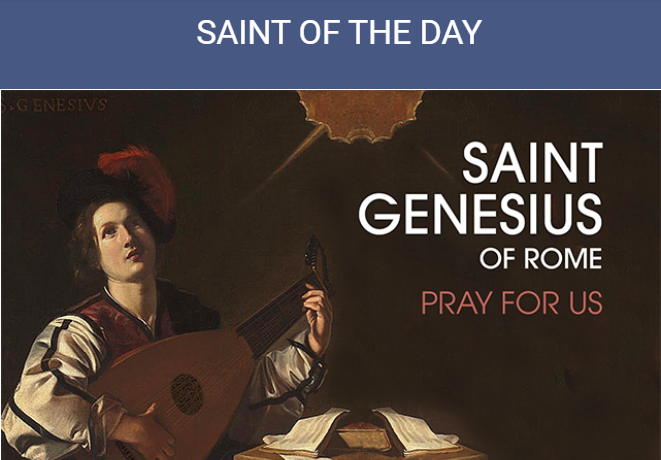
St. Genesius of Rome (d. 303 AD) was a renowned actor and playwright, the leader of a popular acting troupe during the reign of Emperor Diocletian. When the Emperor was killing Christians, Genesius wrote plays to mock them and expose their secret rites to ridicule. To research for a play mocking baptism, he went to a priest pretending to desire the sacraments and was fully instructed as a catechumen. Genesius prepared his play and instructed the other actors in their parts. On performance day the Emperor was present. Genesius played the lead character seeking baptism, and the rite was performed in such a ludicrous manner that all present laughed. As the water was poured over Genesius’ head by an actor playing the priest’s part, Genesius saw a vision of the heavens opened and the hand of God touching him. He also saw an angel who showed him that his many sins had been washed away through the valid baptism he had just received. At that moment Genesius’ heart was changed by the Holy Spirit and he believed in the truth of Christianity. At the conclusion of the play Genesius boldly declared his new faith, recounting how he had been a scoffer until that moment. He implored the audience, including the Emperor, to follow Christ. The crowd thought this was part of the performance, but once they understood it was real, Genesius was seized. The Emperor, furious, subjected him to cruel tortures daily to make him renounce his faith in Christ. Genesius staunchly refused and was beheaded. The Christians collected his body and buried him with the other martyrs. St. Genesius is the patron saint of comedians, dancers, actors, musicians, printers, and torture victims. His feast day is August 25th.
Today, Holy Mother Church celebrates the Solemnity of Pentecost which is when the Holy Spirit came upon the Apostles. It’s also the birthday of the Church. Now, let me ask you a question. When did you first receive the Holy Spirit? At Baptism. Remember, when I baptize you, it is done in the name of the Father, the Son, and the Holy Spirit. When is the next time you receive the gift of the Holy Spirit? At Confession. After that? Holy Communion. Now, you may be thinking, “You also receive the Holy Spirit at Confirmation.” Yeah, you do. You receive Jesus, and you receive God the Father. That 3 in 1 and 1 in 3 thing. You receive the fullness of the Spirit. In each Sacrament, you receive the whole God.
The Sacraments are given for different purposes depending on your particular mission in the Body of Christ. At Baptism, you were given the gift of God Himself. In each Sacrament, you get the gift of the whole God…not just a slice of Him. You get the Father, the Son, and the Holy Spirit. In Baptism, Christ asked for, and you, through your parents, gave Him your human nature. The human nature He took from Mary in the body He was born with, taught with, healed with, suffered with, and redeemed us with is now in Heaven. So, how does He continue His mission to teach, heal, and sanctify the world? It goes on through us by living a good Catholic life. In whatever part of the Body of Christ He has assigned us, we work for His glory and the salvation of souls. So, if you are in hell, you are a self- made man.
Christ takes our human nature at Baptism, so, we are part of His new body which is the Church. Each of us has a place in the body of Christ to do the work of bringing Him to the world. Through the gifts of the Holy Spirit, He helps us accomplish that mission. There are seven gifts (wisdom, understanding, counsel, fortitude, knowledge, piety, and fear of the Lord) and 12 fruits (charity, joy, peace, patience, kindness, goodness, long-suffering, humility, faithfulness, modesty, self-control, and chastity). The whole purpose of giving us the Holy Spirit through the Sacraments is to bring God’s love to the world and to make that love manifest in whatever part of the Body we are in. The graces of the Holy Spirit strengthen us so that we can carry out that mission.
Part of my job as a priest is working at the veterans’ hospital in Hospice. Hospice is a part of the hospital where people who are very sick and in the last six months of their lives are cared for by specially trained doctors and nurses. They have all sorts of terrible diseases. We had one patient who had Progressive Supranuclear Palsy which is a rare disease that the patient contracted while working as a doctor in Vietnam. His brain turned into jelly, and there is no treatment. It’s so sad. The hospice staff try to make their patients as comfortable and pain-free as possible. A few years ago, there was a nice area with a kitchen and dining room where hospice patients could come out of their rooms and eat together. Other veterans from across the hospital would come down and have lunch with them. It was so much fun to laugh and talk with them. I would pick up trays and do whatever I could for them. You know what a sign of God’s love looks like? There was a hospice patient at the luncheon who couldn’t feed himself…he was that sick. Another man who, after this incident died about two weeks later, was also at the luncheon. But, instead of eating his own lunch, he spent that time feeding the patient who couldn’t feed himself. One would think that if you’re dying, it would be all about you. But, this is what God’s love looks like. This was an act of the Holy Spirit. The staff would have fed that patient, but he did it. He didn’t have to do it, but he wanted to. He made sure that man ate before he did. That is a sign of the Holy Spirit in action and God’s love is in the world.
Another thing they have done in Hospice, and hopefully will do again once COVID is over, is that when veterans are actively dying and don’t have family members there, volunteers come and sit with them all night and all day so that they don’t have to die alone. Usually, the veterans are very old and don’t have anybody. But, a veteran should never die alone. In the military, you never leave a fallen comrade. I’ve always thought that this is a sign of Christ, along with their guardian angel, being with them as they leave this life. You see the love of Christ in those volunteers. They don’t need to teach us…their actions teach us everything. It’s all through the promptings of the Holy Spirit who moves and works within us – not always the way want; otherwise, I’d be a monsignor!
I’ll tell you a story about the nursing staff. Don’t let this get back to them. World War II veterans are very old, and when they are nearing the time of their passing, all of the memories of what they had to do during the war come back. Mine will come back too when it’s my time. It’s just part of what we went through. It comes back for a lot of the men who saw combat. Many times, it was their wives who helped them keep it all together, and if their wives are no longer with them, it’s a real hardship for them. I remember this one man who was in his nineties and about to leave us asked the nurse if she would hold his hand until he fell asleep. The memories had come back, and his wife had done that for him. That’s not in any nurse’s job description. But, she sacrificed her own time to sit with that man while he faced his nightmares. I’ve sat with veterans as they were passing from this life…that’s what we do. We offer spontaneous acts of love. I’ve seen you do it. Your acts of generosity are acts of the Holy Spirit. You are showing Christ’s love. If you ask anyone why they do it, they would probably say that they don’t know, but it felt like the right thing to do. Do they get paid for it? No. It was just the right thing to do. These are the actions of the Holy Spirit using our human natures to show Christ’s love to the world. But, so that we can repeat these acts of love, we must be refreshed in the Holy Spirit by frequently participating in the Sacrament of Penance and Holy Communion.
What is so beautiful about these acts of love is that you do it without thinking. It’s just a normal response. You don’t stop and think about what you should or shouldn’t do…you just do it. That’s the action of the Holy Spirit letting the Spirit work in you to bring the love of Christ to the world. And, believe it or not, someone will see and be taught God’s word simply through your acts of love
How will you apply this message to your life? Refresh yourself in the Holy Spirit by frequently participating in the Sacrament of Penance and Holy Communion
You can read all of Father Fitzgibbons’ sermons by going to https://annunciationcatholicalbemarle.com/ and clicking on “Blog” then “Categories” and then “Sermon Notes.” From a cell phone, click on “Blog” then “Menu” and then “Categories” (located at the end of page). There is also a search box if you are looking for a specific topic.