Sermon Notes – March 1, 2026 – “He Wants Your Sins”

“He Wants Your Sins”

 Father Peter Fitzgibbons

March 1, 2026

Gospel: Matthew 17:1-9

During the two seasons of Advent and Lent, Holy Mother Church asks us for penance for the coming into the world of Christ at the nativity, and also for His suffering, death, and resurrection in Lent. The Church asks her faithful to receive the Sacrament of Penance.  When you tell the priest your sins, the priest, who functions in the person of Christ, anoints your soul with His Precious Blood, which washes away all sin and infuses divine grace, healing the harm sin has caused.  It is a beautiful Sacrament.  But over the years, it has, like other things in the Church, suffered from some grave abuses.  A white fence doesn’t stay white; you have to paint it and occasionally maintain it.  It’s the same with the teaching of the Sacraments.  Over the years of my priesthood, I have seen many weird things that Rome had to correct.  This takes some time because they hope that bishops will self-correct.  But the odds of that happening are not great, so Rome must do the correcting. 

Remember when we all had to have reconciliation rooms?  When I came here many years ago, may God have mercy on your souls, there were no confessionals.  Confessions were made in the cry room, which goes against Church law.  “We must have reconciliation rooms.”   No.  Priests are not obligated to hear confessions face-to-face.  Someone appealed to Rome, and Rome said we did not need them.   Monsignor wanted to spend thousands of dollars to create them.  No.  First, reconciliation rooms are not required.  They also cost thousands of dollars.   Homie isn’t playing that game!  Rome reminded the bishops and priests, some of whom are educated beyond their ability, that confessionals are there for the protection of the priest and not for the comfort of the penitent.   It is entirely my choice how I hear confessions.  There have been so many crazy things.  Another one is that priests cannot hear confessions right before Mass because it hinders the penitent from reflecting on the Mass.  It sounds good for those not educated in Theology.  But if you had any knowledge past the first year of Theology, you would know that is all fertilizer.  “You cannot hear confessions right before Mass.”  Rome said, “Yes, you can. You can also hear confessions during Mass.”    The first thing you learn in Sacramental Theology is a Latin phrase: “Sacramenta destinabantur homini” which means the Sacraments were meant for man.   They are not elaborate rituals that satisfy everybody’s desire to be in a high school play.  The Sacraments are God giving life to man.  That is why He came . . . to give us His divine life.  

This comes up sometimes with the Spanish.  They’ll say, “Father, confess?”  Yes, but only if you speak English.  They’ll say, “Yes, yes.”  Then they start rattling off in Spanish.  Wrong!  I am only obligated to hear confessions in the language I understand.  You are blowing stuff by me.  I need English so that I can understand you.  It’s like going to your doctor and describing in Spanish all your symptoms and all the medications you take.  If your doctor doesn’t speak Spanish, what do you think the outcome of your healthcare is going to be?  Not good.  If I cannot understand what you are saying, I don’t know if there is any mortal sin there, so I cannot absolve you, and I cannot apply effective remedies.  When I was overseas, a Korean lady came to camp, and she went to Mass.  She would sit near the back of the Quonset hut with her daughter.   After Mass, her daughter approached me and said, “Father, my mother would like to go to Confession.”  Great.   Her mother spoke Hangeul.  How good do you think my Hangeul is?  I barely speak English.  I do not know Hangeul, so her daughter translated for her.  Priests have told me I cannot do that.  Yes, I can.  It’s in the law.  They must have fallen asleep during Canon Law class that day.  The translator has the same obligation of secrecy regarding the confession as I do.   

Another, and my favorite, is general absolution.  I was at dinner with some priests, and one of them was laughing about a wedding rehearsal he had been to.  Some people at the rehearsal wanted him to hear their confessions.  But he was tired, so he gave them general absolution.    Some of the priests thought that was funny and were laughing.   Well, the way I was raised, you do not make a mockery of the Sacraments because that is blasphemy.   So, I said, “Father, when I was overseas, after I began Mass, we started taking incoming fire, so I gave everybody general absolution.  I do believe that is the only time it is allowed.”   There was deathly silence at the table.   So, it’s getting crazy.   Our bishop, as the pastor and teacher of the diocese, has sent out a letter reminding the priests and the faithful about how to receive and celebrate the Sacrament.  Here is a portion of it:

On the part of Confessors [that would be me], the celebration of the Sacrament of Reconciliation is not counseling, nor is it the appropriate time for spiritual direction.  A brief word of counsel may be given after penitents confess their sins.   If someone needs a longer consultation about their spiritual life, the priest should instruct the penitent to come to the parish office to arrange for an appointment with a priest.

When I was going through the Penance course, the professor said we should not keep penitents for long because it sets a bad example.  Keep your voice quiet.  Don’t yell, “You did what??” or “Oh my God!!”  Don’t do that.   Now back to the bishop’s letter. 

On the part of the faithful approaching the Sacrament, penitents should be instructed to examine their conscience well before the individual confession.  Ask briefly and confess your sins without extraneous details [I get a lot of that] or recounting all the circumstances surrounding your sins [I get a lot of that too.  I have been a chaplain for 42 years, a military chaplain for 24 of those years.  If you have a sin I haven’t heard about, I’ll pay for the privilege of hearing it.]  Confessors should gently remind individual penitents that they only need to briefly mention details that would affect the gravity of the sin or culpability to the penitent to a greater or lesser degree. 

That’s important.  I have heard this a couple of times: “Father, I have committed every sin in the book.”   There are two textbooks in the Moral Theology course: Volumes 1 and 2.  I still have them; they are interesting reading.   When someone says they have committed every sin, I ask them, “So have you married your first cousin?”  No!   There goes a chapter.  I remember we had to study the degrees of affinity in Marriage Law and memorize all the tables.  Gosh!   In my 42 years as a priest, I have never had anyone who had a problem with that one.   But I had to memorize those tables, and I still remember them.  Another question I will ask is: “Did you date any animals?”  No!  Another chapter gone.  “Did you sell the Sacraments?”  No!  Another chapter gone.  Every sin has a name, so just name it.  You’ve got to tell me where it hurts because I’m not a mind reader.   I could probably predict with a high degree of certainty what you did, but that doesn’t help anyone.  When the penitent admits their sins, it opens their soul to Christ’s grace and purity.  And yes, I do go to confession.  At my age, I cannot find priests much older than I am, so I have to go to much younger guys.  Even though you must be 25 or 26 to be ordained, I can smell the Clearasil on them.  We are robbing the cradle! Remember what the Sacrament of Penance is and what it is not.  Christ wants your sins.  He wants to give you the grace and healing God gives you in the Sacrament. 

How will you apply this message to your life? _________________________________________

You can read all of Father Fitzgibbons’ sermons by going to AnnunciationCatholicAlbemarle.com, clicking on “Blog” then “Categories” and then “Sermon Notes.”  On a cell phone: click on “Blog” and then “Menu.”  Scroll to the bottom and click on “Categories.”  Sermon Notes are also available on the Church’s Facebook page at OLA.Catholic.Church.  Click on “Groups” and then “Sermon Notes.”

Sermon Notes – “In the Quietness, God Lets Us Know He Hears Us” – December 15, 2024

“In the Quietness, God Lets Us Know He Hears Us”

Father Peter Fitzgibbons

December 14-15, 2024


Gospel: Luke 3:10-18   

Today Holy Mother Church celebrates the 3rd Sunday of Advent.  I hope and pray to be here for the 4th and final Sunday of Advent.  At 71 years of age, I have more time behind me than I probably have ahead of me.   My chaplain friends ask me if I’m ready for Christmas.  Yeah.  How do you get ready for Christmas?  Saint John the Baptist told us how, as he prepared Israel for the coming of the Savior, he said, “Prepare the way of the Lord, make straight His paths”(Luke 3: 1-6).   

We pass this law and that law so that we can get everybody straightened out and decide how they will live.  Our Lord did not mean that.  He meant us.   We are great at prescribing for other people, but not for ourselves.  We must make straight the paths of the Lord in our own hearts, and He tells us exactly how to do it.  If you have two coats, give one to someone who is cold.  If you have more than enough food, give some to a person who is hungry.  Soldiers should not bully anyone (we never do).  Tax collectors should not take any more than they should.  He tells us how to prepare our souls for the coming of Christ.  Live a moral life.  Living a moral life burns away the stain of sin and prepares our souls to be at peace when our Savior comes, whether it’s in Holy Communion, at our death, at His 2nd coming, or at the commemoration of His incarnation coming on December 25th.   

There are a lot of books on prayer.  “Say these prayers, and everything will be all right.”  No.   I had this one secretary at the VA who said, “I said this prayer, and I claimed that miracle.”  Really?  Do you think that God told the parents who have children in St. Jude’s that if they didn’t pray correctly, He would let their children die?  No.  Prayer is an act of love.  Why do we do acts of love?  For the sake of the Beloved, not for ourselves.

Now, He never says that by doing all these things, you will feel better.  You may not.  He also didn’t say that when you pray you would levitate.  He said, “Pray. Stay with Me for a while.”  He didn’t say you would be happy all the time and doing the happy dance.  Sometimes we can be weak and terrified, so when someone gets sick on pea soup, we panic: “Oh, my God!  It’s satan!”  No, it’s just bad pea soup.   

Living a moral life is very noble.  You all are here, so I know you are trying to live moral lives.  Sometimes it’s not fun, is it?  For example, on doctor’s orders, I have to eat fish twice a week.  It’s part of the Fourth Commandment, so I have to obey it.   Do you know how I feel about the thought of eating fish?  Nauseous.  I hate fish but I have to eat it.  It’s a work of love.  I’m not saying love of self wouldn’t expand my lifespan, but I trust in Almighty God who has given physicians medical knowledge and wisdom.  Doing acts of love does not always feel good.  Occasionally, every now and again, once in a while, our Lord will favor us with His consolation.  In the military, we call that an “atta boy.”  It can be disappointing because I like being told I’m doing a great job.  I have been a priest for 40 years, and I’m still not a monsignor.  That’s really crushing!  I’m a Very Reverend, but that’s just an honorary title.  I wish that were true. 

When you pray through your works of charity, you may feel like, “Hey, God.  I’m doing all this stuff and getting nothing in return.”  Yes, you are.  You are growing away from self-love and toward your love for Him.  You are preparing your soul for Christ.  You are doing a great job, so do not be disappointed.  That’s a great temptation of the devil.  You may be disappointed because you are not getting atta-boys or atta-girls.  But every now and then, God will let us know as He did Elijah in the cave.  Don’t look for a huge and momentous event; that scares people.  But in the quietness, God lets us know He hears us and that we are safe in the palm of His hand.  Our Lord said, “Rejoice and be glad, for your reward is great in Heaven, for so men persecuted the prophets who were before you (Matthew 5:11-12).   So, when we do all these acts of love and do not get anything back from our Lord, that is when we are growing more and more in love with Him.

So, how do we prepare for Christmas?  We do as we are told.  

How will you apply this message to your life? ________________________________________ 

You can read all of Father Fitzgibbons’ sermons by going to AnnunciationCatholicAlbemarle.com, clicking on “Blog” then “Categories” and then “Sermon Notes.”  On a cell phone: click on “Blog” and then “Menu.”  Scroll to the bottom and click on “Categories.”  Sermon Notes are also available on the Church’s Facebook page at OLA.Catholic.Church.  Click on “Groups” and then “Sermon Notes.


Sermon Notes – We Find God in the Silence – December 1, 2024

“We Find God in the Silence”

Father Peter Fitzgibbons

December 1, 2024

Gospel:   Luke 21:25-28, 34-36

Before Mass, I was talking to a lady who just returned from Lourdes.  I’ve been to Fatima several times but never to Lourdes.  Before you enter the shrine area, the grotto, or the church itself, signs ask for silence and appropriate dress.  Shorts are not allowed.  If you are not silent, someone will come to remind you; if one reminder is not enough, they will ask you to leave.  The silence is out of respect for Who dwells there.  Exterior silence is essential for prayer.  C.S. Lewis wrote “The Screw Tape Letters.”  Screwtape was one of the senior devils, and he had a little devil who was trying to rise up the demonic ladder.  This little devil said he was trying to think of innovative ways to get people away from God.  Screwtape told him that they already had an excellent method called noise.  Noise is very distracting.  It takes you away from who you are talking to or who you are trying to listen to. 

In the Mass, there are certain sections for reverential silence.  Unfortunately, the Mass has developed into something where people are moving, singing and doing whatever.  Someone said that those are supposed to be moments of meditation.  No, they are not.  Whoever said that did not go to a proper seminary.  Meditation takes about 20 minutes, and there is a reason for that.  Not only do we get the noise from outside that interferes with our concentration, but we also have silent, distracting noises in our hearts.  So, no matter how quiet it is in church, except for now, while I’m speaking, the hamsters are going and going, aren’t they?

We all have difficulties, and we all think about these things we must do whirling around in our heads.  Ideally, we leave all those things at the door.  But we bring them into church and give them to our Lord.  What happens when we have the stillness of the soul or as best we can?  Remember, we are men, not angels.  It is then we can hear God speak to us as He did to Elijah while he was in the cave.  God was not in the storm.  God was not in the earthquake.  God was in the silence afterward.  In the Garden of Gethsemane, our Lord asked the Apostles, “Can you not spare an hour to watch with Me?”  He didn’t ask them to talk.  He didn’t ask them to sing.  He asked the Apostles to watch with Him.  That is a huge part of prayer.

Last week, the hospice chaplain asked me if I would sit with a man who was actively dying.  He had been actively dying for three days, so he was a little slow at it.  I said, “Sure.”  I have done that many times.  Did I know him?  No.  Did I know his family?  No.  Did I know if he was a good man?  No.  What I did know is that he was a child of God.  So, I sat with him and reminded him to breathe.  He was trying to break the habit.  But in that room, in that reverential silence, I knew God was either there to take him or would be coming soon.  I prayed that he would have a merciful judgment and go joyfully to his loving God.  God was in that room, and I was listening.  That is a part of preparing for Advent. 

People ask, “Father, are you ready for Christmas?”  My response is, “I don’t mean to be sarcastic, but what difference does it make?  It’s going to come whether I am ready or not.”  It makes no difference.  Christmas is coming.  All these things we have to do are wonderful.  However, the most important thing we have to do is our interior preparation, which makes all the exterior preparations worthwhile.   All those gifts people give each other are expressions of God’s love.   The love within them is the love of God expressed by giving to others.  How much more expressive would they be if their souls were holier?  Do yourself a favor this first week of Advent and read “The Gift of the Magi” by O. Henry.

How will you apply this message to your life? ________________________________________ 

You can read all of Father Fitzgibbons’ sermons by going to AnnunciationCatholicAlbemarle.com, clicking on “Blog” then “Categories” and then “Sermon Notes.”  On a cell phone: click on “Blog” and then “Menu.”  Scroll to the bottom and click on “Categories.”  Sermon Notes are also available on the Church’s Facebook page at OLA.Catholic.Church.  Click on “Groups” and then “Sermon Notes.”

Sermon Notes – December 3, 2023 – “ Are You Ready for What May Come? “

“Are You Ready for What May Come?“

Father Peter Fitzgibbons

December 2 – 3, 2023

GospelMark 13:33-37

 Jesus said to his disciples:
“Be watchful! Be alert!
You do not know when the time will come.
It is like a man traveling abroad.
He leaves home and places his servants in charge,
each with his own work,
and orders the gatekeeper to be on the watch.
Watch, therefore;
you do not know when the lord of the house is coming,
whether in the evening, or at midnight,
or at cockcrow, or in the morning.
May he not come suddenly and find you sleeping.
What I say to you, I say to all: ‘Watch!’”

This week there is a Holy Day of Obligation.  We will be observing the Feast Day for the Solemnity of the Immaculate Conception on Friday at 8:30 a.m.  There will be a Vigil Mass on Thursday at 6:30 p.m.  Also, Christmas falls on a Monday this year which means the faithful are obligated to participate in the Mass once for the Sunday and once on the holy day.   Believe it or not, I have already heard the Catholic angst.  “Oh, my goodness!  I have to go to two Masses in three days!”  Really?  Are you starting your own opera here?  That’s a lot of drama over nothing.  If you don’t like the Mass, you won’t like Heaven.  The same Lord appears in both places.  You’ll be fine.  In fact, you’ll be better than fine; you’ll be fantastic.  So, please come. 

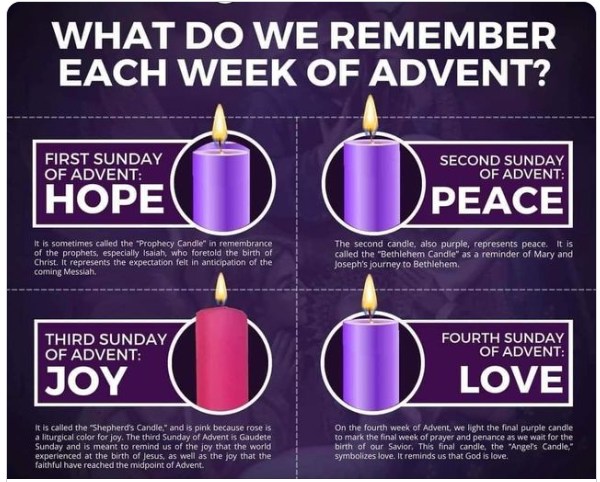
Just like Lent, Advent is a season for penance.  Because it is a penitential season, I’m wearing violet – not purple – violet.  Because this is a season of penance, we will not be saying the Gloria during the Mass.  Advent is a time for reflection and preparing our souls for the coming of our Lord in the flesh.  When He comes again it will be to take us to Heaven. 

On Friday I was visiting a man in hospice.  I asked him how he was doing, and he said, “ho hum.”  At least he didn’t say “fine.”  I hate it when they do that.  So, we were talking, and I asked him how old he was.  I found out that he had been in the Army, and I asked if he had been in Vietnam.  He said, “No.  My brother took an extra tour there so I wouldn’t have to go.”  We kept talking, and I asked him if he was ready for what may happen.  When I’m talking to hospice patients, I never use the “D” word.  If they want to talk about it, they will bring it up.  But I don’t take away that crutch from people until they are ready.  Some patients have stabilized, gone home, and lived a lot longer.   You don’t know where people are on that spectrum.  Some people never reach the acceptance stage and need that crutch.   So, I asked him, “Are you ready for whatever might come?”  He said, “Yeah.”   I said “Okay,” and we talked a bit more. 

In one of his letters, Saint Paul said, “I don’t know if I wish to stay in the body or be at home with Christ” (Philippians 1:21-22).  He wasn’t sure if he should stay in his body to continue the work of the Church or go be with Christ.  Paul was torn but he was ready for anything.  During this penitential season, perhaps that can be a good meditation for us all, as in my question to that sick man: “Are you ready for what may happen?”  Or as in Saint Paul’s statement:  I do not know whether it would be better to stay in my body to build up the Church on Earth or go to Heaven.  Are we ready for whatever may come?

How will you apply this message to your life?  ________________________________________

You can read all of Father Fitzgibbons’ sermons by going to annunciationcatholicalbemarle.com and clicking on “Blog” then “Categories” then “Sermon Notes.”  On a cell phone: click on “Blog” and then “Menu.”  Scroll to the bottom and click on “Categories.”  Sermon Notes are also available on the Church’s Facebook page at ola.catholic.church.  Click on “Groups” and then “Sermon Notes.”

The Catechism in a Year – Day 74 – The Christmas Mystery

Diving deeper into Jesus Christ as Mystery, the Catechism describes the deep mystery in the preparations for Christ’s coming—also known as Advent—as well as the mystery of his first coming in Christmas. Fr. Mike points to one of the last sentences of today’s readings—”Only when Christ is formed in us will the mystery of Christmas be fulfilled in us”—and reminds us that Jesus is the star of the story, not us. Our goal is to become children in relation to God. “He must increase, but I must decrease.” Today’s readings are Catechism paragraphs 522-526.

Click on link to watch video: https://youtu.be/B9A9PyVMAlw