Saint of the Day – February 3, 2021

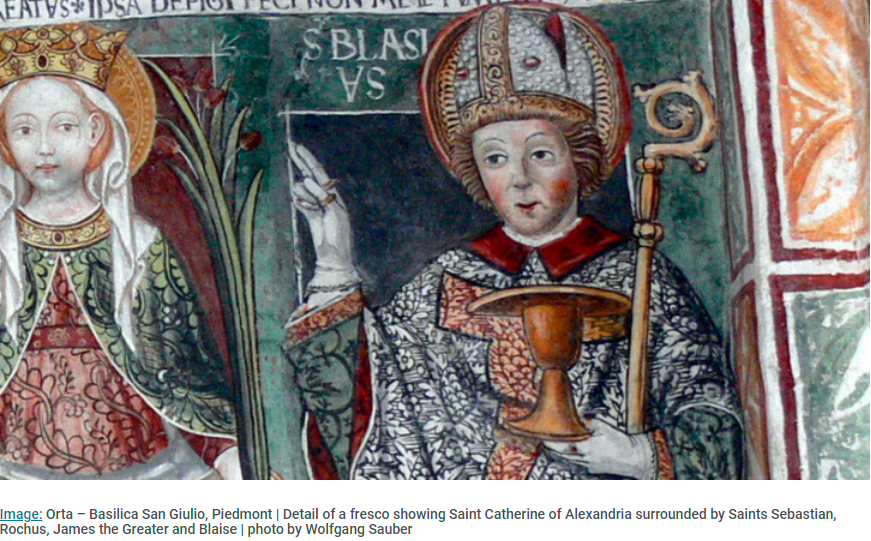
Saint Blaise (d. 316 A.D.)
Saint Blaise’s Story

We know more about the devotion to Saint Blaise by Christians around the world than we know about the saint himself. His feast is observed as a holy day in some Eastern Churches. In 1222, the Council of Oxford prohibited servile labor in England on Blaise’s feast day. The Germans and Slavs hold him in special honor, and for decades many United States Catholics have sought the annual Saint Blaise blessing for their throats.

We know that Bishop Blaise was martyred in his episcopal city of Sebastea, Armenia, in 316. The legendary Acts of St. Blaise were written 400 years later. According to them Blaise was a good bishop, working hard to encourage the spiritual and physical health of his people. Although the Edict of Toleration (311), granting freedom of worship in the Roman Empire, was already five years old, persecution still raged in Armenia. Blaise was apparently forced to flee to the back country. There he lived as a hermit in solitude and prayer, but he made friends with the wild animals. One day a group of hunters seeking wild animals for the amphitheater stumbled upon Blaise’s cave. They were first surprised and then frightened. The bishop was kneeling in prayer surrounded by patiently waiting wolves, lions and bears.

The legend has it that as the hunters hauled Blaise off to prison, a mother came with her young son who had a fish bone lodged in his throat. At Blaise’s command the child was able to cough up the bone.

Agricolaus, governor of Cappadocia, tried to persuade Blaise to sacrifice to pagan idols. The first time Blaise refused, he was beaten. The next time he was suspended from a tree and his flesh torn with iron combs or rakes. Finally, he was beheaded.

Reflection

Four centuries give ample opportunity for fiction to creep in with fact. Who can be sure how accurate Blaise’s biographer was? But biographical details are not essential. Blaise is seen as one more example of the power those have who give themselves entirely to Jesus. As Jesus told his apostles at the Last Supper, “If you remain in me and my words remain in you, ask for whatever you want and it will be done for you” (John 15:7). With faith we can follow the lead of the Church in asking for Blaise’s protection.

Saint Blaise is the Patron Saint of:

Throat Ailments
English Wool Combers
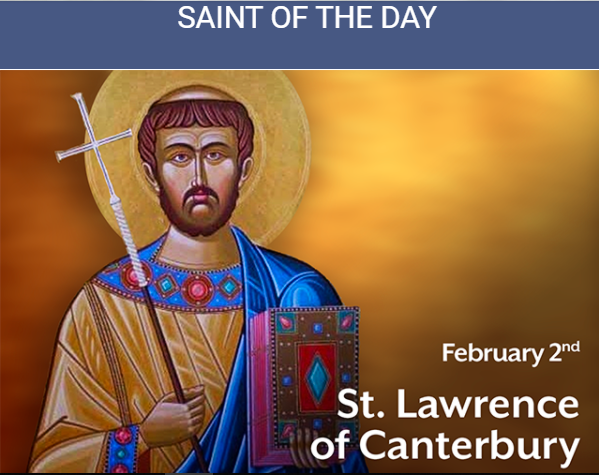

Saint of the Day – February 2nd

St. Lawrence of Canterbury (d. 619 A.D.) was among the original band of missionaries sent from Rome to evangelize England with St. Augustine, the first Archbishop of Canterbury. As a fruit of their labor the region’s most powerful ruler, the King of Kent, became a baptized Christian along with many of his countrymen.

When Augustine died, Lawrence became Canterbury’s second Archbishop. He was a zealous leader and urged the Celtic bishops to keep peace and unity with Rome. When the King of Kent died, his pagan son caused great damage to the faith of the people and the mission work which had been done among them; because of this, some of the missionaries fled to Gaul.

Lawrence was so upset by the abandonment of Christianity among his flock that he considered abandoning his bishopric as well. In response, St. Peter the Apostle appeared to him in a vision, rebuked him, and scourged him so badly that Lawrence had physical marks on his body from the encounter. St. Lawrence then relayed his vision to the king and showed him his wounds, causing the king to convert to the Christian faith as his father did. St. Lawrence’s feast day is February 2nd.


Saint of the Day – February 2nd

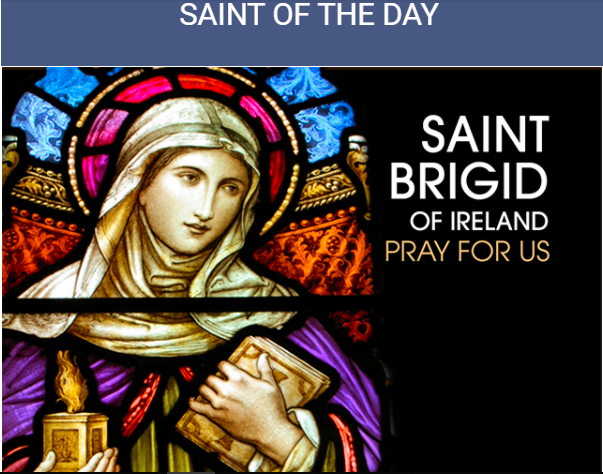
St. Brigid of Ireland (451–525 A.D.), also known as St. Brigit of Kildare, was born to a pagan Irish chieftain and a Christian slave mother. Being the daughter of a slave woman, she also was a slave, and worked as a dairy maid. She became known for her virtuous life and her charity to the poor.

Recognizing her great piety and special graces, a Christian king convinced her father to grant Brigid her freedom. Once free to follow her own course in life, St. Brigid refused marriage, consecrated herself to Christ, and became Ireland’s first nun. She also formed Ireland’s first convent at Kildare and became its abbess. She went on to found many other religious communities, as well as a School of Art famous for its metal working and illuminated manuscripts.

St. Brigid was known for her extraordinary spirituality, even converting her father to the faith after he witnessed her fashioning the sign of the cross from strands of rushes. She was also a contemporary and friend of St. Patrick. When she died, her sisters kept a fire burning in an enclosure at her Kildare convent. This fire burned for centuries, tended by the sisters and not burning out until the 13th century. It was later re-lit and burned for 400 more years until the Protestant revolt.

St. Brigid is the patroness of Ireland and many other causes, most notably of dairy and milk maids, chicken farmers, travelers, and sailors. Her feast day is February 1st.


Saint of the Day – January 31st

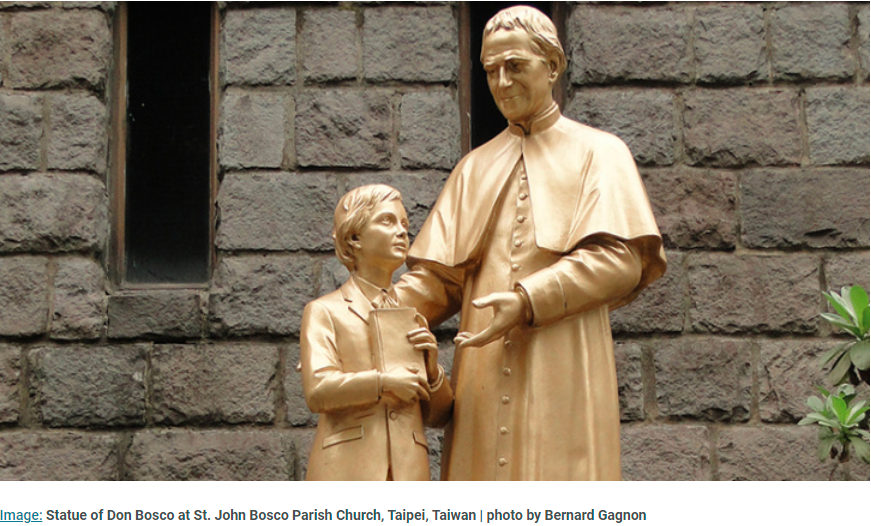
Saint John Bosco’s Story

John Bosco (August 16, 1815 – January 31, 1888) had a theory of education that could well be used in today’s schools. It was a preventive system, rejecting corporal punishment and placing students in surroundings removed from the likelihood of committing sin. He advocated frequent reception of the sacraments of Penance and Holy Communion. He combined catechetical training and fatherly guidance, seeking to unite the spiritual life with one’s work, study and play.

Encouraged during his youth in Turin to become a priest so he could work with young boys, John was ordained in 1841. His service to young people started when he met a poor orphan in Turin, and instructed him in preparation for receiving Holy Communion. He then gathered young apprentices and taught them catechism.

After serving as chaplain in a hospice for working girls, Don Bosco opened the Oratory of St. Francis de Sales for boys. Several wealthy and powerful patrons contributed money, enabling him to provide two workshops for the boys, shoemaking and tailoring.

By 1856, the institution had grown to 150 boys and had added a printing press for publication of religious and catechetical pamphlets. John’s interest in vocational education and publishing justify him as patron of young apprentices and Catholic publishers.

John’s preaching fame spread and by 1850 he had trained his own helpers because of difficulties in retaining young priests. In 1854, he and his followers informally banded together, inspired by Saint Francis de Sales.

With Pope Pius IX’s encouragement, John gathered 17 men and founded the Salesians in 1859. Their activity concentrated on education and mission work. Later, he organized a group of Salesian Sisters to assist girls.

Reflection

John Bosco educated the whole person—body and soul united. He believed that Christ’s love and our faith in that love should pervade everything we do—work, study, play. For John Bosco, being a Christian was a full-time effort, not a once-a-week, Mass-on-Sunday experience. It is searching and finding God and Jesus in everything we do, letting their love lead us. Yet, because John realized the importance of job-training and the self-worth and pride that come with talent and ability, he trained his students in the trade crafts, too.

Saint John Bosco is the Patron Saint of:

Boys
Editors
Youth


Saint of the Day – January 30th

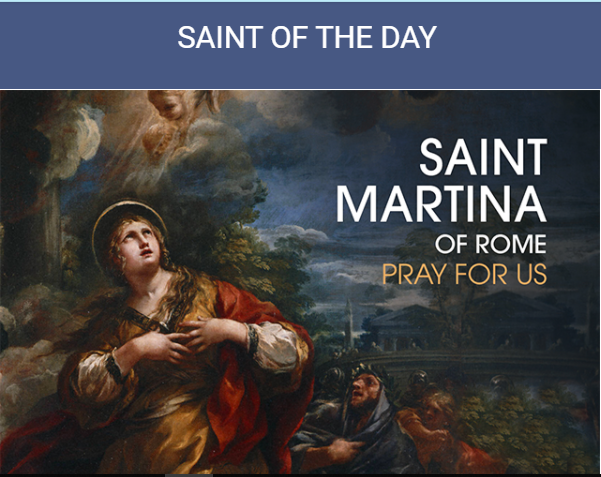
St. Martina of Rome (d. 228 A.D.) was born to a noble Roman family and orphaned at a young age. She was zealous in the practice of her faith, remained a virgin, and, in preparation for the Christian persecutions sweeping the city, gave much of her inheritance to the poor. She was martyred under Roman Emperor Alexander Severus.

According to the accounts of Martina’s martyrdom, she was discovered praying in a church and was arrested by Roman soldiers. She was ordered to pay homage to the pagan gods, which she refused. She was then cruelly tortured over several days. She was raked with iron hooks and scourged, and when a bright light enveloped her, some of her torturers were converted to the Faith amid her fervent prayers. She was then taken to the temple of Diana to be forced to offer sacrifice, but at her presence the temple’s demon left with a scream. They next tried to throw her to a lion (it showed no interest in her) and to burn her alive, but she would not catch fire. Finally, she was beheaded.

St. Martina’s feast day is January 30.


Saint of the Day – January 29th

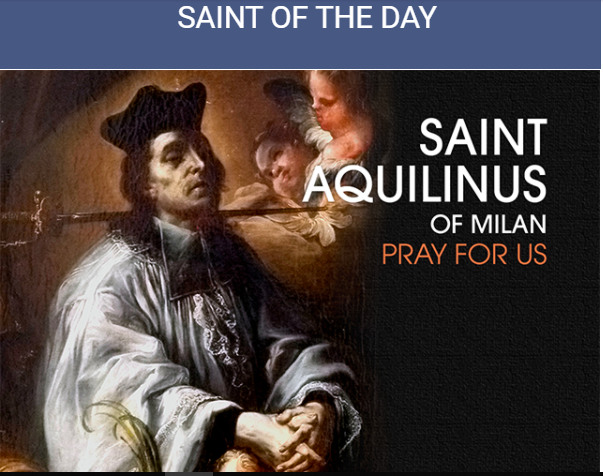
St. Aquilinus of Milan (d. 1015 A.D.), also known as St. Aquilinus of Cologne, was born to a noble family in Bavaria, Germany. He received his education in Cologne, Germany and was ordained to the priesthood. He was offered the bishopric of Cologne, but turned it down in order to be a missionary priest and itinerant preacher.

Aquilinus traveled through various European cities fighting against the dangerous and spreading heresies of the Cathars, Manichaeans, and Arians. He was also known to work miracles by healing people from disease, especially during a cholera epidemic. He eventually settled in Milan, Italy, and was so effective in his preaching against the Arian heretics that they stabbed him to death and threw his body in the city sewer. His body was recovered and buried in the Basilica of San Lorenzo, in a chapel which now bears his name. His feast day is January 29.  


Saint of the Day – January 28th

(1225 – MARCH 7, 1274)

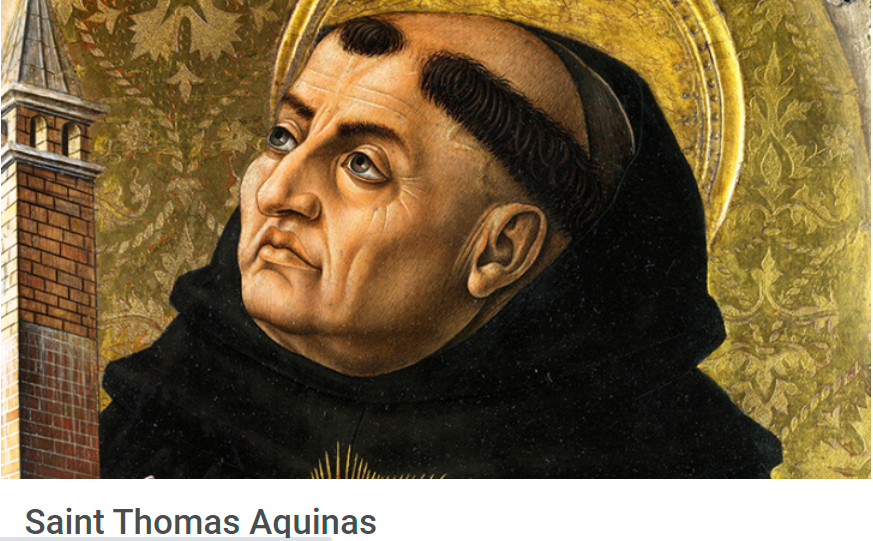
Saint Thomas Aquinas’ Story

By universal consent, Thomas Aquinas is the preeminent spokesman of the Catholic tradition of reason and of divine revelation. He is one of the great teachers of the medieval Catholic Church, honored with the titles Doctor of the Church and Angelic Doctor.

At five he was given to the Benedictine monastery at Monte Cassino in his parents’ hopes that he would choose that way of life and eventually became abbot. In 1239, he was sent to Naples to complete his studies. It was here that he was first attracted to Aristotle’s philosophy.

By 1243, Thomas abandoned his family’s plans for him and joined the Dominicans, much to his mother’s dismay. On her order, Thomas was captured by his brother and kept at home for over a year.

Once free, he went to Paris and then to Cologne, where he finished his studies with Albert the Great. He held two professorships at Paris, lived at the court of Pope Urban IV, directed the Dominican schools at Rome and Viterbo, combated adversaries of the mendicants, as well as the Averroists, and argued with some Franciscans about Aristotelianism.

His greatest contribution to the Catholic Church is his writings. The unity, harmony, and continuity of faith and reason, of revealed and natural human knowledge, pervades his writings. One might expect Thomas, as a man of the gospel, to be an ardent defender of revealed truth. But he was broad enough, deep enough, to see the whole natural order as coming from God the Creator, and to see reason as a divine gift to be highly cherished.

The Summa Theologiae, his last and, unfortunately, uncompleted work, deals with the whole of Catholic theology. He stopped work on it after celebrating Mass on December 6, 1273. When asked why he stopped writing, he replied, “I cannot go on…. All that I have written seems to me like so much straw compared to what I have seen and what has been revealed to me.” He died March 7, 1274.

Reflection

We can look to Thomas Aquinas as a towering example of Catholicism in the sense of broadness, universality, and inclusiveness. We should be determined anew to exercise the divine gift of reason in us, our power to know, learn, and understand. At the same time we should thank God for the gift of his revelation, especially in Jesus Christ.

Saint Thomas Aquinas is the Patron Saint of:

Catholic Schools
Colleges
Schools
Students


Saint of the Day – January 27th

(March 21, 1474 – January 27, 1540)

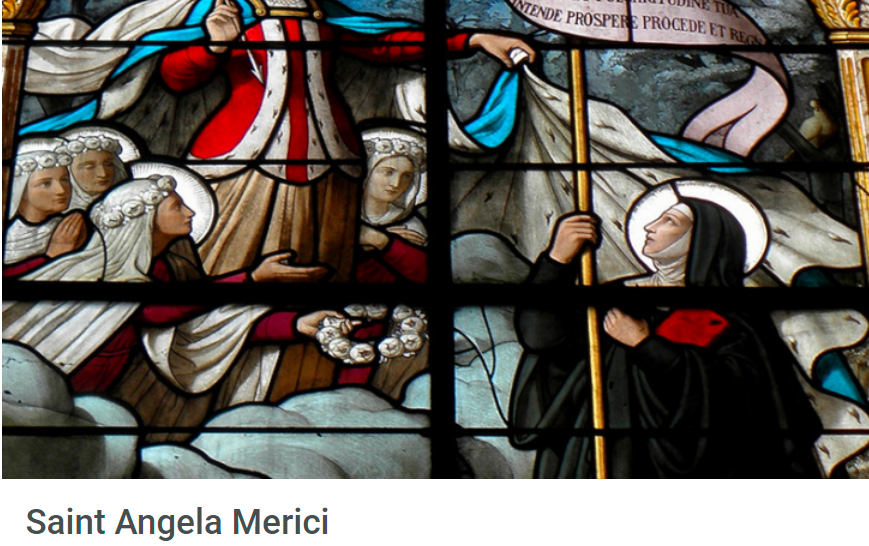
Saint Angela Merici’s story


Angela has the double distinction of founding the first teaching congregation of women in the Church and what is now called a “secular institute” of religious women.

As a young woman, she became a member of the Third Order of Saint Francis, and lived a life of great austerity, wishing, like Saint Francis, to own nothing, not even a bed. Early in life she was appalled at the ignorance among poorer children, whose parents could not or would not teach them the elements of religion. Angela’s charming manner and good looks complemented her natural qualities of leadership. Others joined her in giving regular instruction to the little girls of their neighborhood.

She was invited to live with a family in Brescia (where, she had been told in a vision, she would one day found a religious community). Her work continued and became well known. She became the center of a group of people with similar ideals.

She eagerly took the opportunity for a trip to the Holy Land. When they had gotten as far as Crete, she was struck with blindness. Her friends wanted to return home, but she insisted on going through with the pilgrimage, and visited the sacred shrines with as much devotion and enthusiasm as if she had her sight. On the way back, while praying before a crucifix, her sight was restored at the same place where it had been lost.

At 57, she organized a group of 12 girls to help her in catechetical work. Four years later the group had increased to 28. She formed them into the Company of Saint Ursula (patroness of medieval universities and venerated as a leader of women) for the purpose of re-Christianizing family life through solid Christian education of future wives and mothers. The members continued to live at home, had no special habit and took no formal vows, though the early Rule prescribed the practice of virginity, poverty, and obedience. The idea of a teaching congregation of women was new and took time to develop. The community thus existed as a “secular institute” until some years after Angela’s death.

Reflection

As with so many saints, history is mostly concerned with their activities. But we must always presume deep Christian faith and love in one whose courage lasts a lifetime, and who can take bold new steps when human need demands.

Franciscan Media


Saint of the Day – January 26, 2021

(d. c. 95)

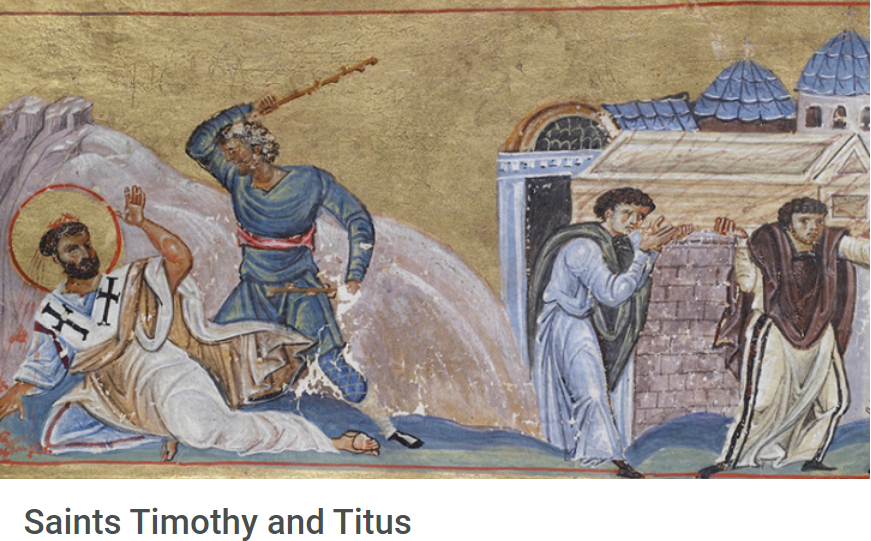
What we know from the New Testament of Timothy’s life makes it sound like that of a modern harried bishop. He had the honor of being a fellow apostle with Paul, both sharing the privilege of preaching the gospel and suffering for it.

Timothy had a Greek father and a Jewish mother named Eunice. Being the product of a “mixed” marriage, he was considered illegitimate by the Jews. It was his grandmother, Lois, who first became Christian. Timothy was a convert of Paul around the year 47 and later joined him in his apostolic work. He was with Paul at the founding of the Church in Corinth. During the 15 years he worked with Paul, he became one of his most faithful and trusted friends. He was sent on difficult missions by Paul—often in the face of great disturbance in local churches which Paul had founded.

Timothy was with Paul in Rome during the latter’s house arrest. At some period Timothy himself was in prison (Hebrews 13:23). Paul installed him as his representative at the Church of Ephesus.

Timothy was comparatively young for the work he was doing. Several references seem to indicate that he was timid. And one of Paul’s most frequently quoted lines was addressed to him: “Stop drinking only water, but have a little wine for the sake of your stomach and your frequent illnesses” (1 Timothy 5:23).

Titus has the distinction of being a close friend and disciple of Paul as well as a fellow missionary. He was Greek, apparently from Antioch. Even though Titus was a Gentile, Paul would not let him be forced to undergo circumcision at Jerusalem. Titus is seen as a peacemaker, administrator, great friend. Paul’s second letter to Corinth affords an insight into the depth of his friendship with Titus, and the great fellowship they had in preaching the gospel.

When Paul was having trouble with the community at Corinth, Titus was the bearer of Paul’s severe letter and was successful in smoothing things out. Paul writes he was strengthened not only by the arrival of Titus but also “by the encouragement with which he was encouraged in regard to you, as he told us of your yearning, your lament, your zeal for me, so that I rejoiced even more…. And his heart goes out to you all the more, as he remembers the obedience of all of you, when you received him with fear and trembling” (2 Corinthians 7:7a, 15).

The Letter to Titus addresses him as the administrator of the Christian community on the island of Crete, charged with organizing it, correcting abuses, and appointing presbyter-bishops.

Reflection

In Titus we get another glimpse of life in the early Church: great zeal in the apostolate, great communion in Christ, great friendship. Yet always there is the problem of human nature and the unglamorous details of daily life: the need for charity and patience in “quarrels with others, fears within myself,” as Paul says. Through it all, the love of Christ sustained them. At the end of the Letter to Titus, Paul says that when the temporary substitute comes, “hurry to me.”

Saints Timothy and Titus are the Patron Saints of:

Stomach Disorders


Saint of the Day – January 25th

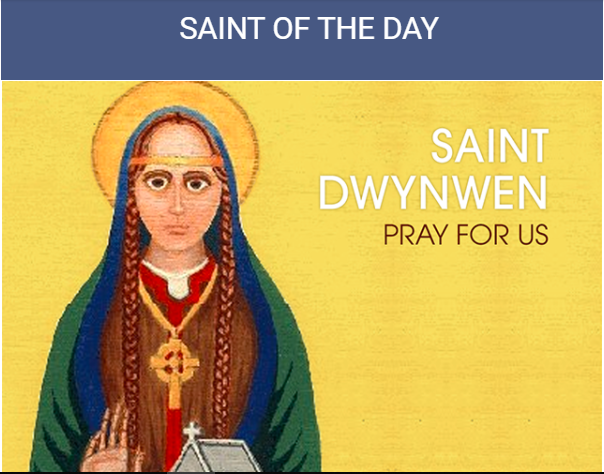
St. Dwynwen (5th c.) was a princess from Anglesey in Wales, the beautiful and virtuous daughter of King Brychan Brycheiniog. According to legend she fell in love with a young man, yet refused to marry him due to her piety and desire for the religious life. She prayed that her desire for marriage would be removed, and that God would give happiness to all lovers. Dwynwen became consecrated to God as a nun and set up a convent on Llanddwyn Island, and her church and its ‘holy well’ became a pilgrimage shrine from the Middle Ages down to today, especially for lovers.

St. Dwynwen is the patron saint of lovers, and in Wales her feast is the equivalent of St. Valentine’s Day.  Dwynwen translated means ‘she who leads a blessed life’, and her feast day is January 25.