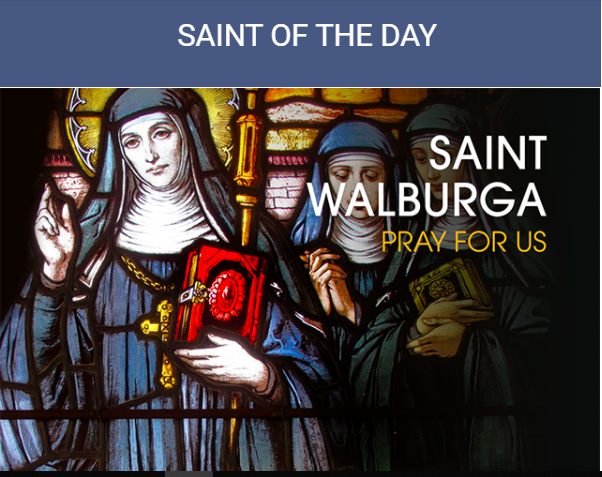
St. Walburga (710-777 A.D.) was born near Devonshire, England, the daughter of St. Richard the Pilgrim (a Saxon king) and the sister of Sts. Willibald and Winebald. When she was eleven her father and brothers went on pilgrimage to the Holy Land, while her father placed her in a convent famous for its holiness. She was well educated according to her rank, became a nun, and lived there for twenty-six years. Her uncle, St. Boniface, then brought her to what is now Germany to help him evangelize that country and establish the Church there. In this missionary activity she joined her brothers who were also laboring for the faith in that country, one as an abbot, the other as a bishop.
Because of Walburga’s education, she was able to document the travels of her brother in the Holy Land, and for this work she became the first female author of England and Germany. She was known as a miracle worker and healer both in her life and after her death.
St. Walburga’s relics have the miraculous property of exuding oil to which many cures have been ascribed through the centuries. St. Walburga is the patron saint of sailors, mariners, and farmers, and against hydrophobia, famine, coughs, rabies, plague, and storms. St. Walburga’s feast day is February 25th.
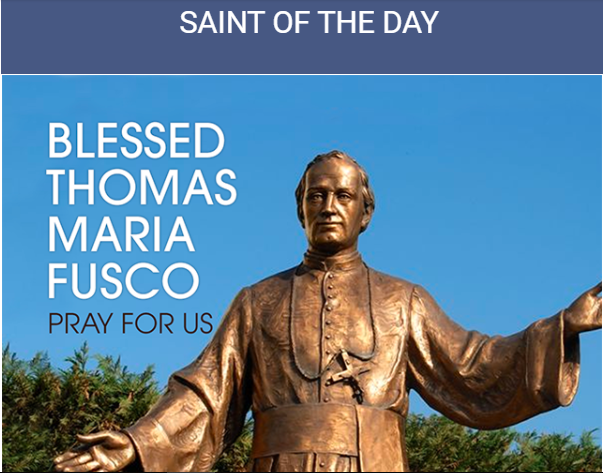
Bl. Thomas Maria Fusco (1831-1891) was born to a noble and pious family in Italy, the seventh of eight children. He was orphaned at an early age and raised by his uncle, a priest, who oversaw his education. He had a deep love for the faith, especially to the Passion of Christ and Our Lady of Sorrows. He became a priest at the age of 24 and opened a school in his own home. He later became an itinerant missionary throughout southern Italy. After traveling for a number of years he opened another school, this time to train priests on how to be good confessors. He also founded the Priestly Society of the Catholic Apostolate to support the missions, which gained papal approval. During his work with the poor he discerned a call to start a new religious order of sisters, the Daughters of Charity of the Most Precious Blood, to minister to orphaned children. In addition to all of this, Fusco was also a parish priest, a confessor to a group of cloistered nuns, and a spiritual father to a lay group at the nearby Shrine of Our Lady of Mount Carmel. He died of liver disease at the age of 59. He was beatified by Pope St. John Paul II in 2001. His feast day is February 24.
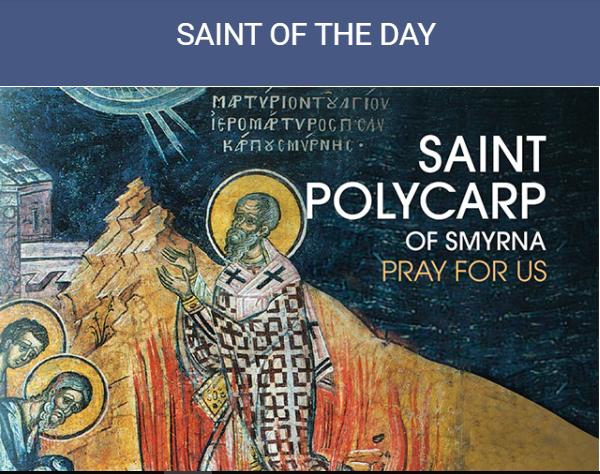
Polycarp, bishop of Smyrna, disciple of Saint John the Apostle and friend of Saint Ignatius of Antioch, was a revered Christian leader during the first half of the second century.
Saint Ignatius, on his way to Rome to be martyred, visited Polycarp at Smyrna, and later at Troas wrote him a personal letter. The Asia Minor Churches recognized Polycarp’s leadership by choosing him as a representative to discuss with Pope Anicetus the date of the Easter celebration in Rome—a major controversy in the early Church.
Only one of the many letters written by Polycarp has been preserved, the one he wrote to the Church of Philippi in Macedonia.
At 86, Polycarp was led into the crowded Smyrna stadium to be burned alive. The flames did not harm him and he was finally killed by a dagger. The centurion ordered the saint’s body burned. The “Acts” of Polycarp’s martyrdom are the earliest preserved, fully reliable account of a Christian martyr’s death. He died in 155.
Reflection
Polycarp was recognized as a Christian leader by all Asia Minor Christians—a strong fortress of faith and loyalty to Jesus Christ. His own strength emerged from his trust in God, even when events contradicted this trust. Living among pagans and under a government opposed to the new religion, he led and fed his flock. Like the Good Shepherd, he laid down his life for his sheep and kept them from more persecution in Smyrna. He summarized his trust in God just before he died: “Father… I bless Thee, for having made me worthy of the day and the hour…” (Acts of Martyrdom, Chapter 14).
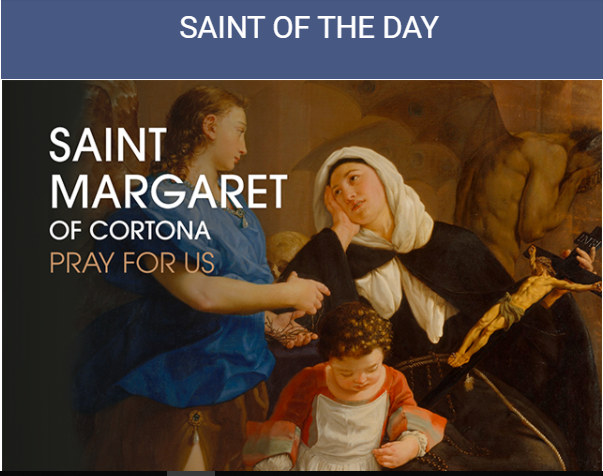
St. Margaret of Cortona (1247-1297) was born in Tuscany, Italy, the only child of a working-class family. She lost her mother at age seven, and had a poor relationship with her stepmother. Margaret was spoiled, willful, reckless, and beautiful, and at the age of seventeen she left her father’s house in the night and became the mistress of a young nobleman.
Margaret lived with him in his family castle for nine years and bore him a son, but he did not marry her due to her lower social class. One day he did not return home from a journey, and his hound came back to the castle alone. The dog led Margaret into the nearby wood where she discovered her lover brutally murdered. This shook her to her core. Her eyes were opened to the sinfulness of her way of life, and she became deeply repentant.
Margaret left his family castle with her son and sought out the Franciscan friars for spiritual direction. She then reformed her life through intense prayer, penance, and self-discipline, eventually joining the Third Order of St. Francis, and living in strict poverty and great charity towards the poor.
St. Margaret of Cortona is the patron saint of the homeless, reformed prostitutes, midwives, single laywomen, the mentally ill, and the falsely accused. Her feast day is February 22nd.
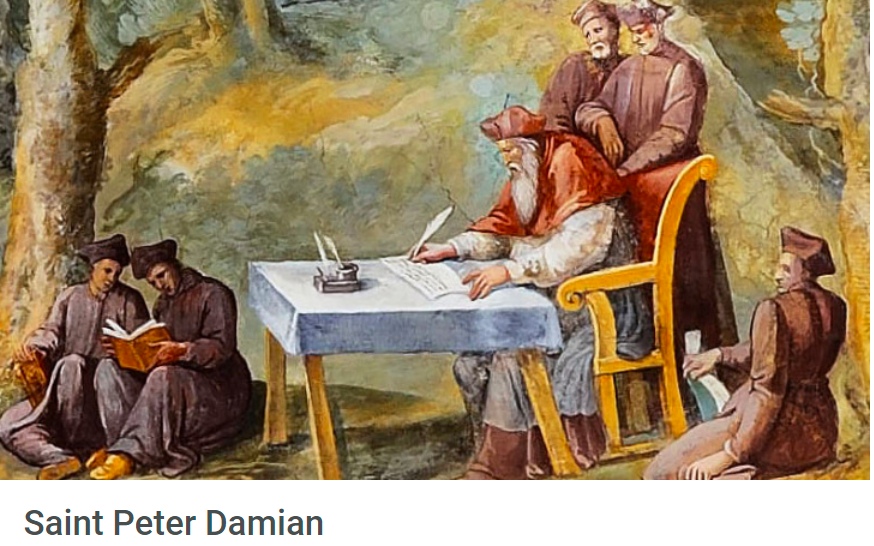
Image: Detail of Cardinal Peter Damian recruits young hermits in the maps room of the Vatican Museums | photo by Livioandronico2013
Saint Peter Damian’s Story (988 – February 22, 1072)
Maybe because he was orphaned and had been treated shabbily by one of his brothers, Peter Damian was very good to the poor. It was the ordinary thing for him to have a poor person or two with him at table and he liked to minister personally to their needs.
Peter escaped poverty and the neglect of his own brother when his other brother, who was archpriest of Ravenna, took him under his wing. His brother sent him to good schools and Peter became a professor.
Already in those days, Peter was very strict with himself. He wore a hair shirt under his clothes, fasted rigorously and spent many hours in prayer. Soon, he decided to leave his teaching and give himself completely to prayer with the Benedictines of the reform of Saint Romuald at Fonte Avellana. They lived two monks to a hermitage. Peter was so eager to pray and slept so little that he soon suffered from severe insomnia. He found he had to use some prudence in taking care of himself. When he was not praying, he studied the Bible.
The abbot commanded that when he died Peter should succeed him. Abbot Peter founded five other hermitages. He encouraged his brothers in a life of prayer and solitude and wanted nothing more for himself. The Holy See periodically called on him, however, to be a peacemaker or troubleshooter, between two abbeys in dispute or a cleric or government official in some disagreement with Rome.
Finally, Pope Stephen IX made Peter the cardinal-bishop of Ostia. He worked hard to wipe out simony—the buying of church offices–and encouraged his priests to observe celibacy and urged even the diocesan clergy to live together and maintain scheduled prayer and religious observance. He wished to restore primitive discipline among religious and priests, warning against needless travel, violations of poverty, and too comfortable living. He even wrote to the bishop of Besancon complaining that the canons there sat down when they were singing the psalms in the Divine Office.
He wrote many letters. Some 170 are extant. We also have 53 of his sermons and seven lives, or biographies, that he wrote. He preferred examples and stories rather than theory in his writings. The liturgical offices he wrote are evidence of his talent as a stylist in Latin.
He asked often to be allowed to retire as cardinal-bishop of Ostia, and finally Pope Alexander II consented. Peter was happy to become once again just a monk, but he was still called to serve as a papal legate. When returning from such an assignment in Ravenna, he was overcome by a fever. With the monks gathered around him saying the Divine Office, he died on February 22, 1072.
In 1828, he was declared a Doctor of the Church.
Reflection
Peter was a reformer and if he were alive today would no doubt encourage the renewal started by Vatican II. He would also applaud the greater emphasis on prayer that is shown by the growing number of priests, religious, and laypersons who gather regularly for prayer, as well as the special houses of prayer recently established by many religious communities.
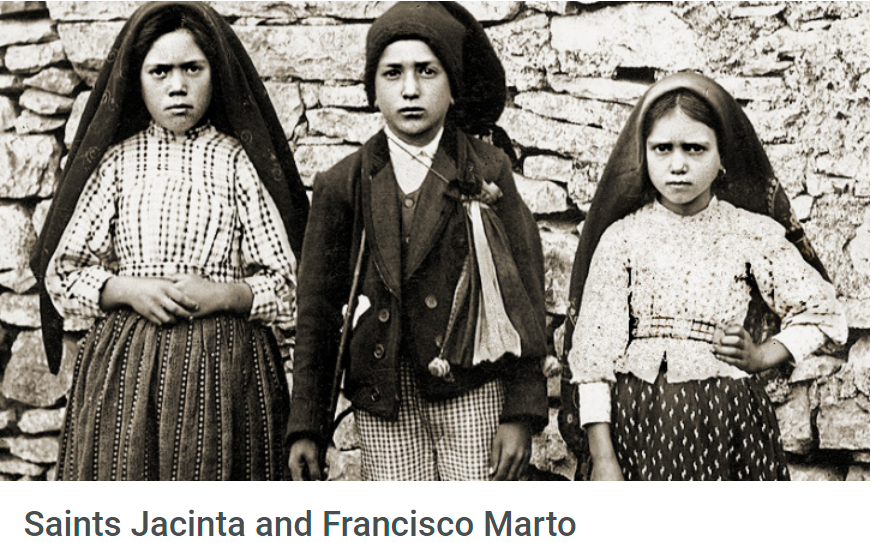
(JACINTA: 1910 – FEBRUARY 20, 1920 | FRANCISCO: 1908 – APRIL 14, 1919)
Saints Jacinta and Francisco Marto’s Story
Between May 13 and October 13, 1917, three Portuguese shepherd children from Aljustrel, received apparitions of Our Lady at Cova da Iria, near Fátima, a city 110 miles north of Lisbon. At that time, Europe was involved in an extremely bloody war. Portugal itself was in political turmoil, having overthrown its monarchy in 1910; the government disbanded religious organizations soon after.
At the first appearance, Mary asked the children to return to that spot on the thirteenth of each month for the next six months. She also asked them to learn to read and write and to pray the rosary “to obtain peace for the world and the end of the war.” They were to pray for sinners and for the conversion of Russia, which had recently overthrown Czar Nicholas II and was soon to fall under communism. Up to 90,000 people gathered for Mary’s final apparition on October 13, 1917.
Less than two years later, Francisco died of influenza in his family home. He was buried in the parish cemetery and then re-buried in the Fátima basilica in 1952. Jacinta died of influenza in Lisbon in 1920, offering her suffering for the conversion of sinners, peace in the world, and the Holy Father. She was re-buried in the Fátima basilica in 1951. Their cousin Lúcia dos Santos, became a Carmelite nun and was still living when Jacinta and Francisco were beatified in 2000; she died five years later. Pope Francis canonized the younger children on his visit to Fátima to commemorate the 100th anniversary of the first apparition–May 13, 2017. The shrine of Our Lady of Fátima is visited by up to 20 million people a year.
Reflection
The Church is always very cautious about endorsing alleged apparitions, but it has seen benefits from people changing their lives because of the message of Our Lady of Fátima. Prayer for sinners, devotion to the Immaculate Heart of Mary, and praying the rosary—all these reinforce the Good News Jesus came to preach.
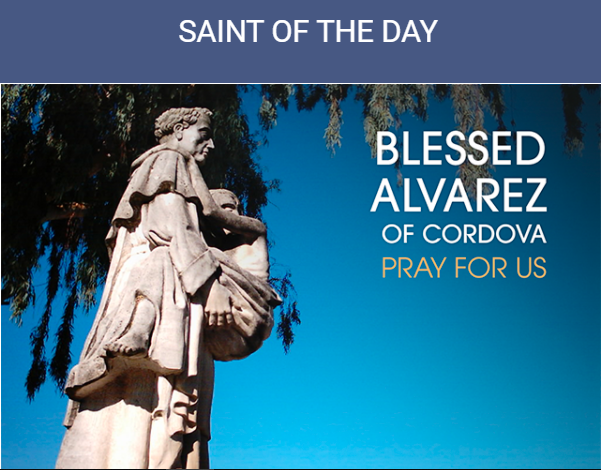
Bl. Alvarez of (Córdoba) Cordova (1350-1430) was born to a noble family in Zamora, Spain. He joined the Dominican Order and preached throughout Spain, and served at the court of Queen Catherine. He went on pilgrimage to the Holy Land, and upon his return preached the crusades against the Muslims. He founded the famous priory of Scala Caeli (Ladder of Heaven) at Cordova, a convent of strict observance, and it is said that angels helped provide its building materials. He erected pictures of the holy places in Jerusalem in its gardens, popularizing the custom of the Stations of the Cross. He lived a life of great austerity and begged for alms even though he could easily obtain what he needed from the royal court. Numerous miracles are attributed to him. It is told that he once found a dying beggar, wrapped him in a blanket, and carried him back to the convent. Upon unwrapping the cloth he found only a crucifix. Blessed Alvarez was dedicated to Christ’s Passion and helped spread devotion to the Way of the Cross throughout western Europe. He also successfully led a resistance against the anti-pope and brought Spain under allegiance to the true pope in Rome. His feast day is February 19.
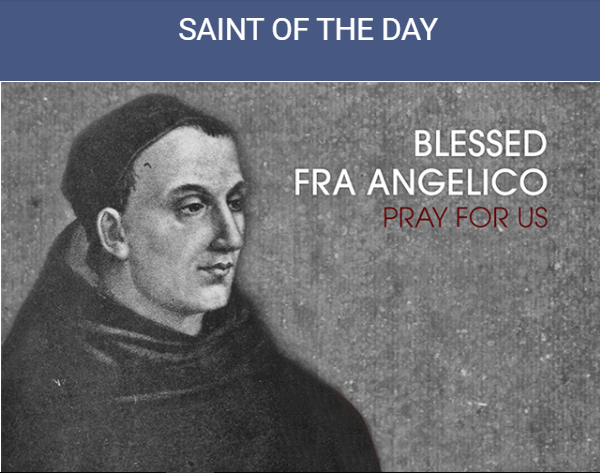
Bl. Fra Angelico (1387-1455) was born Guido di Pietro in Tuscany, Italy. Little is known of his early life, but he became a famous early Italian Renaissance master painter. Fra Angelico would pray earnestly before he painted, being convinced that in order to paint Christ perfectly, one must also be Christlike. His paintings then became tools for contemplating the theological mysteries hidden in the biblical events he depicted. He joined the Dominican Order in 1407 and was given the name Brother John, often called “Angelic Brother John”, or Fra Angelico (Angelic Friar) because of his holiness. He lived and worked in several friaries until moving to the Friary of San Marco in Florence. While in Florence he was surrounded by an artistic community, and, due to his great talent, gained the patronage of the famous Medici family. In 1445 he was summoned to Rome to work on St. Peter’s Basilica in various chapels. From 1449 until shortly before his death, Fra Angelico was also prior of the convent in Fiesole. He passed away while working again in Rome and is buried in the Dominican church of Santa Maria Sopra Minerva. Fra Angelico was beatified by Pope St. John Paul II and is the patron saint of Catholic artists. His feast day is February 18.
The Story of the Seven Founders of the Servite Order
Can you imagine seven prominent men of Boston or Denver banding together, leaving their homes and professions, and going into solitude for a life directly given to God? That is what happened in the cultured and prosperous city of Florence in the middle of the 13th century. The city was torn with political strife as well as the heresy of the Cathari, who believed that physical reality was inherently evil. Morals were low and religion seemed meaningless.
In 1240, seven noblemen of Florence mutually decided to withdraw from the city to a solitary place for prayer and direct service of God. Their initial difficulty was providing for their dependents, since two were still married and two were widowers.
Their aim was to lead a life of penance and prayer, but they soon found themselves disturbed by constant visitors from Florence. They next withdrew to the deserted slopes of Monte Senario.
In 1244, under the direction of Saint Peter of Verona, O.P., this small group adopted a religious habit similar to the Dominican habit, choosing to live under the Rule of St. Augustine and adopting the name of the Servants of Mary. The new Order took a form more like that of the mendicant friars than that of the older monastic Orders.
Members of the community came to the United States from Austria in 1852 and settled in New York and later in Philadelphia. The two American provinces developed from the foundation made by Father Austin Morini in 1870 in Wisconsin.
Community members combined monastic life and active ministry. In the monastery, they led a life of prayer, work and silence while in the active apostolate they engaged in parochial work, teaching, preaching, and other ministerial activities.
Reflection
The time in which the seven Servite founders lived is very easily comparable to the situation in which we find ourselves today. It is “the best of times and the worst of times,” as Dickens once wrote. Some, perhaps many, feel called to a countercultural life, even in religion. All of us are faced in a new and urgent way with the challenge to make our lives decisively centered in Christ.
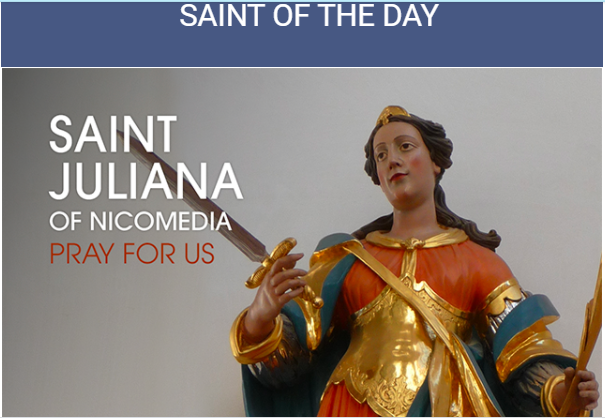
St. Juliana of Nicomedia (c. 270 A.D.) was the daughter of noble pagan parents, born in Nicomedia, a Greek city in ancient Turkey. Although her father was hostile to Christians, Juliana secretly accepted baptism. Her father arranged her marriage to a pagan nobleman and Roman senator. When the time for her wedding came, Juliana refused her consent to be married unless her betrothed converted to the Christian faith. Her father retaliated by mercilessly abusing her, but Juliana would not give in. Her betrothed then denounced her as a Christian before the tribunal under the persecutions of the Roman Emperor Diocletian.
St. Juliana was unwavering in her faith, even after the devil himself appeared to tempt her during her sufferings. She was then publicly tortured by being burned, boiled in oil, and finally beheaded. Some accounts say she died together with St. Barbara. Many were converted to the Christian faith upon witnessing her fortitude in the face of her tortures.
St. Juliana is the patron saint of sickness and bodily ills. Her feast day is February 16th.See More About This Saint >