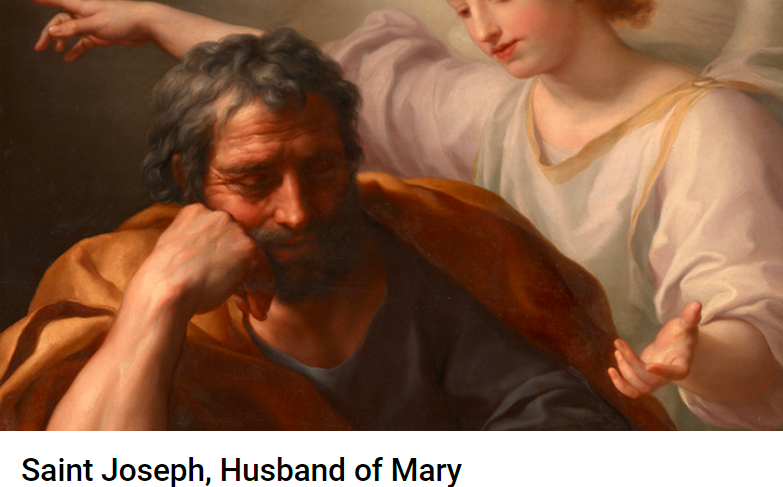
Saint of the Day – March 19th

Saint Joseph’s Story

The Bible pays Joseph the highest compliment: he was a “just” man. The quality meant a lot more than faithfulness in paying debts.

When the Bible speaks of God “justifying” someone, it means that God, the all-holy or “righteous” one, so transforms a person that the individual shares somehow in God’s own holiness, and hence it is really “right” for God to love him or her. In other words, God is not playing games, acting as if we were lovable when we are not.

By saying Joseph was “just,” the Bible means that he was one who was completely open to all that God wanted to do for him. He became holy by opening himself totally to God.

The rest we can easily surmise. Think of the kind of love with which he wooed and won Mary, and the depth of the love they shared during their marriage.

It is no contradiction of Joseph’s manly holiness that he decided to divorce Mary when she was found to be with child. The important words of the Bible are that he planned to do this “quietly” because he was “a righteous man, yet unwilling to expose her to shame” (Matthew 1:19).

The just man was simply, joyfully, wholeheartedly obedient to God—in marrying Mary, in naming Jesus, in shepherding the precious pair to Egypt, in bringing them to Nazareth, in the undetermined number of years of quiet faith and courage.

Reflection

The Bible tells us nothing of Joseph in the years after the return to Nazareth except the incident of finding Jesus in the Temple (Luke 2:41–51). Perhaps this can be taken to mean that God wants us to realize that the holiest family was like every other family, that the circumstances of life for the holiest family were like those of every family, so that when Jesus’ mysterious nature began to appear, people couldn’t believe that he came from such humble beginnings: “Is he not the carpenter’s son? Is not his mother named Mary…?” (Matthew 13:55a). It was almost as indignant as “Can anything good come from Nazareth?” (John 1:46b).

Saint Joseph is the Patron Saint of:

Belgium
Canada
Carpenters
China
Fathers
Happy death
Peru
Russia
Social Justice
Travelers
Universal Church
Vietnam
Workers

//Franciscan Media//
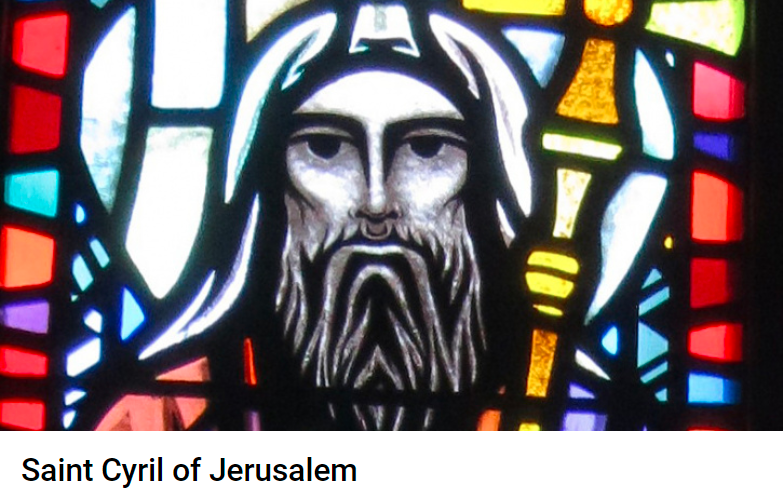

Saint of the Day – March 18th

Saint Cyril of Jerusalem (C. 315 – March 18, 386)

The crises that the Church faces today may seem minor when compared with the threat posed by the Arian heresy, which denied the divinity of Christ and almost overcame Christianity in the fourth century. Cyril was to be caught up in the controversy, accused of Arianism by Saint Jerome, and ultimately vindicated both by the men of his own time and by being declared a Doctor of the Church in 1822.

Raised in Jerusalem and well-educated, especially in the Scriptures, he was ordained a priest by the bishop of Jerusalem and given the task during Lent of catechizing those preparing for Baptism and catechizing the newly baptized during the Easter season. His Catecheses remain valuable as examples of the ritual and theology of the Church in the mid-fourth century.

There are conflicting reports about the circumstances of his becoming bishop of Jerusalem. It is certain that he was validly consecrated by bishops of the province. Since one of them was an Arian, Acacius, it may have been expected that his “cooperation” would follow. Conflict soon rose between Cyril and Acacius, bishop of the rival nearby see of Caesarea. Cyril was summoned to a council, accused of insubordination and of selling Church property to relieve the poor. Probably, however, a theological difference was also involved. He was condemned, driven from Jerusalem, and later vindicated, not without some association with and help from Semi-Arians. Half his episcopate was spent in exile; his first experience was repeated twice. He finally returned to find Jerusalem torn with heresy, schism and strife, and wracked with crime. Even Saint Gregory of Nyssa, who was sent to help, left in despair.

They both went to the Council of Constantinople, where the amended form of the Nicene Creed was promulgated in 381. Cyril accepted the word consubstantial—that is, Christ is of the same substance or nature as the Father. Some said it was an act of repentance, but the bishops of the Council praised him as a champion of orthodoxy against the Arians. Though not friendly with the greatest defender of orthodoxy against the Arians, Cyril may be counted among those whom Athanasius called “brothers, who mean what we mean, and differ only about the word consubstantial.”


Reflection

Those who imagine that the lives of saints are simple and placid, untouched by the vulgar breath of controversy, are rudely shocked by history. Yet, it should be no surprise that saints, indeed all Christians, will experience the same difficulties as their Master. The definition of truth is an endless, complex pursuit, and good men and women have suffered the pain of both controversy and error. Intellectual, emotional, and political roadblocks may slow up people like Cyril for a time. But their lives taken as a whole are monuments to honesty and courage.

//Franciscan Media//


Saint of the Day – March 17th

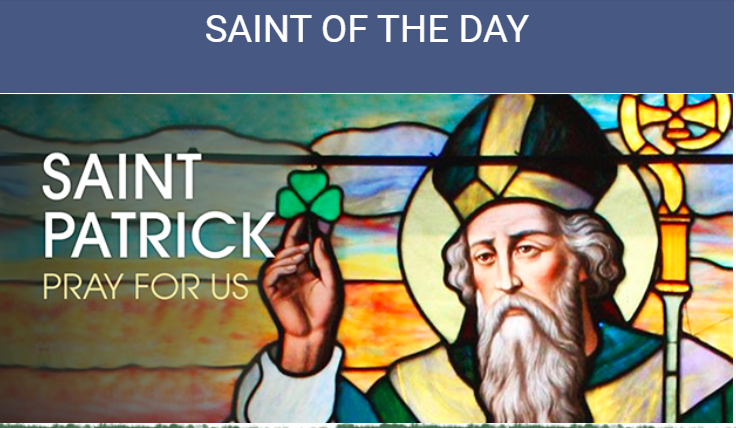
Saint Patrick (C. 415? – 493?)

Legends about Patrick abound; but truth is best served by our seeing two solid qualities in him: He was humble and he was courageous. The determination to accept suffering and success with equal indifference guided the life of God’s instrument for winning most of Ireland for Christ.

Details of his life are uncertain. Current research places his dates of birth and death a little later than earlier accounts. Patrick may have been born in Dunbarton, Scotland, Cumberland, England, or in northern Wales. He called himself both a Roman and a Briton. At 16, he and a large number of his father’s slaves and vassals were captured by Irish raiders and sold as slaves in Ireland. Forced to work as a shepherd, he suffered greatly from hunger and cold.

After six years Patrick escaped, probably to France, and later returned to Britain at the age of 22. His captivity had meant spiritual conversion. He may have studied at Lerins, off the French coast; he spent years at Auxerre, France, and was consecrated bishop at the age of 43. His great desire was to proclaim the good news to the Irish.

In a dream vision it seemed “all the children of Ireland from their mothers’ wombs were stretching out their hands” to him. He understood the vision to be a call to do mission work in pagan Ireland. Despite opposition from those who felt his education had been defective, he was sent to carry out the task. He went to the west and north–where the faith had never been preached–obtained the protection of local kings, and made numerous converts.

Because of the island’s pagan background, Patrick was emphatic in encouraging widows to remain chaste and young women to consecrate their virginity to Christ. He ordained many priests, divided the country into dioceses, held Church councils, founded several monasteries and continually urged his people to greater holiness in Christ.

He suffered much opposition from pagan druids and was criticized in both England and Ireland for the way he conducted his mission. In a relatively short time, the island had experienced deeply the Christian spirit, and was prepared to send out missionaries whose efforts were greatly responsible for Christianizing Europe.

Patrick was a man of action, with little inclination toward learning. He had a rock-like belief in his vocation, in the cause he had espoused. One of the few certainly authentic writings is his Confessio, above all an act of homage to God for having called Patrick, unworthy sinner, to the apostolate.

There is hope rather than irony in the fact that his burial place is said to be in County Down in Northern Ireland, long the scene of strife and violence.

Reflection

What distinguishes Patrick is the durability of his efforts. When one considers the state of Ireland when he began his mission work, the vast extent of his labors, and how the seeds he planted continued to grow and flourish, one can only admire the kind of man Patrick must have been. The holiness of a person is known only by the fruits of his or her work.

Saint Patrick is the Patron Saint of:

Engineers
Ireland
Nigeria

//Franciscan Media//


Saint of the Day – March 16th

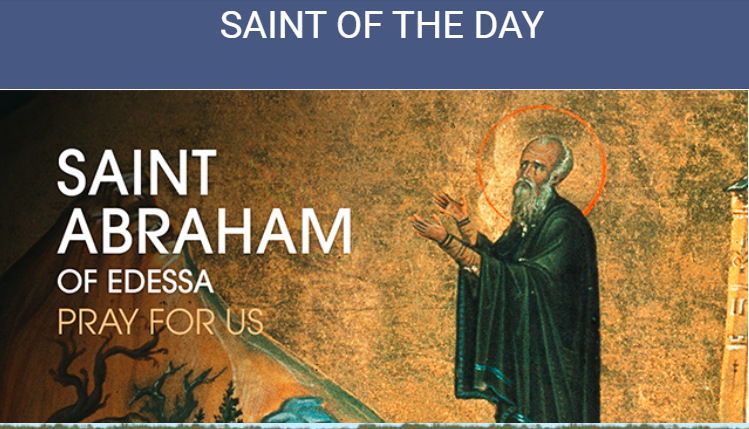
St. Abraham of Edessa (300-360 A.D.), also known as Abraham of Kidunaia, was a rich nobleman from Mesopotamia. He married according to his parents’ wishes, despite his desire to give himself totally to God. After the wedding ceremony he fled to a cave and hid himself, leaving only a small window to receive food. He lived there as a hermit, and after the death of his parents gave his inheritance to the poor.

The Bishop of Edessa ordained him as a priest and sent him to lead a notoriously sinful city. There Abraham was beaten and maligned for three years until his prayers prevailed and every citizen came to him for baptism. He then returned to his hermitage and lived there the rest of his life.

After his brother’s death his young niece was left to his care. He set her up to live as a religious in a cell next to his, which she did for twenty years until she succumbed to the seduction of a rogue hermit. She was so ashamed of her sin that she despaired of God’s mercy and became a prostitute. St. Abraham prayed for his niece earnestly for two years; then, discovering her location, left his cell and came to her disguised as a suitor. When they were alone he revealed his identity to her, and, pleading with her throughout the night, prevailed upon her to return with him to her life of prayer and penance. She came back to her cell, which Abraham relocated directly behind his own for her protection, and became St. Mary of Edessa. St. Abraham’s feast day is March 16th.

//The Catholic Company//


Saint of the Day – March 15th

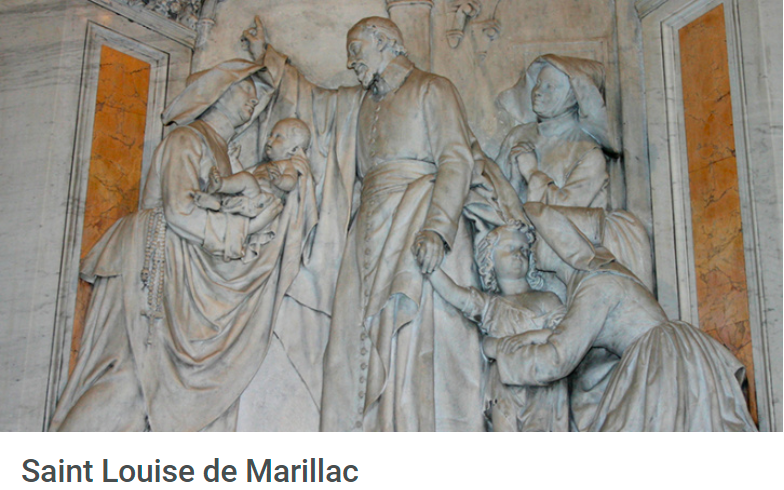
The Story of Saint Louise de Marillac (August 12, 1591 – March 15, 1660)

Born near Meux, France, Louise lost her mother when she was still a child, her beloved father when she was but 15. Her desire to become a nun was discouraged by her confessor, and a marriage was arranged. One son was born of this union. But Louise soon found herself nursing her beloved husband through a long illness that finally led to his death.

Louise was fortunate to have a wise and sympathetic counselor, Francis de Sales, and then his friend, the bishop of Belley, France. Both of these men were available to her only periodically. But from an interior illumination she understood that she was to undertake a great work under the guidance of another person she had not yet met. This was the holy priest Monsieur Vincent, later to be known as Saint Vincent de Paul.

At first, he was reluctant to be her confessor, busy as he was with his “Confraternities of Charity.” Members were aristocratic ladies of charity who were helping him nurse the poor and look after neglected children, a real need of the day. But the ladies were busy with many of their own concerns and duties. His work needed many more helpers, especially ones who were peasants themselves and therefore, close to the poor and able to win their hearts. He also needed someone who could teach them and organize them.

Only over a long period of time, as Vincent de Paul became more acquainted with Louise, did he come to realize that she was the answer to his prayers. She was intelligent, self-effacing, and had physical strength and endurance that belied her continuing feeble health. The missions he sent her on eventually led to four simple young women joining her. Her rented home in Paris became the training center for those accepted for the service of the sick and poor. Growth was rapid and soon there was the need for a so-called “rule of life,” which Louise herself, under the guidance of Vincent, drew up for the Daughters of Charity of St. Vincent de Paul.

Monsieur Vincent had always been slow and prudent in his dealings with Louise and the new group. He said that he had never had any idea of starting a new community, that it was God who did everything. “Your convent,” he said, “will be the house of the sick; your cell, a hired room; your chapel, the parish church; your cloister, the streets of the city or the wards of the hospital.” Their dress was to be that of the peasant women. It was not until years later that Vincent de Paul would finally permit four of the women to take annual vows of poverty, chastity and obedience. It was still more years before the company would be formally approved by Rome and placed under the direction of Vincent’s own congregation of priests.

Many of the young women were illiterate. Still it was with reluctance that the new community undertook the care of neglected children. Louise was busy helping wherever needed despite her poor health. She traveled throughout France, establishing her community members in hospitals, orphanages and other institutions. At her death on March 15, 1660, the congregation had more than 40 houses in France. Six months later Vincent de Paul followed her in death.

Louise de Marillac was canonized in 1934 and declared patroness of social workers in 1960.

Reflection

In Louise’s day, serving the needs of the poor was usually a luxury only fine ladies could afford. Her mentor, Saint Vincent de Paul, wisely realized that women of peasant stock could reach poor people more effectively, and the Daughters of Charity were born under her leadership. Today, that order—along with the Sisters of Charity—continues to nurse the sick and aging and provide refuge for orphans. Many of its members are social workers toiling under Louise’s patronage. The rest of us must share her concern for the disadvantaged.

Saint Louise de Marillac is the Patron Saint of:

Social workers

//The Catholic Company//


Saint of the Day – March 14th

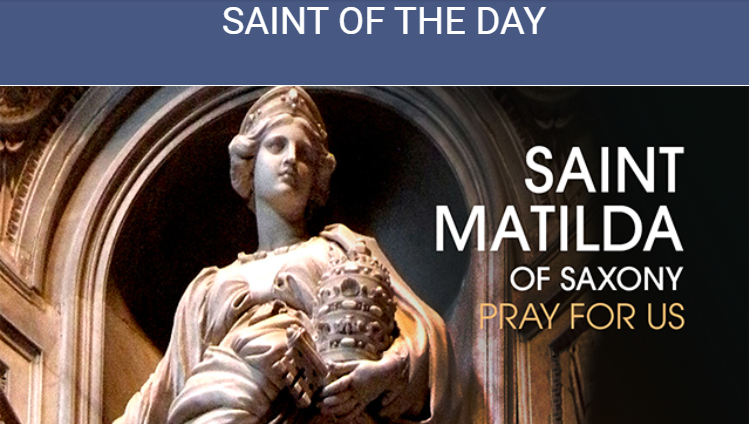
St. Matilda (895-968 A.D.) was born in Prussia, the daughter of a Count, and was raised and educated in a monastery by her grandmother, who was the abbess. A political marriage was arranged for her to Henry I, the future king of Germany. Henry and Matilda enjoyed a happy and blessed marriage. As the Queen of Germany, Matilda became the mother of five important historical figures: Holy Roman Emperor Otto I; Henry, Duke of Bavaria; St. Bruno, Archbishop of Cologne; Gerberga, wife of King Louis IV of France; and Hedwig, mother of Hugh Capet.

Matilda was a holy and virtuous woman known for her generosity to the poor. The king adored his queen and attributed his success in battle to her prayers. They reigned seventeen years, and their eldest son succeeded the throne and became Emperor Otto I. After her husband’s death, Matilda’s two eldest sons chastised her for her generous almsgiving. St. Matilda then took the possessions left to her by her husband and turned them over to her sons, and retired from court. Her sons immediately suffered misfortune, which was attributed to their poor treatment of their holy mother. In order to repair this injustice and regain God’s favor, St. Matilda was begged to return to court, which she did, forgiving her sons for their ill will. She continued to help the poor, build churches, and support many monasteries. St. Matilda was a celebrated monarch and was venerated by the people immediately after her death. Her feast day is March 14th.

//The Catholic Company//


Saint of the Day – March 11th

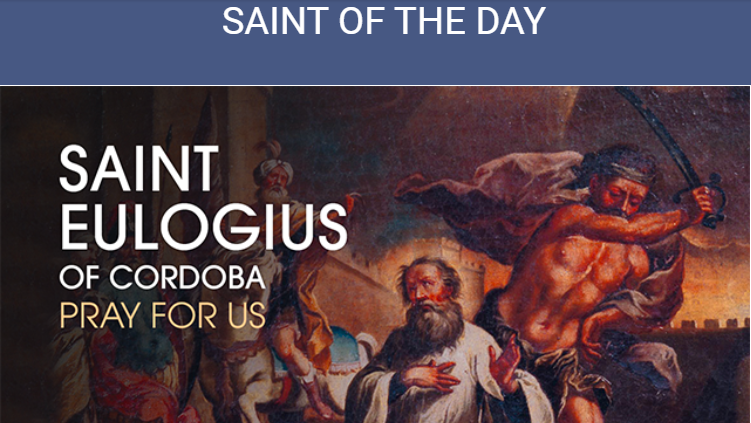
St. Eulogius of Cordoba (9th c.) was a priest from a prominent Christian family in Cordoba (Cordova), Spain. He was well-educated, humble, gentle, friendly, and a gifted leader with the charism of encouragement, especially towards Christians facing martyrdom. In his time Cordoba was the capital of the Muslim conquerors of Catholic Spain.

The Muslim leaders allowed Christians to live in relative peace until a persecution arose when some of the Muslim population began converting to Christianity. They imprisoned the clergy, including Eulogius. While in prison Eulogius read the Bible to his companions and exhorted them to faithfulness in the face of martyrdom. He also wrote to two other young female converts who were facing threats, instructing them that no matter how terribly they were physically abused, it could not harm their souls, and that they must fight for their faith till death and leave God to defend his Church.

St. Eulogius was released and later jailed again for hiding a young female convert who fled from her family in fear of her life. St. Eulogius’ judge offered him escape if he would weaken the practice of his religion, but instead he preached the Gospel to the presiding court. He was immediately beheaded. St. Eulogius’ feast day is March 11th.


Saint of the Day – March 10th

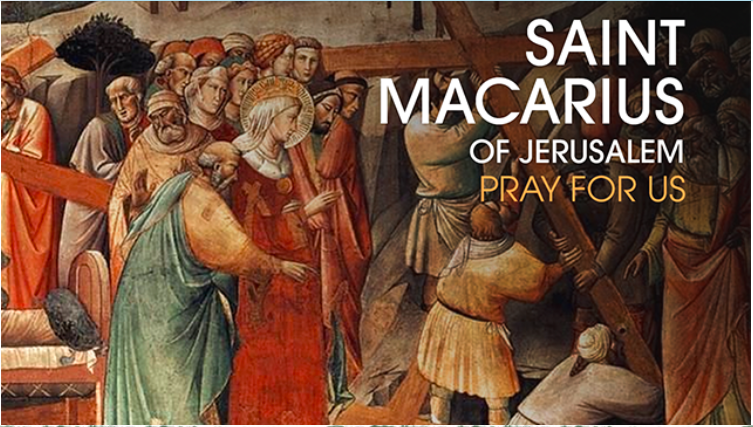
St. Macarius of Jerusalem (4th c.) was the Bishop of Jerusalem from 312-335 A.D. Little is known of his life before this time. He took part in the Council of Nicea in 325 A.D. and vigorously opposed the Arian heresy, which greatly threatened the early Church. It is believed that he was one of the bishops who helped draft the Nicene Creed. St. Athanasius, his contemporary, refers to Macarius as an example of “the honest and simple style of apostolical men.”

After the council, St. Macarius accompanied St. Helen, the queen mother of the Roman Emperor Constantine, in her successful search for the True Cross that Jesus was crucified upon. It was he who suggested to St. Helen that she would identify the real Cross by touching all three of those she found to a seriously ill woman, and observe which one brought immediate healing.

Following the discovery of the True Cross in this miraculous manner, Constantine wrote to Bishop Macarius requesting that he oversee the construction of a magnificent church in Jerusalem, the Basilica of the Holy Sepulchre, to commemorate the sites of the Crucifixion and Burial of Christ, which still exists today as one of the most important Christian pilgrimage sites in the world. His feast day is March 10th.

//The Catholic Company//


Saint of the Day – March 9th


Saint Frances of Rome (1384 – March 9, 1440

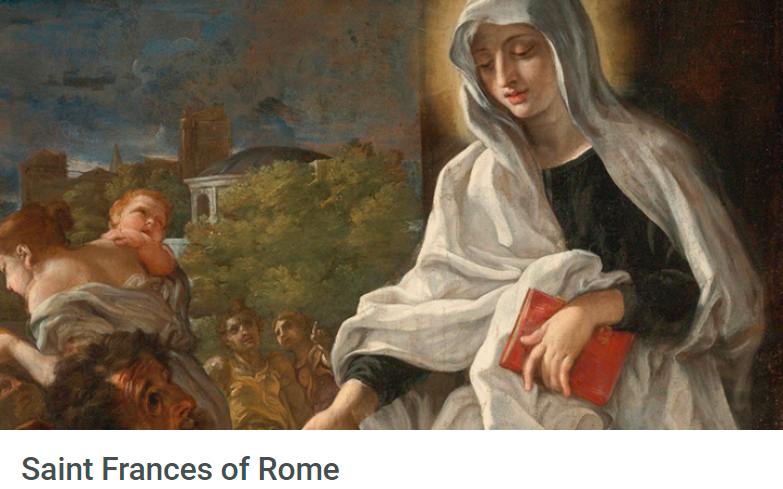
Frances’ life combines aspects of secular and religious life. A devoted and loving wife, she longed for a lifestyle of prayer and service, so she organized a group of women to minister to the needs of Rome’s poor.

Born of wealthy parents, Frances found herself attracted to the religious life during her youth. But her parents objected and a young nobleman was selected to be her husband.

As she became acquainted with her new relatives, Frances soon discovered that the wife of her husband’s brother also wished to live a life of service and prayer. So the two, Frances and Vannozza, set out together—with their husbands’ blessings—to help the poor.

Frances fell ill for a time, but this apparently only deepened her commitment to the suffering people she met. The years passed, and Frances gave birth to two sons and a daughter. With the new responsibilities of family life, the young mother turned her attention more to the needs of her own household.

The family flourished under Frances’ care, but within a few years a great plague began to sweep across Italy. It struck Rome with devastating cruelty and left Frances’ second son dead. In an effort to help alleviate some of the suffering, Frances used all her money and sold her possessions to buy whatever the sick might possibly need. When all the resources had been exhausted, Frances and Vannozza went door to door begging. Later, Frances’ daughter died, and the saint opened a section of her house as a hospital.

Reflection

Looking at the exemplary life of fidelity to God and devotion to her fellow human beings which Frances of Rome was blessed to lead, one cannot help but be reminded of Saint Teresa of Calcutta, who loved Jesus Christ in prayer and also in the poor. The life of Frances of Rome calls each of us not only to look deeply for God in prayer, but also to carry our devotion to Jesus living in the suffering of our world. Frances shows us that this life need not be restricted to those bound by vows.

Saint Frances of Rome is the Patron Saint of:

Motorists
Widows


Saint of the Day – March 8th

Saint John of God (March 8, 1495 – March 8, 1550)

Having given up active Christian belief while a soldier, John was 40 before the depth of his sinfulness began to dawn on him. He decided to give the rest of his life to God’s service, and headed at once for Africa where he hoped to free captive Christians and, possibly, be martyred.

He was soon advised that his desire for martyrdom was not spiritually well based, and returned to Spain and the relatively prosaic activity of a religious goods store. Yet he was still not settled. Moved initially by a sermon of Saint John of Avila, he one day engaged in a public beating of himself, begging mercy and wildly repenting for his past life.

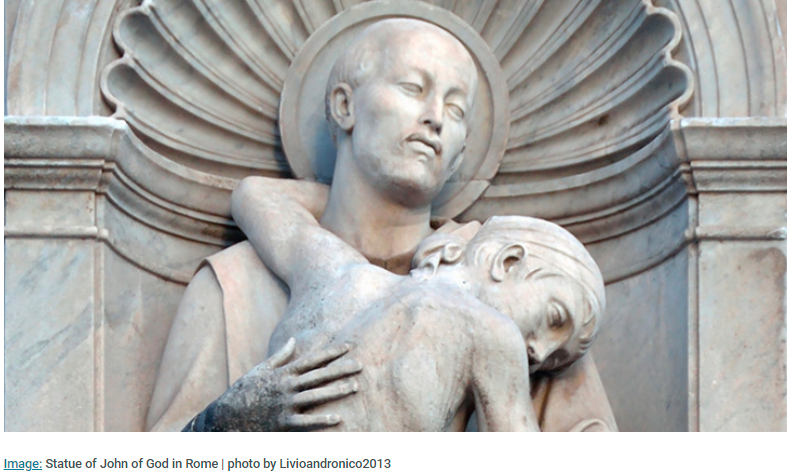
Committed to a mental hospital for these actions, John was visited by Saint John, who advised him to be more actively involved in tending to the needs of others rather than in enduring personal hardships. John gained peace of heart, and shortly after left the hospital to begin work among the poor.

He established a house where he wisely tended to the needs of the sick poor, at first doing his own begging. But, excited by the saint’s great work and inspired by his devotion, many people began to back him up with money and provisions. Among them were the archbishop and marquis of Tarifa.

Behind John’s outward acts of total concern and love for Christ’s sick poor was a deep interior prayer life which was reflected in his spirit of humility. These qualities attracted helpers who, 20 years after John’s death, formed the Brothers Hospitallers, now a worldwide religious order.

John became ill after 10 years of service, but tried to disguise his ill health. He began to put the hospital’s administrative work into order and appointed a leader for his helpers. He died under the care of a spiritual friend and admirer, Lady Ana Ossorio.


Reflection

The utter humility of John of God, which led to a totally selfless dedication to others, is most impressive. Here is a man who realized his nothingness in the face of God. The Lord blessed him with the gifts of prudence, patience, courage, enthusiasm, and the ability to influence and inspire others. He saw that in his early life he had turned away from the Lord, and, moved to receive his mercy, John began his new commitment to love others in openness to God’s love.

Saint John of God is the Patron Saint of:

Booksellers
Firefighters
Heart Patients
Hospitals
Nurses
Printers
Sick