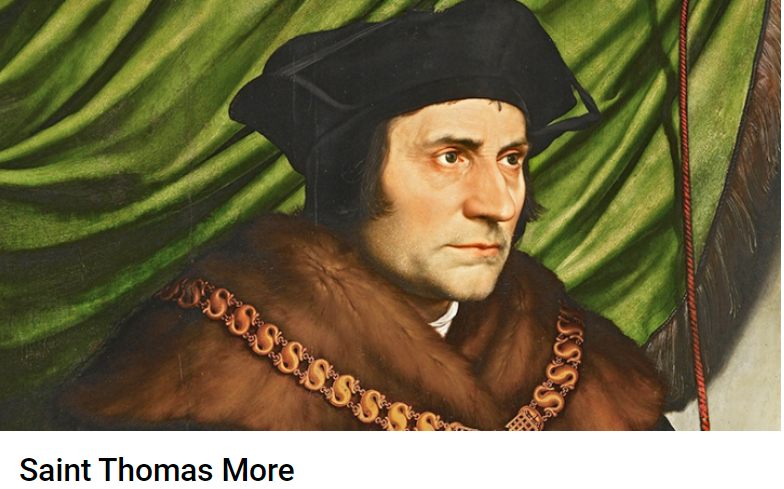
Saint of the Day – June 22 – Saint Thomas More

(FEBRUARY 7, 1478 – JULY 6, 1535)

Saint Thomas More’s Story

His belief that no lay ruler has jurisdiction over the Church of Christ cost Thomas More his life.

Beheaded on Tower Hill, London, on July 6, 1535, More steadfastly refused to approve King Henry VIII’s divorce and remarriage and establishment of the Church of England.

Described as “a man for all seasons,” More was a literary scholar, eminent lawyer, gentleman, father of four children, and chancellor of England. An intensely spiritual man, he would not support the king’s divorce from Catherine of Aragon in order to marry Anne Boleyn. Nor would he acknowledge Henry as supreme head of the Church in England, breaking with Rome, and denying the pope as head.

More was committed to the Tower of London to await trial for treason: not swearing to the Act of Succession and the Oath of Supremacy. Upon conviction, More declared he had all the councils of Christendom and not just the council of one realm to support him in the decision of his conscience.

Reflection

Four hundred years later in 1935, Thomas More was canonized a saint of God. Few saints are more relevant to our time. In the year 2000, in fact, Pope John Paul II named him patron of political leaders. The supreme diplomat and counselor, he did not compromise his own moral values in order to please the king, knowing that true allegiance to authority is not blind acceptance of everything that authority wants. King Henry himself realized this and tried desperately to win his chancellor to his side because he knew More was a man whose approval counted, a man whose personal integrity no one questioned. But when Thomas More resigned as chancellor, unable to approve the two matters that meant most to Henry, the king had to get rid of him.

Saint Thomas More is the Patron Saint of:

Attorneys
Civil Servants
Court Clerks
Lawyers
Politicians
Public Servants

//Franciscan Media//
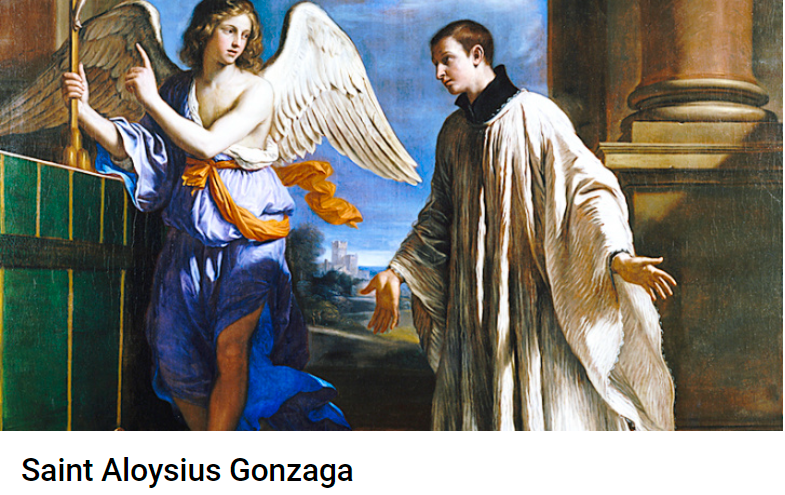

Saint of the Day – June 21 – Saint Aloysius Gonzaga

(MARCH 9, 1568 – JUNE 21, 1591)
Saint Aloysius Gonzaga’s Story

The Lord can make saints anywhere, even amid the brutality and license of Renaissance life. Florence was the “mother of piety” for Aloysius Gonzaga despite his exposure to a “society of fraud, dagger, poison, and lust.” As a son of a princely family, he grew up in royal courts and army camps. His father wanted Aloysius to be a military hero.

At age 7 Aloysius experienced a profound spiritual quickening. His prayers included the Office of Mary, the psalms, and other devotions. At age 9 he came from his hometown of Castiglione to Florence to be educated; by age 11 he was teaching catechism to poor children, fasting three days a week, and practicing great austerities. When he was 13 years old, he traveled with his parents and the Empress of Austria to Spain, and acted as a page in the court of Philip II. The more Aloysius saw of court life, the more disillusioned he became, seeking relief in learning about the lives of saints.

A book about the experience of Jesuit missionaries in India suggested to him the idea of entering the Society of Jesus, and in Spain his decision became final. Now began a four-year contest with his father. Eminent churchmen and laypeople were pressed into service to persuade Aloysius to remain in his “normal” vocation. Finally he prevailed, was allowed to renounce his right to succession, and was received into the Jesuit novitiate.

Like other seminarians, Aloysius was faced with a new kind of penance—that of accepting different ideas about the exact nature of penance. He was obliged to eat more, and to take recreation with the other students. He was forbidden to pray except at stated times. He spent four years in the study of philosophy and had Saint Robert Bellarmine as his spiritual adviser.

In 1591, a plague struck Rome. The Jesuits opened a hospital of their own. The superior general himself and many other Jesuits rendered personal service. Because he nursed patients, washing them and making their beds, Aloysius caught the disease. A fever persisted after his recovery and he was so weak he could scarcely rise from bed. Yet he maintained his great discipline of prayer, knowing that he would die three months later within the octave of Corpus Christi, at the age of 23.

Reflection

As a saint who fasted, scourged himself, sought solitude and prayer, and did not look on the faces of women, Aloysius seems an unlikely patron of youth in a society where asceticism is confined to training camps of football teams and boxers, and sexual permissiveness has little left to permit. Can an overweight and air-conditioned society deprive itself of anything? It will when it discovers a reason, as Aloysius did. The motivation for letting God purify us is the experience of God loving us in prayer.

Saint Aloysius Gonzaga is the Patron Saint of:

Catholic Youth
Teenagers
Seminarians

//Franciscan Media//


Saint of the Day – June 20 – Blessed John Fenwick & Blessed John Gavan

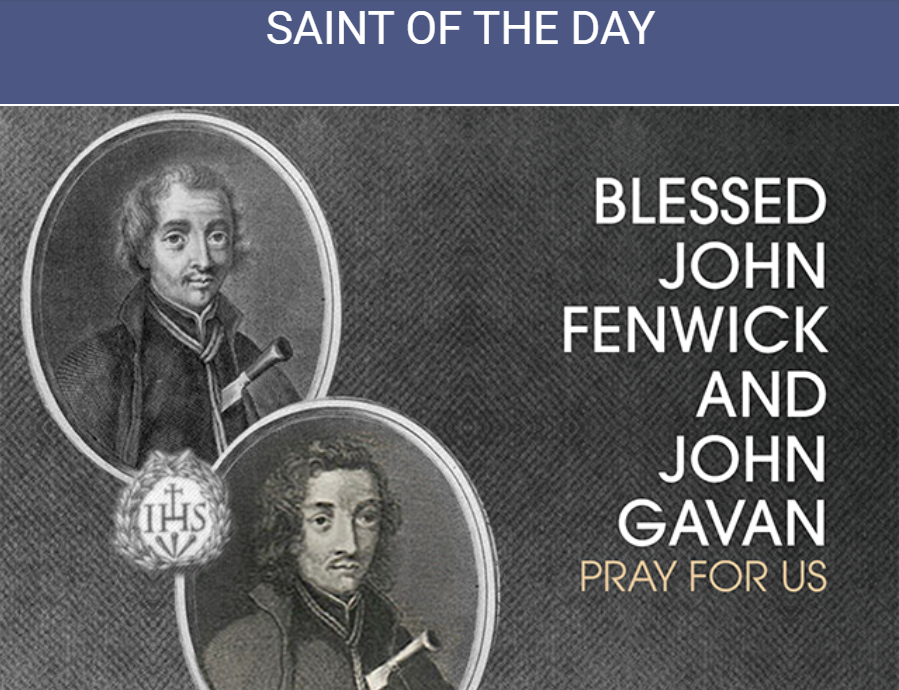
Bl. John Fenwick and Bl. John Gavan (d. 1679) were Englishmen and Jesuit priests who were martyred for their faith in England during the monarchy’s persecution of the Catholic Church. John Fenwick’s Protestant parents disowned him when he became a Catholic. The two priests, along with three other Jesuits, were falsely accused of involvement in the “Popish Plot,” a fabricated conspiracy that mounted to anti-Catholic hysteria in England over the course of three years. The men were charged with complicity to assassinate King Charles II and condemned on the charges of High Treason and subversion of the nation’s Protestant religion. During their trial, John Gavan acted as the principal spokesman for the group; one historian called him one of the ablest priests of his generation. Both priests were condemned to be hung, drawn, and quartered. It is said that the King, knowing they were innocent yet unwilling to grant them pardon, permitted them to be hanged only. After giving a rousing speech declaring their innocence, Bl. John Fenwick and Bl. John Gavan were martyred together on June 20th, 1679. They share a feast day on June 20th.

//Catholic Company//


Saint of the Day – June 18 – Saints Mark & Marcellian

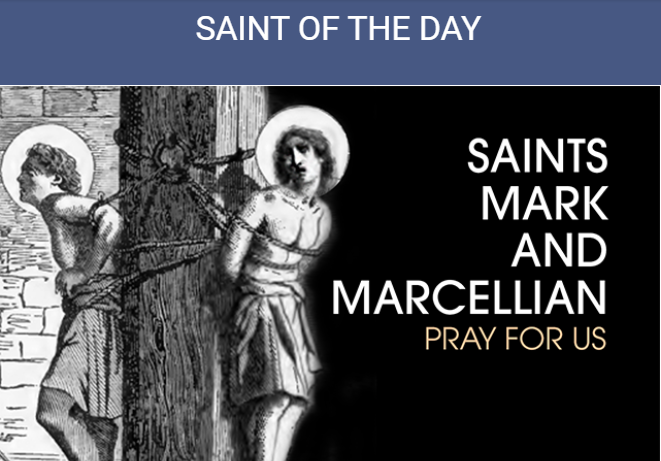
Sts. Mark and Marcellian (d. 286 A.D.) were twin brothers who were martyred for their faith in Rome under Emperor Diocletian. According to legend they were both deacons from a distinguished family who were thrown into prison for being Christians. Their mother and father, who were pagans, visited their sons in prison and pleaded with them to return to the worship of false gods so that they could be saved. At the same time, St. Sebastian also visited the brothers and encouraged them to stand strong in their faith. St. Sebastian’s exhortation was so persuasive that the parents of Marcellian and Mark were converted, along with several friends who were present, as well as the other prisoners. All of these new Christian converts were eventually martyred alongside Mark and Marcellian. The brothers had their feet nailed to a wood post, and later their bodies were pierced with lances. Their feast day is June 18th.

//Catholic Company//


Saint of the Day – June 16 – Saint John Francis Regis

(JANUARY 31, 1597 –  DECEMBER 30, 1640)
Saint John Francis Regis’ Story

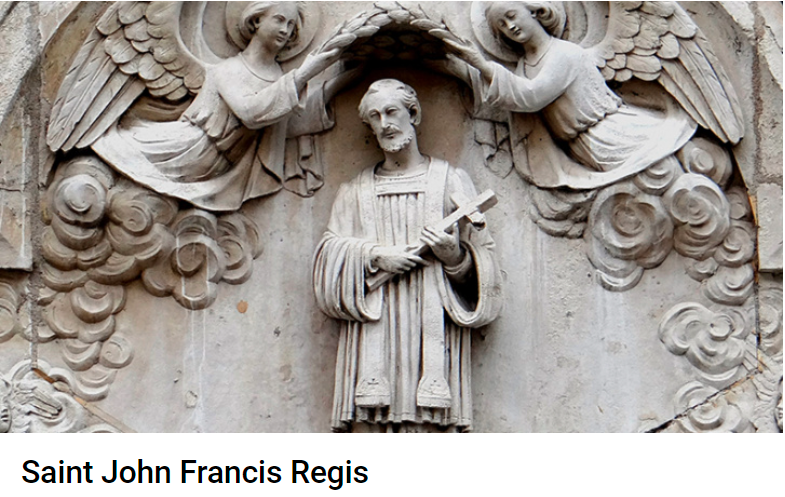
Born into a family of some wealth, John Francis was so impressed by his Jesuit educators that he himself wished to enter the Society of Jesus. He did so at age 18. Despite his rigorous academic schedule, he spent many hours in chapel, often to the dismay of fellow seminarians who were concerned about his health. Following his ordination to the priesthood, John Francis undertook missionary work in various French towns. While the formal sermons of the day tended toward the poetic, his discourses were plain. But they revealed the fervor within him and attracted people of all classes. Father Regis especially made himself available to the poor. Many mornings were spent in the confessional or at the altar celebrating Mass; afternoons were reserved for visits to prisons and hospitals.

The bishop of Viviers, observing the success of Father Regis in communicating with people, sought to draw on his many gifts, especially needed during the prolonged civil and religious strife then rampant throughout France. With many prelates absent and priests negligent, the people had been deprived of the sacraments for 20 years or more. Various forms of Protestantism were thriving in some cases while a general indifference toward religion was evident in other instances. For three years, Father Regis traveled throughout the diocese, conducting missions in advance of a visit by the bishop. He succeeded in converting many people and in bringing many others back to religious observances.

Though Father Regis longed to work as a missionary among the Native Americans in Canada, he was to live out his days working for the Lord in the wildest and most desolate part of his native France. There he encountered rigorous winters, snowdrifts and other deprivations. Meanwhile he continued preaching missions and earned a reputation as a saint. Upon entering the town of Saint-Andé, one man came upon a large crowd in front of a church and was told that people were waiting for “the saint” who was coming to preach a mission.

The last four years of his life were spent preaching and organizing social services, especially for prisoners, the sick and the poor. In the autumn of 1640, Father Regis sensed that his days were coming to a conclusion. He settled some of his affairs and prepared for the end by continuing to do what he did so well: speaking to the people about the God who loved them. On December 31, he spent most of the day with his eyes on the crucifix. That evening, he died. His final words were: “Into thy hands I commend my spirit.”

John Francis Regis was canonized in 1737.

Reflection

John longed to travel to the New World and become a missionary to the Native Americans, but he was called instead to work among his own compatriots. Unlike many famous preachers, he isn’t remembered for golden-tongued oratory. What people who listened to him heard was his own fervent faith, and it had a powerful effect on them. We can recall homilists who impressed us for the same reason. More importantly for us, we can also remember ordinary people, neighbors and friends, whose faith and goodness touched us and brought us to deeper faith. That is the calling most of us must follow.

//Franciscan Media//


Saint of the Day – June 15 – Saint Germaine Cousin

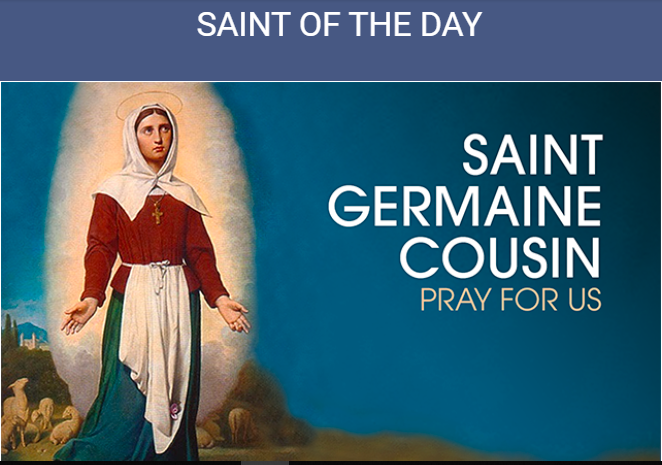
St. Germaine Cousin (1579–1601) was born in a remote French village to a peasant farmer. She was born with a deformed right arm and a disease that causes abscesses in her neck. Her mother died when she was an infant, and her father remarried. Due to Germaine’s deformities, her stepmother was thoroughly disgusted with her. She severely neglected and physically abused the child, and taught others to do the same. Starving, sick, and dressed in rags with no shoes, Germaine was forced to sleep in the barn. Her stepmother once attempted to kill her off by sending her to tend sheep near a wolf-infested forest. St. Germaine was a simple and pious child, and through her extreme hardships she developed a deep interior life. She prayed the rosary and went to Mass daily, leaving her sheep to the care of her guardian angel. Even though she was emaciated, she shared the little food she had with beggars. Her piety was admired by the village children, and adults gradually became aware of her holiness, especially when news of her miracles began to circulate. St. Germaine died at the age of twenty-two, succumbing to her poor living conditions. Many years later her body was found incorrupt. Villagers began praying for her intercession and receiving miraculous cures, resulting in her canonization in 1867. St. Germaine is the patron saint of unattractive people, peasant girls, abuse victims, handicapped people, and abandoned people. Her feast day is June 15th.

//Catholic Company//


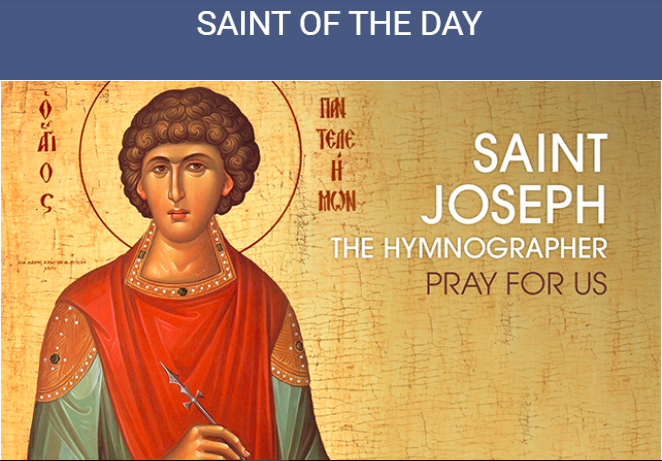
Saint of the Day – June 14 – Saint Joseph the Hymnographer

St. Joseph the Hymnographer (816-883 A.D.) was born in Sicily to a pious Christian family. When Muslims invaded the island, his family moved to Greece to escape persecution. At the age of fifteen he entered a monastery and grew in holiness and virtue. St. Gregory the Dekapolite took Joseph with him to Constantinople to defend the traditional reverence of icons in opposition to the iconoclast heresy. Joseph was then chosen by the local clergy to be a messenger to Pope Leo III to obtain the Holy Father’s assistance in battling the iconoclast heretics, who were gaining power and influence. On his way to Rome, Joseph was captured by Muslims who delivered him into the hands of the iconoclast heretics. While held a prisoner, St. Nicholas appeared to Joseph and asked him to sing in the name of God. After six years Joseph was freed from prison and returned to Constantinople, where he founded a monastery dedicated to his friend St. Gregory. He also dedicated a church in the name of St. Bartholomew, to whom he had a devotion. St. Bartholomew then appeared to Joseph in a dream and encouraged him to write hymns for the Church. After writing his first hymn in honor of St. Bartholomew, Joseph dedicated other hymns to St. Nicholas, the Blessed Virgin Mary, and other saints. During his life he composed nearly 1,000 hymns. When another wave of iconoclasm arose, he again stood steadfast against it and was exiled for eleven years as a result; he was later exiled a second time for defending orthodox Christian doctrine. He finally died full of years in Constantinople. His feast day is June 14.

//Catholic Company//


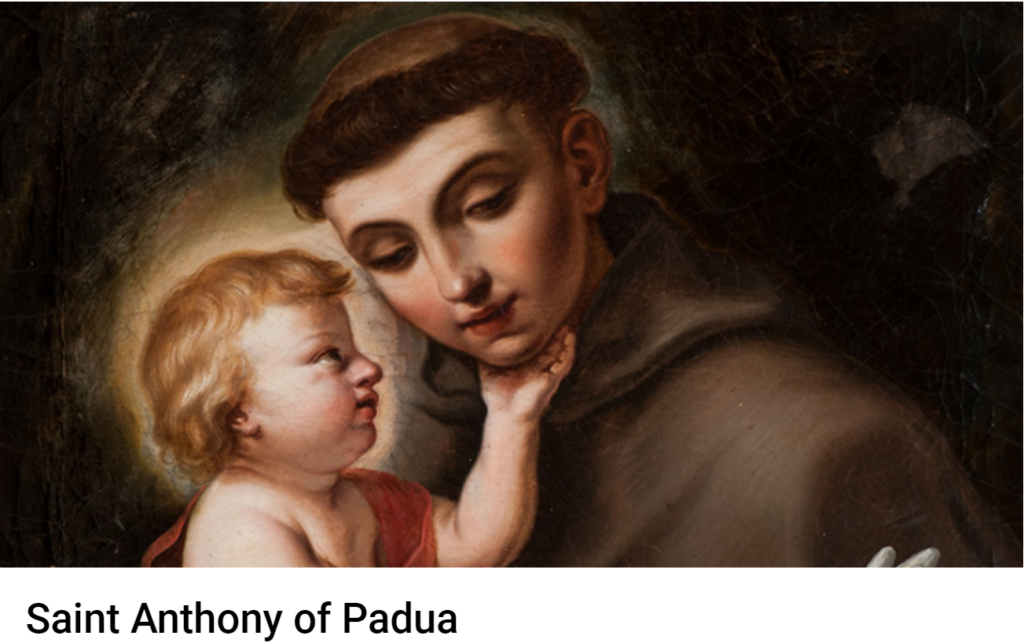
Saint of the Day – June 13 – Saint Anthony of Padua

(1195 – JUNE 13, 1231)

Saint Anthony of Padua’s Story

The gospel call to leave everything and follow Christ was the rule of Saint Anthony of Padua’s life. Over and over again, God called him to something new in his plan. Every time Anthony responded with renewed zeal and self-sacrificing to serve his Lord Jesus more completely.

His journey as the servant of God began as a very young man when he decided to join the Augustinians in Lisbon, giving up a future of wealth and power to be a servant of God. Later when the bodies of the first Franciscan martyrs went through the Portuguese city where he was stationed, he was again filled with an intense longing to be one of those closest to Jesus himself: those who die for the Good News.

So Anthony entered the Franciscan Order and set out to preach to the Moors. But an illness prevented him from achieving that goal. He went to Italy and was stationed in a small hermitage where he spent most of his time praying, reading the Scriptures and doing menial tasks.

The call of God came again at an ordination where no one was prepared to speak. The humble and obedient Anthony hesitantly accepted the task. The years of searching for Jesus in prayer, of reading sacred Scripture and of serving him in poverty, chastity, and obedience had prepared Anthony to allow the Spirit to use his talents. Anthony’s sermon was astounding to those who expected an unprepared speech and knew not the Spirit’s power to give people words.

Recognized as a great man of prayer and a great Scripture and theology scholar, Anthony became the first friar to teach theology to the other friars. Soon he was called from that post to preach to the Albigensians in France, using his profound knowledge of Scripture and theology to convert and reassure those who had been misled by their denial of Christ’s divinity and of the sacraments..

After he led the friars in northern Italy for three years, he made his headquarters in the city of Padua. He resumed his preaching and began writing sermon notes to help other preachers. In the spring of 1231 Anthony withdrew to a friary at Camposampiero where he had a sort of treehouse built as a hermitage. There he prayed and prepared for death.

On June 13, he became very ill and asked to be taken back to Padua, where he died after receiving the last sacraments. Anthony was canonized less than a year later and named a Doctor of the Church in 1946.

Reflection

Anthony should be the patron of those who find their lives completely uprooted and set in a new and unexpected direction. Like all saints, he is a perfect example of turning one’s life completely over to Christ. God did with Anthony as God pleased—and what God pleased was a life of spiritual power and brilliance that still attracts admiration today. He whom popular devotion has nominated as finder of lost objects found himself by losing himself totally to the providence of God.

Saint Anthony of Padua is the Patron Saint of:

Lost items
Poor
Travelers

//Franciscan Media//


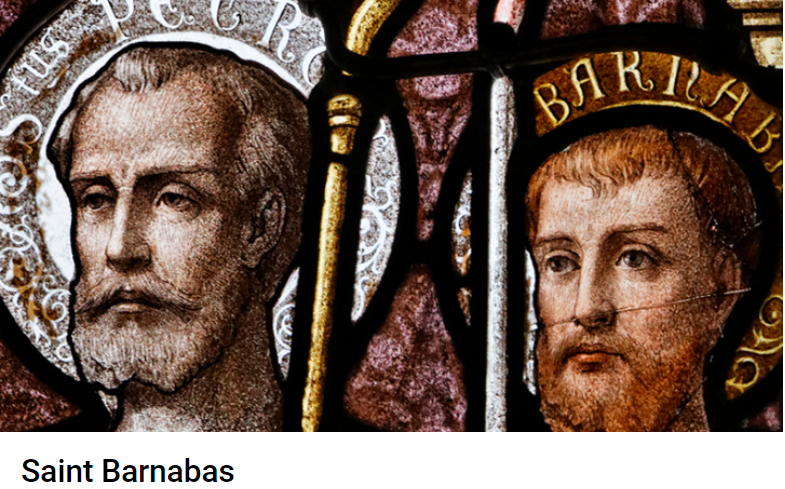
Saint of the Day – June 11 – Saint Barnabas

(C. 75)

Saint Barnabas’ Story

Barnabas, a Jew of Cyprus, comes as close as anyone outside the Twelve to being a full-fledged apostle. He was closely associated with Saint Paul—he introduced Paul to Peter and the other apostles—and served as a kind of mediator between the former persecutor and the still suspicious Jewish Christians.

When a Christian community developed at Antioch, Barnabas was sent as the official representative of the church of Jerusalem to incorporate them into the fold. He and Paul instructed in Antioch for a year, after which they took relief contributions to Jerusalem.

Later Paul and Barnabas, now clearly seen as charismatic leaders, were sent by Antioch officials to preach to the gentiles. Enormous success crowned their efforts. After a miracle at Lystra, the people wanted to offer sacrifice to them as gods—Barnabas being Zeus, and Paul, Hermes—but the two said, “We are of the same nature as you, human beings. We proclaim to you good news that you should turn from these idols to the living God” (see Acts 14:8-18).

But all was not peaceful. They were expelled from one town, they had to go to Jerusalem to clear up the ever-recurring controversy about circumcision, and even the best of friends can have differences. When Paul wanted to revisit the places they had evangelized, Barnabas wanted to take along his cousin John Mark, author of the Gospel, but Paul insisted that since Mark had deserted them once, he was not fit to take along now. The disagreement that followed was so sharp that Barnabas and Paul separated: Barnabas taking Mark to Cyprus, Paul taking Silas to Syria. Later they were reconciled—Paul, Barnabas and Mark.

When Paul stood up to Peter for not eating with gentiles for fear of his Jewish friends, we learn that “even Barnabas was carried away by their hypocrisy” (see Galatians 2:1-13).

Reflection

Barnabas is spoken of simply as one who dedicated his life to the Lord. He was a man “filled with the Holy Spirit and faith. Thereby, large numbers were added to the Lord.” Even when he and Paul were expelled from Antioch in Pisidia—modern-day Turkey—they were “filled with joy and the Holy Spirit.”

Saint Barnabas is the Patron Saint of:

Cyprus

//Franciscan Media//


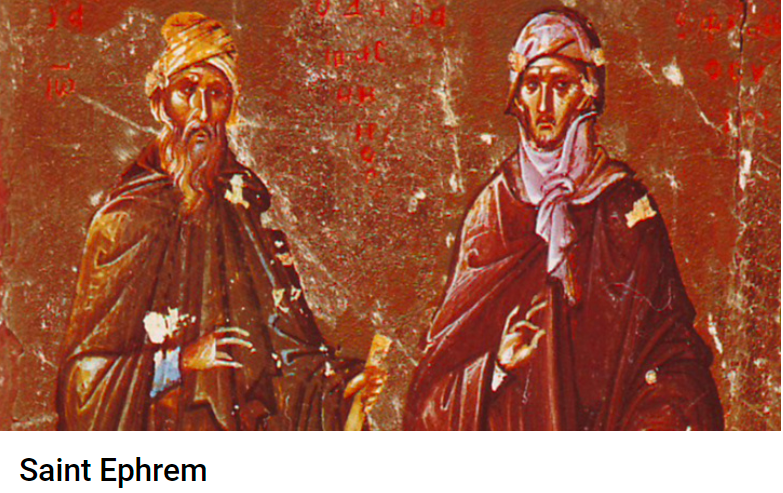
Saint of the Day – June 9 – Saint Ephrem

(C. 306 – JUNE 9, 373)
Saint Ephrem’s Story

Poet, teacher, orator, and defender of the faith, Ephrem is the only Syriac Christian recognized as a doctor of the Church. He took upon himself the special task of opposing the many false doctrines rampant at his time, always remaining a true and forceful defender of the Catholic Church.

Born in Nisibis, Mesopotamia, he was baptized as a young man and became famous as a teacher in his native city. When the Christian emperor had to cede Nisibis to the Persians, Ephrem fled as a refugee to Edessa, along with many other Christians. He is credited with attracting great glory to the biblical school there. He was ordained a deacon but declined becoming a priest. Ephrem was said to have avoided presbyteral consecration by feigning madness!

He had a prolific pen, and his writings best illumine his holiness. Although he was not a man of great scholarship, his works reflect deep insight and knowledge of the Scriptures. In writing about the mysteries of humanity’s redemption, Ephrem reveals a realistic and humanly sympathetic spirit and a great devotion to the humanity of Jesus. It is said that his poetic account of the Last Judgment inspired Dante.

It is surprising to read that he wrote hymns against the heretics of his day. He would take the popular songs of the heretical groups and using their melodies, compose beautiful hymns embodying orthodox doctrine. Ephrem became one of the first to introduce song into the Church’s public worship as a means of instruction for the faithful. His many hymns have earned him the title “Harp of the Holy Spirit.”

Ephrem preferred a simple, austere life, living in a small cave overlooking the city of Edessa. It was here that he died around 373.

Reflection

Many Catholics still find singing in church a problem, probably because of the rather individualistic piety that they inherited. Yet singing has been a tradition of both the Old and the New Testaments. It is an excellent way of expressing and creating a community spirit of unity as well as of joy. An ancient historian testifies that Ephrem’s hymns “lent luster to the Christian assemblies.” We need some modern Ephrems—and cooperating singers—to do the same for our Christian assemblies today.

//Franciscan Media//