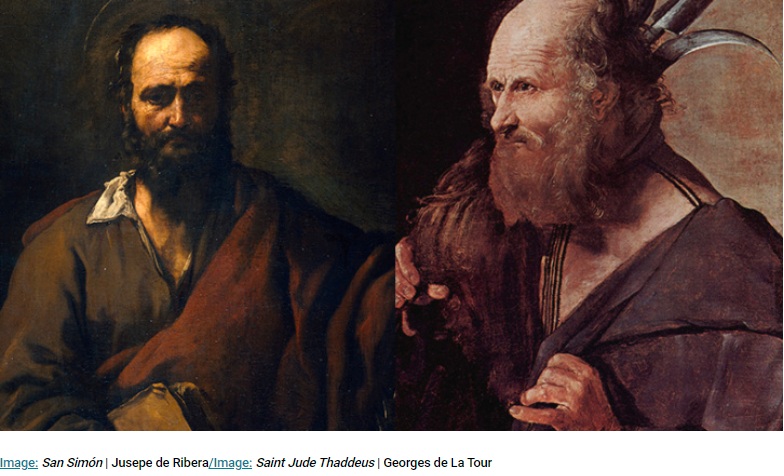
Saint of the Day – October 28 – Saints Simon and Jude

Saints Simon and Jude’s Story (1ST CENTURY)

Jude is so named by Luke and Acts. Matthew and Mark call him Thaddeus. He is not mentioned elsewhere in the Gospels, except of course where all the apostles are mentioned. Scholars hold that he is not the author of the Letter of Jude. Actually, Jude had the same name as Judas Iscariot. Evidently because of the disgrace of that name, it was shortened to “Jude” in English.

Simon is mentioned on all four lists of the apostles. On two of them he is called “the Zealot.” The Zealots were a Jewish sect that represented an extreme of Jewish nationalism. For them, the messianic promise of the Old Testament meant that the Jews were to be a free and independent nation. God alone was their king, and any payment of taxes to the Romans—the very domination of the Romans—was a blasphemy against God. No doubt some of the Zealots were the spiritual heirs of the Maccabees, carrying on their ideals of religion and independence. But many were the counterparts of modern terrorists. They raided and killed, attacking both foreigners and “collaborating” Jews. They were chiefly responsible for the rebellion against Rome which ended in the destruction of Jerusalem in A.D. 70.

Reflection

As in the case of all the apostles except for Peter, James and John, we are faced with men who are really unknown, and we are struck by the fact that their holiness is simply taken to be a gift of Christ. He chose some unlikely people: a former Zealot, a former (crooked) tax collector, an impetuous fisherman, two “sons of thunder,” and a man named Judas Iscariot.

It is a reminder that we cannot receive too often. Holiness does not depend on human merit, culture, personality, effort, or achievement. It is entirely God’s creation and gift. God needs no Zealots to bring about the kingdom by force. Jude, like all the saints, is the saint of the impossible: Only God can create his divine life in human beings. And God wills to do so, for all of us.

Saint Jude is the Patron Saint of:

Desperate Situations

//Franciscan Media//


Saint of the Day – October 30 – Saint Alphonsus Rodriguez

Saint Alphonsus Rodriguez’s Story (1533 – October 30, 1617)

Tragedy and challenge beset today’s saint early in life, but Alphonsus Rodriguez found happiness and contentment through simple service and prayer.

Born in Spain in 1533, Alphonsus inherited the family textile business at 23. Within the space of three years, his wife, daughter, and mother died; meanwhile, business was poor. Alphonsus stepped back and reassessed his life. He sold the business, and with his young son, moved into his sister’s home. There he learned the discipline of prayer and meditation.

At the death of his son years later, Alphonsus, almost 40 by then, sought to join the Jesuits. He was not helped by his poor education. He applied twice before being admitted. For 45 years he served as doorkeeper at the Jesuits’ college in Majorca. When not at his post, he was almost always at prayer, though he often encountered difficulties and temptations.

His holiness and prayerfulness attracted many to him, including Saint Peter Claver, then a Jesuit seminarian. Alphonsus’ life as doorkeeper may have been humdrum, but centuries later he caught the attention of poet and fellow-Jesuit Gerard Manley Hopkins, who made him the subject of one of his poems.

Alphonsus died in 1617. He is the patron saint of Majorca.

Reflection

We like to think that God rewards the good, even in this life. But Alphonsus knew business losses, painful bereavement, and periods when God seemed very distant. None of his suffering made him withdraw into a shell of self-pity or bitterness. Rather, he reached out to others who lived with pain, including enslaved Africans. Among the many notables at his funeral were the sick and poor people whose lives he had touched. May they find such a friend in us!

Saint Alphonsus Rodriguez is the Patron Saint of:

Majorca

//Franciscan Media//


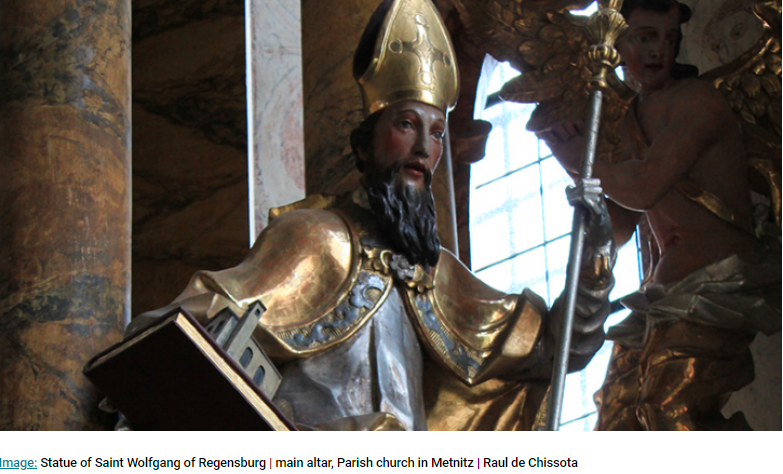
Saint of the Day – October 31 – Saint Wolfgang Regensburg

Saint Wolfgang of Regensburg’s Story (c. 924 – August 31, 994)

Wolfgang was born in Swabia, Germany, and was educated at a school located at the abbey of Reichenau. There he encountered Henry, a young noble who went on to become Archbishop of Trier. Meanwhile, Wolfgang remained in close contact with the archbishop, teaching in his cathedral school and supporting his efforts to reform the clergy.

At the death of the archbishop, Wolfgang chose to become a Benedictine monk and moved to an abbey in Einsiedeln, now part of Switzerland. Ordained a priest, he was appointed director of the monastery school there. Later he was sent to Hungary as a missionary, though his zeal and good will yielded limited results.

Emperor Otto II appointed him Bishop of Regensburg, near Munich. Wolfgang immediately initiated reform of the clergy and of religious life, preaching with vigor and effectiveness and always demonstrating special concern for the poor. He wore the habit of a monk and lived an austere life.

The draw to monastic life never left him, including the desire for a life of solitude. At one point he left his diocese so that he could devote himself to prayer, but his responsibilities as bishop called him back. In 994, Wolfgang became ill while on a journey; he died in Puppingen near Linz, Austria. He was canonized in 1052. His feast day is celebrated widely in much of central Europe.

Reflection

Wolfgang could be depicted as a man with rolled-up sleeves. He even tried retiring to solitary prayer, but taking his responsibilities seriously led him back into the service of his diocese. Doing what had to be done was his path to holiness—and ours.

//Franciscan Media//


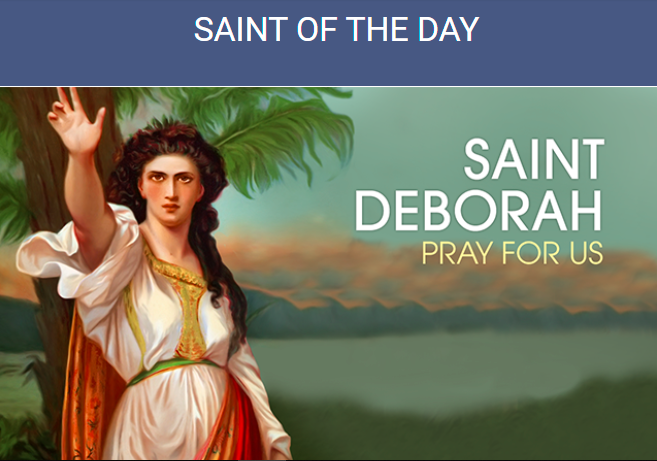
Saint of the Day – November 1 – Saint Deborah the Prophetess

St. Deborah (11th c. B.C.) was a godly widow and saint of the Old Testament. She was a courageous prophetess and champion of the Israelites. All Israel came to her to judge their disputes, and God prophesied to Israel through her. She was Israel’s only female judge. Her role as the military leader who defended the Israelites is commemorated in the Bible’s “Song of Deborah.” It was her military counter-attack against Sisera at Mount Tabor that successfully delivered Israel’s enemies into their hands. As prophetess, she foretold that Israel would have peace for 40 years following this victory. St. Ambrose and St. Jerome observed that St. Deborah is a good role model for the encouragement of courageous, godly women. Her feast day is November 1st.


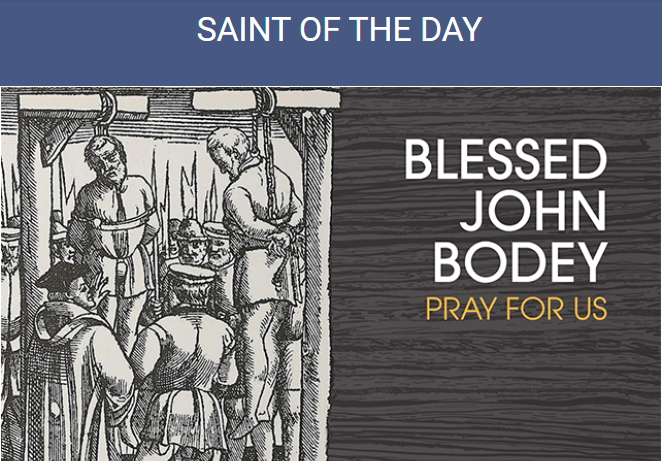
Saint of the Day – November 2 – Blessed John Bodey

Blessed John Bodey (1549-1583) was born in Wells, England, the son of a wealthy merchant and former mayor. He studied at Oxford and became an Oxford Fellow in 1568 at the age of 19. Later he, along with seven others, was deprived of his fellowship for being a Roman Catholic by the Anglican Bishop of Winchester. Bodey, a married layman and schoolmaster, was arrested in 1580 for continuing to practice the Catholic religion and rejecting England’s newly-established heretical Church of England. He was kept in iron shackles for three years, which he called his “school of patience.” In 1583 he was tried for treason, both for being a faithful Roman Catholic and for repudiating King Henry VIII’s claim of supremacy of the Church in England over against the Holy Father. Bodey wrote that his iron chains were earning him glory in heaven, even kissing the chain halter around his neck. He was executed under Queen Elizabeth on November 2, 1583 by being hanged, drawn, and quartered at Andover. He died with the name of Jesus on his lips. His mother rejoiced that her son persevered to the end and won the crown of martyrdom; she gave a feast in honor of him being numbered among the saints in heaven. John Bodey was beatified in 1929 and is one of the 40 Martyrs of England and Wales. His feast day is November 2nd.

//Catholic Company//


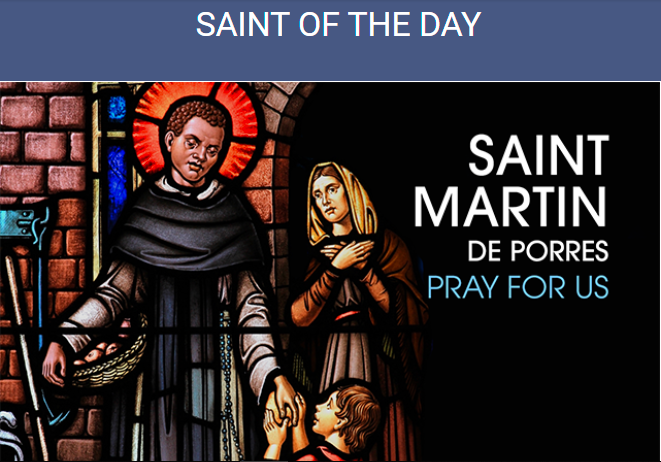
Saint of the Day – November 3 – Saint Martin de Porres

(DECEMBER 9, 1579 – NOVEMBER 3, 1639)
Saint Martin de Porres’ Story

“Father unknown” is the cold legal phrase sometimes used on baptismal records. “Half-breed” or “war souvenir” is the cruel name inflicted by those of “pure” blood. Like many others, Martin might have grown to be a bitter man, but he did not. It was said that even as a child he gave his heart and his goods to the poor and despised.

He was the son of a freed woman of Panama, probably black but also possibly of indigenous stock, and a Spanish grandee of Lima, Peru. His parents never married each other. Martin inherited the features and dark complexion of his mother. That irked his father, who finally acknowledged his son after eight years. After the birth of a sister, the father abandoned the family. Martin was reared in poverty, locked into a low level of Lima’s society.

When he was 12, his mother apprenticed him to a barber-surgeon. Martin learned how to cut hair and also how to draw blood—a standard medical treatment then—care for wounds, and prepare and administer medicines.

After a few years in this medical apostolate, Martin applied to the Dominicans to be a “lay helper,” not feeling himself worthy to be a religious brother. After nine years, the example of his prayer and penance, charity and humility, led the community to request him to make full religious profession. Many of his nights were spent in prayer and penitential practices; his days were filled with nursing the sick and caring for the poor. It was particularly impressive that he treated all people regardless of their color, race, or status. He was instrumental in founding an orphanage, took care of slaves brought from Africa, and managed the daily alms of the priory with practicality, as well as generosity. He became the procurator for both priory and city, whether it was a matter of “blankets, shirts, candles, candy, miracles or prayers!” When his priory was in debt, he said, “I am only a poor mulatto. Sell me. I am the property of the order. Sell me.”

Side by side with his daily work in the kitchen, laundry, and infirmary, Martin’s life reflected God’s extraordinary gifts: ecstasies that lifted him into the air, light filling the room where he prayed, bi-location, miraculous knowledge, instantaneous cures, and a remarkable rapport with animals. His charity extended to beasts of the field and even to the vermin of the kitchen. He would excuse the raids of mice and rats on the grounds that they were underfed; he kept stray cats and dogs at his sister’s house.

Martin became a formidable fundraiser, obtaining thousands of dollars for dowries for poor girls so that they could marry or enter a convent.

Many of his fellow religious took Martin as their spiritual director, but he continued to call himself a “poor slave.” He was a good friend of another Dominican saint of Peru, Rose of Lima.

Reflection

Racism is a sin almost nobody confesses. Like pollution, it is a “sin of the world” that is everybody’s responsibility but apparently nobody’s fault. One could hardly imagine a more fitting patron of Christian forgiveness–on the part of those discriminated against—and Christian justice–on the part of reformed racists—than Martin de Porres.

Saint Martin de Porres is the Patron Saint of:

African Americans
Barbers
Hairdressers
Race Relations
Radio
Social Justice

//Franciscan Media//


Saint of the Day – October 10 – Saint Francis Borgia

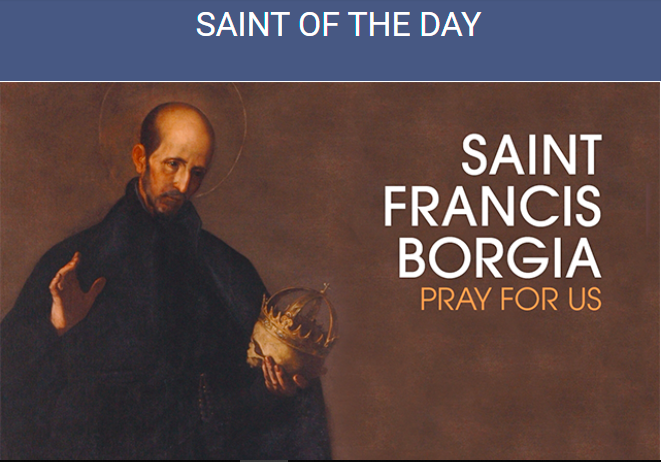
St. Francis Borgia (1510-1572) was born in Spain to a noble family, the son of a Duke. On his father’s side of the family he was the great-grandson of Pope Alexander VI, one of the notorious “Borgia Popes,” and on his mother’s side he was the great-grandson of King Ferdinand of Aragon. Francis joined the Spanish court of King Charles V at the age of 18, married, and had 8 children. In 1539 he experienced a profound religious conversion which caused him to renounce the pomp of the royal court, yet he continued his life of public service as the Viceroy of Catalonia. He made great progress in the spiritual life, and after his father’s death he became the Duke of Gandia. He built a university and invited the newly-founded Society of Jesus to work in his duchy. After the death of his wife, and after providing for his children, he joined the Jesuits in Rome and was given a prominent position in the order by St. Ignatius of Loyola. Under Francis’ leadership and reforms, the Jesuits advanced to such a great extent that he is considered to be their second founder. In the years following Ignatius’ death, Francis became head of the order and established Jesuit missions in multiple countries. He also counseled his missionaries in both practical strategies as well as spiritual discipline. St. Francis of Borgia was a celebrated preacher and a key figure in the Counter-Reformation movement. His feast day is October 10th.

//Catholic Company//


Saint of the Day – November 9 – Saint Benignus

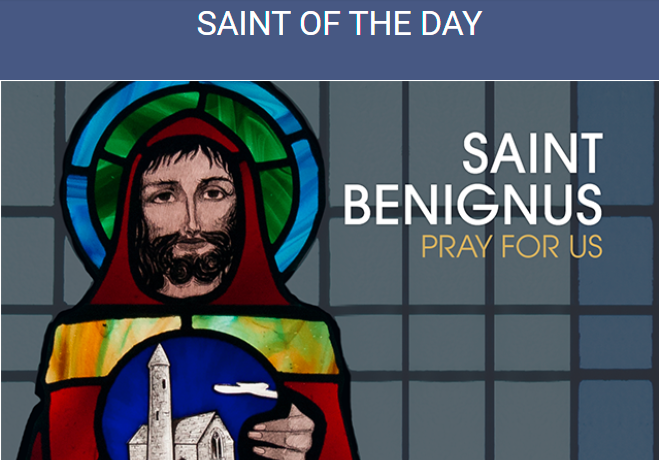
St. Benignus of Armagh (d. 467 A.D.) was the son of a pagan Irish chieftain in what is now County Meath in Ireland. He was baptized by St. Patrick and became his loyal follower in the saint’s ministry across Ireland. In 450 A.D. Benignus became coadjutor with St. Patrick in the Diocese of Armagh, and also became the first rector of the Catholic school there. St. Benignus was a talented singer and worked to form choral groups wherever they traveled for their missionary work; for this he was called “Patrick’s Psalmist.” He also assisted with the compilation of the Senchus Mor, the Irish Code of Law, and sat on a number of commissions, councils, and synods that helped further establish the Catholic faith across Ireland. His feast day is November 9th.

//Catholic Company//


Saint of the Day – November 11- Saint Martin of Tours

(C. 316 – NOVEMBER 8, 397)
Saint Martin of Tours’ Story

A conscientious objector who wanted to be a monk; a monk who was maneuvered into being a bishop; a bishop who fought paganism as well as pleaded for mercy to heretics—such was Martin of Tours, one of the most popular of saints and one of the first not to be a martyr.

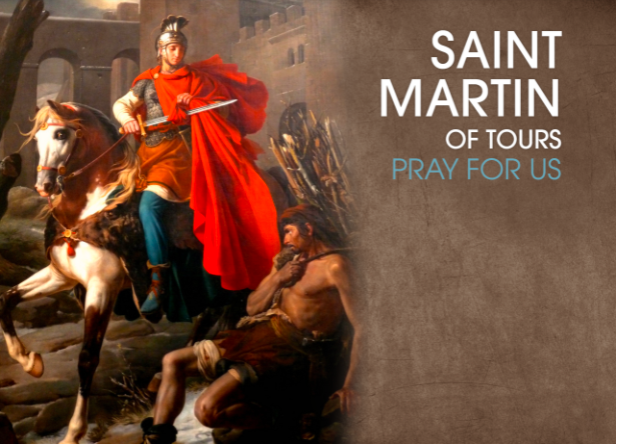
Born of pagan parents in what is now Hungary, and raised in Italy, this son of a veteran was forced at the age of 15 to serve in the army. Martin became a Christian catechumen and was baptized when he was 18. It was said that he lived more like a monk than a soldier. At 23, he refused a war bonus and told his commander: “I have served you as a soldier; now let me serve Christ. Give the bounty to those who are going to fight. But I am a soldier of Christ and it is not lawful for me to fight.” After great difficulties, he was discharged and went to be a disciple of Hilary of Poitiers.

He was ordained an exorcist and worked with great zeal against the Arians. Martin became a monk, living first at Milan and later on a small island. When Hilary was restored to his see following his exile, Martin returned to France and established what may have been the first French monastery near Poitiers. He lived there for 10 years, forming his disciples and preaching throughout the countryside.

The people of Tours demanded that he become their bishop. Martin was drawn to that city by a ruse—the need of a sick person—and was brought to the church, where he reluctantly allowed himself to be consecrated bishop. Some of the consecrating bishops thought his rumpled appearance and unkempt hair indicated that he was not dignified enough for the office.

Along with Saint Ambrose, Martin rejected Bishop Ithacius’s principle of putting heretics to death—as well as the intrusion of the emperor into such matters. He prevailed upon the emperor to spare the life of the heretic Priscillian. For his efforts, Martin was accused of the same heresy, and Priscillian was executed after all. Martin then pleaded for a cessation of the persecution of Priscillian’s followers in Spain. He still felt he could cooperate with Ithacius in other areas, but afterwards his conscience troubled him about this decision.

As death approached, Martin’s followers begged him not to leave them. He prayed, “Lord, if your people still need me, I do not refuse the work. Your will be done.”

Reflection

Martin’s worry about cooperation with evil reminds us that almost nothing is either all black or all white. The saints are not creatures of another world: They face the same perplexing decisions that we do. Any decision of conscience always involves some risk. If we choose to go north, we may never know what would have happened had we gone east, west, or south. A hyper-cautious withdrawal from all perplexing situations is not the virtue of prudence; it is in fact, a bad decision, for “not to decide is to decide.”

Saint Martin of Tours is a Patron Saint of:

Horses
Soldiers
South Africa