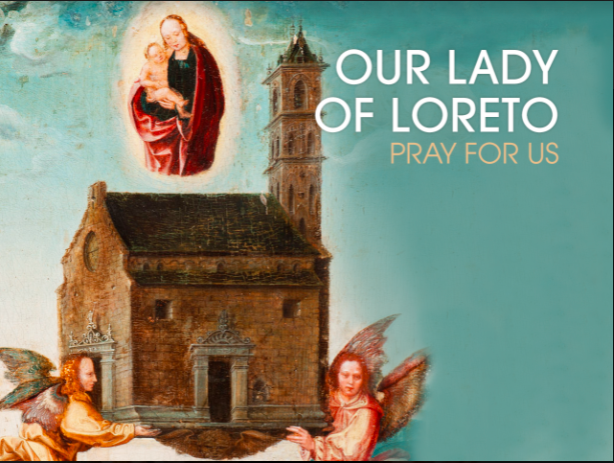
Our Lady of Loreto is a title of the Blessed Virgin Mary associated with the house where Mary was born, the site of the Annunciation, and the dwelling place of the Holy Family. The tradition and history of the Holy House goes back to Apostolic times. In the 13th century the house was mysteriously moved in one piece from Nazareth in the Holy Land to a final resting place in Loreto, Italy, carried by angels, a miracle to which the Church attests. It was transported to prevent its destruction by Muslims who destroyed the basilica which housed it. A new basilica was built around the Holy House in Italy, known as the Shrine of Our Lady of Loreto, one of the most popular pilgrimage sites in the world. Written at the door of the basilica are these words: “The whole world has no place more sacred … For here was the Word made Flesh, and here was born the Virgin Mother.” Our Lady of Loreto is the patron of aviators, fliers, pilots, and builders. Her feast day is December 10th.
One of Ambrose’s biographers observed that at the Last Judgment, people would still be divided between those who admired Ambrose and those who heartily disliked him. He emerges as the man of action who cut a furrow through the lives of his contemporaries. Even royal personages were numbered among those who were to suffer crushing divine punishments for standing in Ambrose’s way.
When the Empress Justina attempted to wrest two basilicas from Ambrose’s Catholics and give them to the Arians, he dared the eunuchs of the court to execute him. His own people rallied behind him in the face of imperial troops. In the midst of riots, he both spurred and calmed his people with bewitching new hymns set to exciting Eastern melodies.
In his disputes with the Emperor Auxentius, he coined the principle: “The emperor is in the Church, not above the Church.” He publicly admonished Emperor Theodosius for the massacre of 7,000 innocent people. The emperor did public penance for his crime. This was Ambrose, the fighter sent to Milan as Roman governor, and chosen while yet a catechumen to be the people’s bishop.
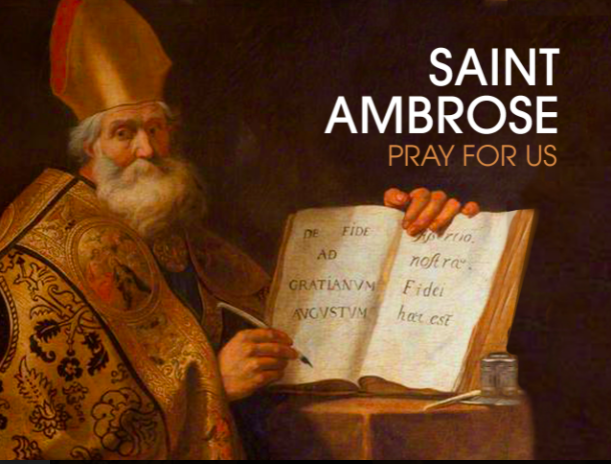
There is yet another side of Ambrose—one which influenced Augustine of Hippo, whom Ambrose converted. Ambrose was a passionate little man with a high forehead, a long melancholy face, and great eyes. We can picture him as a frail figure clasping the codex of sacred Scripture. This was the Ambrose of aristocratic heritage and learning.
Augustine found the oratory of Ambrose less soothing and entertaining but far more learned than that of other contemporaries. Ambrose’s sermons were often modeled on Cicero, and his ideas betrayed the influence of contemporary thinkers and philosophers. He had no scruples in borrowing at length from pagan authors. He gloried in the pulpit in his ability to parade his spoils—“gold of the Egyptians”—taken over from the pagan philosophers.
His sermons, his writings, and his personal life reveal him as an otherworldly man involved in the great issues of his day. Humanity for Ambrose was, above all, spirit. In order to think rightly of God and the human soul, the closest thing to God, no material reality at all was to be dwelt upon. He was an enthusiastic champion of consecrated virginity.
The influence of Ambrose on Augustine will always be open for discussion. The Confessions reveal some manly, brusque encounters between Ambrose and Augustine, but there can be no doubt of Augustine’s profound esteem for the learned bishop.
Neither is there any doubt that Saint Monica loved Ambrose as an angel of God who uprooted her son from his former ways and led him to his convictions about Christ. It was Ambrose, after all, who placed his hands on the shoulders of the naked Augustine as he descended into the baptismal fountain to put on Christ.
Reflection
Ambrose exemplifies for us the truly catholic character of Christianity. He is a man steeped in the learning, law, and culture of the ancients and of his contemporaries. Yet, in the midst of active involvement in this world, this thought runs through Ambrose’s life and preaching: The hidden meaning of the Scriptures calls our spirit to rise to another world.
Saint Nicholas’ Story (March 15, 270 – December 6, 343)
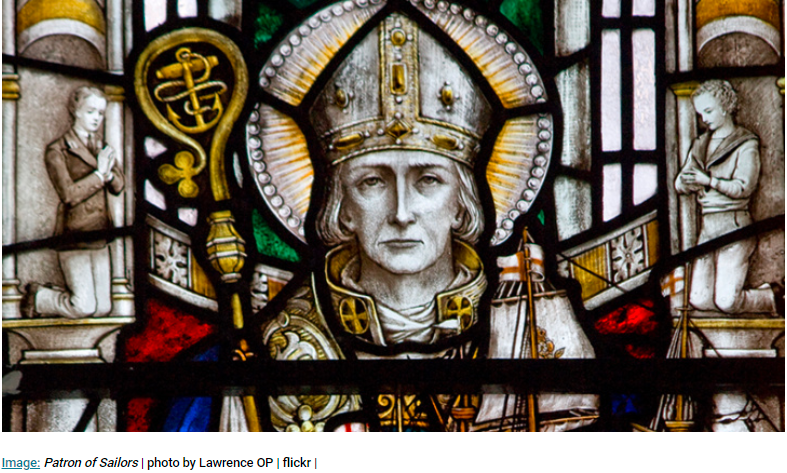
The absence of the “hard facts” of history is not necessarily an obstacle to the popularity of saints, as the devotion to Saint Nicholas shows. Both the Eastern and Western Churches honor him, and it is claimed that after the Blessed Virgin, he is the saint most pictured by Christian artists. And yet historically, we can pinpoint only the fact that Nicholas was the fourth-century bishop of Myra, a city in Lycia, a province of Asia Minor.
As with many of the saints, however, we are able to capture the relationship which Nicholas had with God through the admiration which Christians have had for him—an admiration expressed in the colorful stories which have been told and retold through the centuries.
Perhaps the best-known story about Nicholas concerns his charity toward a poor man who was unable to provide dowries for his three daughters of marriageable age. Rather than see them forced into prostitution, Nicholas secretly tossed a bag of gold through the poor man’s window on three separate occasions, thus enabling the daughters to be married. Over the centuries, this particular legend evolved into the custom of gift-giving on the saint’s feast. In the English-speaking countries, Saint Nicholas became, by a twist of the tongue, Santa Claus—further expanding the example of generosity portrayed by this holy bishop.
Reflection
The critical eye of modern history makes us take a deeper look at the legends surrounding Saint Nicholas. But perhaps we can utilize the lesson taught by his legendary charity, look deeper at our approach to material goods in the Christmas season, and seek ways to extend our sharing to those in real need.
Saint Nicholas is a Patron Saint of:
Bakers Brides and Grooms Children Greece Pawnbrokers Travelers
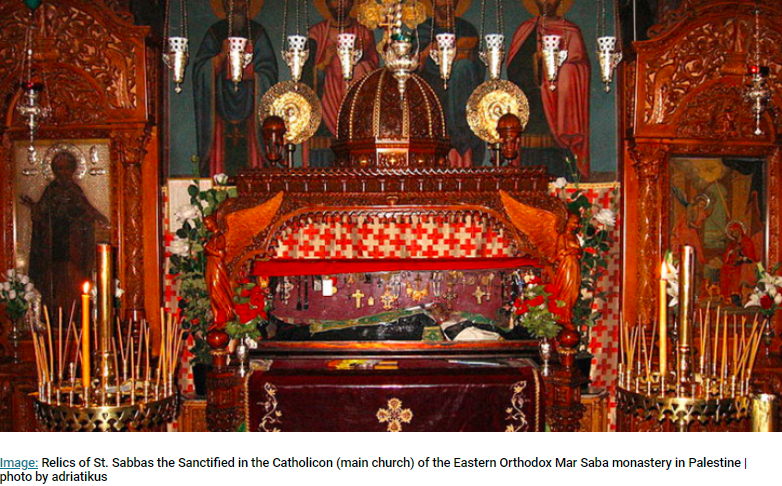
Born in Cappadocia, Sabas is one of the most highly regarded patriarchs among the monks of Palestine, and is considered one of the founders of Eastern monasticism.
After an unhappy childhood in which he was abused and ran away several times, Sabas finally sought refuge in a monastery. While family members tried to persuade him to return home, the young boy felt drawn to monastic life. Although the youngest monk in the house, he excelled in virtue.
At age 18 he traveled to Jerusalem, seeking to learn more about living in solitude. Soon he asked to be accepted as a disciple of a well-known local solitary, though initially he was regarded as too young to live completely as a hermit. Initially, Sabas lived in a monastery, where he worked during the day and spent much of the night in prayer. At the age of 30 he was given permission to spend five days each week in a nearby remote cave, engaging in prayer and manual labor in the form of weaving baskets. Following the death of his mentor, Saint Euthymius, Sabas moved farther into the desert near Jericho. There he lived for several years in a cave near the brook Cedron. A rope was his means of access. Wild herbs among the rocks were his food. Occasionally men brought him other food and items, while he had to go a distance for his water.
Some of these men came to him desiring to join him in his solitude. At first he refused. But not long after relenting, his followers swelled to more than 150, all of them living in individual huts grouped around a church, called a laura.
The bishop persuaded a reluctant Sabas, then in his early 50s, to prepare for the priesthood so that he could better serve his monastic community in leadership. While functioning as abbot among a large community of monks, he felt ever called to live the life of a hermit. Throughout each year—consistently in Lent—he left his monks for long periods of time, often to their distress. A group of 60 men left the monastery, settling at a nearby ruined facility. When Sabas learned of the difficulties they were facing, he generously gave them supplies and assisted in the repair of their church.
Over the years Sabas traveled throughout Palestine, preaching the true faith and successfully bringing back many to the Church. At the age of 91, in response to a plea from the Patriarch of Jerusalem, Sabas undertook a journey to Constantinople in conjunction with the Samaritan revolt and its violent repression. He fell ill and soon after his return, died at the monastery at Mar Saba. Today the monastery is still inhabited by monks of the Eastern Orthodox Church, and Saint Sabas is regarded as one of the most noteworthy figures of early monasticism.
Reflection
Few of us share Sabas’ yearning for a cave in the desert, but most of us sometimes resent the demands others place on our time. Sabas understands that. When at last he gained the solitude for which he yearned, a community immediately began to gather around him, and he was forced into a leadership role. He stands as a model of patient generosity for anyone whose time and energy are required by others—that is, for all of us.
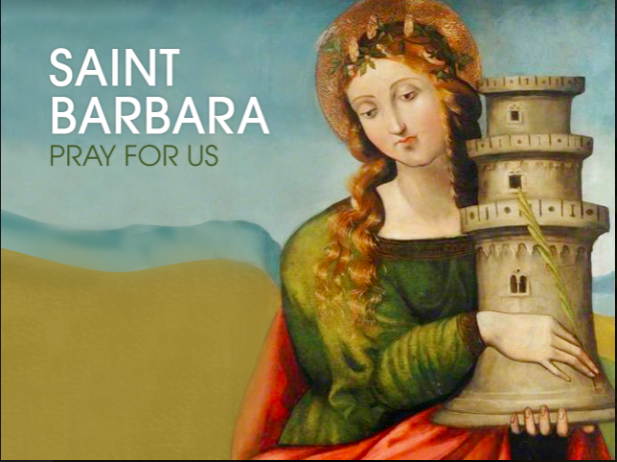
St. Barbara (3rd c.) was born in Nicomedia in modern day Turkey. According to tradition, after the death of her mother she was raised by her rich and tyrannical pagan father who, because of her beauty and intelligence, guarded her closely, keeping her locked away in a tower to protect her from the outside world. She was educated by tutors and came to reject the false gods she was taught to worship in favor of the true God for whom she yearned and wished to discover, dedicating her life and virginity to this purpose. She developed a prayer life and resisted her father’s attempts to have her marry. Believing Barbara to be negatively affected by the seclusion, her father allowed her more freedom to associate with the world. She soon discovered Christians, and, recognizing the Creator she sought, and was baptized in secret. After informing her father that she was a Christian, he denounced her to the authorities under the persecution of Roman Emperor Maximian. She was imprisoned and cruelly tortured, but remained steadfast in her faith. During the night she would pray fervently, and her wounds would miraculously heal. This only subjected her to greater torments, followed by more miraculous interventions. She was finally beheaded by her own father, and afterward he was struck and killed by lightening as punishment. St. Barbara is the patron saint of firemen, armorers, artillerymen, military engineers, miners, and others who work with explosives. She is also the patron against storms, lightning, and fire, to name a few. St. Barbara’s feast day is December 4th.
St. Catherine Labouré (1806 – 1876) was born in Burgundy, France, the ninth of seventeen children of a pious and prosperous farming family. Her mother died when she was nine years old. After her mother’s funeral, Catherine kissed a statue of the Virgin Mary in her home, saying, “Now you will be my mother.” Catherine was devout and simple, and did not learn to read or write. She cared for her family for many years and, drawn to the religious life, entered the Daughters of Charity of St. Vincent de Paul in Paris at the age of twenty-two. In the year 1830, on the eve of the feast of St. Vincent de Paul, Catherine experienced her first apparition of the Blessed Mother. Mary entrusted to Catherine the mission of spreading devotion to her Miraculous Medal, the design of which she revealed to the saint in a vision. The Blessed Virgin appeared to Catherine two more times, and eventually the Miraculous Medal was mass-produced, widely promoted, and approved by the Church as a sacramental for public devotion. Catherine preferred anonymity and remained unknown as the visionary to whom Our Lady appeared, even to the sisters of her own convent. She continued to live a quiet life in service to the sick. After her death many miracles were ascribed to her relics. St. Catherine Labouré is one of the Church’s incorruptible saints: her body is reposed in a glass casket in the chapel where she received the vision of Our Lady. Her feast day is November 28th.
St. Edmund Campion (1540–1581) was born in London, England, the son of a bookseller. He was a promising student and went on to become an esteemed and celebrated Oxford scholar, winning the high regard of Queen Elizabeth who admired his wit and pleasant disposition. Although raised Catholic, he was ordained an Anglican deacon. Unsettled by his move away from the Church, he repented and returned to the Catholic faith. While in disguise to protect his safety following his reversion, he witnessed the martyrdom of a fellow scholar and recognized his vocation. He went to Rome and became a Jesuit priest, and while assigned to minister in Moravia he received a vision of the Blessed Virgin Mary who foretold his martyrdom. He later returned to England as an undercover priest during the severe persecution of Catholics upon the Pope’s excommunication of Queen Elizabeth. His mission was to strengthen Catholics wavering under government pressure and win converts among the Protestants. St. Edmund was eventually hunted down, imprisoned in the Tower of London, and tortured. After being found guilty of treason, he said, “In condemning us, you condemn all your own ancestors, all our ancient bishops and kings, all that was once the glory of England — the island of saints, and the most devoted child of the See of Peter.” After spending his last days in prayer, he was dragged with two fellow priests to be hanged, drawn, and quartered on December 1st, 1581 at 41 years of age. His feast day is December 1st.
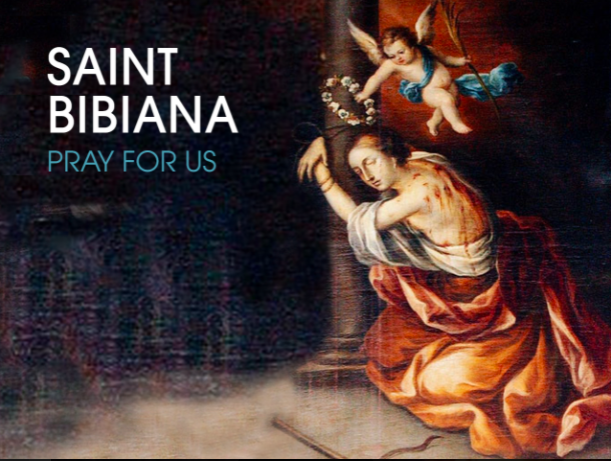
St. Bibiana, also known as Vibiana or Viviana (d. 361), was born in Rome, the daughter of Christian parents who were martyred in the persecutions of Roman Emperor Julian the Apostate. Her father was severely beaten and sent to live in exile as a slave, but died from his wounds. Her mother was beheaded shortly after. St. Bibiana and her sister, Demetria, were stripped of their possessions and imprisoned in their family home in utter poverty and hunger. They were offered reward if only they would renounce Jesus, but the sisters, strong in faith and prayer, said they would rather die. Finding that they did not die from lack of food, the Roman governor summoned them. Demetria, after professing the faith, died at his feet. St. Bibiana was given to the guardianship of a pagan woman who tried to force her into prostitution. St. Bibiana refused and resolutely maintained her faith in Christ. For this she was beaten, tied to a pillar, and cruelly scourged. She eventually died from her tortures, and her body was discarded to be eaten by wild dogs. The animals, however, would not touch her. Her body was recovered by a priest and buried, with a chapel built over the tomb for her veneration. St. Bibiana’s feast day is December 2nd.
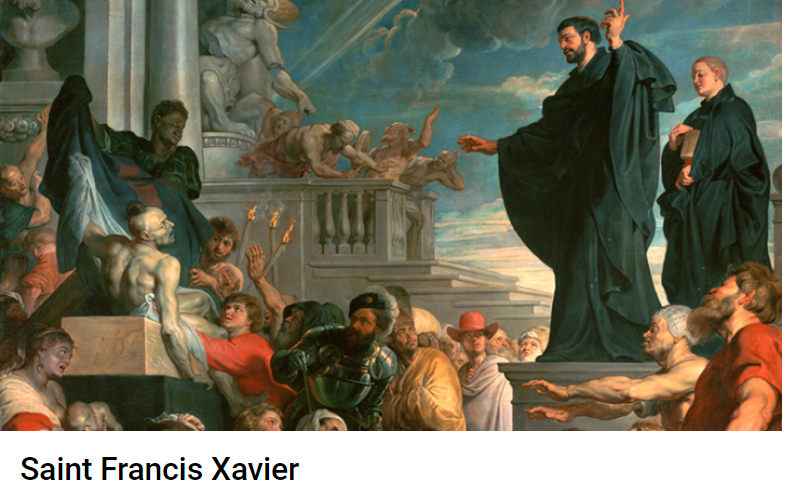
Saint Francis Xavier’s Story (APRIL 7, 1506 – DECEMBER 3, 1552)
Jesus asked, “What profit would there be for one to gain the whole world and forfeit his life?” (Matthew 16:26a). The words were repeated to a young teacher of philosophy who had a highly promising career in academics, with success and a life of prestige and honor before him.
Francis Xavier, 24 at the time, and living and teaching in Paris, did not heed these words at once. They came from a good friend, Ignatius of Loyola, whose tireless persuasion finally won the young man to Christ. Francis then made the spiritual exercises under the direction of Ignatius, and in 1534, joined his little community, the infant Society of Jesus. Together at Montmartre they vowed poverty, chastity, obedience, and apostolic service according to the directions of the pope.
From Venice, where he was ordained a priest in 1537, Xavier went on to Lisbon and from there sailed to the East Indies, landing at Goa, on the west coast of India. For the next 10 years he labored to bring the faith to such widely scattered peoples as the Hindus, the Malayans, and the Japanese. He spent much of that time in India, and served as provincial of the newly established Jesuit province of India.
Wherever he went, Xavier lived with the poorest people, sharing their food and rough accommodations. He spent countless hours ministering to the sick and the poor, particularly to lepers. Very often he had no time to sleep or even to say his breviary but, as we know from his letters, he was filled always with joy.
Xavier went through the islands of Malaysia, then up to Japan. He learned enough Japanese to preach to simple folk, to instruct, and to baptize, and to establish missions for those who were to follow him. From Japan he had dreams of going to China, but this plan was never realized. Before reaching the mainland, he died. His remains are enshrined in the Church of Good Jesus in Goa. He and Saint Thérèse of Lisieux were declared co-patrons of the missions in 1925.
Reflection
All of us are called to “go and preach to all nations—see Matthew 28:19. Our preaching is not necessarily on distant shores but to our families, our children, our husband or wife, our coworkers. And we are called to preach not with words, but by our everyday lives. Only by sacrifice, the giving up of all selfish gain, could Francis Xavier be free to bear the Good News to the world. Sacrifice is leaving yourself behind at times for a greater good, the good of prayer, the good of helping someone in need, the good of just listening to another. The greatest gift we have is our time. Francis Xavier gave his to others.