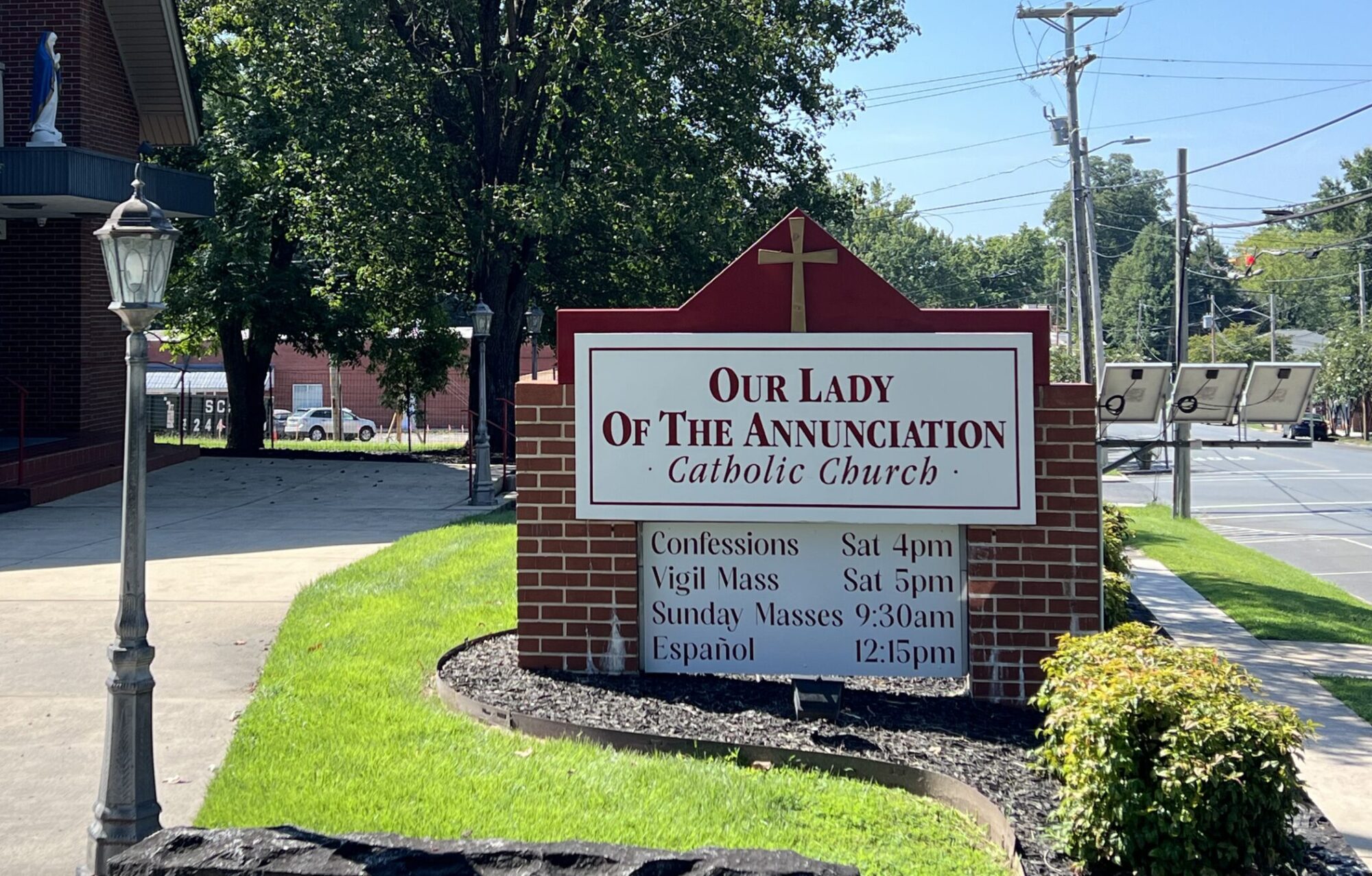
St. Catherine del Ricci (1522-1590) was born with the name Alessandra in Florence, Italy, to a respectable merchant family. Her mother died while she was very young, so that from her childhood Alessandra took the Blessed Virgin Mary as her mother. She was given to prayer and religious fervor, and at the age of fourteen decided to enter a strict Third Order Dominican convent, taking Catherine as her religious name. She developed into a great mystic with an intense devotion to the Passion of Christ.
For many years Catherine would go into ecstasy from noon every Thursday through 4 p.m. on Friday, experiencing in a mystical manner the sufferings of Christ during his Passion. She was also given the spiritual gift of the stigmata; Christ’s wounds would appear on her body through the course of the ecstasy. After enduring much humiliation for years on account of these sufferings, she was eventually accepted as a holy woman and later became prioress.
Catherine’s advice was widely sought on many spiritual and practical matters. Despite being cloistered, she kept up a loving correspondence with many relatives, friends, and her spiritual children. Among those in her correspondence were three future popes, Pope Marcellus II, Pope Clement VIII, and Pope Leo XI. Her feast day is February 13.
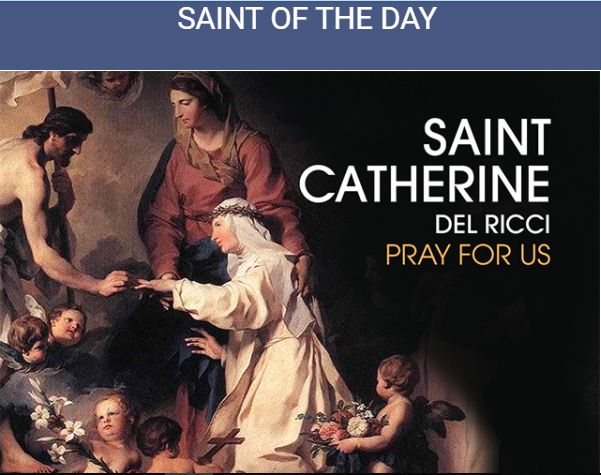
St. Julian the Hospitaller (4th c.) came from a wealthy noble family in Europe. Little of his life is known with certainty. According to legend he married a noble widow, and was put under a curse at some point in his life. The curse was that he would one day kill his parents. To prevent this from happening, Julian and his wife moved far away from them. Julian’s parents later found their whereabouts and made an unexpected visit while Julian was away. Julian’s wife offered them her bed to sleep for the night. When Julian arrived home and found his bed occupied with a couple, he slew them both assuming it was his wife with another man. When Julian learned the truth, he was horrified by his actions and spent the rest of his life in penance. He and his wife went on a pilgrimage to Rome, and on their return established a hospital to continue their penance, dedicating their lives to caring for the poor and sick.
One day a leper came to stay in the hospital; after Julian cared for his wounds, the leper revealed himself to be an angel and told Julian that God granted him absolution for his sins. The hospital was built near a river that was often crossed by pilgrims on their way to the Crusades.
St. Julian the Hospitaller is the patron saint of hospitality, travelers, innkeepers, boatmen, pilgrims, and knights. His feast day is celebrated on February 12th.
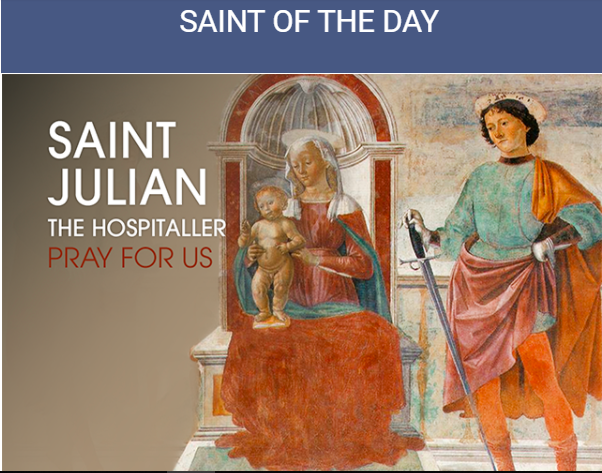
Blessed Bartholomew of Olmedo (1485-1524) was a Spanish Mercedarian priest, and the first priest to arrive on Mexican soil in 1516 at the age of 31. He was chaplain for the expedition of Spanish Conquistador Fernando Cortés, who began the Spanish colonization of the Americas and the downfall of the Aztec empire. Bartholomew was well-liked by the native people. He taught them the Christian faith and exhorted them to end their practice of human sacrifice. He also defended them against injustice and restrained Cortés from acting out in violence against them. Bartholomew taught the native Mexicans devotion to the Blessed Virgin Mary under the title of Our Lady of Mercy, which they embraced. Blessed Bartholomew of Olmedo baptized more than 2500 people before he died in Mexico in 1524 at the age of 39. He was buried in Santiago de Tlatelolco. His feast day is February 11.
“You Cannot Judge Someone’s Insides by Their Outside“
Father Peter Fitzgibbons
February 6 – 7, 2021
Gospel: Mark 1: 29-39
A number of years ago, I was vacationing at my now dead brother’s house. My sister-in-law is very nice, and she let me stay there. Why she married my brother is a mystery to me. In my bedroom was a fireplace. This is a four bedroom house with two fireplaces, and I had one of them. I was looking around at all of their pictures…I love looking at people’s pictures. I saw a picture of my sister-in-law’s brother. He was a good looking officer dressed in his Army Class-A uniform. I asked my sister-in-law if he had ever served in Vietnam, and she said yes. Did he ever tell you anything about the ribbons on his uniform? She said no. Well, I wouldn’t expect him to, but I’ll tell you this, because I think you need to know. You might want to ask him about this top ribbon. The highest award always goes on top. That is the Distinguished Flying Cross which is usually a downgraded Medal of Honor. You should know about that. A few years later, he and I were sitting in the ICU while my brother was on his journey to Heaven. He told me about some of his travels while he was in Vietnam. I can’t tell you about them, because they are all classified, but, he did some pretty impressive things. Now, he looks like a retired old man. You just never know what people have done…about the good they have done.
When my brother was laid out in the box, he had all of these badges on his uniform. He was a fire captain and assigned to fire and rescue. I didn’t understand what the badges meant, so I asked a friend of his, Mike Scallion. Mike said, “He never told you?” No. “Well, these are for the people he saved… he saved a lot of lives.” But, my brother never told us. People would come up and ask him to loan them money. He’d say, “Sure!” To my brother, it was a gift. He never loaned money. You never know the good things people have done. I still hear stories about my brother when I go home.
Conversely, you never know about the crosses people were given to carry by our good Lord. There are the crosses we bear from birth that God gives us all. Some change throughout our lives and come with age. There are the crosses we have because of our sins which we have acquired on our own. There are also the crosses that other people have given us. Perhaps we didn’t have perfect parents. I see a lot of those crosses in the Gated Community I visit. People with those crosses have a harder shot at life than most of us. You never know the crosses people are called to carry. But, they have made their choices, and their crosses are mostly because they avoid God and choose to do evil. The habit and attraction of sin carries its own cross. Finally, there are the crosses we bear for our family, friends, and others.
Now, when you leave here, you will probably encounter people who will irk the living you-know-what out of you. Somehow, they find a way to stumble across our path. They may cut us off in traffic. They may take our buggy in Harris teeter or Walmart. They’ll do something, and you may want to go charismatic on them. We might do that to people too, believe it or not, some of you might irk other people…I don’t know. My First-Sergeant had a very effective counselling technique. He was charismatic and laid hands on people. We used to call it “wall-to-wall counselling,” and it usually solved the problem in one short session. If it’s not strangers that irk us, it’s our family. Those are the ones who can irk us the most. My cousin calls me and always wants to Face-Time. The last time he called me, I was hearing confessions when all of a sudden the theme from the “Godfather” starts playing – that’s my ring tone. My phone showed that it was Jim, and he wanted to FaceTime. Hey Cuz – I don’t do Face-Time. Learn it. God allows people in our lives for a number of reasons, not just to irk us, but to teach us patience.
You obviously want to be holy, because you are here. But, being here is only a part of becoming holy. You have to go out and practice what you receive here. All of those rosaries do no good if we don’t use them. All the great Catholic books in the world and all the crucifixes do no good if we don’t put them into practice. It’s nice when people say, “Father, that was a great sermon.” Thanks. Take a copy of the sermon notes; I’ll even autograph it for you. But it does no good unless you put the message into practice. So, God sends people into our lives to remind us to pray for others and to help them carry their crosses. He puts these people in our lives to help us learn patience along with suffering. We don’t know what crosses people are carrying. We all would like for people to be considerate and compassionate toward us, but how can we be considerate and compassionate toward them? By praying for them and helping them carry their crosses, whatever those crosses are. They may be helping to carry someone else’s cross…you never know. You cannot judge someone’s insides by their outside.
I ask patients how they are doing. Some will say, “Fine!” But, you are in Hospice care. Do you know what fine means? I think we need to talk. I wouldn’t be putting in menu orders for tomorrow if I were you. We don’t know what’s going on inside of people. But, if they are like us, and yes, they are all like us, some better…some worse, but generally, we are all the same. We can help them carry their crosses. If they are irksome and obnoxious to us, it may be because you have called upon them when they were struggling or having a bad day, or maybe they had just gotten some bad news. There are all sorts of reasons, culpable and inculpable, but we are called to pray for them all. By doing so, you are helping them carry their cross. Even if we do something nice for them, and they don’t thank us…boy, that ticks you off, doesn’t it? You do something nice for someone, and they don’t thank you? Oh, baby! I need a thank you note for that dinner or that Christmas gift! But, be thankful to have been found worthy to suffer for Him. Say, “Thank you, Jesus for allowing me to suffer for the sake of your name.”
Father’s Afterthoughts…
Alcohol is very good for COVID, but only if used externally
You can read all of Father Fitzgibbons’ sermons by going to https://annunciationcatholicalbemarle.com/ and clicking on “Blog” then “Categories” and then “Sermon Notes. From a cell phone, click on “Blog” then “Menu” and then “Categories.”
Twins often share the same interests and ideas with an equal intensity. Therefore, it is no surprise that Scholastica and her twin brother, Benedict, established religious communities within a few miles from each other.
Born in 480 of wealthy parents, Scholastica and Benedict were brought up together until he left central Italy for Rome to continue his studies.
Little is known of Scholastica’s early life. She founded a religious community for women near Monte Cassino at Plombariola, five miles from where her brother governed a monastery.
The twins visited each other once a year in a farmhouse because Scholastica was not permitted inside the monastery. They spent these times discussing spiritual matters.
According to the Dialogues of St. Gregory the Great, the brother and sister spent their last day together in prayer and conversation. Scholastica sensed her death was close at hand and she begged Benedict to stay with her until the next day.
He refused her request because he did not want to spend a night outside the monastery, thus breaking his own Rule. Scholastica asked God to let her brother remain and a severe thunderstorm broke out, preventing Benedict and his monks from returning to the abbey.
Benedict cried out, “God forgive you, Sister. What have you done?” Scholastica replied, “I asked a favor of you and you refused. I asked it of God and he granted it.”
Brother and sister parted the next morning after their long discussion. Three days later, Benedict was praying in his monastery and saw the soul of his sister rising heavenward in the form of a white dove. Benedict then announced the death of his sister to the monks and later buried her in the tomb he had prepared for himself.
Reflection
Scholastica and Benedict gave themselves totally to God and gave top priority to deepening their friendship with him through prayer. They sacrificed some of the opportunities they would have had to be together as brother and sister in order better to fulfill their vocation to the religious life. In coming closer to Christ, however, they found they were also closer to each other. In joining a religious community, they did not forget or forsake their family but rather found more brothers and sisters.
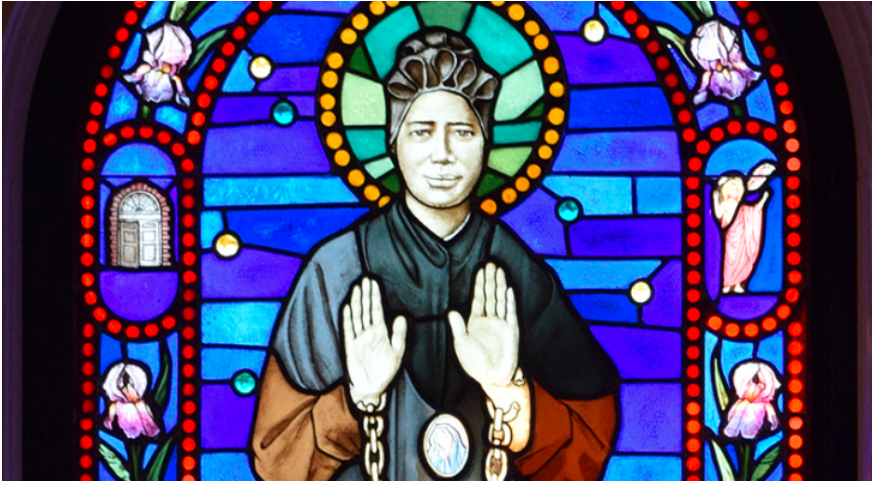
Image: Stained Glass of St. Josephine Bakhita, Saint John Paul II Chapel, Mundelein | photo by Fr. Gaurav Shroff | flickr
Saint Josephine Bakhita’s Story
For many years, Josephine Bakhita (c. 1869 – February 8, 1947) was a slave but her spirit was always free and eventually that spirit prevailed.
Born in Olgossa in the Darfur region of southern Sudan, Josephine was kidnapped at the age of 7, sold into slavery and given the name Bakhita, which means fortunate. She was resold several times, finally in 1883 to Callisto Legnani, Italian consul in Khartoum, Sudan.
Two years later, he took Josephine to Italy and gave her to his friend Augusto Michieli. Bakhita became babysitter to Mimmina Michieli, whom she accompanied to Venice’s Institute of the Catechumens, run by the Canossian Sisters. While Mimmina was being instructed, Josephine felt drawn to the Catholic Church. She was baptized and confirmed in 1890, taking the name Josephine.
When the Michielis returned from Africa and wanted to take Mimmina and Josephine back with them, the future saint refused to go. During the ensuing court case, the Canossian Sisters and the patriarch of Venice intervened on Josephine’s behalf. The judge concluded that since slavery was illegal in Italy, she had actually been free since 1885.
Josephine entered the Institute of St. Magdalene of Canossa in 1893 and made her profession three years later. In 1902, she was transferred to the city of Schio (northeast of Verona), where she assisted her religious community through cooking, sewing, embroidery, and welcoming visitors at the door. She soon became well loved by the children attending the sisters’ school and the local citizens. She once said, “Be good, love the Lord, pray for those who do not know Him. What a great grace it is to know God!”
The first steps toward her beatification began in 1959. She was beatified in 1992 and canonized eight years later.
Reflection
Josephine’s body was mutilated by those who enslaved her, but they could not touch her spirit. Her Baptism set her on an eventual path toward asserting her civic freedom and then service to God’s people as a Canossian Sister.
She who worked under many “masters” was finally happy to address God as “master” and carry out everything that she believed to be God’s will for her.
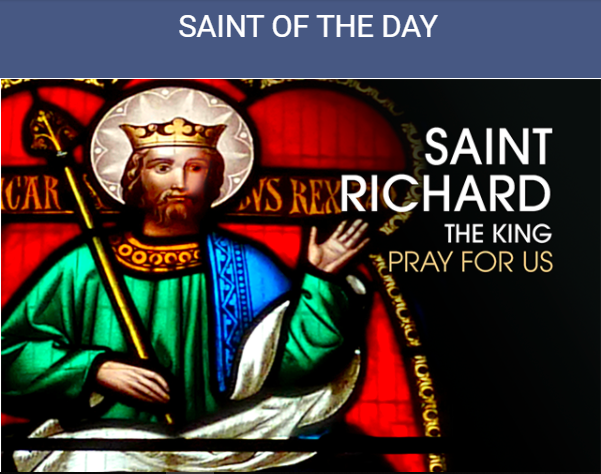
St. Richard the King (c. 720 A.D.), also known as Richard the Pilgrim, was a Saxon king born in Wessex, England, who was related by blood to the royal house of Kent. His brother-in-law was St. Boniface, and three of his children are numbered among the saints: St. Willibald, St. Winnebald, and St. Walburga.
When Willibald was gravely ill as a child, Richard’s prayers for his son are said to have saved his life. He wrapped his child in a blanket and took him to the foot of a large crucifix erected near their village, and the child recovered. When Willibald was grown, he convinced his father and brother to accompany him on a missionary pilgrimage to Rome and the Holy Land. St. Richard agreed, renounced his royal estate, and embarked on the journey with his two sons, while his daughter entered a convent. In Italy he became sick and died, and was buried in Tuscany at the Church of San Frediano. Numerous miracles are reported to have occurred at his tomb. Some of his relics were transported to Eichstatt, Germany, where his son Winnebald would become Bishop. His feast day is celebrated on February 7th.
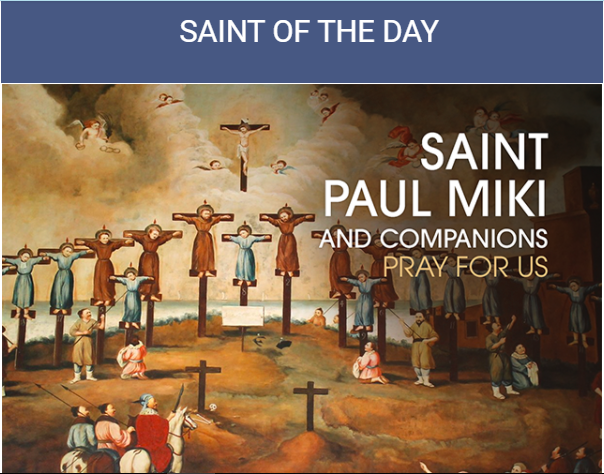
Nagasaki, Japan, is familiar to Americans as the city on which the second atomic bomb was dropped, immediately killing over 37,000 people. Three and a half centuries before, 26 martyrs of Japan were crucified on a hill, now known as the Holy Mountain, overlooking Nagasaki. Among them were priests, brothers, and laymen, Franciscans, Jesuits, and members of the Secular Franciscan Order; there were catechists, doctors, simple artisans, and servants, old men and innocent children—all united in a common faith and love for Jesus and his Church.
Brother Paul Miki, a Jesuit and a native of Japan, has become the best known among the martyrs of Japan. While hanging upon a cross, Paul Miki preached to the people gathered for the execution: “The sentence of judgment says these men came to Japan from the Philippines, but I did not come from any other country. I am a true Japanese. The only reason for my being killed is that I have taught the doctrine of Christ. I certainly did teach the doctrine of Christ. I thank God it is for this reason I die. I believe that I am telling only the truth before I die. I know you believe me and I want to say to you all once again: Ask Christ to help you to become happy. I obey Christ. After Christ’s example I forgive my persecutors. I do not hate them. I ask God to have pity on all, and I hope my blood will fall on my fellow men as a fruitful rain.”
When missionaries returned to Japan in the 1860s, at first they found no trace of Christianity. But after establishing themselves they found that thousands of Christians lived around Nagasaki and that they had secretly preserved the faith. Beatified in 1627, the martyrs of Japan were finally canonized in 1862.
Reflection
Today, a new era has come for the Church in Japan. Although the number of Catholics is not large, the Church is respected and has total religious freedom. The spread of Christianity in the Far East is slow and difficult. Faith such as that of the 26 martyrs is needed today as much as in 1597.
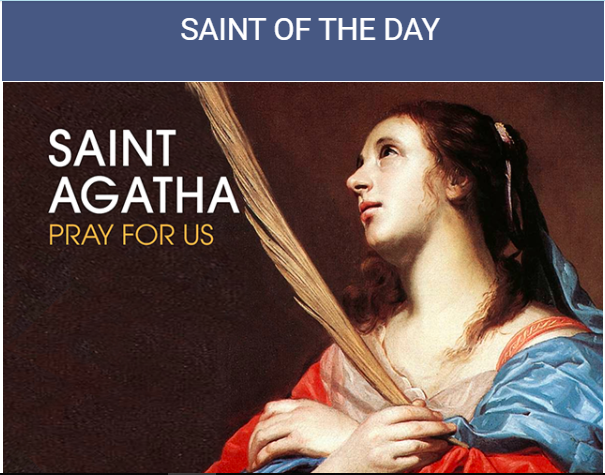
As in the case of Agnes (C. 230 – 251), another virgin-martyr of the early Church, almost nothing is historically certain about this saint except that she was martyred in Sicily during the persecution of Emperor Decius in 251.
Legend has it that Agatha, like Agnes, was arrested as a Christian, tortured, and sent to a house of prostitution to be mistreated. She was preserved from being violated, and was later put to death.
She is claimed as the patroness of both Palermo and Catania. The year after her death, the stilling of an eruption of Mt. Etna was attributed to her intercession. As a result, apparently, people continued to ask her prayers for protection against fire.
Reflection
The scientific modern mind winces at the thought of a volcano’s might being contained by God because of the prayers of a Sicilian girl. Still less welcome, probably, is the notion of that saint being the patroness of such varied professions as those of foundry workers, nurses, miners and Alpine guides. Yet, in our historical precision, have we lost an essential human quality of wonder and poetry, and even our belief that we come to God by helping each other, both in action and prayer?