//Ascension Press//
416 N 2nd St, Albemarle NC 28001 | (704) 982-2910
//Ascension Press//
//Ascension Press//
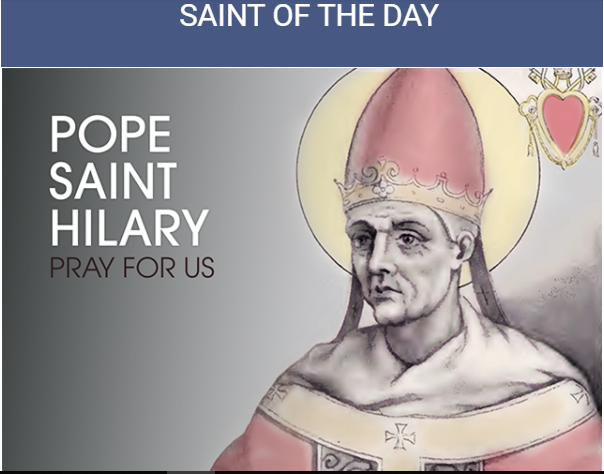
Pope Saint Hilary (5th c.) was Bishop of Rome from 461 to 468. Not much is known of his early life other than that he was from Sardinia. He rose to prominence in the Church when he became archdeacon under Pope St. Leo the Great, working closely with him as a trusted aid. St. Leo sent Hilary as one of the papal legates to the Council of Ephesus in 449. There St. Hilary fought bravely against the monophysite heresy, for which his life was threatened. He was forced into hiding and fled back to Rome for safety. He was so highly esteemed that after Pope Leo’s death he was elected to the papacy. As pope, St. Hilary fought for the rights of the papacy in spiritual matters against the Roman Emperor, and increased organization and discipline between the bishops and the Holy See. He also did much work in building, remodeling, and decorating Roman churches and other public places. Pope St. Hilary’s feast day is February 28.
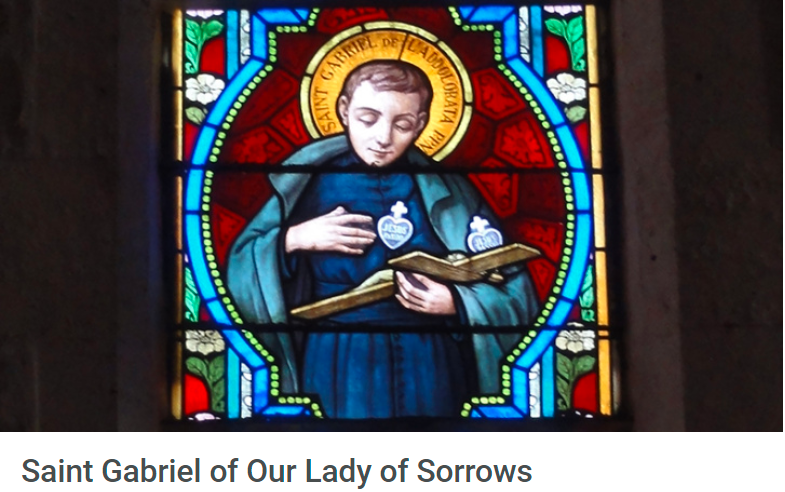
Saint Gabriel of Our Lady of Sorrows’ Story
St. Gabriel Possenti (1838-1862), also known as St. Gabriel of Our Lady of Sorrows, was born in Italy into a large family and baptized Francis, Saint Gabriel lost his mother when he was only four years old. He was educated by the Jesuits and, having been cured twice of serious illnesses, came to believe that God was calling him to the religious life. Young Francis wished to join the Jesuits but was turned down, probably because of his age, not yet 17. Following the death of a sister to cholera, his resolve to enter religious life became even stronger and he was accepted by the Passionists. Upon entering the novitiate he was given the name Gabriel of Our Lady of Sorrows.
Ever popular and cheerful, Gabriel quickly was successful in his effort to be faithful in little things. His spirit of prayer, love for the poor, consideration of the feelings of others, exact observance of the Passionist Rule as well as his bodily penances—always subject to the will of his wise superiors— made a deep impression on everyone.
His superiors had great expectations of Gabriel as he prepared for the priesthood, but after only four years of religious life symptoms of tuberculosis appeared. Ever obedient, he patiently bore the painful effects of the disease and the restrictions it required, seeking no special notice. He died peacefully on February 27, 1862, at age 24, having been an example to both young and old.
Saint Gabriel of Our Lady of Sorrows was canonized in 1920.
Reflection
When we think of achieving great holiness by doing little things with love and grace, Therese of Lisieux comes first to mind. Like her, Gabriel died painfully from tuberculosis. Together they urge us to tend to the small details of daily life, to be considerate of others’ feelings every day. Our path to sanctity, like theirs, probably lies not in heroic doings but in performing small acts of kindness every day.
Saint Gabriel of Our Lady of Sorrows is the Patron Saint of:
Clergy
Students
Young People
//Franciscan Media//

“Maximizing the Minimum“
Father Peter Fitzgibbons
February 20 – 21, 2021
Gospel: Mark 1: 12-15
How can you love God more? How can you experience more of His love? The answer is really very simple. By loving yourself less. God is love Himself. He has no need of our love and is totally self-sufficient. But, God wants to give us His love. Unfortunately, God, being the perfection of all virtues, including politeness and courtesy, won’t break into our souls. We have to open our souls up to Him. If our souls are closed off by self-centeredness, He cannot come in. He wants to give us His immense love and to fill our souls completely with Himself.
We can grow in the love of God by taking on little penances and pious practices. Doing so will help, but two things are important. They have to be small, and they have to be practical. Too often, people say they will grow in the love of God by doing a lot of grandiose things. But, it’s impractical, because they won’t do it. Instead, take little steps. The first step to take is to realize that we need to improve. That’s actually a big step, because many people are satisfied with maximizing the minimums. “Father, I go to Mass on Sundays and Holy Days.” “I go to confession once a year.” “I don’t eat meat on Fridays during Lent.” “I obey the Ten Commandments.” “I don’t rob banks.” Okay. But, there’s a lot more in the book our Lord tells us to do. You know that, right? We tend to maximize the minimums. “Father, I am good.” Well, I don’t know about that. The Lord said not to call anybody “good.” We are called to be perfect. That’s in the black part of the Bible, not the white part. Be perfect as your Heavenly Father is perfect. “I’m here at Mass.” You are physically here but is your mind? Look! Squirrel. Distraction during prayer is normal; just come back to it.
Giving yourself totally over to God, to overcome self-centeredness is what we always must work toward. Our first parents disobeyed God, and we continue to do the same thing. “I won’t let God in until I need Him.” “I will only go to church if the Mass is in English, or Spanish, or Latin, and only if it’s at 12:00 on my day off, if I’m not too tired, or if it’s over by 5:30 because I have dinner reservations somewhere.” We use all these stipulations, and the Church has unfortunately bought into to it. “I will only go to confession if there are reconciliation rooms.” So, parishes have spent thousands of dollars creating reconciliation rooms. Come on! I hear confessions…I wish I heard a lot more.
We must take up our cross every day and follow Him. The ego is a terrible thing and destroys people. In any 12 Step program, you must have ego deflation at depth. Where did they get that I wonder. From the Catholic Church? Go figure. How do we overcome our ego and self-centeredness? By doing little things. “I need to pray more.” Well, then pray more. Say the rosary. By the time you get to Coy’s laundry mat or to the court house, you have plenty of time to say a decade of the rosary. There are five stop lights, so you have plenty of time to say it. You have to sit there anyway. You can’t zip right through the traffic lights, although they made it less likely to be caught when they have moved the police station. My point is that you have plenty of time to do little things. “I want to lose weight and to eat better.” Then do it, one step at a time.
God has no limit on His love. We are the ones who limit His love with our self-centeredness. We determine our salvation. God says, “I will give you the way to salvation if you let Me into your soul.” We say, “I’ll get back to you. Thank you very much. Appreciate the offer.” We want to cling to ourselves. One of my good friends who recently passed away, a judge, used to say, “I’m not much, but I’m all I think about.” I deserve to speed, because I’m important. I have business to attend to. That would be me. However, I should mention that a lot of cops are not Catholic. We want what we want when we want it. That’s what we all have to fight…our self-centeredness. “You can’t tell me what to do. “I deserve this.” That kind of thinking shuts God out.
We have to be humble. In fact, we are commanded to be humble. The 4th and 5th Commandments command us to obey our physicians and caregivers. You don’t go to your physician’s office and say, “Oh, what the heck do they know.” Doctors are very intelligent, so listen to them and do what they tell you. That’s humility. “I don’t want a colonoscopy.” That’s humility, especially when I had mine. I know everyone in that department. I work there. I knew them all. Having a colonoscopy is not a side of me they wanted to see, but what the heck…if you’ve seen one, you’ve seen them all. As Saint Therese de Lisieux said, when you are humble, you are small and safe. As long as you continue doing small acts of penance, day after day, you are growing in God’s love and opening the door to your soul so that He can come in. God will not force his way in. He does not need our love. God is self-sufficient. But, He wants to give His love to us, because that is His nature. We are the ones with selfish self-centeredness and close the door on love. But, if we focus on the little things, we will grow spiritually and gradually open the door more and more to allow the love of our good Lord into our souls.
The Law of Physics says that two objects cannot occupy the same space at the same time. If our souls are full of ourselves, God cannot get in. God isn’t going to push us aside. He isn’t going to make us love Him. We have to decide to love Him by renouncing ourselves and our attachment to things. You will discover that once you become detached from things, you will have far more joy and pleasures than you ever could have imagined. Saint Augustine and Saint Thomas both said that if there is any labor involved, love is no labor at all. It’s all a joy. Each sacrifice is a joy. Each sacrifice makes a way for greater enjoyment and greater love. It creates a way for a greater union with the Almighty and, therefore, a greater union with one another. So, we are the ones who determine how much we will love. The secret of loving God and experiencing His love is really easy. We just have to love ourselves a heck of a lot less.
How will you apply this message to your life? Are you maximizing the minimum? Will you fight to overcome self-centeredness and make room for God in your heart and soul?
You can read all of Father Fitzgibbons’ sermons by going to https://annunciationcatholicalbemarle.com/ and clicking on “Blog” then “Categories” and then “Sermon Notes. From a cell phone, click on “Blog” then “Menu” and then “Categories” (located at the end of the page). There is also a search box if you are looking for a specific topic.

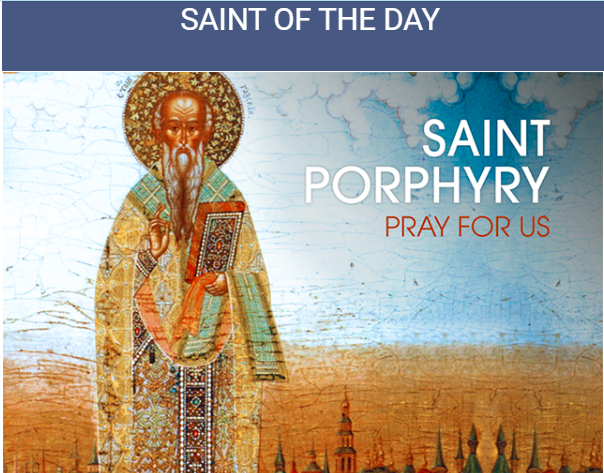
St. Porphyry (Porphyrius) of Gaza (c. 347-420 A.D.) was born in Thessalonica in present-day Greece. Although a wealthy man, at the age of 25 he went to live in Egypt as a desert hermit. He later moved to Palestine near the Jordan River, then to Jerusalem itself. He did great penances and would often visit the holy places where Jesus lived and walked, despite his poor health. He then renounced all material goods and his inheritance and became a priest in Jerusalem at the age of 40. The relics of the True Cross in Jerusalem were entrusted to his care. Despite his protests he was ordained Bishop of Gaza, a pagan stronghold with an insignificant Christian community. Gaza’s pagans were hostile, and St. Porphyry appealed to the emperor for protection and for the destruction of pagan temples, which he obtained. St. Porphyry built a Christian church on the site of the most important pagan temple dedicated to the chief god, so that he could say Mass in the place where the devil was previously most honored. St. Porphyry labored for his flock and won many converts through his miracles, though pagan opposition continued throughout his life. He was successful in spreading the Christian faith across his diocese. His feast day is February 26.
//The Catholic Company//
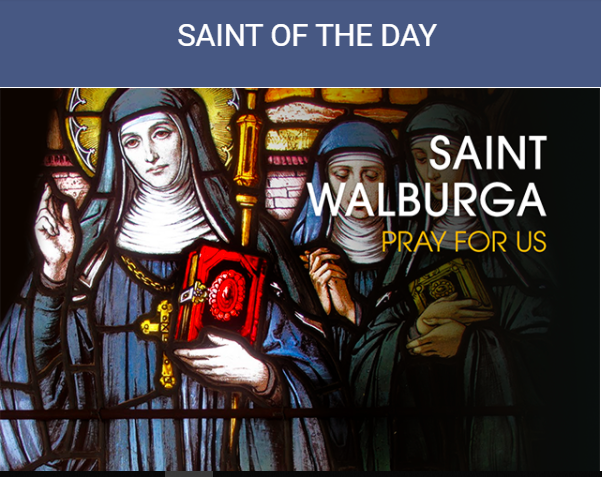
St. Walburga (710-777 A.D.) was born near Devonshire, England, the daughter of St. Richard the Pilgrim (a Saxon king) and the sister of Sts. Willibald and Winebald. When she was eleven her father and brothers went on pilgrimage to the Holy Land, while her father placed her in a convent famous for its holiness. She was well educated according to her rank, became a nun, and lived there for twenty-six years. Her uncle, St. Boniface, then brought her to what is now Germany to help him evangelize that country and establish the Church there. In this missionary activity she joined her brothers who were also laboring for the faith in that country, one as an abbot, the other as a bishop.
Because of Walburga’s education, she was able to document the travels of her brother in the Holy Land, and for this work she became the first female author of England and Germany. She was known as a miracle worker and healer both in her life and after her death.
St. Walburga’s relics have the miraculous property of exuding oil to which many cures have been ascribed through the centuries. St. Walburga is the patron saint of sailors, mariners, and farmers, and against hydrophobia, famine, coughs, rabies, plague, and storms. St. Walburga’s feast day is February 25th.
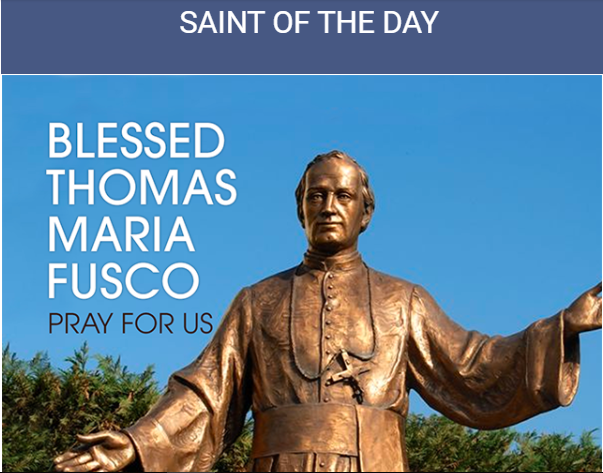
Bl. Thomas Maria Fusco (1831-1891) was born to a noble and pious family in Italy, the seventh of eight children. He was orphaned at an early age and raised by his uncle, a priest, who oversaw his education. He had a deep love for the faith, especially to the Passion of Christ and Our Lady of Sorrows. He became a priest at the age of 24 and opened a school in his own home. He later became an itinerant missionary throughout southern Italy. After traveling for a number of years he opened another school, this time to train priests on how to be good confessors. He also founded the Priestly Society of the Catholic Apostolate to support the missions, which gained papal approval. During his work with the poor he discerned a call to start a new religious order of sisters, the Daughters of Charity of the Most Precious Blood, to minister to orphaned children. In addition to all of this, Fusco was also a parish priest, a confessor to a group of cloistered nuns, and a spiritual father to a lay group at the nearby Shrine of Our Lady of Mount Carmel. He died of liver disease at the age of 59. He was beatified by Pope St. John Paul II in 2001. His feast day is February 24.
//Ascension//
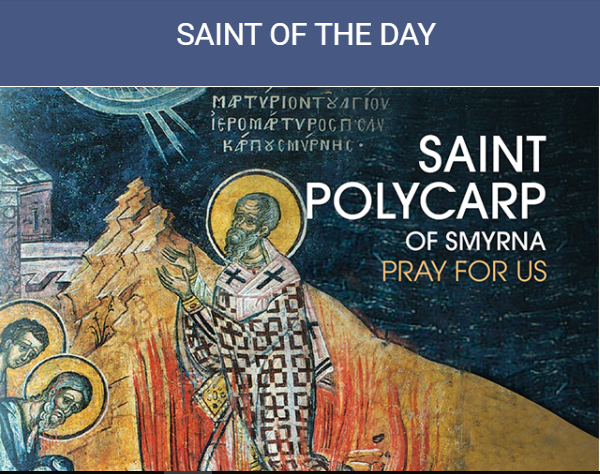
Saint Polycarp’s Story
Polycarp, bishop of Smyrna, disciple of Saint John the Apostle and friend of Saint Ignatius of Antioch, was a revered Christian leader during the first half of the second century.
Saint Ignatius, on his way to Rome to be martyred, visited Polycarp at Smyrna, and later at Troas wrote him a personal letter. The Asia Minor Churches recognized Polycarp’s leadership by choosing him as a representative to discuss with Pope Anicetus the date of the Easter celebration in Rome—a major controversy in the early Church.
Only one of the many letters written by Polycarp has been preserved, the one he wrote to the Church of Philippi in Macedonia.
At 86, Polycarp was led into the crowded Smyrna stadium to be burned alive. The flames did not harm him and he was finally killed by a dagger. The centurion ordered the saint’s body burned. The “Acts” of Polycarp’s martyrdom are the earliest preserved, fully reliable account of a Christian martyr’s death. He died in 155.
Reflection
Polycarp was recognized as a Christian leader by all Asia Minor Christians—a strong fortress of faith and loyalty to Jesus Christ. His own strength emerged from his trust in God, even when events contradicted this trust. Living among pagans and under a government opposed to the new religion, he led and fed his flock. Like the Good Shepherd, he laid down his life for his sheep and kept them from more persecution in Smyrna. He summarized his trust in God just before he died: “Father… I bless Thee, for having made me worthy of the day and the hour…” (Acts of Martyrdom, Chapter 14).
Saint Polycarp is the Patron Saint of:
Earaches