Sermon Notes – Rules? There Are Rules?

“Rules? There Are Rules?”

Father Peter Fitzgibbons

May 8 – 9, 2021

Gospel:  John 15:9-17

Now, when I was in seminary we had to study…a lot.  “So, Father, you learned a lot of rules.”  Maybe.  We had a semester in Moral Theology.  Then there was the Canon Law course which we took twice, because there are two different versions…the one we were living under at the time and the one that would be in effect five years down the road.  The funny thing about that is the first part was the one we had to study and were tested on, but it was only written in Latin.  It could not be translated into English, because there wasn’t a precise translation, and Canon Law is very precise.  So, you sit there in class with a Latin dictionary.  Great!  One year of Latin in high school just didn’t quite cut it.  So, yeah, there are a lot of rules, if you want to look at it that way.  If you look at them without love, then they are RULES.  But, if you at them with love, they are the way God gives us His healing power and keeps us from harm.  So, they aren’t really RULES. 

You know what else has RULES?  Flight school.  Anybody can take a plane up, and everybody can land it…but, landing the plane safely is the tricky part.  You know who else has RULES?  Doctors.  Medicine has lots of RULES.  You can’t do this and you can’t do that…well, you could, but a good outcome would be doubtful.  What’s the first rule in. Medicine?  Do no harm.  Great idea!  That philosophy almost applies to military doctors.  Doctors study all these RULES so they can bring God’s healing gift to you.  Otherwise, there are a lot of people who wouldn’t be here today.  What are the RULES for?  Through the actions of our health providers, the RULES are there so that God’s healing gifts may be granted to heal us, to console us, and to comfort our families.   It’s the same with God’s Commandments.  If you follow them, you get what He promised.  The RULES of medicine are acts of love.  The emptying of oneself, because you don’t know everything, allows God’s healing power to flow from you to the other person. 

The same thing is true with the Church.  The RULES are set in the Gospel as Commandments.  What are they?  They are works of love.  “If you love me, keep My Commandments.” So, the Commandments are works of love.  They are not RULES.  What makes people look at the Church and say, “There are a lot of RULES” is ego.  We call that “king baby.”  “I want what I want when I want it.”  Now, I am blessed to have a wonderful cardiologist.  He’s a very, very gifted man and a wonderful healer, except he lacks something in his education.  Maybe, he was sick that day in medical school.  Apparently, he doesn’t know that bacon is heart healthy, and I can’t quite convince him that it is.  I want what I want when I want it.  Those are people’s RULES. 

God loves us unconditionally, because God is love itself.  He created us out of love, and He saved us out of love. God continues to loves us even when we tick him off by sinning.  We have to accept His love and give that love back.  But, we put conditions on receiving Him as if we are the ones making the RULES.  Is anybody here perfect?  Bea, don’t put your hand up.  So, no one.  That’s why we need a Savior, and that’s why we are here.  This is a hospital for sinners – not hotel for saints.  We do not set conditions on His love; instead, we seek it.   He wants to give Himself to us, but not if we aren’t prepared to receive Him.  These are the RULES so that the gift of His love will not be insulted, mocked, or held up for ridicule.  We take His love and make a mockery of it. 

Even though God’s love is unconditional, we cannot do whatever we want just because God will love us anyway.  “I can do this because God loves me unconditionally.”  “I’m going to do that because God will love me anyway.”   No…you cannot.  In the Gospel, our Lord said, “Whoever does not carry his cross and follow Me cannot be My disciple” (Matthew 10:38) and everybody left Him.   When He declared that marriage is between one man and one woman (Matthew 19:4-7), everybody left Him.  When our Lord told His disciples, “…unless you eat the flesh of the Son of man and drink his blood, you have no life in you” (John 6:53), everybody left Him.  Christ said, “If you keep My commandments, you will remain in My love” (John 15:10). These are the RULES.  We have RULES to guide us so that we understand what acts of love are and what they are not. 

We all make mistakes, and we are judged on them.  “My conscious is my guide.”   Well, it shouldn’t be.  The judgement of the Church should be your guide, because it is infallible in matters of faith and morals.  My own judgement is not too good.  Remember bacon?  There are rules about Holy Communion.  Non-Catholics and non-practicing Catholics cannot receive.  Saint Paul wrote that whoever receives the Eucharist unworthily “will have to answer for the body and blood of the Lord” (1 Cor. 11:27-30).  They are not guilty of being impolite – they are guilty of His death.  Instead of loving Christ, those who receive unworthily are taking His gift and throwing it in His face.  “I don’t care what You want, this is what I want.”   Be sure to read the black part of Scripture, and leave the white part alone.  These are not RULES.  There are no RULES in the Church…only acts of love.  If we find His Commandments and the Church’s rules to be odious and burdensome, that’s our ego from the first sin.  Remember, it was not committed by Adam and Eve, but by Lucifer who said, “I will not serve.”   

The next time you hear someone say, “Catholics have a lot of RULES,” just say, ‘”You know, if you read the Gospels, Jesus had a lot of RULES.  But, those RULES tell us how to die to ourselves so that He can live within us.”  Yes, we have RULES, but they are acts of love.  If we have a problem with the RULES, then we have a problem with our love of God. 

How will you apply this message to your life? Are you making a mockery of His love by following your own set of rules instead of His Commandments?    

You can read all of Father Fitzgibbons’ sermons by going to: https://annunciationcatholicalbemarle.com/ and clicking on “Blog” then “Categories” and then “Sermon Notes.”  From a cell phone, click on “Blog” then “Menu” and then “Categories” (located at the end of page).  There is also a search box if you are looking for a specific topic.
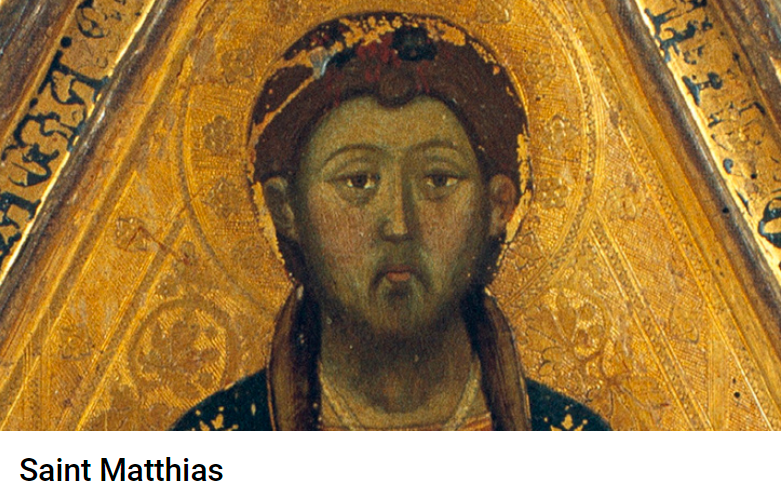

Saint of the Day – May 14 – Saint Matthias

St. Matthias the Apostle (1st c.) followed Jesus during his entire earthly ministry and was one of his 72 disciples. Matthias was chosen by the 11 Apostles to replace Judas Iscariot after his betrayal of Christ and subsequent suicide. After Christ’s Ascension into heaven, St. Matthias devoted himself to preaching Christianity among the pagans, some of them barbarians and cannibals, all over Judea, Cappadocia, and Ethiopia for over 30 years. Many miracles are ascribed to him as the pagans sought to kill him: that he was unharmed after being forced to drink poison, that he once hid by becoming invisible, and that the earth opened up and swallowed his attackers. St. Matthias also preached the need for mortification of the flesh as an aid to growth in holiness. Eventually, at God’s appointed time, he was martyred for the cause of Christ, though there are conflicting traditions as to exactly where and how. St. Matthias is the patron saint of carpenters, tailors, and reformed alcoholics. His feast day is May 14th.

Matthias is not mentioned by name anywhere else in the New Testament.

Reflection

What was the holiness of Matthias? Obviously, he was suited for apostleship by the experience of being with Jesus from his baptism to his ascension. He must also have been suited personally, or he would not have been nominated for so great a responsibility. Must we not remind ourselves that the fundamental holiness of Matthias was his receiving gladly the relationship with the Father offered him by Jesus and completed by the Holy Spirit? If the apostles are the foundations of our faith by their witness, they must also be reminders, if only implicitly, that holiness is entirely a matter of God’s giving, and it is offered to all, in the everyday circumstances of life. We receive, and even for this God supplies the power of freedom.

//Franciscan Media & The Catholic Company//


Saint of the Day – May 13 – Saint Julian of Norwich

St. Julian/Juliana of Norwich (1342–1416) is a Benedictine nun who lived as a recluse in Norwich, England. Little is known of her life with certainty. At the age of 30 she was suddenly struck by a severe illness which almost took her life. During this illness she received a series of visions of Jesus Christ in sixteen separate revelations. When she recovered from her illness the visions stopped. Fifteen years later, Our Lord appeared to her to give her the meaning of her visions. St. Julian wrote her visions down in a book called Revelations of Divine Love, the earliest surviving book in the English language known to have been written by a woman. After these revelations she began to live a solitary life as an anchoress in a little cell built into the wall at the church of St. Julian in Norwich, not far from London. During her life the Church was in schism, and England was caught in a long war with France. The book contains a message of optimism based on the certainty of being loved by God and of being protected by his Providence. She received visitors to her cell and gave them guidance on the spiritual life, becoming a spiritual mother to many. St. Julian is an important medieval mystic whose response to the problem of evil is cited in the Catechism of the Catholic Church. Her feast day is May 13th.  

//The Catholic Company//


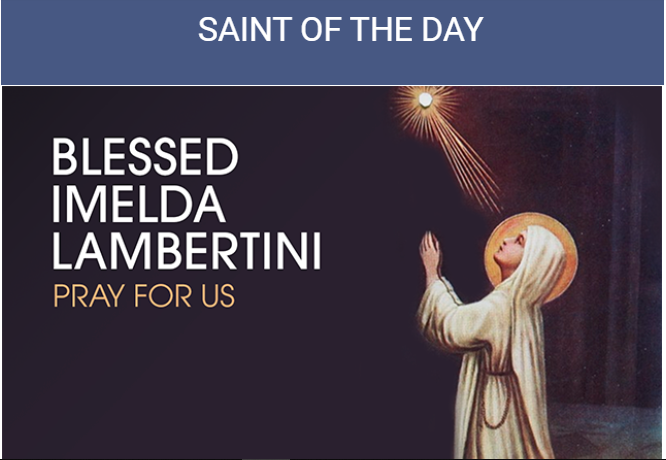
Saint of the Day – May 12 – Blessed Imelda Lambertini

Bl. Imelda Lambertini (1322–1333) was born to a noble and devout family in Bologna, Italy. As a child she developed a great love for prayer, the Holy Sacrifice of the Mass, and the Holy Eucharist. She spent much of her time in the Dominican monastery praying with the nuns, and at nine years of age requested to enter there as a postulant. Her parents and the nuns allowed her to enter, however, in that era children her age were not permitted to receive Holy Communion. Imelda repeatedly pleaded to receive Communion, but each time she was denied. Nevertheless, she developed a close relationship with Jesus in the Blessed Sacrament. When the feast of the Ascension approached, Imelda begged to make her First Holy Communion on this feast. Again, she was denied. On the Vigil of the Feast of the Ascension she was in the chapel praying, as usual, as the other Sisters received Holy Communion. Afterwards a glowing host was seen suspended in the air above the child. The priest understood this as a sign that the child should be permitted to receive, and he ministered the Holy Eucharist to her. Imelda remained kneeling in prayer in thanksgiving as the nuns left the chapel. When they returned for her, they found her just as they had left her, but her body was lifeless. It was understood that Imelda died of pure ecstatic joy after receiving Jesus in the Blessed Sacrament, as she had so ardently desired. Bl. Imelda Lambertini is the patron saint of First Communicants. Her feast day is May 12th.

//The Catholic Company//


Saint of the Day – May 11 – Saint Francis of Girolamo

St. Francis de Girolamo (1642-1716) was the eldest of eleven children born to honorable and virtuous parents in Naples, Italy. As a child he was drawn to God and a life of prayer. Realizing his vocation to Holy Orders, he was ordained a Jesuit priest at the age of 28. He became a renowned public preacher due to his distinguished and eloquent voice. He was described as “a lamb when he talks, and a lion when he preaches.”

Francis had a heart for the missions after his patron St. Francis Xavier, but instead of traveling to distant lands he accepted his hometown of Naples as his India. He went as a missionary priest into country towns and villages for open-air preaching in the streets. He sought to convert sinners wherever they were—in brothels, prisons, galleys, hospitals, and asylums—as well as instructing the pious in their religious houses. He converted Muslim prisoners of war to the Christian faith, rescued children from dangerous and degrading situations, and opened a pawn shop for charity.

The fruit of his labor was abundant. He converted many souls, even hardened sinners, and made them virtuous. Everyone knew Francis for his holiness and zeal. He also had a reputation for being a miracle worker during his lifetime and after his death. After spending 40 years in apostolic labor in Naples, he died of an illness from which he suffered greatly without complaint. His feast day is May 11th.

//The Catholic Company//


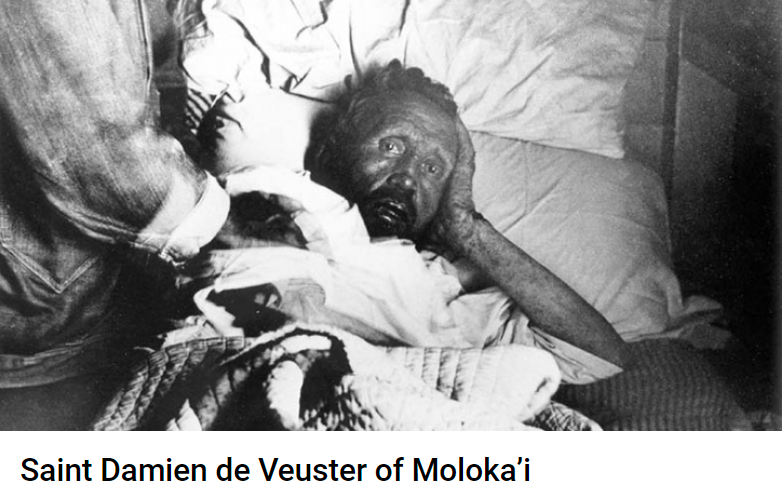
Saint of the Day – May 10 – Saint Damien de Veuster of Moloka’i

(JANUARY 3, 1840 – APRIL 15, 1889)

Saint Damien de Veuster of Moloka’i’s Story

When Joseph de Veuster was born in Tremelo, Belgium, in 1840, few people in Europe had any firsthand knowledge of leprosy, Hansen’s disease. By the time he died at the age of 49, people all over the world knew about this disease because of him. They knew that human compassion could soften the ravages of this disease.

Forced to quit school at age 13 to work on the family farm, Joseph entered the Congregation of the Sacred Hearts of Jesus and Mary six years later, taking the name of a fourth-century physician and martyr. When his brother Pamphile, a priest in the same congregation, fell ill and was unable to go to the Hawaiian Islands as assigned, Damien quickly volunteered in his place. In May 1864, two months after arriving in his new mission, Damien was ordained a priest in Honolulu and assigned to the island of Hawaii.

In 1873, he went to the Hawaiian government’s leper colony on the island of Moloka’i, set up seven years earlier. Part of a team of four chaplains taking that assignment for three months each year, Damien soon volunteered to remain permanently, caring for the people’s physical, medical, and spiritual needs. In time, he became their most effective advocate to obtain promised government support.

Soon the settlement had new houses and a new church, school and orphanage. Morale improved considerably. A few years later, he succeeded in getting the Franciscan Sisters of Syracuse, led by Mother Marianne Cope, to help staff this colony in Kalaupapa.

Damien contracted Hansen’s disease and died of its complications. As requested, he was buried in Kalaupapa, but in 1936 the Belgian government succeeded in having his body moved to Belgium. Part of Damien’s body was returned to his beloved Hawaiian brothers and sisters after his beatification in 1995.

When Hawaii became a state in 1959, it selected Damien as one of its two representatives in the Statuary Hall at the US Capitol. Damien was canonized by Pope Benedict XVI on October 11, 2009.

Reflection

Some people thought Damien was a hero for going to Moloka’i and others thought he was crazy. When a Protestant clergyman wrote that Damien was guilty of immoral behavior, Robert Louis Stevenson vigorously defended him in an “Open Letter to Dr. Hyde.”

//Franciscan Media//


Sermon Notes – May 2, 2021 – His Sacred Heart

“His Sacred Heart“

Father Peter Fitzgibbons

May 1 – 2, 2021

Gospel:  John 15:1-8

I was talking to one of my fellow chaplains with whom I share an office at the VA.  We call it the cell.  So, I said to my cell-mate, “Hey Gary, you’re a bright guy, even though you went into the Air Force, you’re a bright guy.”  He was too old for Girl Scouts, but he does have a master’s degree in Divinity.  “Where are the green pastures that our Lord, the Good Shepherd, leads us to give us repose?”  Gary said “Heaven.”  That’s true.  Then, I said, “Would you say that, before we get there, He leads us to heaven on Earth…to a place in His Sacred Heart?”  That is Heaven.  Our Savior’s heart beats with love for us, and our two hearts will beat as one in Heaven.  The Good Shepherd calls us, not just to follow Him, but to be part of His Sacred Heart and to take our rest there.  It is in our Lord’s Sacred Heart that we will find peace and rest for our souls. 

Our Lord said in Matthew 11:30:  “…my yoke is sweet and my burden light.”  The sweet yoke is our crosses that are just for us and not for anyone else.  In that lovely green garden and pasture where He gives us repose, He also gives us strength, courage, and consolation as we carry our cross.  We carry our cross with the Good Shepherd, if we let Him, so that we are able to carry it for our redemption and the redemption of others.  And sometimes, but not nearly often enough, we will find joy in it.  We will find joy in carrying our cross. 

The Good Shepherd would like to lead us to His Sacred Heart.  Saint Augustine said, “Our heart is restless until it rests in thee.”  We will find peace for our souls which is what our souls need, but we try to fill it with every person, place, or thing.  In His Sacred Heart, we will find rest.  We will find strength, and we will find contentment.  We walk with our Lord by the way of the Cross.  First He leads us to His Sacred Heart, and then He walks with us all the way through to our passion and death.

How will you apply this message to your life? Will you let Him help you carry your cross for your redemption and the redemption of others?

Father’s Afterthoughts: 

I had a meeting with the Bishop the other day.  Sadly, I’m still not a monsignor.  I had to drive 50+ miles to hear that bad news.  Anyway, I felt safer in Iraq while driving to Charlotte on Hwy 485.  Those people are crazy!   I was never so glad to see Walmart in Locust and Mecklenburg County in my rear view mirror.  One thing we discussed at the meeting is that, in the next couple of months, the Bishop will probably reinstitute the Sunday Mass obligation.  When he does, the Mass will be a bit longer than those I’ve been giving. 

I really don’t like the word “obligation.”  Are you are obligated to remember your mother’s birthday or remember her on Mother’s Day?  If you have to be told that, you need to be taken outside with a few of the guys for a chat.  We come here out of love.  If we say, “Oh, I’m too tired” or “I’m too whatever,” we lose the opportunity to grow in love. 

Also, keep in your prayers, Father Michael Kottar.  He’s 57 years old and a great priest.  Father Kottar has been diagnosed with bovine spongiform encephalopathy or Mad Cow Disease.  There is no treatment, so please keep him in your prayers. 

You can read all of Father Fitzgibbons’ sermons by going to https://annunciationcatholicalbemarle.com/ and clicking on “Blog” then “Categories” and then “Sermon Notes.”  From a cell phone, click on “Blog” then “Menu” and then “Categories” (located at the end of page).  There is also a search box if you are looking for a specific topic.

Saint of the Day – May 7 – Saint Rose Venerini

(FEBRUARY 9, 1656 – MAY 7, 1728)

Saint Rose Venerini’s Story

Rose was born at Viterbo in Italy, the daughter of a doctor. Following the death of her fiancé she entered a convent, but soon returned home to care for her newly widowed mother. Meanwhile, Rose invited the women of the neighborhood to recite the rosary in her home, forming a sort of sodality with them.

As she looked to her future under the spiritual guidance of a Jesuit priest, Rose became convinced that she was called to become a teacher in the world rather than a contemplative nun in a convent. Clearly, she made the right choice: She was a born teacher, and the free school for girls she opened in 1685 was well received.

Soon the cardinal invited her to oversee the training of teachers and the administration of schools in his diocese of Montefiascone. As Rose’s reputation grew, she was called upon to organize schools in many parts of Italy, including Rome. Her disposition was right for the task as well, for Rose often met considerable opposition but was never deterred.

She died in Rome in 1728, where a number of miracles were attributed to her. She was beatified in 1952 and canonized in 2006. The sodality, or group of women she had invited to prayer, was ultimately given the rank of a religious congregation. Today, the so-called Venerini Sisters can be found in the United States and elsewhere, working among Italian immigrants.

Reflection

Whatever state of life God calls us to, we bring with us an assortment of experiences, interests and gifts—however small they seem to us. Rose’s life stands as a reminder that all we are is meant to be put to service wherever we find ourselves.

//Franciscan Media//


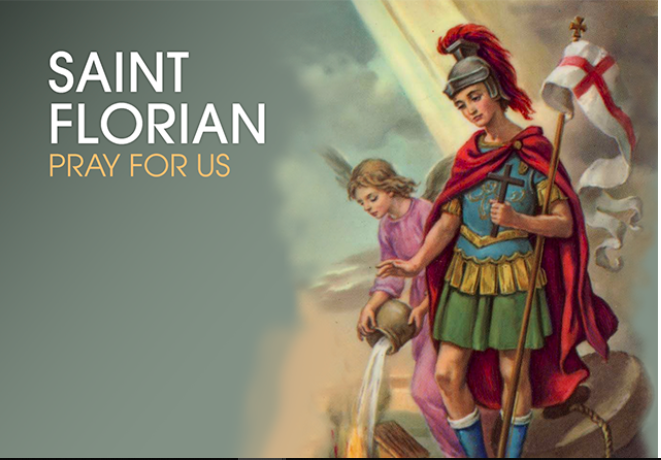
Saint of the Day – May 4 – Saint Florian

St. Florian (C. 250-304 A.D.) was a commander in the Roman army in what is now Austria. He served during the reign of Emperor Diocletian, who violently persecuted Christians. Among Florian’s military duties was the organization of firefighting brigades. St. Florian was secretly a Christian and was known for miraculously saving a town from being destroyed by fire; after praying to God for help, he extinguished a raging fire with a single bucket of water. Word reached the Emperor that Florian was not enforcing the ban against Christianity in his territory. He was put under investigation and was discovered to be a Christian. In one account, it was for refusing to offer sacrifice to the gods; in another, for refusing to execute a group of Christians. He was then condemned to be tortured and executed for his Christian faith. Refusing to recant, St. Florian was then flayed alive, scourged, and martyred by being dumped in the river with a millstone attached to his body. His body was later recovered, and today his relics are venerated at a church named for him in Kraków, Poland. St. Florian is the patron saint of firefighters, chimney-sweeps, brewers, drowning victims, Austria, Poland, and against floods, fires, and battles. St. Florian’s feast day is May 4th.

//The Catholic Company//


Sermon Notes – The Good Shepherd

“The Good Shepherd“

Father Peter Fitzgibbons

April 24 – 25, 2021

Gospel:  John 10:11-18

I have been meditating on the Gospel of the Good Shepherd.  Where in the Gospel do we first hear about the Good Shepherd?   You’ll find it in Genesis when God went looking for Adam and Eve.   They had sinned and were trying to hide, but God looked for them to bring them back.  Why did they run from God?  They were “necked.”  That’s naked for all you Yankees.  They hid because they had sinned.  They ran away from God, but God went after them.  God goes after sinners, because He does not want us to succumb to the evil one.  Adam and Eve were afraid, because sin causes fear.  They were afraid of the One who loves us.  Sin makes us stay away from the One who has the power to heal sin.  “We’re going to be punished!”  But, this is a great act of love as we see on the Crucifix.  He asks us to partake of His love by receiving and asking for His forgiveness.  If we run from God after we have sinned, it is an offense against God. 

I have heard this statement from a number of priests and others:  “I have to forgive myself.”  Excuse me..WHAT??  That’s a sin right there.  The sin wasn’t against you.  You egotistical jerk!  The sin was against God and no one else. That statement is blasphemous. It’s pop psychology, and it’s blasphemous.  It’s your own fertilizer excuse…you know the word.  It’s a fertilizer excuse justifying the act.  “I have to forgive myself.”  You cannot bring healing to yourself. That would require penance and divine forgiveness.  Only God can absolve sin, and only God can heal it.  Sin in this world is made manifest by fear.  What do people do when they are afraid?  They try to hide.  They lay down conditions for coming back.  “I’m not coming back to the Church until priests can get married.”  Do you ask any of the professionals in your life if they are married?  “I’m not coming back until Mass is in English, until Confession is face-to-face, or until people can marry whoever or whatever they want.”  Really? 

Sin causes fear and anger which distorts reality.  So, people try to deny that they did anything wrong.  “I didn’t do anything!”  “It wasn’t that bad.”  “You cops are all crooked.”  “You priests are all perverts.”   They try to deny what they’ve done by lashing out.  When a dog is afraid, it may snarl at you. People try to deny their sin and will do anything but say “I’ve done wrong, and I’m sorry.”  That fear changes your perspective and it changes your attitude.

I was driving up to the VA hospital the other day, and I always try to find the State Troopers and the Sheriff’s deputies.  It keeps you aware, and it’s kind of fun to see where they might be hiding.  I appreciate the art form.  But, I can always tell where they are just by watching people in front of me slam on their brakes.  Why are you afraid?  Just do the speed limit. Come on!  But, they are afraid.  What are they afraid of?  They are only afraid if they’ve done something wrong.  But, God’s love casts out all fear…not self-love… but God’s love. 

God is love itself.  We see His love when we look at the Crucifix.  We see that love portrayed at every altar, at every confession, at every hospital visit by a priest, at every marriage ceremony, and at every baptism and confirmation.  This is God’s great love manifested.  I’ll give you some homework for tonight.  Read the poem, “Hound of Heaven” by Francis Thompson.  Francis was a drug addict and alcoholic.  He had fear, and he kept running and running afraid a great beast was going to kill him.  Finally, he ran out of energy and said, “Fine, kill me.  I don’t care anymore.”   When he stopped, he saw that the beast was actually a puppy that wanted to kiss him.  The last part of the poem is:  “Whom wilt thou find to love ignoble thee, Save Me, save only Me?”

God is the Good Shepherd.  But, we have to be willing to be led.  Remember what the first sin was?  It wasn’t by Adam and Eve, but by Lucifer who would not serve.  It’s the same thing when we want to be led by God.  We have to say, “I will serve.” “I will follow.”  It is sinful to say, “I will not serve.”  “I will not listen to you.”  “I know what’s best.”  We are all sinners, that’s why we are all here.  He is the Good Shepherd and brings us home if we want to be led.

How will you apply this message to your life? Are you running from God?  Are you fearful and angry?  Stop running and let God lead you.

You can read all of Father Fitzgibbons’ sermons by going to https://annunciationcatholicalbemarle.com/ and clicking on “Blog” then “Categories” and then “Sermon Notes.  From a cell phone, click on “Blog” then “Menu” and then “Categories” (located at the end of page).  There is also a search box if you are looking for a specific topic.