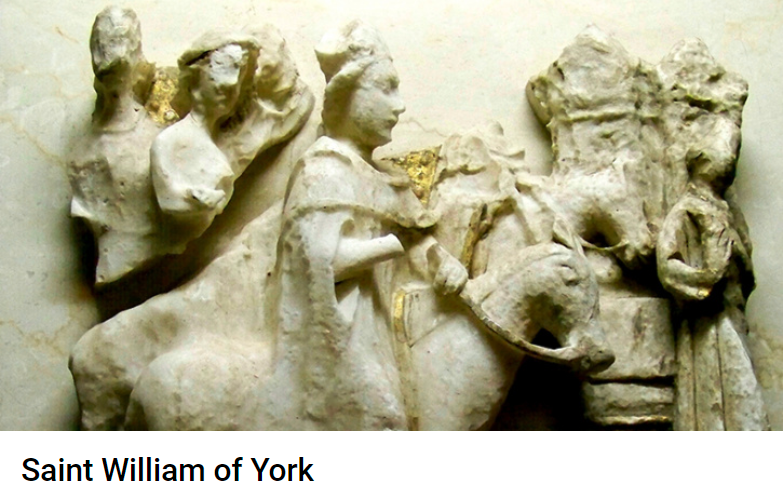
A disputed election as archbishop of York and a mysterious death. Those are the headlines from the tragic life of today’s saint.
Born into a powerful family in 12th-century England, William seemed destined for great things. His uncle was next in line for the English throne—though a nasty dynastic struggle complicated things. William himself faced an internal Church feud.
Despite these roadblocks, he was nominated as archbishop of York in 1140. Local clergymen were less enthusiastic, however, and the archbishop of Canterbury refused to consecrate William. Three years later a neighboring bishop performed the consecration, but it lacked the approval of Pope Innocent II, whose successors likewise withheld approval. William was deposed, and a new election was ordered.
It was not until 1154—14 years after he was first nominated—that William became archbishop of York. When he entered the city that spring after years of exile, he received an enthusiastic welcome. Within two months he was dead, probably from poisoning. His administrative assistant was a suspect, though no formal ruling was ever made.
Despite all that happened to him, William did not show resentment toward his opponents. Following his death, many miracles were attributed to him. He was canonized 73 years later.
Reflection
“Good things come to those who wait” might be the catch phrase for today’s saint. We don’t always get what we want when we want it. Sometimes we have to wait patiently, trusting that if it is for our good, God will bless us.
Bl. Anne of St. Bartholomew (1549–1626) was born in Spain, one of seven children. Her parents died when the plague swept through Spain, leaving her an orphan at the age of ten. She then became a shepherdess tending her brother’s sheep. From a young age she had an extraordinary spiritual life, including being graced with many visions. In one of them the Blessed Virgin Mary told her she would become a nun, which was further encouraged by a vision of Jesus. When she tried to enter the monastery she was turned away for being too young. Years later, when her family tried to arrange her marriage, she finally entered the Carmelite monastery at the age of 21, the same one in which St. Teresa of Avila lived. St. Teresa chose Anne as her personal secretary and assistant, even though she had to teach Anne how to write. For five years St. Anne was the companion of St. Teresa of Avila, traveling with her and assisting her in the establishment of new foundations. It was in Anne’s arms that St. Teresa died in 1582. After Teresa’s death, Anne assisted in the foundation of several other monasteries in France, becoming prioress at three of them. She went on to found a monastery in the Netherlands where she remained until her death. After her death over 150 approved miracles (and more that have not been officially approved) were attributed to her intercession. Her feast day is June 7th.
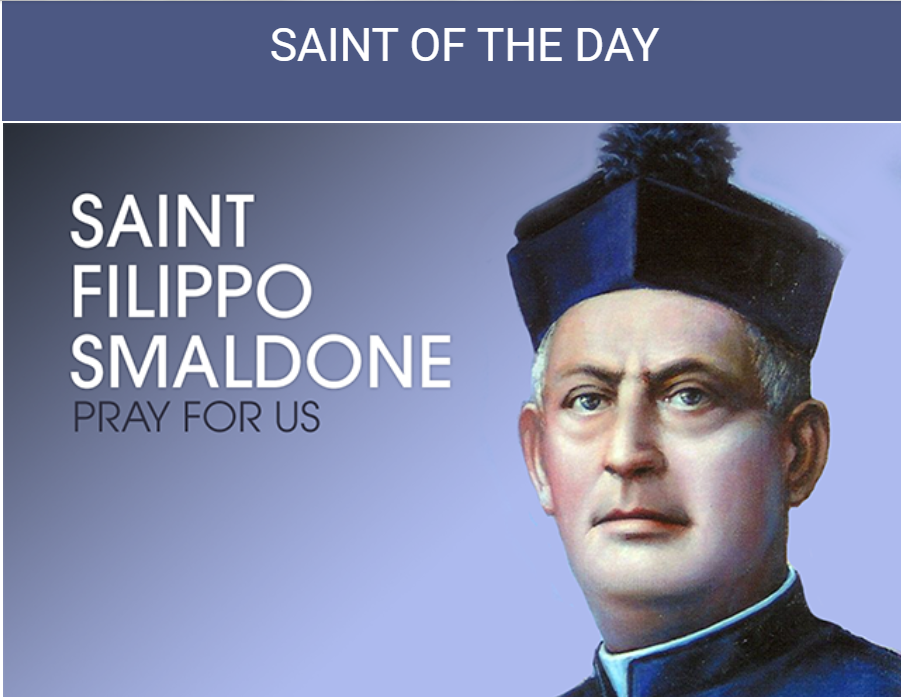
St. Filippo Smaldone (1848–1923) was born in Naples, Italy, during a time of upheaval and unrest both in Italy and in the Church. He decided to become a priest, and while in seminary he took on a personal apostolate of assisting the deaf and mute community in Naples. He dedicated so much time to this work that he barely passed his exams. After his ordination he continued to assist the marginalized of his community, especially the sick. When the plague hit his city he contracted it, however, he was healed after praying to Our Lady of Pompeii, to whom he had a special devotion. He continued his pioneer work in the education of the deaf and mute, though he became discouraged at the difficulty of the task and considered going into the foreign missions instead. Dissuaded from the abandonment of his work by his confessor, St. Filippo committed his life’s mission to the needs of the deaf and mute, training a group of nuns in the work which grew into a new religious foundation. He later expanded his work to include children that were blind, orphaned, and abandoned. His feast day is June 4th.
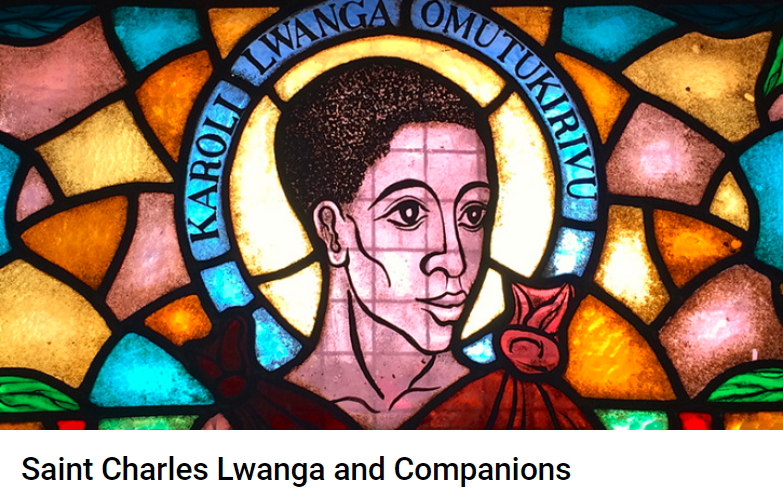
One of 22 Ugandan martyrs, Charles Lwanga is the patron of youth and Catholic action in most of tropical Africa. He protected his fellow pages, aged 13 to 30, from the homosexual demands of the Bagandan ruler, Mwanga, and encouraged and instructed them in the Catholic faith during their imprisonment for refusing the ruler’s demands.
Charles first learned of Christ’s teachings from two retainers in the court of Chief Mawulugungu. While a catechumen, he entered the royal household as assistant to Joseph Mukaso, head of the court pages.
On the night of Mukaso’s martyrdom for encouraging the African youths to resist Mwanga, Charles requested and received baptism. Imprisoned with his friends, Charles’s courage and belief in God inspired them to remain chaste and faithful.
For his own unwillingness to submit to the immoral acts and his efforts to safeguard the faith of his friends, Charles was burned to death at Namugongo on June 3, 1886, by Mwanga’s order.
When Pope Paul VI canonized these 22 martyrs on October 18, 1964, he also made reference to the Anglican pages martyred for the same reason.
Reflection
Like Charles Lwanga, we are all teachers and witnesses to Christian living by the examples of our own lives. We are all called upon to spread the word of God, whether by word or deed. By remaining courageous and unshakable in our faith during times of great moral and physical temptation, we live as Christ lived.
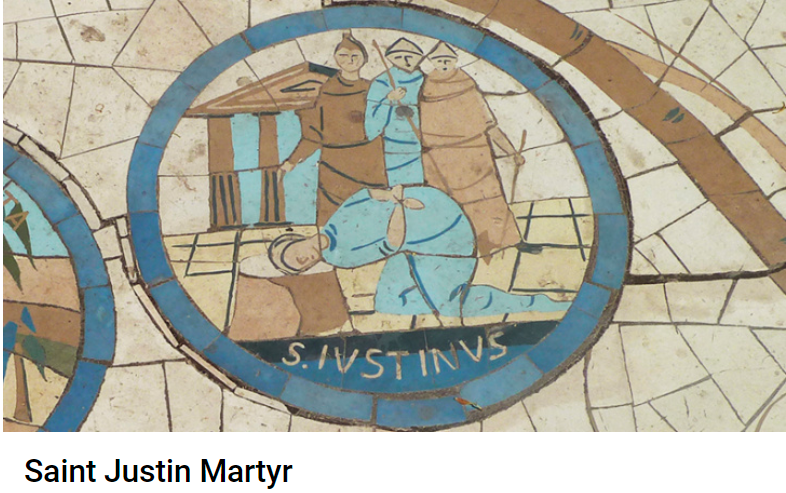
Justin never ended his quest for religious truth even when he converted to Christianity after years of studying various pagan philosophies.
As a young man, he was principally attracted to the school of Plato. However, he found that the Christian religion answered the great questions about life and existence better than the philosophers.
Upon his conversion he continued to wear the philosopher’s mantle, and became the first Christian philosopher. He combined the Christian religion with the best elements in Greek philosophy. In his view, philosophy was a pedagogue of Christ, an educator that was to lead one to Christ.
Justin is known as an apologist, one who defends in writing the Christian religion against the attacks and misunderstandings of the pagans. Two of his so-called apologies have come down to us; they are addressed to the Roman emperor and to the Senate.
For his staunch adherence to the Christian religion, Justin was beheaded in Rome in 165.
Reflection
As patron of philosophers, Justin may inspire us to use our natural powers—especially our power to know and understand—in the service of Christ, and to build up the Christian life within us. Since we are prone to error, especially in reference to the deep questions concerning life and existence, we should also be willing to correct and check our natural thinking in light of religious truth. Thus we will be able to say with the learned saints of the Church: I believe in order to understand, and I understand in order to believe.
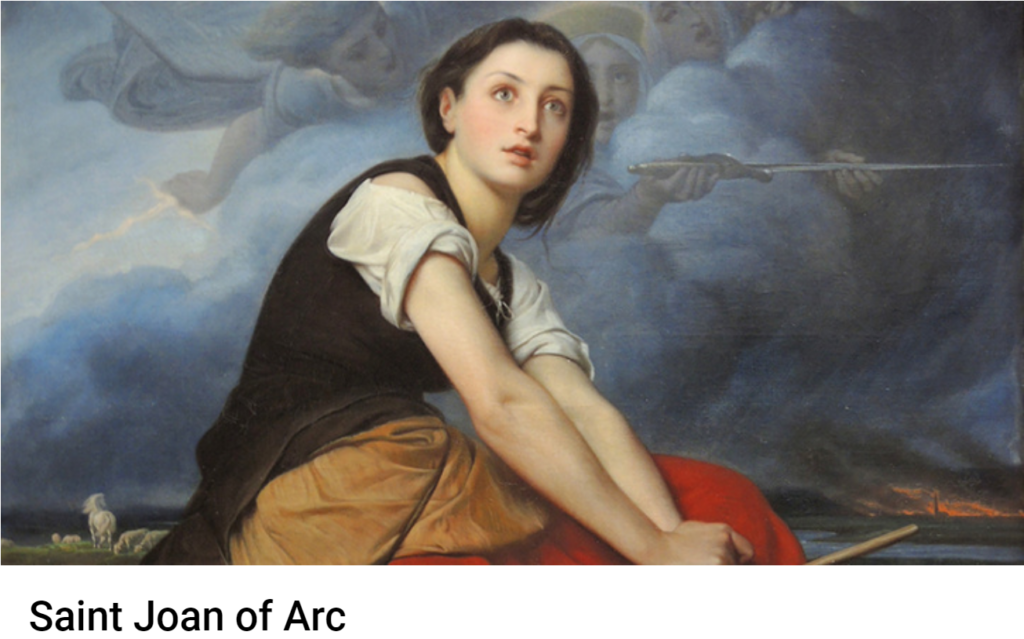
Burned at the stake as a heretic after a politically-motivated trial, Joan was beatified in 1909 and canonized in 1920.
Born of a fairly well-to-do peasant couple in Domremy-Greux southeast of Paris, Joan was only 12 when she experienced a vision and heard voices that she later identified as Saints Michael the Archangel, Catherine of Alexandria, and Margaret of Antioch.
During the Hundred Years War, Joan led French troops against the English and recaptured the cities of Orléans and Troyes. This enabled Charles VII to be crowned as king in Reims in 1429. Captured near Compiegne the following year, Joan was sold to the English and placed on trial for heresy and witchcraft. Professors at the University of Paris supported Bishop Pierre Cauchon of Beauvis, the judge at her trial; Cardinal Henry Beaufort of Winchester, England, participated in the questioning of Joan in prison. In the end, she was condemned for wearing men’s clothes. The English resented France’s military success–to which Joan contributed.
On this day in 1431, Joan was burned at the stake in Rouen, and her ashes were scattered in the Seine River. A second Church trial 25 years later nullified the earlier verdict, which was reached under political pressure.
Remembered by most people for her military exploits, Joan had a great love for the sacraments, which strengthened her compassion toward the poor. Popular devotion to her increased greatly in 19th-century France and later among French soldiers during World War I. Theologian George Tavard writes that her life “offers a perfect example of the conjunction of contemplation and action” because her spiritual insight is that there should be a “unity of heaven and earth.”
Joan of Arc has been the subject of many books, plays, operas and movies.
Reflection
“Joan of Arc is like a shooting star across the landscape of French and English history, amid the stories of the Church’s saints and into our consciousness. Women identify with her; men admire her courage. She challenges us in fundamental ways. Despite the fact that more than 500 years have passed since she lived, her issues of mysticism, calling, identity, trust and betrayal, conflict and focus are our issues still.” (Joan of Arc: God’s Warrior by Barbara Beckwith)
Today, Holy Mother Church celebrates the Solemnity of Pentecost which is when the Holy Spirit came upon the Apostles. It’s also the birthday of the Church. Now, let me ask you a question. When did you first receive the Holy Spirit? At Baptism. Remember, when I baptize you, it is done in the name of the Father, the Son, and the Holy Spirit. When is the next time you receive the gift of the Holy Spirit? At Confession. After that? Holy Communion. Now, you may be thinking, “You also receive the Holy Spirit at Confirmation.” Yeah, you do. You receive Jesus, and you receive God the Father. That 3 in 1 and 1 in 3 thing. You receive the fullness of the Spirit. In each Sacrament, you receive the whole God.
The Sacraments are given for different purposes depending on your particular mission in the Body of Christ. At Baptism, you were given the gift of God Himself. In each Sacrament, you get the gift of the whole God…not just a slice of Him. You get the Father, the Son, and the Holy Spirit. In Baptism, Christ asked for, and you, through your parents, gave Him your human nature. The human nature He took from Mary in the body He was born with, taught with, healed with, suffered with, and redeemed us with is now in Heaven. So, how does He continue His mission to teach, heal, and sanctify the world? It goes on through us by living a good Catholic life. In whatever part of the Body of Christ He has assigned us, we work for His glory and the salvation of souls. So, if you are in hell, you are a self- made man.
Christ takes our human nature at Baptism, so, we are part of His new body which is the Church. Each of us has a place in the body of Christ to do the work of bringing Him to the world. Through the gifts of the Holy Spirit, He helps us accomplish that mission. There are seven gifts (wisdom, understanding, counsel, fortitude, knowledge, piety, and fear of the Lord) and 12 fruits (charity, joy, peace, patience, kindness, goodness, long-suffering, humility, faithfulness, modesty, self-control, and chastity). The whole purpose of giving us the Holy Spirit through the Sacraments is to bring God’s love to the world and to make that love manifest in whatever part of the Body we are in. The graces of the Holy Spirit strengthen us so that we can carry out that mission.
Part of my job as a priest is working at the veterans’ hospital in Hospice. Hospice is a part of the hospital where people who are very sick and in the last six months of their lives are cared for by specially trained doctors and nurses. They have all sorts of terrible diseases. We had one patient who had Progressive Supranuclear Palsy which is a rare disease that the patient contracted while working as a doctor in Vietnam. His brain turned into jelly, and there is no treatment. It’s so sad. The hospice staff try to make their patients as comfortable and pain-free as possible. A few years ago, there was a nice area with a kitchen and dining room where hospice patients could come out of their rooms and eat together. Other veterans from across the hospital would come down and have lunch with them. It was so much fun to laugh and talk with them. I would pick up trays and do whatever I could for them. You know what a sign of God’s love looks like? There was a hospice patient at the luncheon who couldn’t feed himself…he was that sick. Another man who, after this incident died about two weeks later, was also at the luncheon. But, instead of eating his own lunch, he spent that time feeding the patient who couldn’t feed himself. One would think that if you’re dying, it would be all about you. But, this is what God’s love looks like. This was an act of the Holy Spirit. The staff would have fed that patient, but he did it. He didn’t have to do it, but he wanted to. He made sure that man ate before he did. That is a sign of the Holy Spirit in action and God’s love is in the world.
Another thing they have done in Hospice, and hopefully will do again once COVID is over, is that when veterans are actively dying and don’t have family members there, volunteers come and sit with them all night and all day so that they don’t have to die alone. Usually, the veterans are very old and don’t have anybody. But, a veteran should never die alone. In the military, you never leave a fallen comrade. I’ve always thought that this is a sign of Christ, along with their guardian angel, being with them as they leave this life. You see the love of Christ in those volunteers. They don’t need to teach us…their actions teach us everything. It’s all through the promptings of the Holy Spirit who moves and works within us – not always the way want; otherwise, I’d be a monsignor!
I’ll tell you a story about the nursing staff. Don’t let this get back to them. World War II veterans are very old, and when they are nearing the time of their passing, all of the memories of what they had to do during the war come back. Mine will come back too when it’s my time. It’s just part of what we went through. It comes back for a lot of the men who saw combat. Many times, it was their wives who helped them keep it all together, and if their wives are no longer with them, it’s a real hardship for them. I remember this one man who was in his nineties and about to leave us asked the nurse if she would hold his hand until he fell asleep. The memories had come back, and his wife had done that for him. That’s not in any nurse’s job description. But, she sacrificed her own time to sit with that man while he faced his nightmares. I’ve sat with veterans as they were passing from this life…that’s what we do. We offer spontaneous acts of love. I’ve seen you do it. Your acts of generosity are acts of the Holy Spirit. You are showing Christ’s love. If you ask anyone why they do it, they would probably say that they don’t know, but it felt like the right thing to do. Do they get paid for it? No. It was just the right thing to do. These are the actions of the Holy Spirit using our human natures to show Christ’s love to the world. But, so that we can repeat these acts of love, we must be refreshed in the Holy Spirit by frequently participating in the Sacrament of Penance and Holy Communion.
What is so beautiful about these acts of love is that you do it without thinking. It’s just a normal response. You don’t stop and think about what you should or shouldn’t do…you just do it. That’s the action of the Holy Spirit letting the Spirit work in you to bring the love of Christ to the world. And, believe it or not, someone will see and be taught God’s word simply through your acts of love
How will you apply this message to your life? Refresh yourself in the Holy Spirit by frequently participating in the Sacrament of Penance and Holy Communion
You can read all of Father Fitzgibbons’ sermons by going to https://annunciationcatholicalbemarle.com/ and clicking on “Blog” then “Categories” and then “Sermon Notes.” From a cell phone, click on “Blog” then “Menu” and then “Categories” (located at the end of page). There is also a search box if you are looking for a specific topic.
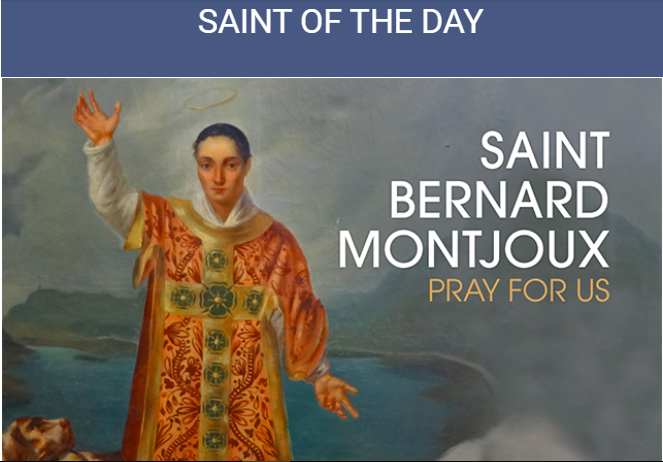
St. Bernard of Montjoux (c. 923–1008 A.D.), also known as St. Bernard of Menthon, was born to a wealthy and noble family in the Kingdom of Arles (present day France and Switzerland). As an adult he refused an honorable marriage and determined instead to give his life in service to the Church. He became a priest in northern Italy and spent more than four decades doing missionary work in the Alps. He built schools and churches, and is especially known for aiding travelers. The area where he ministered had an ancient, snowy, and dangerous pass winding through the mountains along which pilgrims traveled to and from Rome. To serve the pilgrims St. Bernard built a hospice at the highest point of the pass, 8,000 feet above sea level. Later he founded another hospice along another smaller pass.
St. Bernard obtained papal approval for communities of priests to serve in the hospices, which have generously aided travelers for more than a millennium. The priests and their well-trained dogs (the St. Bernard breed named for the saint) would seek and rescue lost pilgrims. St. Bernard was declared the patron saint of skiers and mountain climbers by Pope Pius XI in 1923. His feast day is celebrated on May 28th.
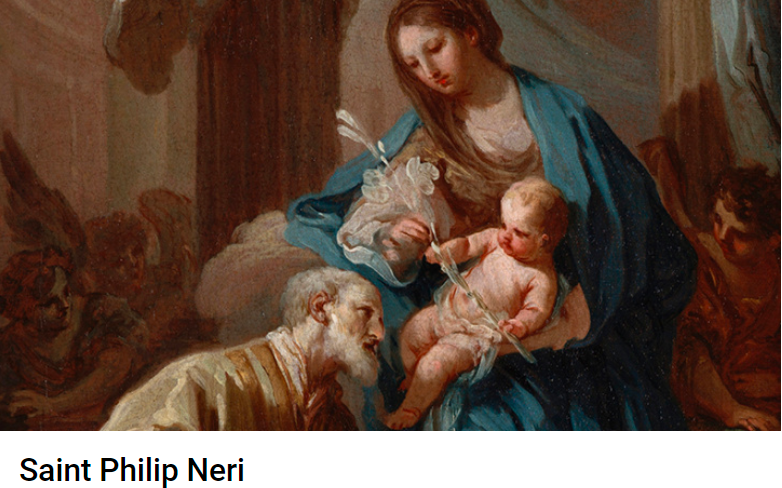
Philip Neri was a sign of contradiction, combining popularity with piety against the background of a corrupt Rome and a disinterested clergy: the whole post-Renaissance malaise.
At an early age, Philip abandoned the chance to become a businessman, moved to Rome from Florence, and devoted his life and individuality to God. After three years of philosophy and theology studies, he gave up any thought of ordination. The next 13 years were spent in a vocation unusual at the time—that of a layperson actively engaged in prayer and the apostolate.
As the Council of Trent (1545-63) was reforming the Church on a doctrinal level, Philip’s appealing personality was winning him friends from all levels of society, from beggars to cardinals. He rapidly gathered around himself a group of laypersons won over by his audacious spirituality. Initially, they met as an informal prayer and discussion group, and also served poor people in Rome.
At the urging of his confessor, Philip was ordained a priest and soon became an outstanding confessor himself, gifted with the knack of piercing the pretenses and illusions of others, though always in a charitable manner and often with a joke. He arranged talks, discussions, and prayers for his penitents in a room above the church. He sometimes led “excursions” to other churches, often with music and a picnic on the way.
Some of Philip’s followers became priests and lived together in community. This was the beginning of the Oratory, the religious institute he founded. A feature of their life was a daily afternoon service of four informal talks, with vernacular hymns and prayers. Giovanni Palestrina was one of Philip’s followers, and composed music for the services. The Oratory was finally approved after suffering through a period of accusations of being an assembly of heretics, where laypersons preached and sang vernacular hymns!
Philip’s advice was sought by many of the prominent figures of his day. He is one of the influential figures of the Counter-Reformation, mainly for converting to personal holiness many of the influential people within the Church itself. His characteristic virtues were humility and gaiety.
After spending a day hearing confessions and receiving visitors, Philip Neri suffered a hemorrhage and died on the feast of Corpus Christi in 1595. He was beatified in 1615 and canonized in 1622. Three centuries later, Cardinal John Henry Newman founded the first English-speaking house of the Oratory in London.
Reflection
Many people wrongly feel that such an attractive and jocular personality as Philip’s cannot be combined with an intense spirituality. Philip’s life melts our rigid, narrow views of piety. His approach to sanctity was truly catholic, all-embracing, and accompanied by a good laugh. Philip always wanted his followers to become not less but more human through their striving for holiness.
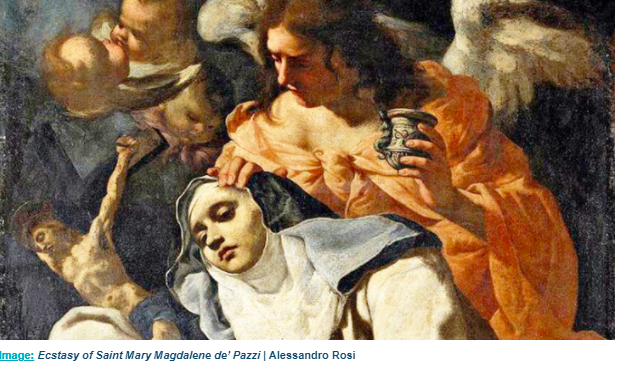
Mystical ecstasy is the elevation of the spirit to God in such a way that the person is aware of this union with God while both internal and external senses are detached from the sensible world. Mary Magdalene de’ Pazzi was so generously given this special gift of God that she is called the “ecstatic saint.”
Catherine de’ Pazzi was born into a noble family in Florence in 1566. The normal course would have been for her to have married into wealth and enjoyed comfort, but Catherine chose to follow her own path. At 9, she learned to meditate from the family confessor. She made her first Communion at the then-early age of 10, and made a vow of virginity one month later. At 16, Catherine entered the Carmelite convent in Florence because she could receive Communion daily there.
Catherine had taken the name Mary Magdalene and had been a novice for a year when she became critically ill. Death seemed near, so her superiors let her make her profession of vows in a private ceremony from a cot in the chapel. Immediately after, Mary Magdalene fell into an ecstasy that lasted about two hours. This was repeated after Communion on the following 40 mornings. These ecstasies were rich experiences of union with God and contained marvelous insights into divine truths.
As a safeguard against deception and to preserve the revelations, her confessor asked Mary Magdalene to dictate her experiences to sister secretaries. Over the next six years, five large volumes were filled. The first three books record ecstasies from May of 1584 through Pentecost week the following year. This week was a preparation for a severe five-year trial. The fourth book records that trial and the fifth is a collection of letters concerning reform and renewal. Another book, Admonitions, is a collection of her sayings arising from her experiences in the formation of women religious.
The extraordinary was ordinary for this saint. She read the thoughts of others and predicted future events. During her lifetime, Mary Magdalene appeared to several persons in distant places and cured a number of sick people.
It would be easy to dwell on the ecstasies and pretend that Mary Magdalene only had spiritual highs. This is far from true. It seems that God permitted her this special closeness to prepare her for the five years of desolation that followed when she experienced spiritual dryness. She was plunged into a state of darkness in which she saw nothing but what was horrible in herself and all around her. She had violent temptations and endured great physical suffering. Mary Magdalene de’ Pazzi died in 1607 at age 41, and was canonized in 1669. Her liturgical feast is celebrated on May 25.
Reflection
Intimate union, God’s gift to mystics, is a reminder to all of us of the eternal happiness of union he wishes to give us. The cause of mystical ecstasy in this life is the Holy Spirit, working through spiritual gifts. The ecstasy occurs because of the weakness of the body and its powers to withstand the divine illumination, but as the body is purified and strengthened, ecstasy no longer occurs. See Teresa of Avila’s Interior Castle, and John of the Cross’ Dark Night of the Soul, for more about various aspects of ecstasies.