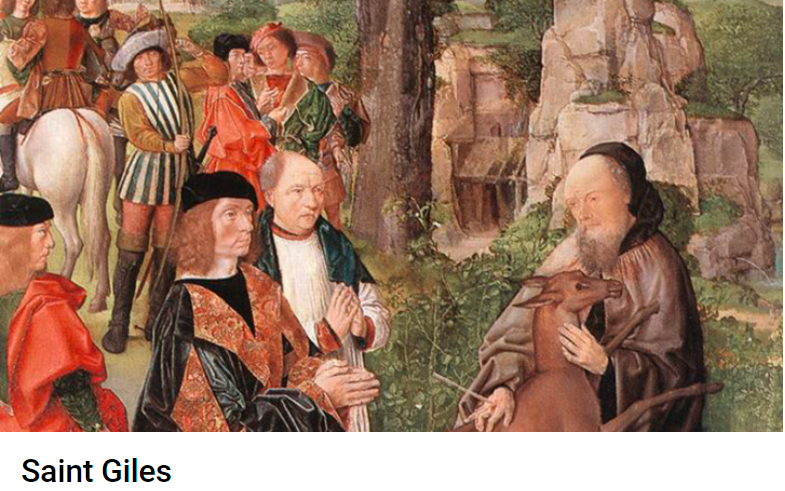
Despite the fact that much about Saint Giles is shrouded in mystery, we can say that he was one of the most popular saints in the Middle Ages. Likely, he was born in the first half of the seventh century in southeastern France. That is where he built a monastery that became a popular stopping-off point for pilgrims making their way to Compostela in Spain, and the Holy Land.
In England, many ancient churches and hospitals were dedicated to Giles. One of the sections of the city of Brussels is named after him. In Germany, Giles was included among the so-called 14 Holy Helpers, a popular group of saints to whom people prayed, especially for recovery from disease, and for strength at the hour of death. Also among the 14 were Saints Christopher, Barbara, and Blaise. Interestingly, Giles was the only non-martyr among them. Devotion to the “Holy Helpers” was especially strong in parts of Germany and in Hungary and Sweden. Such devotion made his popularity spread. Giles was soon invoked as the patron of the poor and the disabled.
The pilgrimage center that once drew so many fell into disrepair some centuries after Giles’ death.
Reflection
Saint Giles may not have been a martyr but, as the word martyr means, he was a true witness to the faith. This is attested to by the faith of the People of God in the Middle Ages. He became one of the “holy helpers” and can still function in that role for us today.
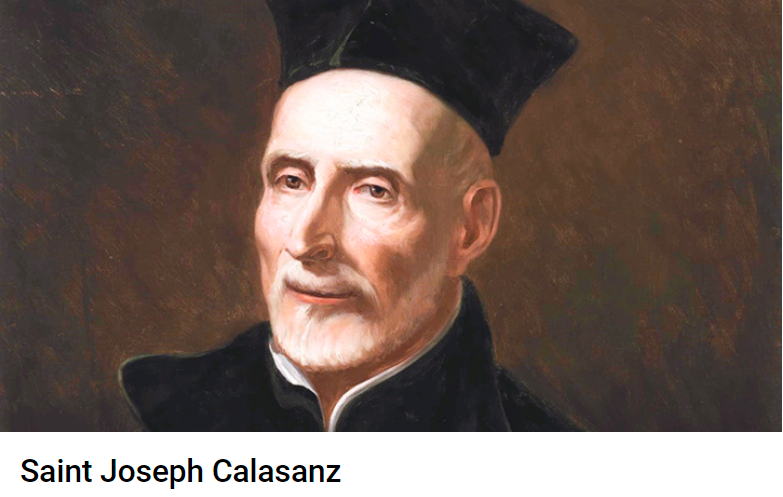
From Aragon where he was born in 1556, to Rome where he died 92 years later, fortune alternately smiled and frowned on the work of Joseph Calasanz. A priest with university training in canon law and theology, respected for his wisdom and administrative expertise, he put aside his career because he was deeply concerned with the need for education of poor children.
When he was unable to get other institutes to undertake this apostolate at Rome, Joseph and several companions personally provided a free school for deprived children. So overwhelming was the response that there was a constant need for larger facilities to house their effort. Soon, Pope Clement VIII gave support to the school, and this aid continued under Pope Paul V. Other schools were opened; other men were attracted to the work, and in 1621 the community—for so the teachers lived—was recognized as a religious community, the Clerks Regular of Religious Schools—Piarists or Scolopi. Not long after, Joseph was appointed superior for life.
A combination of various prejudices and political ambition and maneuvering caused the institute much turmoil. Some did not favor educating the poor, for education would leave the poor dissatisfied with their lowly tasks for society! Others were shocked that some of the Piarists were sent for instruction to Galileo—a friend of Joseph—as superior, thus dividing the members into opposite camps. Repeatedly investigated by papal commissions, Joseph was demoted; when the struggle within the institute persisted, the Piarists were suppressed. Only after Joseph’s death were they formally recognized as a religious community. His liturgical feast is celebrated on August 25.
Reflection
No one knew better than Joseph the need for the work he was doing; no one knew better than he how baseless were the charges brought against him. Yet if he were to work within the Church, he realized that he must submit to its authority, that he must accept a setback if he was unable to convince authorized investigators. While the prejudice, the scheming and the ignorance of men often keep the truth from emerging for a long period of time, Joseph was convinced, even under suppression, that his institute would again be recognized and authorized. With this trust he joined exceptional patience and a genuine spirit of forgiveness.
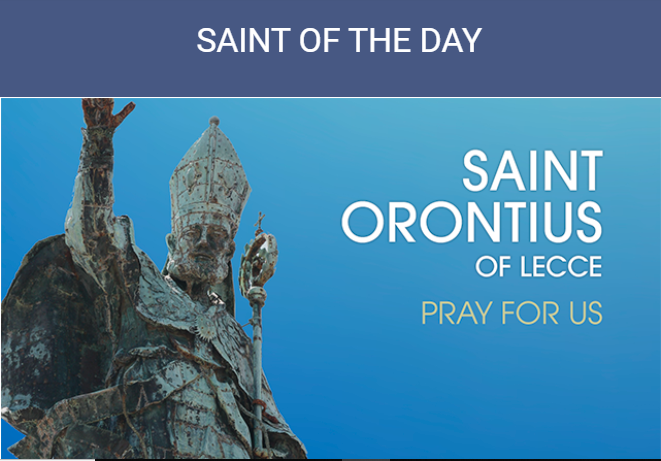
St. Orontius of Lecce (1st c.) was the son of the Roman imperial treasurer in Lecce, Italy. Upon his father’s death he inherited the position. Orontius was converted to the Christian faith along with his nephew, Fortunatus, by Justus, a disciple of St. Paul the Apostle. Orontius was later denounced to the authorities as a Christian and was ordered to sacrifice to the pagan gods. He refused and was arrested, removed from his office, tortured, and exiled to Corinth together with Fortunatus. In Corinth the pair met St. Paul the Apostle, who consecrated Orontius as the first bishop of Lecce. When Orontius and Fortunatus returned to Lecce they were persecuted and imprisoned again, but were released and ordered to stop preaching. They continued to preach in the surrounding cities, and were arrested a third time and executed. St. Orontius’ feast day is August 26th.
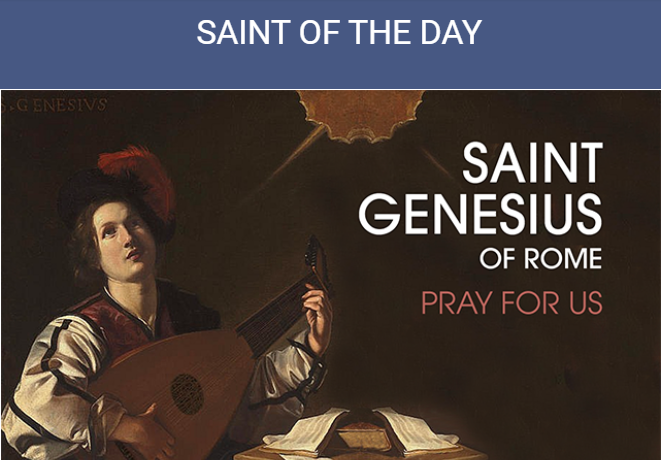
St. Genesius of Rome (d. 303 AD) was a renowned actor and playwright, the leader of a popular acting troupe during the reign of Emperor Diocletian. When the Emperor was killing Christians, Genesius wrote plays to mock them and expose their secret rites to ridicule. To research for a play mocking baptism, he went to a priest pretending to desire the sacraments and was fully instructed as a catechumen. Genesius prepared his play and instructed the other actors in their parts. On performance day the Emperor was present. Genesius played the lead character seeking baptism, and the rite was performed in such a ludicrous manner that all present laughed. As the water was poured over Genesius’ head by an actor playing the priest’s part, Genesius saw a vision of the heavens opened and the hand of God touching him. He also saw an angel who showed him that his many sins had been washed away through the valid baptism he had just received. At that moment Genesius’ heart was changed by the Holy Spirit and he believed in the truth of Christianity. At the conclusion of the play Genesius boldly declared his new faith, recounting how he had been a scoffer until that moment. He implored the audience, including the Emperor, to follow Christ. The crowd thought this was part of the performance, but once they understood it was real, Genesius was seized. The Emperor, furious, subjected him to cruel tortures daily to make him renounce his faith in Christ. Genesius staunchly refused and was beheaded. The Christians collected his body and buried him with the other martyrs. St. Genesius is the patron saint of comedians, dancers, actors, musicians, printers, and torture victims. His feast day is August 25th.
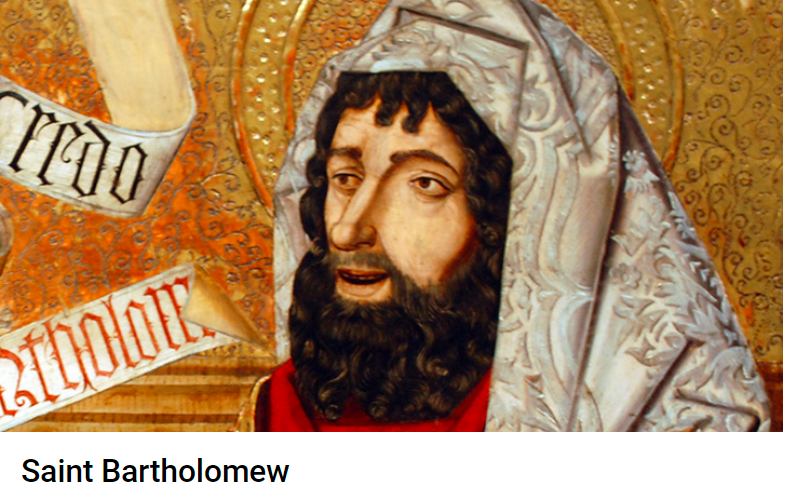
In the New Testament, Bartholomew is mentioned only in the lists of the apostles. Some scholars identify him with Nathanael, a man of Cana in Galilee who was summoned to Jesus by Philip. Jesus paid him a great compliment: “Here is a true Israelite. There is no duplicity in him” (John 1:47b). When Nathanael asked how Jesus knew him, Jesus said, “I saw you under the fig tree” (John 1:48b). Whatever amazing revelation this involved, it brought Nathanael to exclaim, “Rabbi, you are the Son of God; you are the King of Israel” (John 1:49b). But Jesus countered with, “Do you believe because I told you that I saw you under the fig tree? You will see greater things than this” (John 1:50b).
Nathanael did see greater things. He was one of those to whom Jesus appeared on the shore of the Sea of Tiberias after his resurrection (see John 21:1-14). They had been fishing all night without success. In the morning, they saw someone standing on the shore though no one knew it was Jesus. He told them to cast their net again, and they made so great a catch that they could not haul the net in. Then John cried out to Peter, “It is the Lord.”
When they brought the boat to shore, they found a fire burning, with some fish laid on it and some bread. Jesus asked them to bring some of the fish they had caught, and invited them to come and eat their meal. John relates that although they knew it was Jesus, none of the apostles presumed to inquire who he was. This, John notes, was the third time Jesus appeared to the apostles.
Reflection
Bartholomew or Nathanael? We are confronted again with the fact that we know almost nothing about most of the apostles. Yet the unknown ones were also foundation stones, the 12 pillars of the new Israel whose 12 tribes now encompass the whole earth. Their personalities were secondary—without thereby being demeaned—to their great office of bearing tradition from their firsthand experience, speaking in the name of Jesus, putting the Word Made Flesh into human words for the enlightenment of the world. Their holiness was not an introverted contemplation of their status before God. It was a gift that they had to share with others. The Good News was that all are called to the holiness of being Christ’s members, by the gracious gift of God.
The simple fact is that humanity is totally meaningless unless God is its total concern. Then humanity, made holy with God’s own holiness, becomes the most precious creation of God.
The first canonized saint of the New World has one characteristic of all saints—the suffering of opposition—and another characteristic which is more for admiration than for imitation—excessive practice of mortification.
She was born to parents of Spanish descent in Lima, Peru, at a time when South America was in its first century of evangelization. She seems to have taken Catherine of Siena as a model, in spite of the objections and ridicule of parents and friends.
The saints have so great a love of God that what seems bizarre to us, and is indeed sometimes imprudent, is simply a logical carrying out of a conviction that anything that might endanger a loving relationship with God must be rooted out. So, because her beauty was so often admired, Rose used to rub her face with pepper to produce disfiguring blotches. Later, she wore a thick circlet of silver on her head, studded on the inside, like a crown of thorns.
When her parents fell into financial trouble, she worked in the garden all day and sewed at night. Ten years of struggle against her parents began when they tried to make Rose marry. They refused to let her enter a convent, and out of obedience she continued her life of penance and solitude at home as a member of the Third Order of Saint Dominic. So deep was her desire to live the life of Christ that she spent most of her time at home in solitude.
During the last few years of her life, Rose set up a room in the house where she cared for homeless children, the elderly, and the sick. This was a beginning of social services in Peru. Though secluded in life and activity, she was brought to the attention of Inquisition interrogators, who could only say that she was influenced by grace.
What might have been a merely eccentric life was transfigured from the inside. If we remember some unusual penances, we should also remember the greatest thing about Rose: a love of God so ardent that it withstood ridicule from without, violent temptation, and lengthy periods of sickness. When she died at 31, the city turned out for her funeral. Prominent men took turns carrying her coffin.
Reflection
It is easy to dismiss excessive penances of the saints as the expression of a certain culture or temperament. But a woman wearing a crown of thorns may at least prod our consciences. We enjoy the most comfort-oriented life in human history. We eat too much, drink too much, use a million gadgets, fill our eyes and ears with everything imaginable. Commerce thrives on creating useless needs on which to spend our money. It seems that when we have become most like slaves, there is the greatest talk of “freedom.” Are we willing to discipline ourselves in such an atmosphere?
Saint Rose of Lima is the Patron Saint of:
Americas Florists Latin America Peru Philippines South America
Where I’m from up north, I lived in a diverse community with very strong ethnic ties and associations. There was this gentleman who approached a priest and said, “Hey Father, you visit my mother – I remember your name.” Okay…I’d love to. What son, as hated as this gentleman allegedly was, doesn’t want to honor his mother. There’s no shame in honoring one’s mother. That’s true for us even with all our sins. What about our good Lord? He was the only child in history who actually created His mother. Throughout the centuries, for thousands of years, the Church has always called for devotion to the Blessed Mother – not for worship or adoration – that belongs only to God Himself – but for devotion. It’s not just a pious tradition for old women sitting in their living-rooms knitting, it’s for the whole Church. Over the past 50 years or so, Devotion to the Blessed Mother has really fallen to the wayside which is sad, because people really don’t know their faith or scripture. Non-Catholics say, “I study scripture and I pray scripturally.” Well, if you studied scripture and prayed scripturally, you would be Catholic. When you honor the Blessed Mother, you are praying scripturally.
You’ve heard the proclamation of the Holy Gospel of Saint Luke. Where did Luke get his gospel? He wasn’t one of the apostles. At the Annunciation, Mary was alone when the angel came to her. Luke wasn’t there. He wasn’t at Elizabeth’s house when Mary visited her. So, where did he get all of this information? Did Luke channel his inner Miss Cleo the psychic? The first part of the Gospel of Luke is known as the Gospel of Mary, because she told him everything that’s in it. So, Mary’s words are scriptural. All of those people who have gotten biblical, theological, or philosophy degrees and who are not Catholic, should sue their professors for theological and intellectual malpractice. You wasted your money. Because if you made it this far in the scriptures, then you must be Catholic, and you must honor the Blessed Mother.
What did Mary say further into the Magnificat? “All generations will call me blessed.” So, it’s a scriptural command to honor the mother of Jesus. It has been 70 years since the so-called Second Vatican Council and some decided that devotion to the Blessed Mother was not scriptural. Really? Devotion is decreasing and along with it purity and belief in the Real Presence. In order to understand Jesus, you have to understand Mary. In theological studies, Mariology (the study of Mary) is a subset of Christology (the study of Christ). It was from the Blessed Mother that He took His human nature. If you look throughout scripture, I’m not going to give you a whole class on Mariology today – it’s a semester-long study – but just look at the highlights. Protestants say they don’t have to rely on the saints. Really? Where is that in scripture? Who interceded for us before the first miracle recorded in scripture? The Blessed Mother at the wedding in Cana. During the Passion, our Lord looked at His mother and said, “Woman, behold your son.” He then looked at John and said, “Behold your mother.” Protestants also say, “In order to be saved, you must be washed in the blood.” Who was standing beneath the cross getting spattered with His blood? The Blessed Mother. The blood did not stop. . .the Romans were very good at what they did. When they took her Son down from the cross, He was placed in her lap. She was covered in His blood. Was she not bathed in the blood? Walk in the blood? After the Resurrection, Mary was in the Upper Room with the apostles when the Holy Spirit came. This was the second time that the Holy Spirit came to her. Remember the Annunciation? The angel said, “Hail full of grace.” Nobody else in scripture has been called that. The power of the Holy Spirit came and overshadowed her. “Oh, you have to be born again in the Holy Spirit.” Well, Mary did it twice.
This is why we have devotion to the Blessed Mother. Just like our own mothers who have died, and hopefully in Heaven, intercede for us to the Holy Father. How much more so can the mother of Christ intercede for us. The original woman, the old Eve, took us all out of paradise to the new Eve who leads us to paradise. Our Blessed Mother is the new Eve.
Not too long ago, I received a call to go visit woman who was in her last days. So, I went into the house and gave her the Last Rites. She said, “Father, I have a Rosary.” Oh, that’s great! It was beautiful set of beads. I said to her, “Hold them in your hands, and as often as you can say the Rosary so that when the time comes when you are to leave this world, our Blessed Mother will come take you by the hand and lead you to her Son.”
How will you apply this message to your life? Remain devoted to the Blessed Mother and ask for her intercession with her Son.
You can read all of Father Fitzgibbons’ sermons by going to https://annunciationcatholicalbemarle.com/ and clicking on “Blog” then “Categories” and then “Sermon Notes.” From a cell phone, click on “Blog” then “Menu” and then “Categories” (located at the end of page). There is also a search box if you are looking for a specific topic.
On Friday, the Church celebrated the Feast of the Transfiguration. Ten days before His Passion, our good Lord took three of the twelve apostles – Peter, James, and John – up to the mountain to give them the final revelation of who He was …the final miracle before His Passion. He did this to strengthen them for the trial that was to come. On the mountain, Jesus lowered the veil of His humanity to show them His divinity. Remember, Jesus was one Who and two What’s . . . one person and two natures. The human nature that He took from the Blessed Mother was assumed into His divine nature. On the altar, when I put one drop of water into the chalice with the wine, it symbolizes two natures in one person. The wine is consecrated and turned into the Most Precious Blood on the altar. We have a foretaste of what Heaven will be like.
Now, the apostles saw Moses and Elijah, but how did they know it was them? There were no pictures. There were no selfies back in the days of the Old Testament. There were no statues. So, how did they know? Their minds were enlightened in the presence of God. Moses and Elijah talked to our Lord like one man to another just as we will when we are in Heaven. They talked about what would happen in future events. How? Because Heaven is the eternal now. God said, “I who I am.” He is the eternal now . . . no past and no future . . . the eternal present. It’s a foretaste of His gift. Our Lord gave the apostles this great gift to strengthen them for the terrible scandal of the cross. And, what happened? Even though they had seen three years of miracles and the revelation of who Jesus was, they all took off. They had not comprehended the lessons. Afterward, they realized that this is what He is. They had a spiritual V-8 moment.
Our good Lord, as He did for the apostles, He does for us. Before our great trials, we have a sense of God’s presence when He manifests Himself to us. He also does that every now and then to remind us of His love. Oftentimes, like the apostles, we miss it. We are too busy, too wound up, and too distracted, so we miss it. I read a book about 40 years ago by Father Adrian Van Kaam. In the book, he said, “God speaks to us with ordinary signs like the wind and the stars, and we often miss it. We are looking for something else.” With these terribly ordinary signs that we miss, God is telling us that He loves us and is with us.
During this big crisis we have right now, it may be comforting to think that in ages past it was much better. Ahh…No. You know why we think the past was better? Because we didn’t live in it. That’s why we think it was much better back then. But it wasn’t You weren’t there. Name for me any time period since the beginning of the world that was much better. You can’t, because there isn’t one. Everybody has their crosses in this world. We are much better off today except for our being so self-absorbed especially during this time. Now that the Corona virus has mutated into the Delta variant and the Lambda variant, people are panicking. “Oh my God! We are all going to die!” Well, I hate to bust your spiritual bubble, but we are all going to die. “Oh! This is terrible!” The Corona virus has a 99% survival rate. Okay? It’s much better than anything else we could possibly get. When I work in the hospital, doctors often tell patients, “We can’t fix you.” And, they panic. You know, when you panic, you make wrong decisions. Fear paralyzes you. “But, the virus is out there!” So, what are you going to do about it? You will take the ordinary precautions and move on with life. Do not be trapped by fear. That’s a tool of the devil. When you listen to his suggestions, it causes you to make bad judgements. God is always present and giving you signs of His love. That’s why I never stop the Mass when something happens. . .they are signs that God is with us. Would I like to be sick? No, I’d rather not. I’m not a very good sick person. I’m not a very good person, in general, but I’m really not a very good sick person. Besides my personality disorder of being a pain, you know why? Because I’m a soldier. I can soldier my way out of this. Ask Stump or Doc or anyone else who has served in the military. When I had to undergo anesthesia for a couple of procedures, I thought, “I’m good. I can drive.” I couldn’t walk, but I thought I could drive. I’ll be fine! Like a soldier, I do my job…a sign that God is with me.
If you stare at something with intent, you will miss the obvious, because you are looking at something else. Keep in mind that every now and then, you will see something extraordinary. Remember that our Lord is constantly with us. He is always present and desperately trying to get our attention. Whether it’s through a sign by our Guardian Angel or the Blessed Mother, our Lord shows us that He is present and never far away and may even be right next to you. God talks to us through people, places, and things. I’m great at loving myself. Sometimes, I wonder if God loves me as much as I love me. I’m pretty sure He loves me more. My vocation tells me that He does. We can show human kindness to others through Corporal Works of Mercy. We can act as Christ would have us act. Perhaps, we can be nice while driving and let someone in. Maybe, we can let someone go ahead of us in the checkout line at Wally-World or Harris Teeter . . . just ordinary, everyday things. Showing extra courtesy is so extraordinary these days.. We can show courtesy not by just doing things, but by not doing things. If someone cuts you off in traffic or is going ten miles below the speed limit or doing what I call “the slinky” . . . their speed goes from 40 to 58 to 25 to 52. Yo, dude, you’ve got cruise control on that car. Use it! If it’s an older driver, you don’t know what’s going on with them. They may be crackers, so you need to practice patience. Say the Rosary. Also, if they are really old people – if you can’t see them over the back seat – they are probably on their way to Florida. They are like a Q-Tip driving a car. All you can see is this puff of white hair over the seat. But they may have just buried their husband. They may have just buried their wife. Wouldn’t we love for someone to show us extra courtesy? We have our troubles too. So, if we are willing, God can use our human nature, like He used the one He took from Mary, to show His love to the world and make it visible.
How will you apply this message to your life? Will you show human kindness to others through the Corporal Works of Mercy?
You can read all of Father Fitzgibbons’ sermons by going to https://annunciationcatholicalbemarle.com/ and clicking on “Blog” then “Categories” and then “Sermon Notes.” From a cell phone, click on “Blog” then “Menu” and then “Categories” (located at the end of page). There is also a search box if you are looking for a specific topic.
St. John Kemble (1599-1679) was born in England to a prominent Catholic family when Catholicism was outlawed in the country. He was ordained a priest in 1625 and ministered in England as an itinerant priest for fifty-three years. Although persecution of Catholics was rampant, in his particular region Catholics were generally not harassed. In the infamous “Popish Plot” of 1678, Protestant politicians began a violent crackdown on Catholics, particularly on priests. Although 80 years old at the time, Father John Kemble was arrested. He was warned in advance but declined to leave his flock, saying, “According to the course of nature, I have but a few years to live. It will be an advantage to suffer for my religion and, therefore, I will not abscond.” Although he was found innocent of any involvement in the “Popish Plot,” he was condemned for being a Catholic priest and sentenced to death by being hanged, drawn, and quartered on August 22, 1679. His last words, addressed to the crowd were: “The failure of the authorities in London to connect me to the plot makes it evident that I die only for profession of the Catholic religion, which was the religion that first made this Kingdom Christian.” He was canonized by Pope Paul VI in 1970. St. John Kemble is one of the Forty Martyrs of England and Wales. His feast day is August 22.
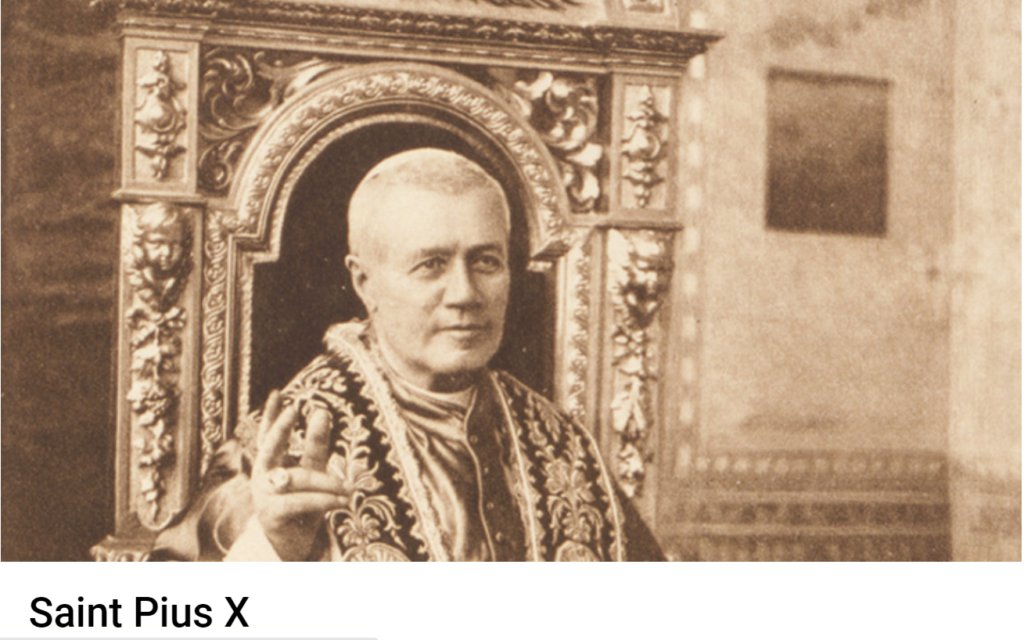
Pope Pius X is perhaps best remembered for his encouragement of the frequent reception of Holy Communion, especially by children.
The second of 10 children in a poor Italian family, Joseph Sarto became Pius X at age 68. He was one of the 20th century’s greatest popes.
Ever mindful of his humble origin, Pope Pius stated, “I was born poor, I lived poor, I will die poor.” He was embarrassed by some of the pomp of the papal court. “Look how they have dressed me up,” he said in tears to an old friend. To another, “It is a penance to be forced to accept all these practices. They lead me around surrounded by soldiers like Jesus when he was seized in Gethsemani.”
Interested in politics, Pope Pius encouraged Italian Catholics to become more politically involved. One of his first papal acts was to end the supposed right of governments to interfere by veto in papal elections—a practice that reduced the freedom of the 1903 conclave which had elected him.
In 1905, when France renounced its agreement with the Holy See and threatened confiscation of Church property if governmental control of Church affairs were not granted, Pius X courageously rejected the demand.
While he did not author a famous social encyclical as his predecessor had done, he denounced the ill treatment of indigenous peoples on the plantations of Peru, sent a relief commission to Messina after an earthquake, and sheltered refugees at his own expense.
On the 11th anniversary of his election as pope, Europe was plunged into World War I. Pius had foreseen it, but it killed him. “This is the last affliction the Lord will visit on me. I would gladly give my life to save my poor children from this ghastly scourge.” He died a few weeks after the war began, and was canonized in 1954.
Reflection
His humble background was no obstacle in relating to a personal God and to people whom he loved genuinely. Pius X gained his strength, his gentleness and warmth for people from the source of all gifts, the Spirit of Jesus. In contrast, we often feel embarrassed by our backgrounds. Shame makes us prefer to remain aloof from people whom we perceive as superior. If we are in a superior position, on the other hand, we often ignore simpler people. Yet we, too, have to help “restore all things in Christ,” especially the wounded people of God.