Sermon Notes – Leprechauns Are Not Real

“Leprechauns Are Not Real“

Father Peter Fitzgibbons

April 3 – 4, 2021

Gospel:  John 20: 1-9

How do you know someone is alive if you don’t see them?  I’ve taken a clue from the sheriff detective…there is fresh evidence.  For instance, you may not see a family member for a day, but you know they are alive, right?  You see dirty plates right where they left them. You see your husband’s dirty socks right where he left them.  I guess he figured the Molly Maid Service would come by and pick them up. You may not see the person, but you see fresh evidence that they’ve been there and that they are alive.  They may have left a note for you.  They may have cooked dinner for you.  You know they are alive even though you may not have touched them or laid eyes on them.  Likewise, we have not touched the resurrected Christ, but we know that He is alive.  We see the evidence. 

From the very beginning, the Chief Priests bribed Roman soldiers to lie and say that disciples stole the body of Christ.  That must have been one big bribe.  The Romans knew quite well what betrayal meant.  It meant instant death. The Romans did not refer anyone to defense counsel.  If you failed in doing your duty, you were duly executed in a very brutal way.  The Roman army did not play. No bail. No defense attorney.  You were executed.  So, it had to be a pretty big bribe.  Even back then, there was fake news.  “Christ wasn’t resurrected.”  “His body was stolen.”   You don’t steal a body after a couple days in Palestine.  Trust me on this one.  Ask any police officer or nurse.  Nobody steals a body after that length of time.  That’s fake news.  Sound familiar?  As scripture says, there’s nothing new under the sun.  All through the centuries, people have claimed that Christ is dead or He was just a nice guy or He was the same as Muhammad and Buddha.  None of them claimed that He was God.  They try to relegate religion to just old wives tales.  But, as much as they tried, the Chief Priests couldn’t keep a lid on the news of Christ’s resurrection even with the use of armies and the threat of persecution.  That’s because it’s true.  If it wasn’t, why would they spend all the time, money, and energy to say it’s not?

Why do people complain about the Catholic Church and its teachings?  It’s the message of Christ.  If it’s not true, why do they bother?  If it’s not true, why do they care?  They can go live their lives and do other stuff.  They complain, because they know it is true.  Our Lord proved Himself to all those detractors.  They are gone, but we are still here.  We have evidence through the centuries that Christ is still alive.  Look at what our Catholic Church has done.  We have built universities and hospitals.  These are the things we do best.  What was the cause of all those centuries of good works?  It was the love of Christ in us.  The living love of Christ is still evident today.  You know it’s true, because you are here today.  You have faith in the resurrection, and you have faith in Jesus Christ. You are here to be touched by the love of God and to draw closer to Him.  Is there some fear in all of us?  Of course there is, just as there was for the women at the tomb.  But, you overcome your fear through your faith.  That’s why you are here today.  By your presence, you proclaim the resurrection of Christ, and that He is not dead.  He’s not a footnote in history.  He wasn’t just some really nice guy.  By your faithful attendance at Mass and participation in the Sacraments, you are making your profession and belief in the resurrection and that Christ lives.  One day you will share His life.  Most of us won’t be around for the end of the world; as far as I know.. I haven’t gotten any phone calls.  On that day, we too will go to the tomb just like Mary Magdalene and the women did on Good Friday morning.

As you look through the history of the Church, God has never been unfaithful to His followers.  Never…not once. In seminary I learned a lot of stuff, well they think I did, but I was supposed to learn a lot of stuff.  We studied Thomas Aquinas and the five proofs of God.   I will prove to you that God exists and also how faithful He is.  I guarantee that if you pray for this it will happen on your way home.  Guaranteed.  Pray for patience. “Lord, I want to grow in patience, I want to be meek, humble, and understanding,”  Pray that prayer, and I guarantee that you will find five nitwits who will irritate the living heck out of you and try your patience on the way home.  Patience is an acquired virtue that you get by practice.  Ask for patience, and our good Lord will say, “Great!  You got it.”  He will send all those nitwits to help you grow in that virtue.  That’s the quickest way to prove that God exists.  The quickest proof that God listens to your prayers and answers them.  God is alive and active. We have 2,000 years of proof.  We see His results.  Do we see them as often as we’d like?  No.  He hides in our human nature. 

We believe in the resurrection of Christ.  If it wasn’t true, why have so many people for over 2,000 years kept saying it’s not true?  You can see that God is alive.  We do not see Him directly, but He is alive.  He is working in us. He is working through you.  He took the humanity that He received from the Blessed Mother to His sacred Passion and resurrection and then to Heaven.  He uses His humanity to make His love present and known to the world.  He does that for us.  Each of us, in our own vocation, are to prove to the world that God’s love is alive.  The grave could not hold Him.  God promised that we will imitate His resurrection. So, for those who follow Him, the grave will not hold us.  We will be like Him. We will suffer probably, in one way or another, and we will rest in our graves until the day of our own resurrection.  That is not defeat…that is victory.

How will you apply this message to your life?  Will you help prove to the world that God’s love is alive?

Father’s Afterthoughts…

Now part of my Irish cultural heritage is the belief that leprechauns are real.  I think it’s because we drank a wee bit too much ale.  You never hear anyone complain about leprechauns.  But, they don’t exist.  If you see any, I can get you some help.  I know people.  You will feel much better.

You can read all of Father Fitzgibbons’ sermons by going to https://annunciationcatholicalbemarle.com/ and clicking on “Blog” then “Categories” and then “Sermon Notes.  From a cell phone, click on “Blog” then “Menu” and then “Categories” (located at the end of page).  There is also a search box if looking for a specific topic.


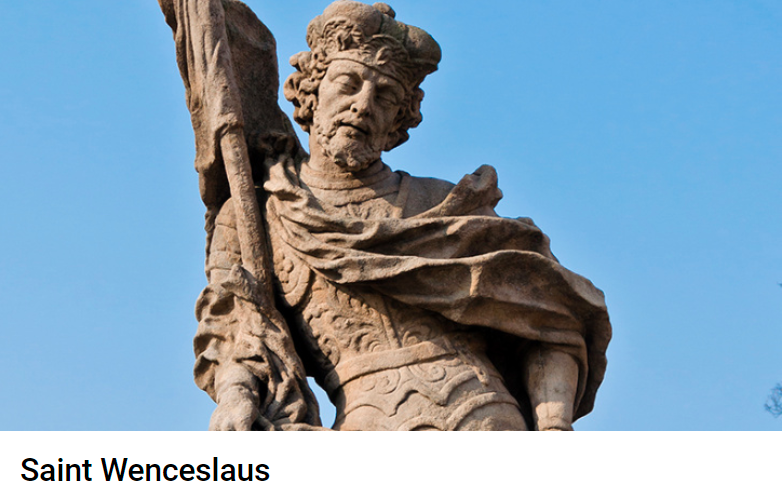
Saint of the Day – September 28 – Saint Wenceslaus

(C. 907 – 929)
Saint Wenceslaus’ Story

If saints have been falsely characterized as “other worldly,” the life of Wenceslaus stands as an example to the contrary: He stood for Christian values in the midst of the political intrigues which characterized 10th-century Bohemia.

Wenceslaus was born in 907 near Prague, son of the Duke of Bohemia. His saintly grandmother, Ludmilla, raised him and sought to promote him as ruler of Bohemia in place of his mother, who favored the anti-Christian factions. Ludmilla was eventually murdered, but rival Christian forces enabled Wenceslaus to assume leadership of the government.

His rule was marked by efforts toward unification within Bohemia, support of the Church, and peace-making negotiations with Germany, a policy which caused him trouble with the anti-Christian opposition. His brother Boleslav joined in the plotting, and in September of 929 invited Wenceslaus to Alt Bunglou for the celebration of the feast of Saints Cosmas and Damian. On the way to Mass, Boleslav attacked his brother, and in the struggle, Wenceslaus was killed by supporters of Boleslav.

Although his death resulted primarily from political upheaval, Wenceslaus was hailed as a martyr for the faith, and his tomb became a pilgrimage shrine. He is hailed as the patron of the Bohemian people and of the former Czechoslovakia.

Reflection

“Good King Wenceslaus” was able to incarnate his Christianity in a world filled with political unrest. While we are often victims of violence of a different sort, we can easily identify with his struggle to bring harmony to society. The call to become involved in social change and in political activity is addressed to Christians; the values of the gospel are sorely needed today.

Saint Wenceslaus is the Patron Saint of:

Bohemia

//Franciscan Media//


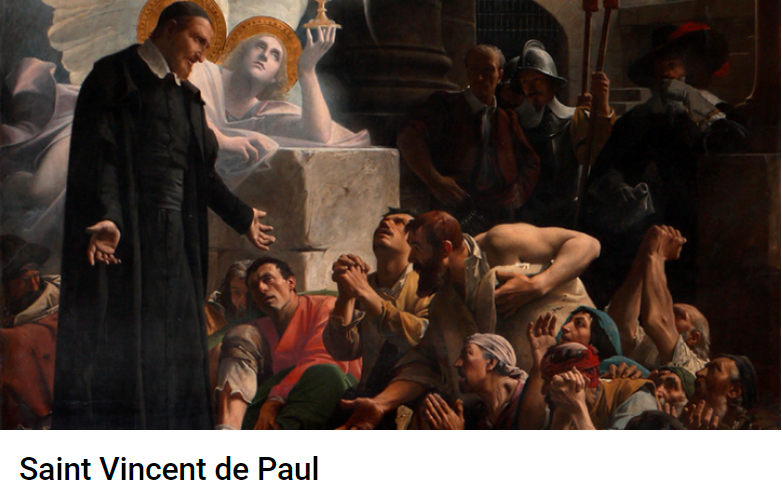
Saint of the Day – September 27 – Saint Vincent de Paul

(1580 – SEPTEMBER 27, 1660)
Saint Vincent de Paul’s Story

The deathbed confession of a dying servant opened Vincent de Paul’s eyes to the crying spiritual needs of the peasantry of France. This seems to have been a crucial moment in the life of the man from a small farm in Gascony, France, who had become a priest with little more ambition than to have a comfortable life.

The Countess de Gondi—whose servant he had helped—persuaded her husband to endow and support a group of able and zealous missionaries who would work among poor tenant farmers and country people in general. Vincent was too humble to accept leadership at first, but after working for some time in Paris among imprisoned galley slaves, he returned to be the leader of what is now known as the Congregation of the Mission, or the Vincentians. These priests, with vows of poverty, chastity, obedience, and stability, were to devote themselves entirely to the people in smaller towns and villages.

Later, Vincent established confraternities of charity for the spiritual and physical relief of the poor and sick of each parish. From these, with the help of Saint Louise de Marillac, came the Daughters of Charity, “whose convent is the sickroom, whose chapel is the parish church, whose cloister is the streets of the city.” He organized the rich women of Paris to collect funds for his missionary projects, founded several hospitals, collected relief funds for the victims of war, and ransomed over 1,200 galley slaves from North Africa. He was zealous in conducting retreats for clergy at a time when there was great laxity, abuse, and ignorance among them. He was a pioneer in clerical training and was instrumental in establishing seminaries.

Most remarkably, Vincent was by temperament a very irascible person—even his friends admitted it. He said that except for the grace of God he would have been “hard and repulsive, rough and cross.” But he became a tender and affectionate man, very sensitive to the needs of others.

Pope Leo XIII made him the patron of all charitable societies. Outstanding among these, of course, is the Society of St. Vincent de Paul, founded in 1833 by his admirer Blessed Frédéric Ozanam.

Reflection

The Church is for all God’s children, rich and poor, peasants and scholars, the sophisticated and the simple. But obviously the greatest concern of the Church must be for those who need the most help—those made helpless by sickness, poverty, ignorance, or cruelty. Vincent de Paul is a particularly appropriate patron for all Christians today, when hunger has become starvation, and the high living of the rich stands in more and more glaring contrast to the physical and moral degradation in which many of God’s children are forced to live.

Saint Vincent de Paul is the Patron Saint of:

Charitable Societies


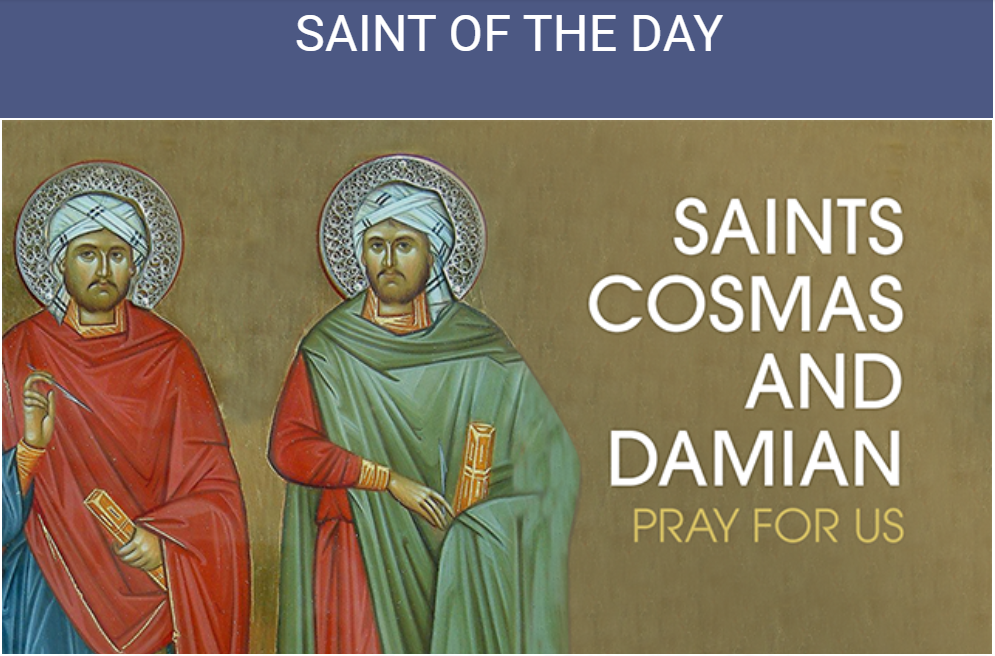
Saint of the Day – September 26 – Saints Cosmas and Damian

Sts. Cosmas and Damian (d. 287 A.D.) were twin brothers born in Arabia. They both became skilled physicians who practiced in Asia Minor. They took no money for their medical services, for which they were well-respected. Because of their charity they drew many to the Catholic faith. During the Christian persecution under the Roman Emperor Diocletian, Cosmas and Damian were targeted, arrested, and tortured. After being miraculously preserved from injury throughout their cruel tortures, holding firm in their faith to the end, they were finally killed by beheading. They were martyred together with their three brothers. Their remains were buried in Syria and many miracles were attributed to them. In gratitude for the healing he received through the intercession of Sts. Cosmas and Damian, Roman Emperor Justinian I (6th c.) restored a church dedicated to their honor in Constantinople, which became a place of pilgrimage. Sts. Cosmas and Damian are regarded as the patron saints of physicians, surgeons, and pharmacists. They are mentioned by name in the Roman Canon of the Mass, and share a feast day on September 26th.

//Catholic Company//


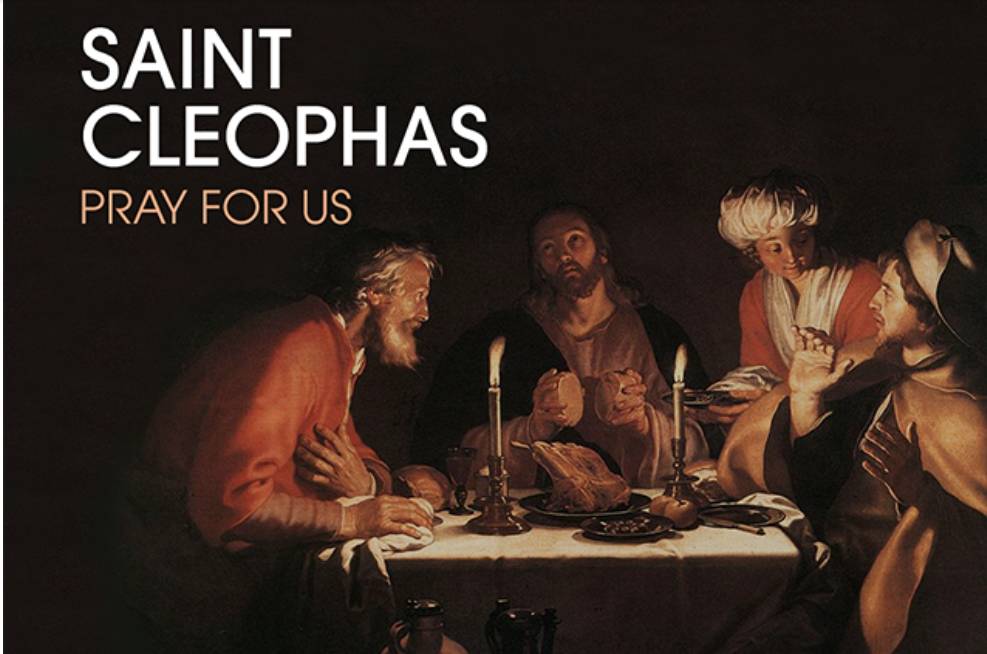
Saint of the Day – September 25 – Saint Cleophas

St. Cleophas (1st c.) was one of Jesus’ seventy disciples, and one of the two disciples who were traveling along the road to Emmaus after the crucifixion and resurrection of Jesus in Jerusalem, as recounted in Luke’s Gospel. The resurrected Jesus appeared and walked along the road with St. Cleophas and his companion, explaining the events of his Passion and how they fulfilled the Holy Scriptures. According to one tradition, Cleophas (also known as Alphaeus), was a relative of Jesus; he was the brother of St. Joseph, and therefore was Jesus’ uncle. Cleophas was the husband of St. Mary of Cleophas, and they had three sons we know by name: St. Simon, St. James the Less, and St. Jude. St. Cleophas, through his daughter Mary Salome, was also grandfather to St. James the Greater and St. John. Therefore three of his sons and two of his grandsons were among the Twelve Apostles. According to tradition, St. Cleophas was martyred by the Jewish authorities in the same home in which he received Jesus as a guest. His feast day is September 25th.

//Catholic Company//


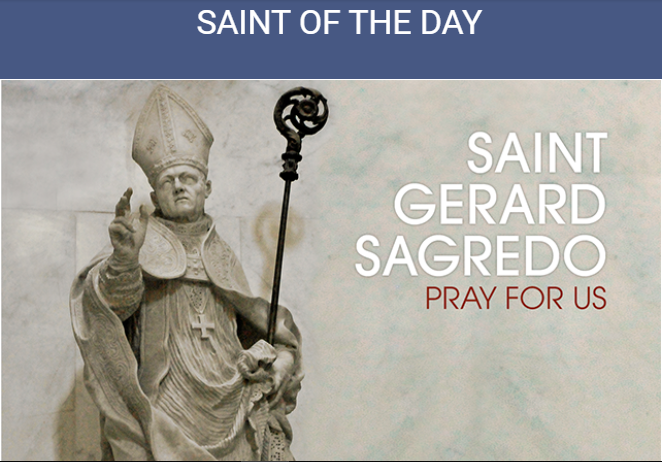
Saint of the Day – September 24 – Saint Gerard Sagredo

St. Gerard Sagredo (980–1046 A.D.) was born in Venice, Italy. From an early age he desired to dedicate his life to God, and as a young man became a Benedictine monk. He first served as abbot at a monastery in Venice, but left to make a pilgrimage to the Holy Land. While passing through Hungary he met the Hungarian king, St. Stephen, who asked him to stay in his country to evangelize and minister to his people. St. Gerard agreed, and was named Bishop of Csanád and the royal tutor of the Hungarian prince. He ministered tirelessly among the Hungarian people and helped to convert the whole country to Christianity, for which he is called the “Apostle of Hungary.” After the death of King St. Stephen there was a pagan uprising against the Christians, and St. Gerard was martyred for the faith along with two others. His death took place on a hill in Budapest which is now named after him; according to one tradition he was placed in a barrel lined with spikes, and rolled down the hill. He was declared a saint in 1083 by Pope St. Gregory VII. St. Gerard Sagredo is the patron saint of Hungary, and his feast day is September 24th.

//Catholic Company//


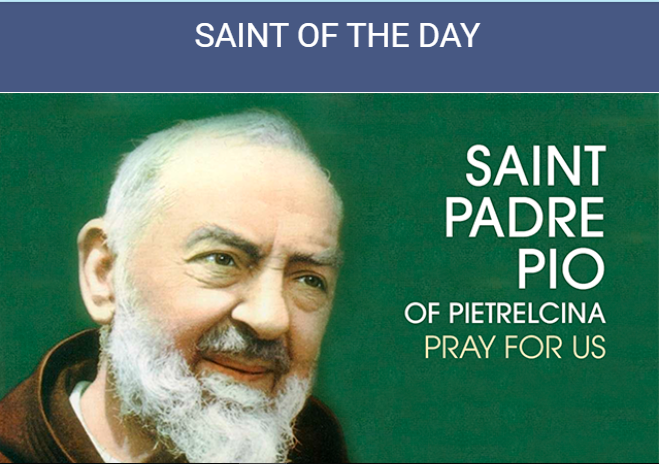
Saint of the Day – September 23 – Saint Padre Pio of Pietrelcina

St. Padre Pio of Pietrelcina (1887–1968) was born to peasant farmers in southern Italy. By the time he was 5 years old he practiced a life of penance and made the decision to give himself completely to God. He grew up working in the fields, and at the age of 19 joined the Capuchin Franciscan friars. His Franciscan spirituality was characterized by a life of poverty, love of nature, and charity to those in need, especially to those who were his “spiritual children.” St. Padre Pio had many spiritual gifts and was a great miracle-worker. These were well-documented from multiple reliable sources and included bilocation, levitation, reading souls, and physical healing by touch. Word of his holiness spread and people both pious and curious flocked to see him, especially to have him hear their confession. He is the first priest known to have received the stigmata, for which he suffered suspicion and investigation. Because of the unusual supernatural phenomena surrounding his life, he is considered one of the great visionaries and mystics of the Church. Padre Pio died in 1968 at the age of 81. He was canonized by Pope St. John Paul II in 2002. Because of the many miracles he performed during his life, he is commonly invoked as a healing saint for various ailments. His feast day is September 23rd.

//Franciscan Media//


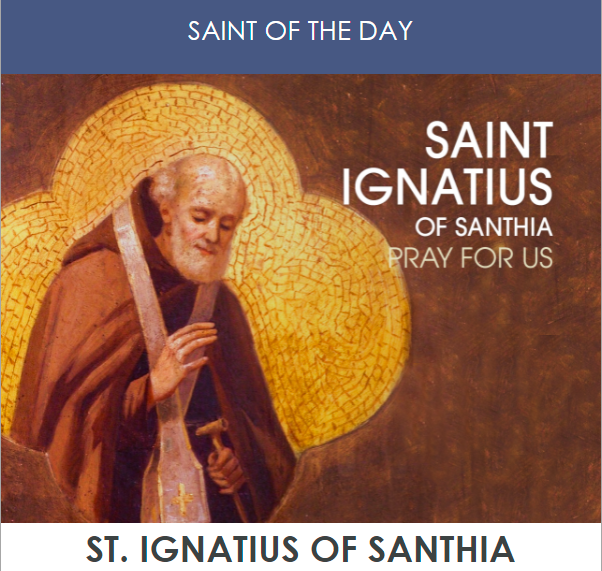
Saint of the Day – September 22 – Saint Ignatius of Santhia

St. Ignatius of Santhia (1686-1770) was born in Italy to an upper-class family. He received his early education from a devout priest, a relative of his mother, who inspired him to join the priesthood. He studied philosophy and theology, and after his ordination served as a diocesan priest for six years. St. Ignatius earned a reputation as an excellent preacher of retreats and missions, and he had a promising future within the diocese. His family and parishioners were surprised and disappointed when he decided to join the Capuchin Franciscans in Turin as a poor, humble friar. However, St. Ignatius flourished in the poverty and simplicity of the Franciscan way of life. He became well-known for his wisdom and sanctity, and many people from all walks of life came to him for confession and spiritual direction. He had a great devotion to the Blessed Virgin Mary and prayed the rosary faithfully. He served God with humble obedience and inspired this virtue in the Franciscan novices over whom he had charge. He spent his last years on a sickbed where he continued to hear confessions and give direction to his visitors. St. Ignatius of Santhia’s feast day is September 22nd.

//Catholic Company//


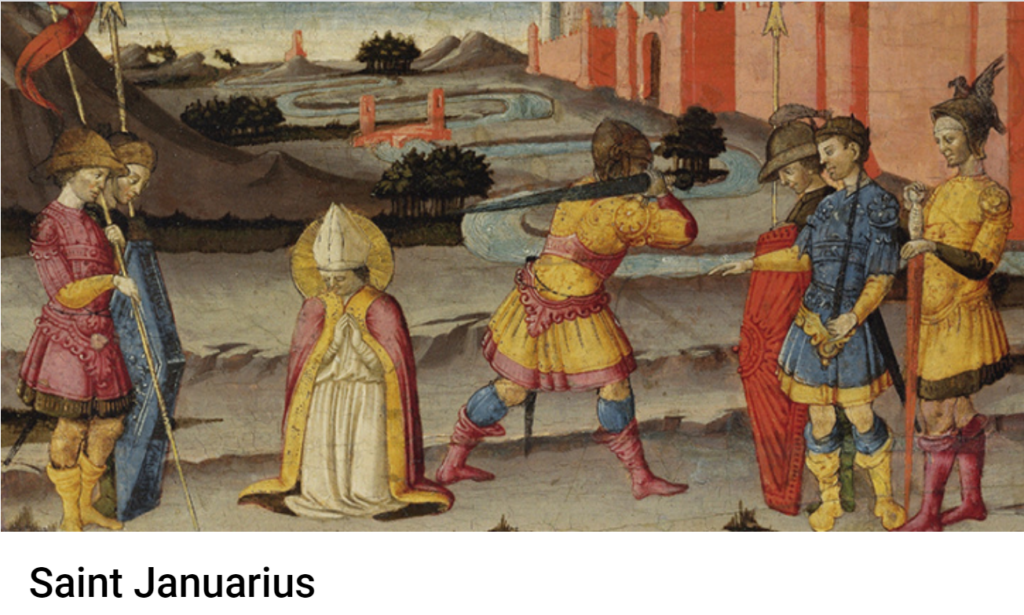
Saint of the Day – September 19 – Saint Januarius

(c. 300)

Saint Januarius’ Story

Little is known about the life of Januarius. He is believed to have been martyred in the Emperor Diocletian’s persecution of 305. Legend has it that Januarius and his companions were thrown to the bears in the amphitheater of Pozzuoli, but the animals failed to attack them. They were then beheaded, and Januarius’ blood ultimately brought to Naples.

“A dark mass that half fills a hermetically sealed four-inch glass container, and is preserved in a double reliquary in the Naples cathedral as the blood of St. Januarius, liquefies 18 times during the year…Various experiments have been applied, but the phenomenon eludes natural explanation….” [From the Catholic Encyclopedia]

Reflection

It is defined Catholic doctrine that miracles can happen and are recognizable. Problems arise, however, when we must decide whether an occurrence is unexplainable in natural terms, or merely unexplained. We do well to avoid an excessive credulity but, on the other hand, when even scientists speak about “probabilities” rather than “laws” of nature, it is something less than imaginative for Christians to think that God is too “scientific” to work extraordinary miracles to wake us up to the everyday miracles of sparrows and dandelions, raindrops and snowflakes.

Saint Januarius is the Patron Saint of:

Blood Banks/Blood Donors
Naples

//Franciscan Media//


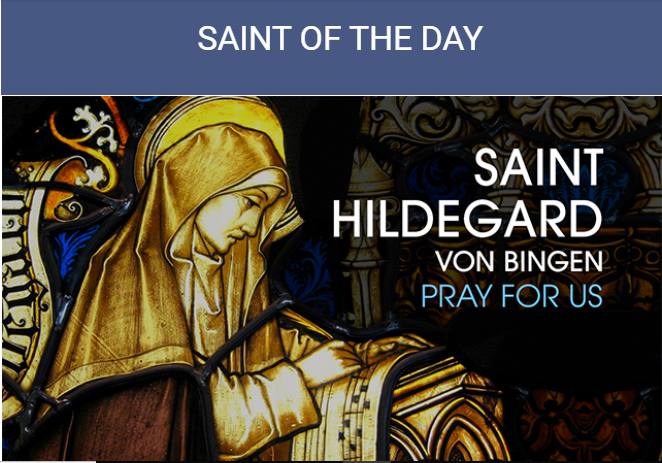
Saint of the Day – September 17 – Saint Hildegard Von Bingen

St. Hildegard von Bingen (1098–1179) was born to a large and noble German family. She began to have mystical visions at the age of three which continued throughout her life. Her parents, promising her to the service of God, sent her to be educated at the Benedictine Abbey by an anchoress when she was about eight years of age. At the age of fourteen she became a consecrated nun attached to the Abbey, where she lived a quiet life of prayer for many years. At the age of 38, after the anchoress’ death, she was chosen as the new leader of a growing group of nuns. Hildegard led a remarkable and unusual life for a woman of her day. She was an avid composer of sacred music and liturgy, in addition to poems and plays. She also wrote heavily on theology, natural medicine, and natural science. At the age of 42, at the command of God, Hildegard began writing down what she saw in her visions. Her works were widely read, even by the Pope, and leaders around the world sought her council. Her fame as a mystic and prophetess grew, earning her the name “Sibyl of the Rhine.” More nuns flocked to join her, causing Hildegard to establish a new monastery at Rupertsberg. She wrote proficiently on the harmony of created nature and man’s need to live in balance with it, especially in virtue, morality, and the love of God, which led Pope Benedict XVI to declare her the fourth female Doctor of the Church in 2012 alongside Teresa of Avila, Catherine of Siena, and Thérèse of Lisieux.  Because her works were far ahead of her time she is regarded as a historical phenomenon. Hildegard of Bingen is considered the founder of scientific natural history in Germany. Her feast day is September 17th.

//Catholic Company//